Private Investigator Resume Examples: what gets the call
Build a Private Investigator Resume That Wins Cases
By Mustafa Tarabya, founder of CVBooster · Published · Updated
Craft a compelling private investigator resume that showcases your investigative skills, surveillance expertise, and case resolution record.
Sample resumes for a private investigator
The same private investigator content laid out in three CVBooster templates, so you can see what the finished document looks like before you write a word.
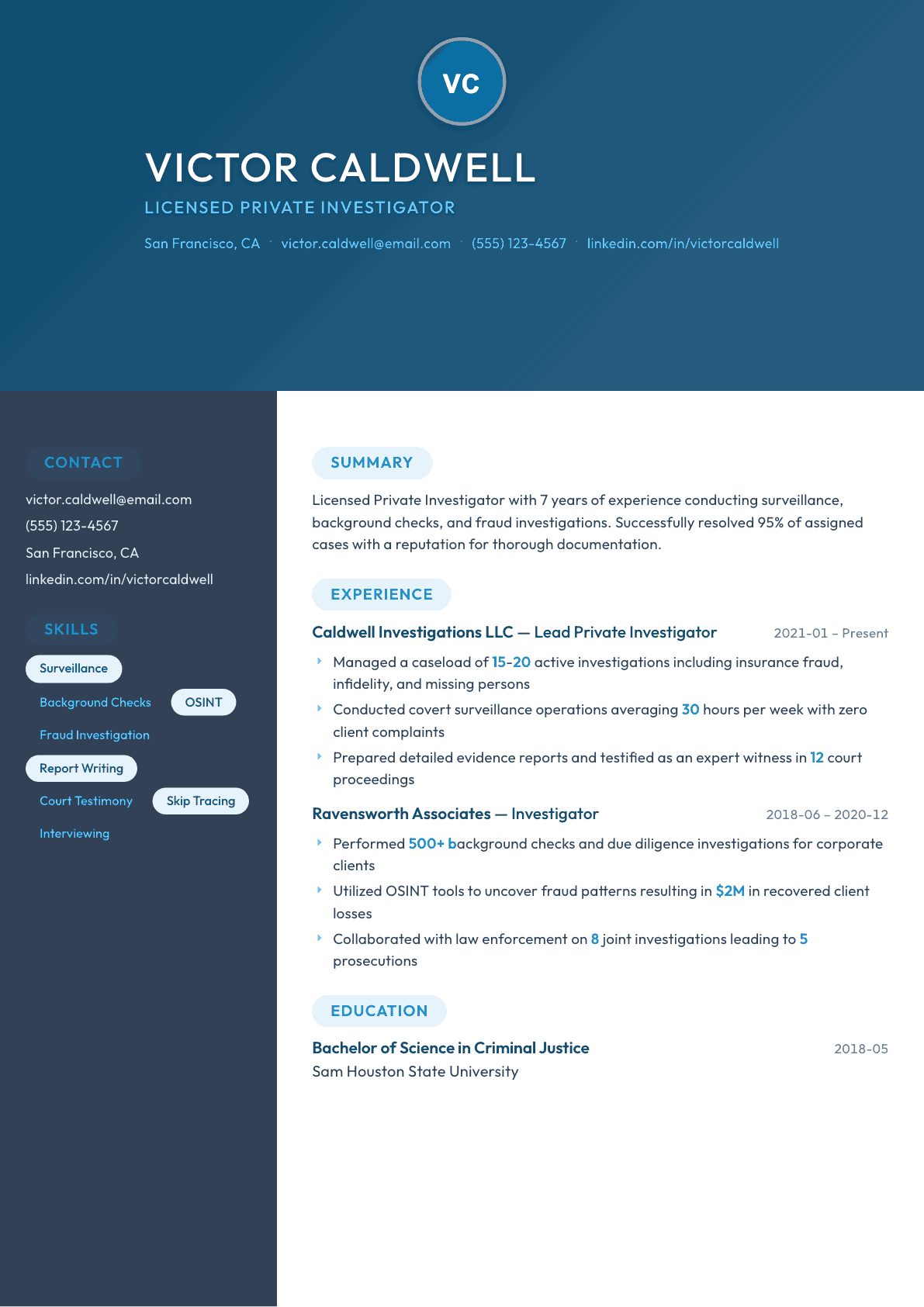
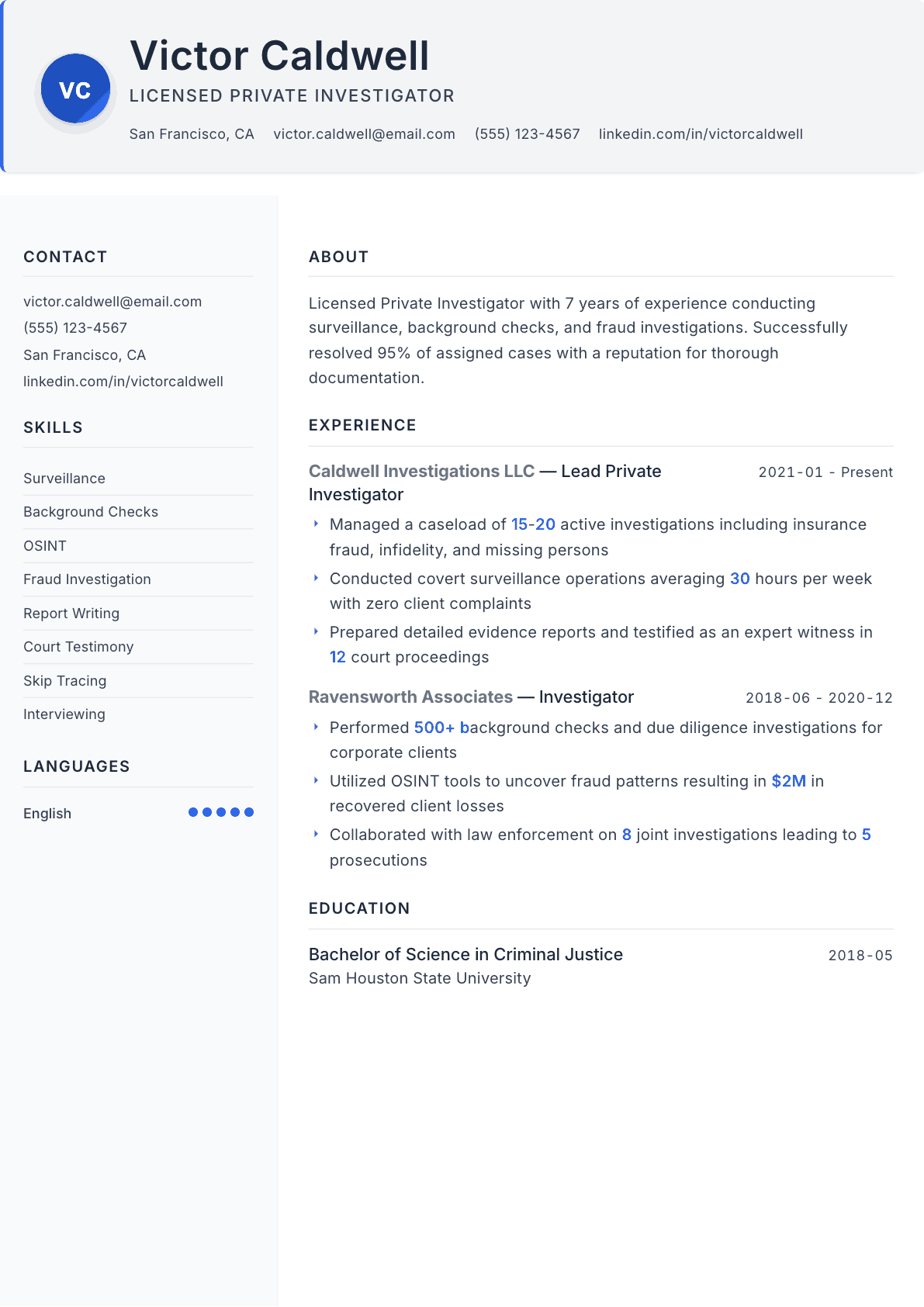
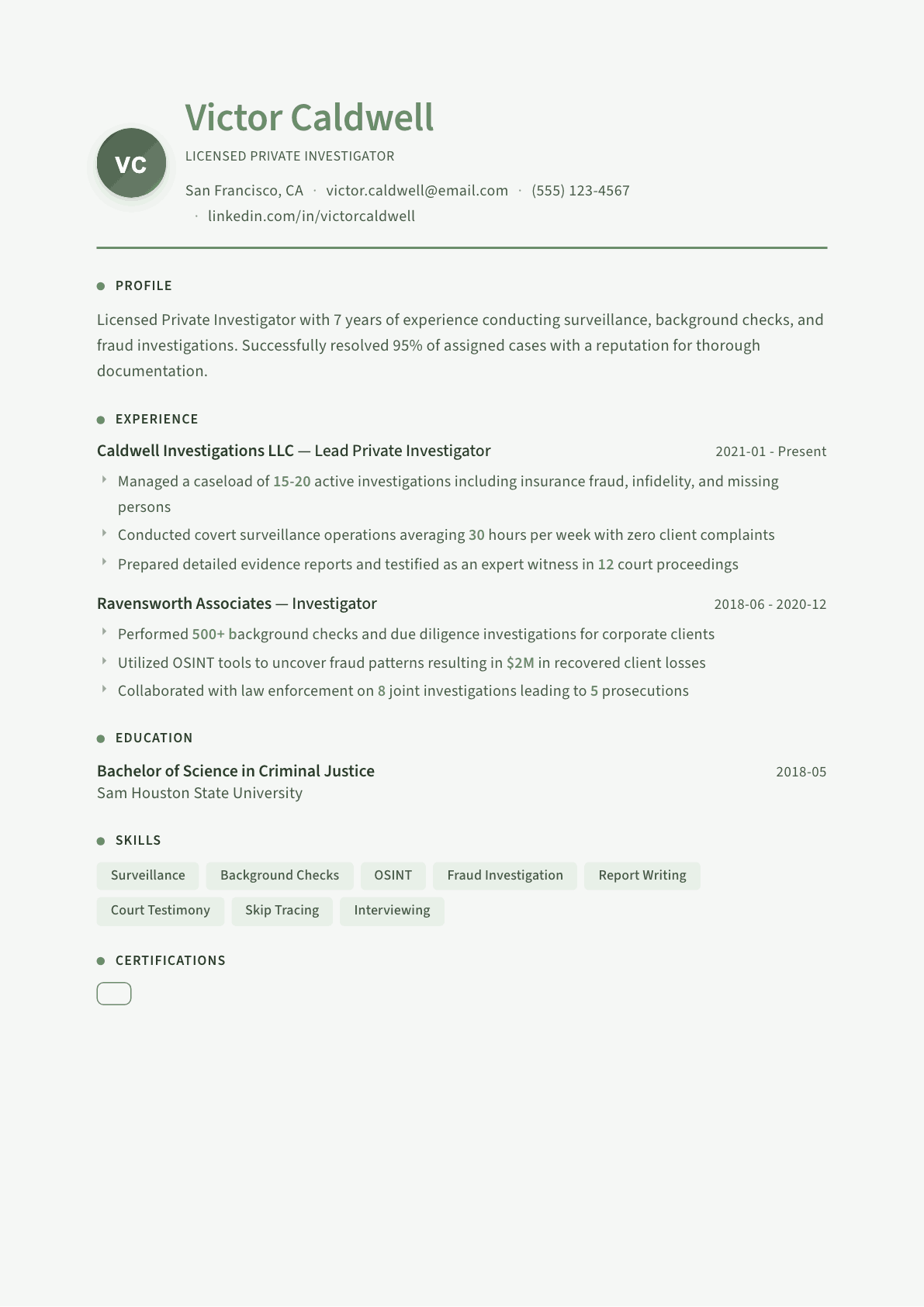
Example Private Investigator summary
Licensed Private Investigator with 7 years of experience and a 95% case resolution rate. Expert in surveillance, OSINT, and fraud investigations with courtroom testimony experience in 12+ proceedings.
Skills to list on a Private Investigator resume
- Surveillance Operations
- Background Investigations
- OSINT Research
- Fraud Detection
- Skip Tracing
- Interview & Interrogation
- Evidence Collection
- Court Testimony
- Report Preparation
- Case Management
What actually gets this resume read
- Highlight your state license and any specialized certifications like CFE or CII.
- Quantify your case resolution rate and the number of investigations handled.
- Include court testimony experience as it significantly boosts your credibility.
- Mention OSINT and technology tools you use to demonstrate modern investigative methods.
How to write a private investigator resume
Private investigation resumes are read by an agency owner or a corporate investigations manager who is trying to establish two things fast: are you licensed in the right state, and can your work survive a courtroom. Everything else is secondary, because an investigator whose reports fall apart under cross-examination costs a client the case regardless of how good the surveillance was.
The second filter is specialty. Insurance defense surveillance, domestic cases, corporate due diligence and background investigation, skip tracing, criminal defense investigation, and fraud examination are separate practices with different clients and different evidentiary standards. A resume that lists all of them without depth in any reads as a generalist nobody will assign a serious case to.
This guide covers how to structure a private investigator resume, three summaries from a new licensee to a senior investigator, before-and-after bullets that show method rather than drama, and the questions investigators ask when case confidentiality limits what can be written.
Format: license first, specialty second
One page for most investigators, two if you have long agency ownership or extensive testimony history. Reverse chronological with unbroken dates, because clients and agencies run background checks and licensing boards require a clean history.
Put a licensing block directly under the header: the state license type and number where it is appropriate to publish it, the states you are licensed or reciprocal in, any armed endorsement, and your insurance or bonding status if you operate independently. Follow it with your specialty in plain words.
- Header: name, city and state, phone, email, and the states you can legally work in.
- Order: summary, licensing, specialty experience, testimony record, tools and training, education.
- Note prior law enforcement or military investigative service in its own block if you have it.
Summary: specialty, caseload, evidentiary record
Three lines. Name the practice areas you actually work, your typical active caseload, the client type you serve, and the fact that your work has held up: reports accepted, depositions given, testimony provided. Clients buy defensible work product, so the summary should say that in professional language rather than promising results.
If you are newly licensed, lead with the investigative background you bring: patrol or detective service, claims adjusting, military intelligence, paralegal or research work. Agencies hire on transferable investigative discipline and on the ability to write, and both can be evidenced from a prior career.
Experience: method, hours, and work product
Describe surveillance by structure and volume: field hours logged, mobile and static setups, video captured and how it was preserved, and how you documented a timeline. Say that you maintained continuity of the recording and a contemporaneous log, because that is what makes footage admissible rather than merely interesting.
Describe research work by source discipline. Public records, court records, corporate filings, property and lien searches, open source intelligence, and database work under permissible use rules. State the compliance framework you work inside, since permissible purpose under the federal fair credit and driver privacy rules is a genuine screening question for corporate clients.
Give reporting its own bullets. A private investigator is paid for the report, not the hours, and agency owners complain about writing quality more than about any other candidate weakness. Say what a report of yours contains, how quickly you turn it around, and whether attorneys have used it in filings.
If you have testified, treat it as a distinct credential: the number of proceedings, the case types, and whether it was deposition or courtroom testimony. Do not name parties or case numbers.
Tools, training and the limits of the law
Name the tooling: the records and skip tracing databases you are credentialed on, case management software, covert video and long-lens camera equipment, GPS use where lawful, and open source research techniques. Investigators who list only equipment and no legal framework look risky to a corporate client.
Show that you know the boundaries. Pretexting restrictions, recording consent rules that differ by state, trespass limits during surveillance, and the difference between what you may gather and what a court will accept. Writing one line that shows this awareness does more for credibility than three lines about equipment.
Keywords the screen and the client both look for
The phrases that recur are licensed private investigator, surveillance, background investigation, due diligence, skip tracing, insurance fraud, workers compensation investigation, criminal defense investigation, open source intelligence, evidence collection, chain of custody, report writing, deposition and expert testimony. Mirror the posting language once near the top and once inside a bullet with a result. Keep case counts believable, because an agency owner knows exactly how many hours a real caseload takes.
Private Investigator resume summary examples
Newly licensed investigator
Newly licensed private investigator with six years as a patrol officer and two as a claims adjuster. Trained in mobile surveillance and public records research, comfortable writing detailed reports for attorney clients, and available for insurance defense and background assignments statewide.
Seven years in practice
Licensed Private Investigator carrying 15 to 20 active cases in insurance fraud, background investigation and domestic matters. Logs roughly 30 field surveillance hours a week, prepares evidence reports for attorney clients, and has testified in 12 proceedings without a challenge to the work product.
Senior investigator and agency lead
Senior investigator running corporate due diligence and complex fraud files for law firm and insurer clients, supervising three field investigators. Builds source research plans, reviews all outgoing reports for evidentiary sufficiency, and gives deposition and courtroom testimony on surveillance and records findings.
Work experience bullets: before and after
Before: Conducted surveillance on subjects for clients.
After: Logged around 30 field surveillance hours a week on mobile and static setups, capturing continuous timestamped video with a contemporaneous activity log for each observation period.
Hours, setup type and continuity of the record are what make surveillance product usable by an attorney.
Before: Performed background checks for corporate clients.
After: Completed more than 500 background and due diligence files using court records, corporate filings, property and lien searches, and open source research under documented permissible purpose.
Naming the source set and the compliance basis separates a professional researcher from someone running database queries.
Before: Wrote reports on case findings.
After: Delivered evidence reports within 48 hours of field work, structured with a chronology, exhibit index and source list, and used by attorney clients as filed exhibits.
Turnaround, structure and downstream use prove that the report was the product rather than an afterthought.
Before: Testified in court about my investigations.
After: Gave testimony in twelve proceedings on surveillance methodology, video continuity and records research, including deposition testimony in insurance defense matters.
Specifying what you were examined on shows the areas where your method has already withstood scrutiny.
Before: Located people who could not be found.
After: Ran skip tracing on hard-to-locate subjects using utility and address history, court filings and social network analysis, closing the majority of assignments within two weeks.
The technique list and a realistic closure window make a skip tracing claim credible to an agency owner.
Hard skills
- Mobile and static surveillance
- Covert video and photography
- Background and due diligence investigation
- Open source intelligence research
- Public and court records research
- Skip tracing and locate work
- Insurance fraud investigation
- Interviewing and statement taking
- Evidence handling and chain of custody
- Investigative report writing
- Case management systems
- Deposition and courtroom testimony
Soft skills
- Patience through long static observation
- Discretion with client matters
- Objectivity when a client wants a result
- Clear writing under deadline
- Ethical judgment on legal boundaries
Certifications worth listing
- Certified Fraud Examiner (CFE) (Association of Certified Fraud Examiners)
- Certified Legal Investigator (CLI) (National Association of Legal Investigators)
- Professional Certified Investigator (PCI) (ASIS International)
- Certified International Investigator (CII) (Council of International Investigators)
- Certified Forensic Interviewer (CFI) (International Association of Interviewers)
Mistakes that cost private investigator candidates the interview
- Leaving the state license off the page, which stops the file at the first compliance check.
- Claiming every specialty at once, so no agency owner can tell which kind of case to assign you.
- Writing about cases in identifiable detail instead of describing the method, the sources and the outcome type.
- Treating report writing as a minor duty, when the report is the deliverable clients actually pay for.
- Inflating case volume beyond what the hours in a week allow, which an experienced reader spots immediately.
- Ignoring the legal framework around recording consent, permissible purpose and trespass, which makes corporate clients nervous.
- Describing equipment at length while never mentioning continuity of evidence or documentation practice.
Private Investigator resume questions
Do I need to list my private investigator license number?
List the state and the license type at minimum, and include the number when the jurisdiction publishes it or the application asks. Agencies verify licensing before an interview, so making that check easy moves your file forward faster.
How do I describe cases without breaching client confidentiality?
Write about case types, methods and outcomes rather than parties. Say that a workers compensation surveillance assignment produced video that resolved a claim, not who was involved. Confidentiality on the page is itself evidence that you can be trusted with a file.
Does prior law enforcement experience help a private investigator resume?
Yes, and it should be translated rather than listed. Detectives bring interviewing, case documentation and testimony experience, all of which transfer directly. Describe the investigative work rather than rank and assignment codes a civilian client will not recognize.
Should I include a case resolution rate?
Only if you can define it. Say what you counted, such as assignments closed with a documented finding, and over what volume. An unexplained success rate invites a hard question in the interview and undercuts the rest of the resume.
What matters more, surveillance skill or writing skill?
Agency owners consistently name writing, because unusable reports waste good field work and cost clients cases. Show both, but make sure at least one bullet demonstrates report structure, turnaround time and how attorneys have used your work product.
Related resume examples
- Cybersecurity Manager Resume example
- Loss Prevention Manager Resume example
- Bodyguard Resume example
- Criminal Investigator Resume example
- Police Detective Resume example
- Federal Agent Resume example