Customs Compliance Specialist Resume Examples: free score
Write a Customs Compliance Specialist Resume That Survives an Audit
By Mustafa Tarabya, founder of CVBooster · Published · Updated
A customs compliance specialist resume covering classification, valuation, audits and trade programs, with a sample resume and a detailed writing guide.
Sample resumes for a customs compliance specialist
The same customs compliance specialist content laid out in three CVBooster templates, so you can see what the finished document looks like before you write a word.
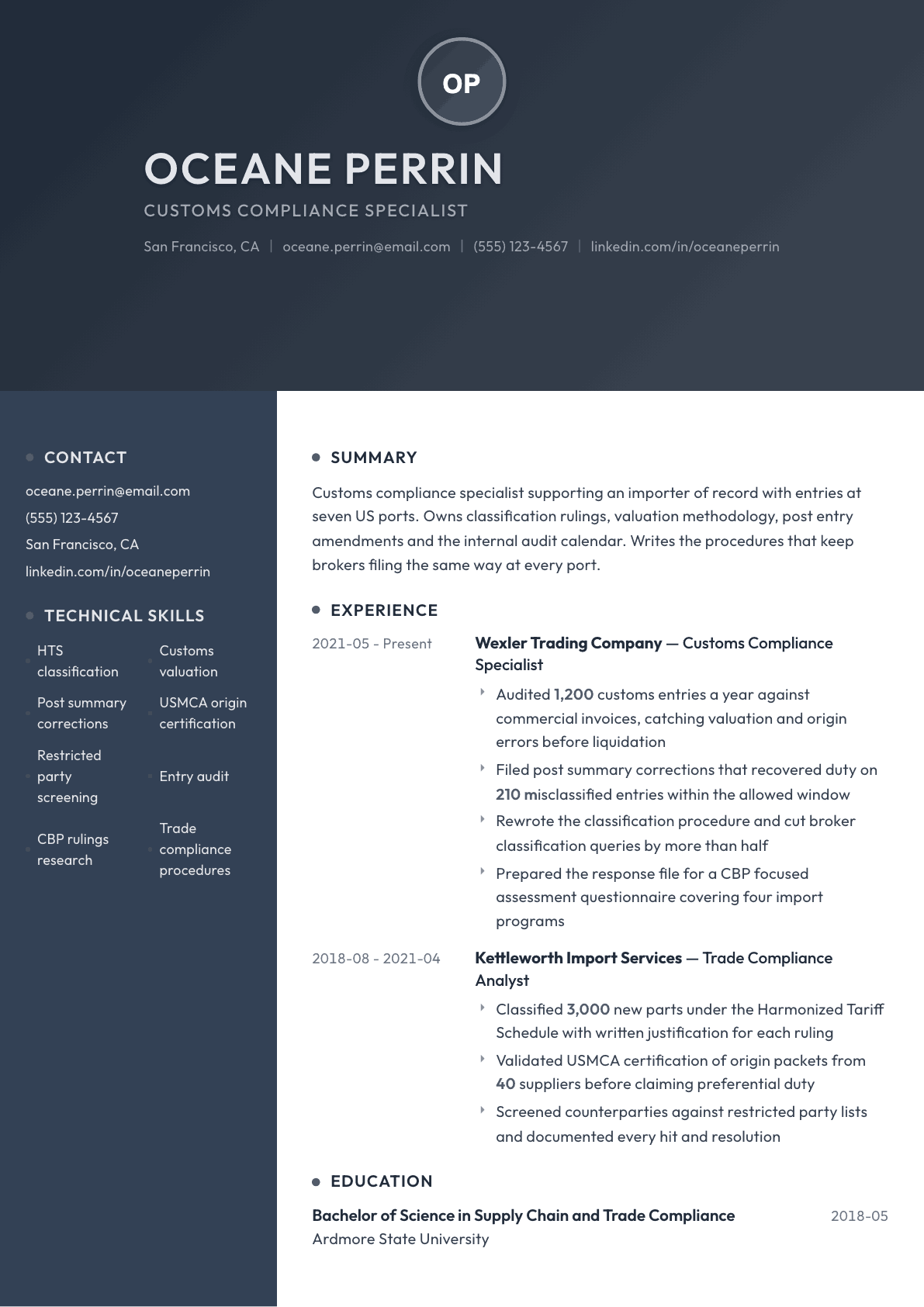
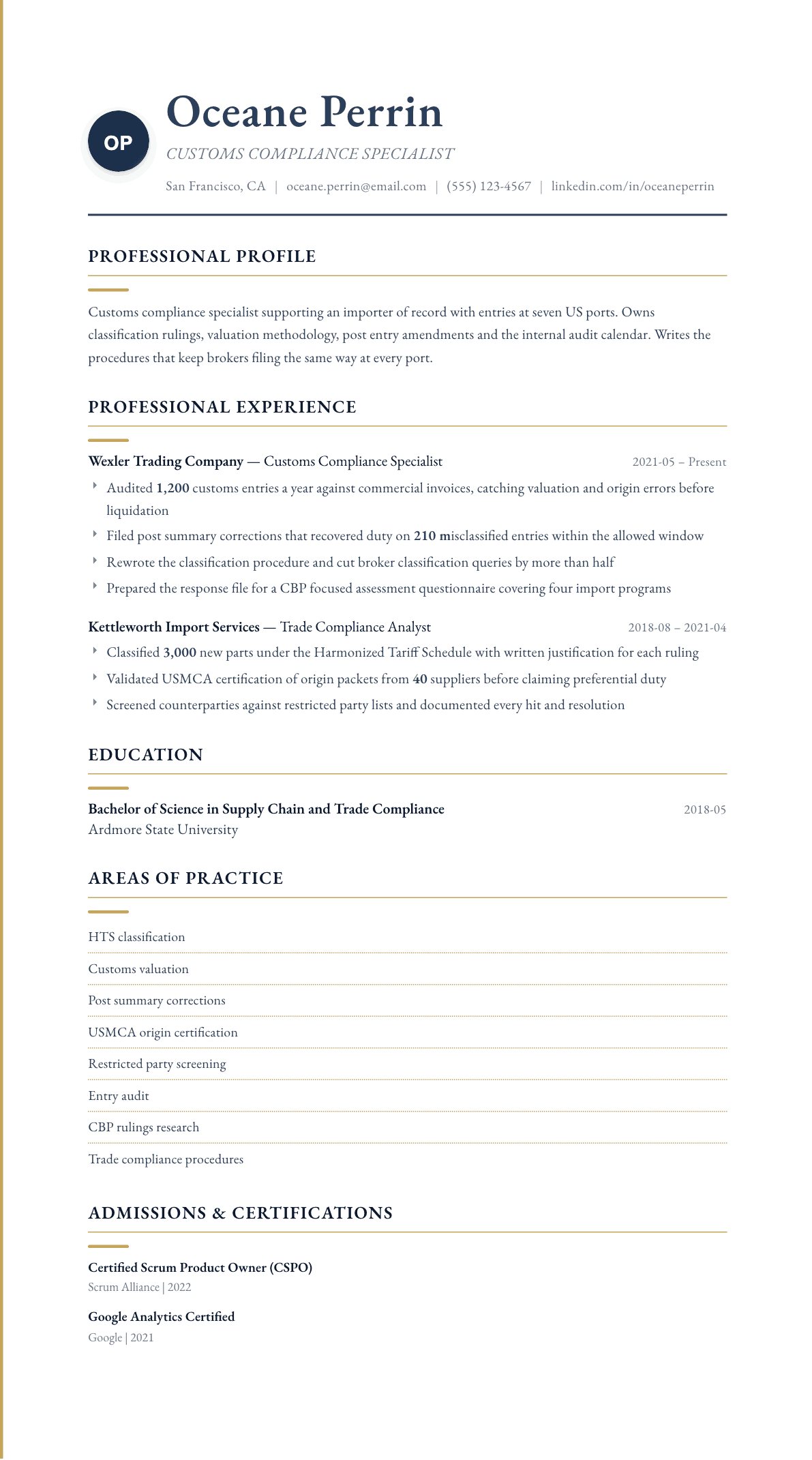
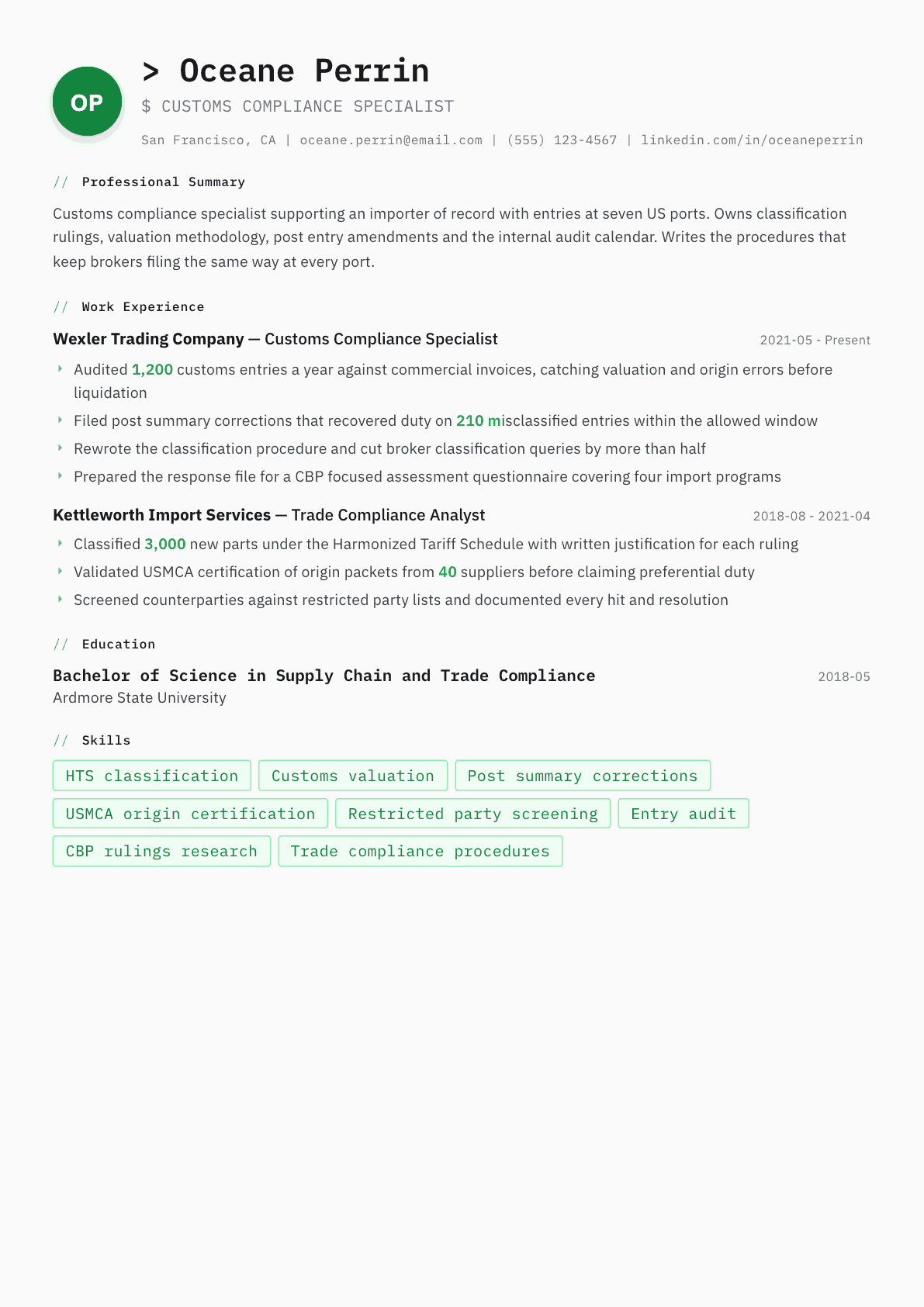
Example Customs Compliance Specialist summary
Customs compliance specialist with six years supporting importers of record across multiple US ports. Owns tariff classification, valuation methodology, origin determination and post entry corrections, and audits broker filings before liquidation. Recovered duty on more than two hundred misclassified entries and prepared a full response to a CBP focused assessment. Seeking a trade compliance role with program ownership.
Skills to list on a Customs Compliance Specialist resume
- Harmonized Tariff Schedule classification
- Customs valuation methods
- Country of origin determination
- USMCA and free trade agreements
- Post summary correction
- Prior disclosure
- Restricted party screening
- Export controls awareness
- CTPAT program support
- Duty drawback
- Foreign trade zone operations
- Entry audit and recordkeeping
- Broker oversight
- Trade compliance training
What actually gets this resume read
- Put your licenses and trade programs near the top: customs broker license, CTPAT membership, importer self assessment.
- Quantify the audit work with entries reviewed, error rates found and duty recovered through post entry corrections.
- Name the regulations and programs by their real names so a compliance manager sees domain fluency immediately.
- Show the written work, because procedures, classification rationales and audit memos are the output of this job.
- Describe how you worked with brokers and forwarders, since consistency across ports is what compliance protects.
- Include any government interaction such as a focused assessment, a prior disclosure or a request for information.
How to write a customs compliance specialist resume
A customs compliance specialist resume is read as a risk document. The trade compliance manager on the other side is asking whether hiring you reduces the chance of a penalty, a detained shipment or an audit finding. That means the page has to show classification depth, valuation understanding, origin analysis, and a record of catching errors before a customs authority does.
Generic trade language sinks these applications. Ensuring compliance with customs regulations is a sentence that appears on every resume in the stack and proves nothing. What proves competence is naming the tariff work, the correction mechanisms you have used, the programs you support and the audits you have been through.
This guide walks the sections in the order a compliance manager reads them, offers summaries for an analyst, a working specialist and a senior one, rewrites five bullets that recur across trade compliance applications, and answers the questions specialists ask when their filings and their resume have to say the same thing.
Format: one page, credentials and program scope up front
Reverse chronological with a credentials block near the top. Customs brokerage licensure, recognized trade credentials and any program membership belong above the experience, because they are the first filter a compliance manager applies.
Then open each job with scope: importer of record or broker side, annual entry volume, the ports involved, the product categories, and whether the operation was import only or included export controls. Compliance is judged by exposure, and exposure is described by volume and product complexity.
- Credentials block: license, trade credentials, program roles, each with the issuing body.
- Experience opening with entry volume, ports, product categories and side of the transaction.
- A programs line: free trade agreements, drawback, foreign trade zone, partnership programs.
- A systems line covering the ERP, classification tool and any global trade management platform.
Summary: exposure, ownership, and the audit record
Name the scale of what you are responsible for. Entries per year, ports of entry, importing entities and the tariff chapters your goods fall under. A specialist covering machinery components across seven ports is carrying more classification risk than one covering a single finished product line.
Then name the audit record. Customs reviews, internal audits, prior disclosures, or a focused assessment you helped answer. Compliance hiring is conservative, and a candidate who has been through a government review and can describe it calmly is far more attractive than one who never has.
Experience: classification, valuation, origin, correction
Classification comes first. Say how many items you have classified, the tariff chapters involved, whether you write the rationale and how you research: explanatory notes, binding rulings, cross rulings and manufacturer specifications. A specialist who documents the basis for a code is protecting the company years later when an auditor asks why.
Valuation and origin come next, and they are the areas most resumes skip. Transaction value and its additions, assists, royalties, related party pricing, first sale, and origin analysis including substantial transformation and preferential rules. Even a sentence on each signals a candidate who works at the level of the regulation and not just the entry screen.
Then correction and audit. Post entry amendments, protests, prior disclosures, internal entry review programs and broker oversight. Give volumes and outcomes: entries reviewed, error types found, duty recovered or additional duty tendered. Compliance is one of the few functions where finding your own mistakes is the achievement.
Programs, procedures and training others
List the programs you support with the work you did on each: free trade agreement solicitation and certificate validation, duty drawback claims, foreign trade zone admissions and withdrawals, and supply chain security partnership requirements. Program experience is scarce and directly reduces onboarding time.
Then show the written output. Compliance runs on documents: classification procedures, work instructions for brokers, audit memos, training decks for buyers and engineers, and record retention policies. Say what you authored and who followed it. A specialist who has trained sourcing teams on origin documentation is operating above the transactional level.
- Programs supported and your specific role in each.
- Procedures and work instructions you wrote and maintained.
- Training you delivered, and to which internal audience.
- How you oversaw brokers to keep filings consistent across ports.
Keywords a trade compliance team searches
The recurring terms are tariff classification, valuation, country of origin, substantial transformation, preferential treatment, post entry correction, protest, prior disclosure, restricted party screening, export controls, drawback, foreign trade zone, entry audit, recordkeeping and broker oversight. Use the ones you have done and skip the ones you have only read about.
Be exact with program and regulation names. Compliance readers notice when a term is used loosely, and a slightly wrong phrase does more damage here than in almost any other field.
Customs Compliance Specialist resume summary examples
Trade compliance analyst
Trade compliance analyst who classified 3,000 new parts under the Harmonized Tariff Schedule with written justification for each determination. Validates supplier origin certification packets before preferential claims and screens counterparties against restricted party lists, documenting every hit and its resolution.
Four years in compliance
Customs compliance specialist supporting an importer of record filing at seven ports. Owns classification rulings, valuation methodology and post entry corrections, audits 1,200 entries a year before liquidation, and prepared the response file for a customs focused assessment covering four import programs.
Senior compliance specialist
Senior customs compliance specialist owning the import compliance manual, broker oversight and the internal audit calendar for a multi-entity importer. Led a prior disclosure to closure, runs origin training for sourcing and engineering teams, and manages a drawback claim program with outside counsel.
Work experience bullets: before and after
Before: Classified products under the tariff schedule.
After: Classified 3,000 new parts under the Harmonized Tariff Schedule, writing a documented rationale for each code from explanatory notes and manufacturer specifications.
The item count and the documented basis show defensible classification rather than code selection.
Before: Reviewed entries for accuracy.
After: Audited 1,200 entries a year against commercial invoices and purchase orders, catching valuation and origin errors before liquidation closed the window to correct them.
Volume plus the liquidation timing proves the review was placed where it could still change the outcome.
Before: Filed corrections with customs when errors were found.
After: Filed post summary corrections on 210 misclassified entries within the allowed period, recovering overpaid duty and tendering additional duty where the correction ran the other way.
Naming both directions of correction demonstrates integrity, which is the trait the function hires for.
Before: Helped prepare for a customs audit.
After: Assembled the response file for a focused assessment questionnaire covering four import programs, reconciling entry data to financial records for the review period.
The reconciliation detail shows what audit preparation actually involves rather than assisting in general.
Before: Wrote compliance procedures for the team.
After: Rewrote the classification procedure and the broker work instructions, cutting broker classification queries by more than half within two quarters.
A downstream effect turns document authorship into a measurable improvement in filing consistency.
Hard skills
- Harmonized Tariff Schedule classification
- Customs valuation methodology
- Country of origin and substantial transformation analysis
- Free trade agreement qualification
- Post entry corrections and protests
- Prior disclosure preparation
- Restricted party screening
- Export control classification awareness
- Duty drawback claims
- Foreign trade zone operations
- Entry audit and recordkeeping
- Broker oversight and work instructions
Soft skills
- Regulatory reading and interpretation
- Written precision
- Cross-functional training delivery
- Escalation without alarm
- Working with outside counsel
- Holding a position under commercial pressure
Certifications worth listing
- Licensed Customs Broker (US Customs and Border Protection)
- Certified Customs Specialist (CCS) (National Customs Brokers and Forwarders Association of America)
- Certified Export Specialist (CES) (NCBFAA Educational Institute)
- Certified Supply Chain Professional (CSCP) (Association for Supply Chain Management)
Mistakes that cost customs compliance specialist candidates the interview
- Filling the page with compliance language while never naming a tariff chapter, program or correction mechanism.
- Omitting valuation and origin work, which is where most real customs exposure sits.
- Hiding an audit or disclosure you worked on, when that experience is exactly what employers want to hire.
- Claiming broker licensure or a credential you have not been granted, which is a fast disqualification.
- Listing entry counts with no error findings, recoveries or process changes attached.
- Skipping the procedures and training you authored, which is the output that outlasts your entries.
- Using loose terminology for a precise regulatory concept, which a compliance reader notices immediately.
Customs Compliance Specialist resume questions
Do I need a customs broker license for this role?
Not always. Many corporate compliance specialists are unlicensed and work with a licensed broker or in-house license holder. Holding the license widens your options considerably, so list it if you have it and list an examination attempt in progress if you do not.
How do I show classification skill on a resume?
Give the number of items classified, the tariff chapters involved, and the research sources you rely on such as explanatory notes and published rulings. Then mention that you document the rationale, because defensible reasoning is what a compliance manager is buying.
Should I mention a prior disclosure or penalty case?
Describe your role in the process without naming the company detail or the amount involved. Handling a disclosure well is a credential in this field. Keep the tone procedural and avoid anything that would read as disclosing confidential matters.
How much export control experience should I claim?
Only what you have done. Screening, classification support or license determination support are all worth listing, but export controls are a separate discipline and overstating it will surface quickly in a technical interview with a compliance lead.
What separates a specialist resume from an analyst resume?
A specialist owns decisions and documents: classification determinations, procedures, program management and broker oversight. An analyst supports them with data and research. Write the page around the decisions you owned, and be honest where you contributed rather than decided.
Related resume examples
- Customs Broker Resume example
- Customs Officer Resume example
- Import Coordinator Resume example
- Import-Export Specialist Resume example
- Logistics Specialist Resume example
- Freight Coordinator Resume example