Customs Broker Resume Examples: the lines they read
Clear the Way to Success with a Customs Broker Resume
By Mustafa Tarabya, founder of CVBooster · Published · Updated
Build a customs broker resume featuring your trade compliance expertise, tariff classification skills, and CBP regulatory knowledge.
Sample resumes for a customs broker
The same customs broker content laid out in three CVBooster templates, so you can see what the finished document looks like before you write a word.
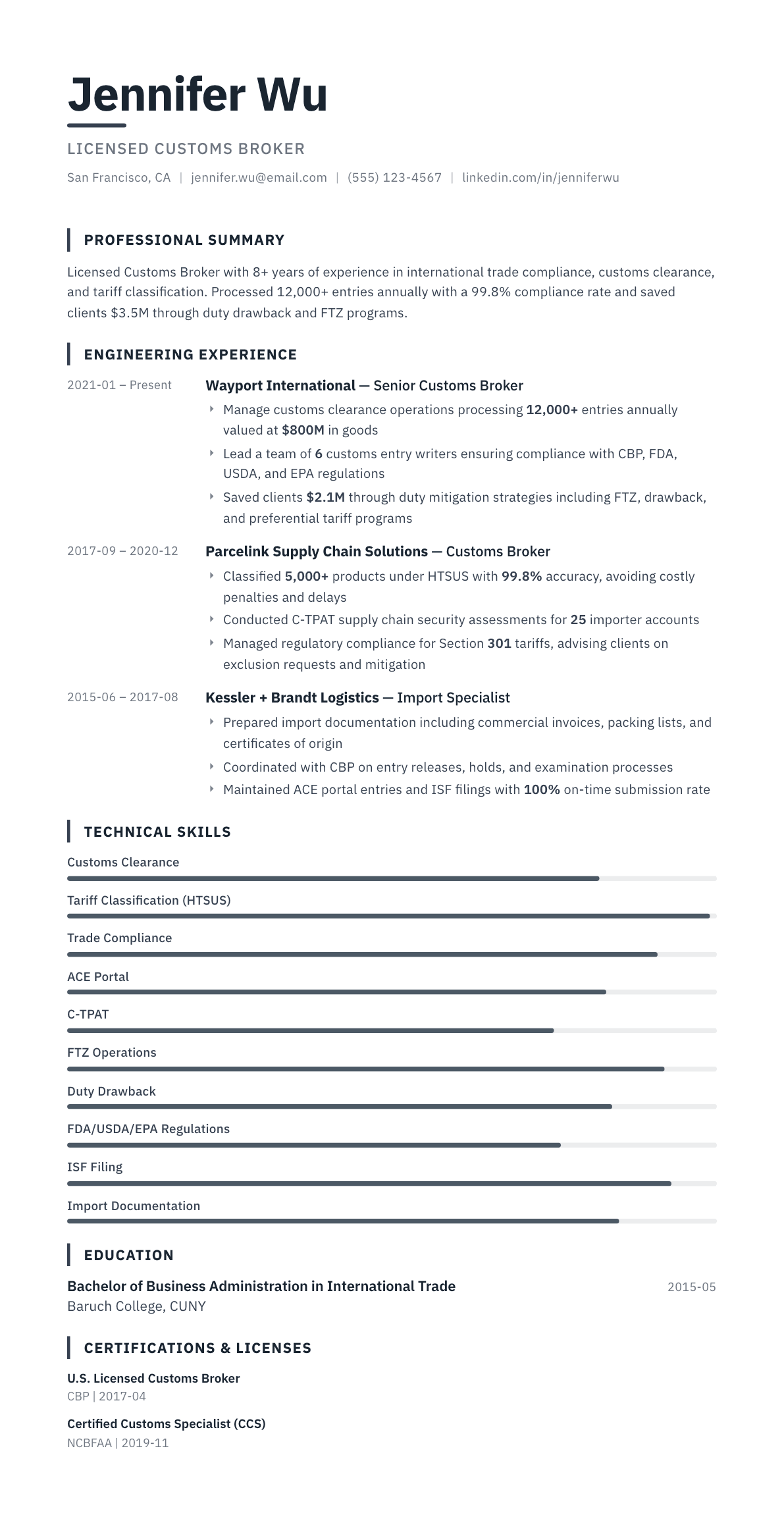
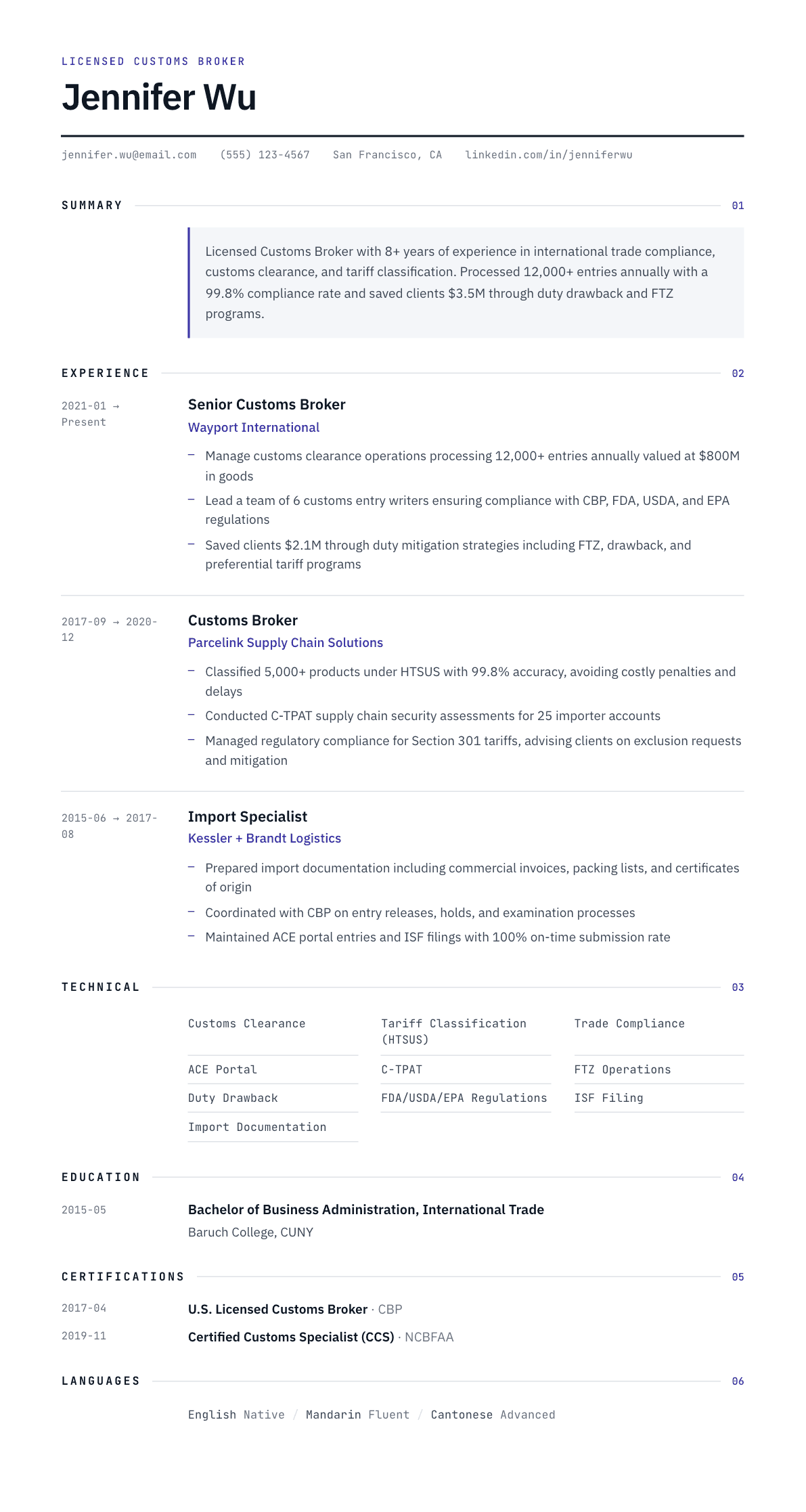
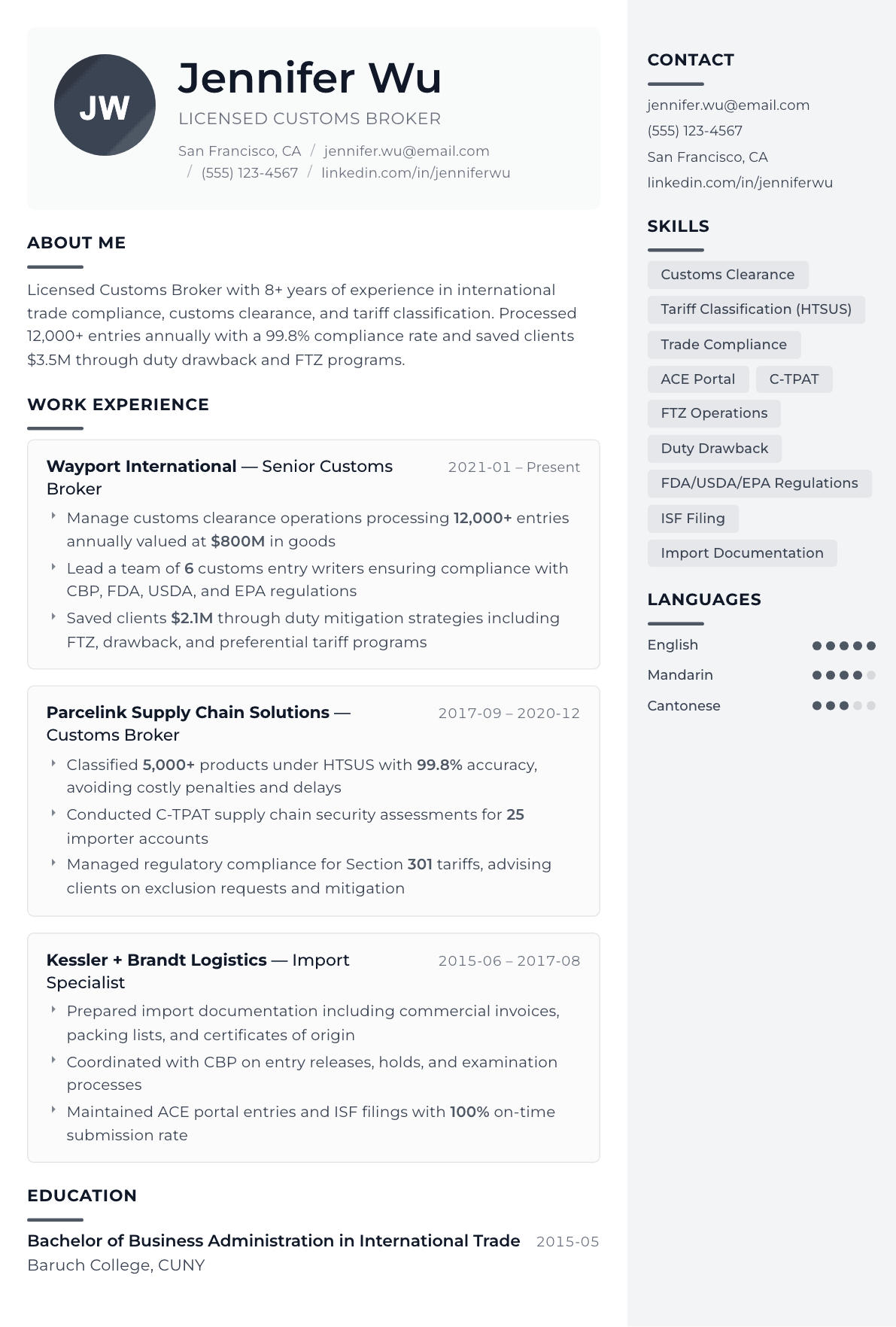
Example Customs Broker summary
Licensed Customs Broker with 8 years of experience in trade compliance and customs clearance, processing 12,000+ entries annually. Saved clients $3.5M through duty mitigation and FTZ programs with a 99.8% compliance rate. Seeking a trade compliance manager role.
Skills to list on a Customs Broker resume
- Customs Clearance
- Tariff Classification (HTSUS)
- Trade Compliance
- ACE / ABI Systems
- C-TPAT Security
- Foreign Trade Zones
- Duty Drawback
- Import/Export Regulations
- ISF Filing
- FDA / USDA Compliance
- Free Trade Agreements
- Valuation
- Country of Origin
- Broker Management Software
What actually gets this resume read
- List your U.S. Customs Broker License number and date prominently. This is a mandatory requirement.
- Quantify your throughput: entries processed, value of goods cleared, compliance accuracy rate.
- Highlight duty savings achieved through FTZ, drawback, preferential tariffs, or classification rulings.
- Include experience with government agency regulations: FDA, USDA, EPA, CPSC, FCC, TTB.
- Mention ACE, ABI, and other CBP systems proficiency.
- Show knowledge of trade agreements (USMCA, CAFTA-DR) and tariff programs (GSP, Section 301).
How to write a customs broker resume
A customs broker resume is screened on one binary first: are you licensed. The individual license issued by U.S. Customs and Border Protection after the broker examination is the credential that lets a company put your name on entries, and a resume that mentions it in passing or leaves the reader guessing between licensed broker and entry writer will be sorted into the wrong pile. Say it in the header, say it again in a credentials block, and give the district or national permit status.
After the license, the reader is a compliance manager or a branch director weighing risk. Their questions are specific: what entry types have you filed, which partner government agencies have you cleared goods through, how large was your entry volume, have you handled antidumping and countervailing duty merchandise, have you sat through an audit or a focused assessment, and what happened. Penalties, seizures and detentions are expensive, so evidence of clean, documented practice beats any adjective.
This guide covers the layout for brokerage and corporate trade compliance roles, how to write entry volume and classification work, how to present duty savings programs without exaggerating, three summaries from an entry writer to a director of compliance, before-and-after bullets, and the questions brokers ask when moving between a forwarder, an importer and a consultancy.
Format: license first, then the trade lanes and agencies you know
Two pages is normal in this field because the detail matters. Put the license and permit status in a credentials block directly under the summary, followed by the commodities and trade lanes you have handled. A compliance manager hiring for an apparel account and one hiring for pharmaceutical imports are looking for different classification experience, and the commodity line answers that before the job history does.
Keep it single column and plain. Brokerage and forwarding employers run applicant tracking systems keyed to terms like entry summary, classification, drawback and free trade zone, and a designed layout puts those terms where a parser mishandles them.
- Header: name with the licensed broker designation, city and state, phone, email.
- Sections in this order: summary, license and credentials, trade compliance experience, systems, education.
- Add a short line for commodities handled and the ports you have filed at.
- Unlicensed candidates state exam status honestly, including a passed exam awaiting license issuance.
Summary: license, years, entry volume, and the specialty that earns money
Name the license, the years in trade, the annual entry volume you have carried, the commodity groups and the one specialty a hiring firm pays for. Duty mitigation, partner government agency clearances, antidumping exposure, free trade zone administration and post-entry work are all separate specialties, and the summary is where you claim yours.
If you are moving from a brokerage to a corporate importer, say so and name the transferable part. In-house compliance work is about the importer own program, so classification databases, supplier certifications, recordkeeping and internal controls matter more there than filing speed does.
Experience: entries, agencies, classifications and exceptions
Head each job with the employer type, your desk, and the book you worked: number of importers of record supported, annual entry count, entry types filed, and the ports involved. A desk filing consumption entries for three large importers is a different job from one filing informal entries for hundreds of small accounts, and both are different from a corporate role where you file nothing but own the compliance program.
Then write bullets around the work that carries risk. Tariff classification under the harmonized schedule, valuation including assists and related-party pricing, country of origin and marking, preferential treatment claims under trade agreements, importer security filings, in-bond movements, and clearances through the food, agriculture, environmental, transport and wildlife agencies. Name the agencies you have actually cleared through, because each has its own data set and its own way of holding a shipment.
Exceptions are where a broker proves value. Detentions and holds resolved, requests for information answered, post summary corrections filed, protests prepared, prior disclosures supported, binding ruling requests submitted, and audits or focused assessments survived. One well-written exception bullet outweighs three describing routine filing.
- Volume: annual entries, importers supported, ports of entry, entry types by number.
- Classification: commodity groups, number of parts in the classification database you maintained, ruling requests filed.
- Duty programs: free trade zone admissions, drawback claims, trade agreement qualification, temporary importation and reconciliation.
- Enforcement: antidumping and countervailing duty merchandise, exclusion requests, forced labor documentation, denied party screening.
Duty savings: quantify carefully, in units rather than currency
Duty mitigation is the most attractive thing on a brokerage resume and the easiest to overstate. Write what you can defend from records: the number of drawback claims filed and their approval rate, the number of parts requalified under a trade agreement, the volume admitted to a free trade zone, exclusion requests granted, and reconciliation entries closed. Percentages of duty avoided invite a question you may not want in an interview.
Compliance results deserve the same treatment. Entry accuracy verified through internal audit, corrections filed within the statutory window, recordkeeping completeness against the retention requirement, and audits closed without a penalty action are all measurable and verifiable.
Where you supported a legal filing such as a protest or a prior disclosure, describe your role precisely. Brokers who overstate authorship of a legal position are caught quickly by anyone who has done the work.
Systems, security programs and the vocabulary to mirror
Name the systems: the automated commercial environment portal, the brokerage operating platform you filed in, the classification and denied party screening tools, and any importer resource planning system you interfaced with. Employers weigh onboarding time, and a broker already fluent in their filing platform starts producing in the first week.
Supply chain security programs belong in their own line. Participation in a trusted trader program, validation site visits, security profile updates and importer self-assessment work all show that you understand the program obligations rather than only the entry desk.
Mirror the posting language. Brokerage listings use entry writing, classification, clearance, holds and customer service. Corporate listings use trade compliance program, internal controls, audit, supplier certification and recordkeeping. Consultancy listings use assessment, remediation, ruling strategy and training delivery.
Customs Broker resume summary examples
Entry writer
Customs entry writer with two years filing consumption and informal entries for 30 importer accounts through the automated commercial environment, including food and agriculture agency clearances. Passed the customs broker examination and awaiting license issuance. Seeking a licensed broker desk with classification responsibility.
Licensed customs broker
Licensed customs broker with eight years managing clearance for 40 importers across apparel, electronics and consumer goods, filing roughly 9,000 entries a year at four ports. Handles food, agriculture and environmental agency clearances, antidumping merchandise and post summary corrections, with a 99.8% entry accuracy rate on internal audit.
Director of trade compliance
Director of trade compliance and licensed broker with fifteen years across a brokerage and two importers, leading a team of nine. Owns the classification database of 8,000 parts, the free trade zone program, drawback filings and trusted trader validation, and closed the last focused assessment with no penalty action.
Work experience bullets: before and after
Before: Filed customs entries for import clients.
After: Filed roughly 9,000 entries a year for 40 importers across four ports, covering consumption, informal and warehouse entry types with food, agriculture and environmental agency data sets.
Volume, account count, ports and entry types let a manager size the desk you have actually run.
Before: Classified products under the tariff schedule.
After: Maintained a classification database of 8,000 parts under the harmonized tariff schedule, resolving 60 disputed classifications with supporting explanatory notes and filing four binding ruling requests.
Database size and ruling requests show classification depth rather than routine code lookup.
Before: Saved clients money on duties.
After: Filed 120 drawback claims with an approval rate above 95% and requalified 400 parts under a preferential trade agreement after collecting supplier origin certifications.
Countable filings and approval outcomes are defensible, while a headline savings figure invites a question you cannot document.
Before: Handled customs holds and exams.
After: Resolved 75 agency holds and detentions a year, assembling documentation packages for requests for information and clearing a wildlife agency detention that had stopped a shipment for three weeks.
The exception volume and a named difficult case demonstrate the judgment brokers are actually hired for.
Before: Ensured compliance with customs regulations.
After: Built an internal entry audit sampling 200 entries a quarter, corrected findings through post summary corrections inside the statutory window, and closed a focused assessment with no penalty action.
A named control with a sample size and a regulatory outcome proves a program existed instead of an intention.
Hard skills
- Tariff classification under the harmonized schedule
- Entry summary preparation and filing
- Automated commercial environment portal
- Importer security filing
- Customs valuation and related-party pricing
- Country of origin and marking rules
- Free trade agreement qualification
- Duty drawback claims
- Free trade zone administration
- Antidumping and countervailing duty merchandise
- Partner government agency clearances
- Post summary corrections and protests
- Recordkeeping and internal audit
- Denied party screening
Soft skills
- Precision under filing deadlines
- Client communication during holds
- Written regulatory reasoning
- Cross-border coordination
- Training importers on obligations
- Discretion with confidential trade data
Certifications worth listing
- Customs Broker License (U.S. Customs and Border Protection)
- Certified Customs Specialist (CCS) (National Customs Brokers and Forwarders Association of America)
- Certified Supply Chain Professional (CSCP) (Association for Supply Chain Management)
- Certified Global Business Professional (CGBP) (NASBITE International)
- Dangerous Goods Regulations Training (International Air Transport Association)
Mistakes that cost customs broker candidates the interview
- Blurring the line between licensed broker and entry writer, which a compliance manager treats as a serious misrepresentation.
- Leaving out entry volume and importer count, so nobody can judge the desk you have carried.
- Naming no partner government agencies, when agency clearances are where most of the difficulty lives.
- Headlining a large duty savings figure with no filings behind it that you could produce in an interview.
- Skipping the exception work: holds, detentions, corrections, protests and audits are the proof of competence.
- Omitting the filing platform and portal experience, which is the biggest driver of onboarding time.
- Sending a brokerage resume to a corporate importer without translating filing work into program, controls and supplier documentation.
Customs Broker resume questions
Do I need a customs broker license to get hired in trade compliance?
Not always. Entry writers, compliance analysts and corporate trade roles are frequently filled by unlicensed specialists. The license is required to transact customs business on behalf of others, and it moves you into higher-paying supervisory desks, so state your exam status even when you are not yet licensed.
How do I show duty savings without inflating the number?
Report countable filings instead of headline savings: drawback claims filed and approved, parts requalified under a trade agreement, free trade zone admissions, exclusion requests granted and reconciliation entries closed. Those figures survive an interview question, while a single large savings claim usually does not.
What should a customs broker resume say about audits?
Say which type you went through, what your role was, what the findings were and how they closed. Supporting a focused assessment, an importer self-assessment or an internal review with a documented remediation plan is one of the strongest signals a compliance manager can read.
How is a corporate trade compliance resume different from a brokerage one?
A brokerage resume is built on entry volume, ports, clearance speed and client service. A corporate resume is built on the importer own program: classification governance, supplier origin documentation, internal controls, recordkeeping, training and audit readiness. Reorder the bullets accordingly for each application.
Which systems should I list on a customs broker resume?
The government filing portal, the brokerage operating platform you filed entries in, your classification and screening tools, and any enterprise system you exchanged data with. Onboarding time is a real hiring factor, so system fluency often decides between two similarly experienced brokers.
Related resume examples
- Import-Export Specialist Resume example
- Freight Broker Resume example
- Logistics Coordinator Resume example
- Customs Compliance Specialist Resume example
- Import Coordinator Resume example
- Logistics Specialist Resume example