Customs Officer Resume Examples: the lines they read
Write a Customs Officer Resume That Shows Real Inspection Depth
By Mustafa Tarabya, founder of CVBooster · Published · Updated
Customs officer resume example with port of entry keywords, cargo and passenger inspection language, and a guide to seizures and enforcement writing.
Sample resumes for a customs officer
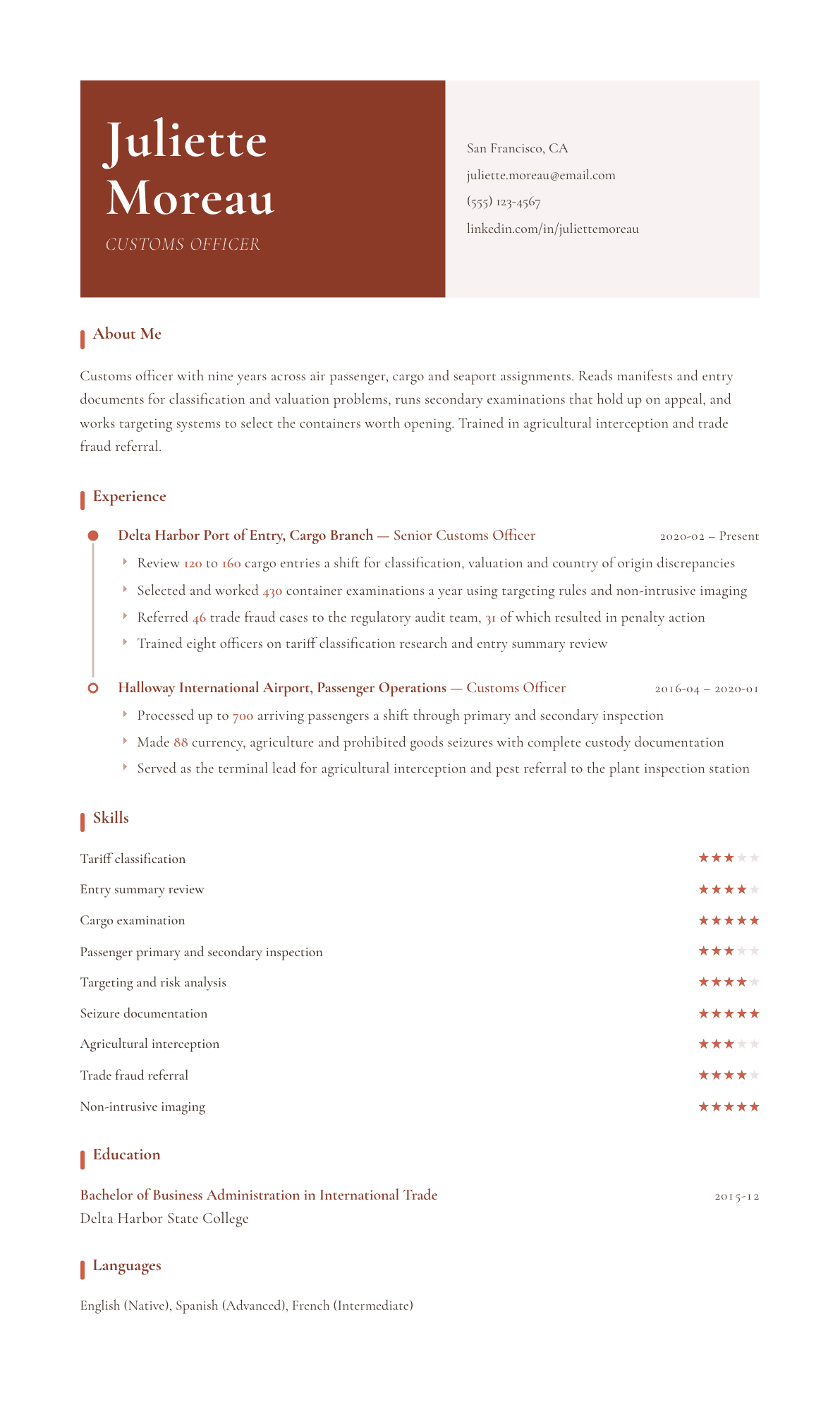
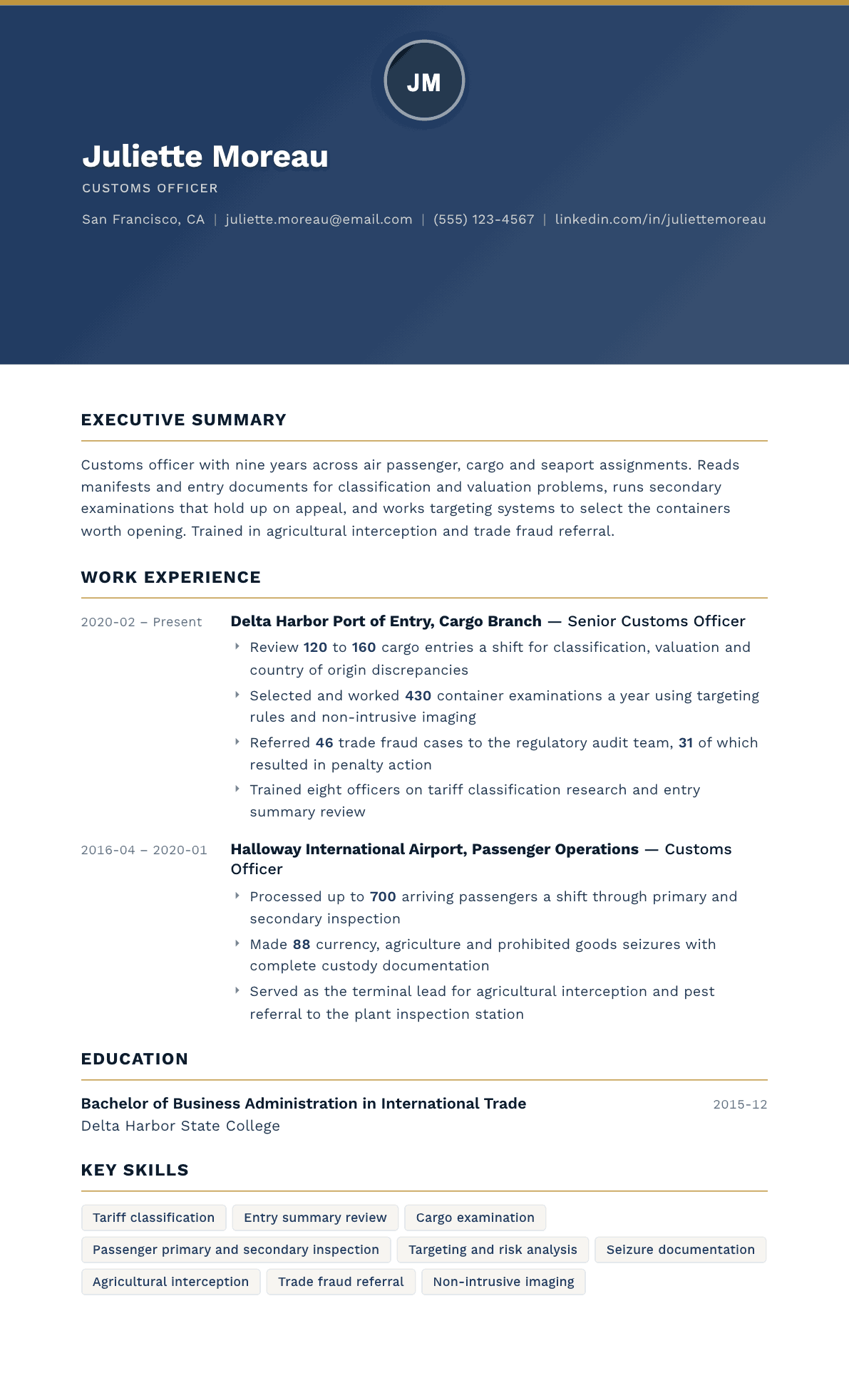
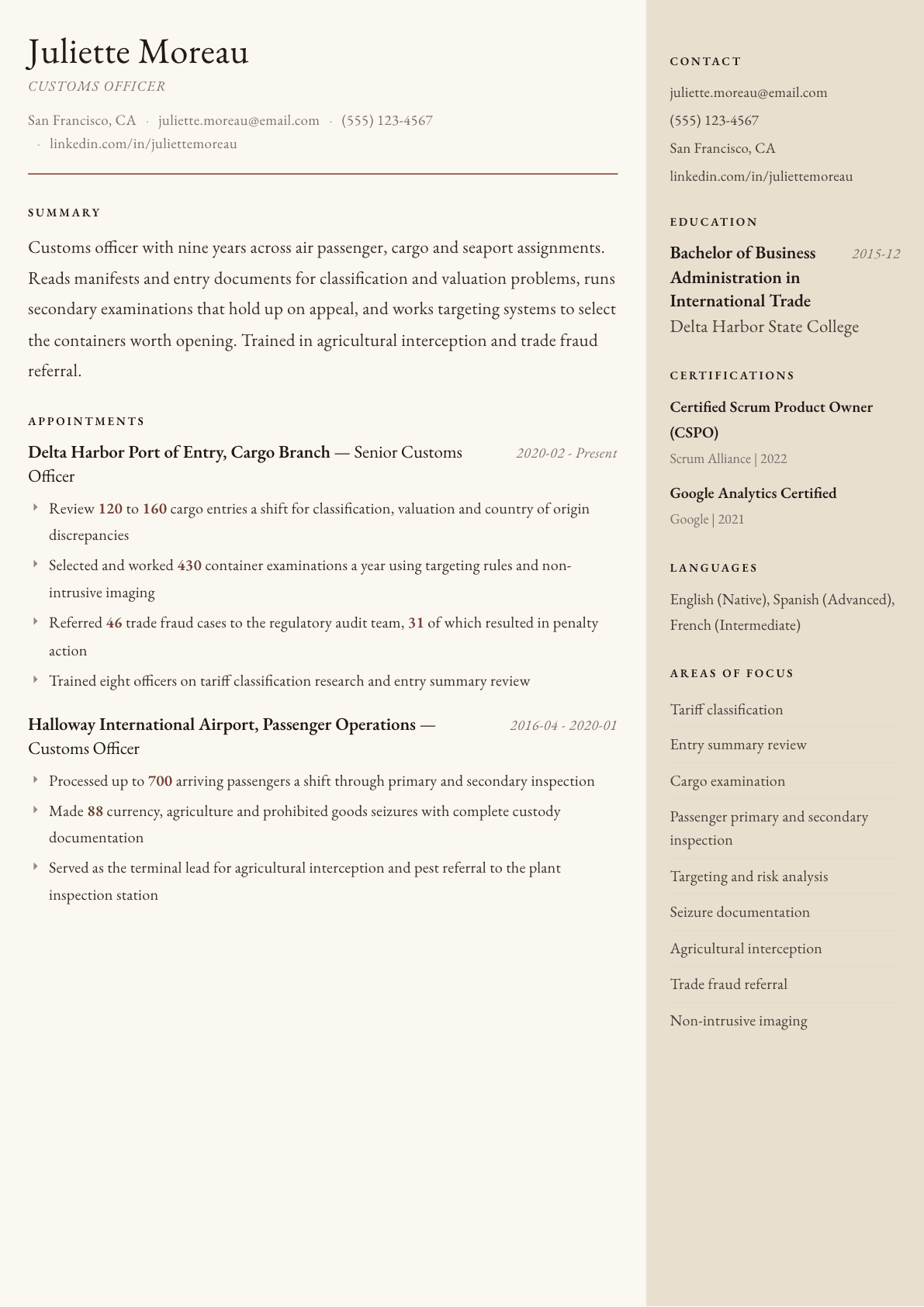
The same customs officer content laid out in three CVBooster templates, so you can see what the finished document looks like before you write a word.
Example Customs Officer summary
Customs officer with nine years across cargo, air passenger and seaport assignments. Reviews entry summaries and manifests for classification and valuation problems, selects containers worth examining using targeting rules and imaging, and documents seizures so they survive appeal. Refers trade fraud to audit teams with penalty outcomes, and trains newer officers on tariff research. Seeking a senior cargo enforcement post.
Skills to list on a Customs Officer resume
- Tariff classification research
- Customs valuation review
- Entry summary and manifest review
- Cargo container examination
- Passenger inspection and questioning
- Targeting and risk rules
- Non-intrusive inspection technology
- Seizure and forfeiture documentation
- Chain of custody control
- Agricultural quarantine interception
- Trade fraud detection
- Intellectual property enforcement
- Interagency referral
- Report and case writing
- Bilingual interviewing
What actually gets this resume read
- Say which environment you worked, because air passenger, land border and seaport cargo hire on different strengths.
- Use the exact vocabulary of the work: manifest, entry summary, classification, valuation, country of origin.
- Give examination volume and seizure counts with the documentation standard you held them to.
- Show that you can defend a decision on appeal, not only make one at the counter.
- Name the targeting and imaging systems you operated, since each port runs a different mix of them.
- Add any language you interview in and the level you were tested at, which shapes port assignment.
How to write a customs officer resume
A customs officer resume is judged on two things that rarely appear in the same candidate: enforcement instinct and document literacy. The port needs someone who can read an entry summary and see that the declared value does not match the commodity, and who can also stand at a counter and decide, in under a minute, which traveler goes to secondary inspection.
Most applications lean hard on one half. Trade compliance candidates write beautifully about classification and never mention an inspection they conducted. Enforcement candidates describe seizures and never show they can defend a classification decision on appeal. The page that gets an interview shows both halves working together.
This guide breaks the resume down for each port environment: air passenger, land border and seaport cargo. It covers how to write examination volume, seizure documentation and targeting work, gives three summaries by career stage, rewrites weak bullets, and answers what officers ask when they move between environments or into trade enforcement.
Format: name your port environment before anything else
Reverse chronological, one page for early career and two once you have worked several ports. The first thing to establish is environment, because a hiring official at a seaport container terminal and one at an international airport are filling genuinely different jobs and will discount experience they cannot place.
For federal announcements the same rules apply as for any government application: hours per week, grade level, dates by month and supervisor contact for every position. Write the duty narratives long, mirroring the specialized experience language in the announcement, and keep a shorter version for private sector trade compliance roles where nobody rates points.
- Header for a customs officer: name, city and state, phone, email, and the port and branch you currently work.
- Environment line under the summary: air passenger, land border, seaport cargo or mail and express consignment.
- Order the page as summary, environment, port experience, enforcement training, languages, education, systems.
- Trade compliance candidates crossing into enforcement lead with classification, valuation and audit work.
Summary: environment, volume, enforcement specialty
Three lines that name the port type, your years, your examination or passenger volume and the specialty you carry. A customs officer trained in agricultural interception is filling a different gap than one who works intellectual property enforcement, and both are more useful to a port director than a general claim of inspection experience.
If you are moving between environments, use the summary to bridge. Passenger work builds questioning technique and rapid assessment; cargo work builds document analysis and targeting. Say which one you have and which one you are moving toward, so the reader does not have to decide whether your record fits the vacancy.
Experience: documents, examinations and seizures
For cargo assignments, write the document work first: entries reviewed per shift, the commodity families you know, classification and valuation problems you caught, and country of origin questions you pursued. Then the physical side: examinations selected, imaging used, the intensive examinations you worked and what they produced.
For passenger assignments, give throughput and the questioning work behind it. Passengers processed per shift, referral rate to secondary, and the categories of finding you made: currency, agriculture, prohibited goods, fraudulent documents. Describe the interview approach rather than claiming a talent for reading people, because a supervisor wants a method she can teach to the next officer.
Seizures need documentation attached to them. A recovery that falls apart because the custody record has a hole costs the port more than a missed examination. Say that your seizure packages were complete, note how many were challenged and how they resolved, and mention any penalty or forfeiture action that followed.
Targeting, systems and trade enforcement
Targeting is what separates an officer who examines what is in front of them from one who decides what to examine. Write how you built or applied risk rules, the indicators you worked from, and your hit rate in general terms. A port measures examination productivity, and an officer whose selections produce findings is worth several who open containers at random.
Name the systems: the automated commercial environment, targeting platforms, non-intrusive imaging equipment, radiation detection and the tariff research tools you use. Add the trade side if you have it, including audit referrals, protest and appeal responses, and any work on intellectual property or antidumping enforcement, since those cases run on document analysis rather than physical search.
Skills, keywords and the language line
Postings reuse a compact vocabulary: manifest, entry summary, classification, valuation, country of origin, admissibility, seizure, forfeiture, targeting, admissible cargo, quarantine. Put those words where the work shows them. A keyword block with no matching duty narrative reads as padding to anyone who has actually worked a port.
Language ability deserves its own line at any international port. State the languages, the level tested and the duties you performed in them, since a port with heavy traffic in a particular language will assign you accordingly. Add customer facing detail as well, because most complaints from travelers concern how an inspection was explained rather than that one happened.
Customs Officer resume summary examples
New to the port
International trade graduate with two years as a freight forwarding coordinator handling entry documentation and tariff research. Reads manifests and commercial invoices fluently, speaks Mandarin and English, and is applying for a customs officer position at a seaport cargo branch.
Nine years across ports
Customs officer with nine years across cargo, air passenger and seaport assignments. Reviews 120 to 160 entries a shift for classification and valuation problems, worked 430 container examinations last year through targeting and imaging, and documents seizures that hold up on appeal.
Senior enforcement officer
Senior customs officer with fifteen years and a trade enforcement focus, referring fraud cases to regulatory audit and supporting penalty actions. Built the port targeting rule set for a high risk commodity family, trains officers on tariff research, and acts as branch supervisor during vacancies.
Work experience bullets: before and after
Before: Inspected cargo shipments arriving at the port.
After: Selected and worked 430 container examinations a year using targeting rules and non-intrusive imaging, prioritizing commodity families with a history of valuation problems.
Selection method matters more than examination count, because it shows judgment.
Before: Reviewed import documents for accuracy.
After: Reviewed 120 to 160 cargo entries a shift for classification, valuation and country of origin discrepancies, referring 46 trade fraud matters to the regulatory audit team.
Volume plus the referral outcome proves the document work led somewhere.
Before: Made seizures of prohibited items.
After: Made 88 currency, agriculture and prohibited goods seizures with complete custody documentation, none of which were overturned on administrative challenge.
The documentation standard is what makes a seizure count rather than the raw total.
Before: Questioned travelers at the inspection counter.
After: Processed up to 700 arriving passengers a shift through primary inspection, referring to secondary on declaration inconsistencies rather than appearance or nationality.
Naming the referral basis shows a defensible method a supervisor can teach.
Before: Trained other officers on customs procedures.
After: Trained eight officers on tariff classification research and entry summary review, building a reference sheet for the commodity families the port sees most.
A concrete subject and a durable artifact beat a general claim of training others.
Hard skills
- Tariff classification research
- Customs valuation review
- Entry summary and manifest analysis
- Country of origin determination
- Cargo container examination
- Passenger primary and secondary inspection
- Targeting and risk rule application
- Non-intrusive inspection technology
- Radiation detection equipment
- Seizure and forfeiture documentation
- Agricultural quarantine interception
- Intellectual property enforcement
- Trade fraud referral and audit support
Soft skills
- Reading inconsistency in a declaration calmly
- Explaining an inspection so it does not become a complaint
- Patience with repetitive document review
- Cooperation with agriculture and immigration partners
- Defending a decision without becoming defensive
Certifications worth listing
- Customs Broker License (U.S. Customs and Border Protection)
- Certified Customs Specialist (CCS) (National Customs Brokers and Forwarders Association of America)
- Certified Export Specialist (CES) (NCBFAA Educational Institute)
Mistakes that cost customs officer candidates the interview
- Failing to name the port environment, which leaves a hiring official unable to place your experience.
- Writing enforcement without document skill, or document skill with no inspection you personally conducted.
- Counting examinations without explaining how you chose which cargo to open.
- Reporting seizures with no word about custody documentation or how challenges resolved.
- Using vague terms like reviewed paperwork when the field has exact words for every document.
- Dropping language ability into a skills list instead of tying it to the interviews you conducted.
Customs Officer resume questions
What is the difference between a customs officer and a customs broker?
An officer works for the government enforcing import and export rules at a port. A broker works for importers, filing entries and advising on classification and duty. The knowledge overlaps heavily, which is why brokers move into officer roles and officers move into trade compliance.
Can I move from cargo to passenger work, or the other way?
Yes, and many officers do across a career. Write the transferable half explicitly: cargo work proves document analysis and targeting, passenger work proves questioning and rapid assessment. Say which environment you are moving toward so your record is read against the right vacancy.
How much detail should I give about seizures?
Give categories, counts and the documentation standard you held. Avoid case specifics, subject names and anything from an ongoing matter. A hiring official cares that your packages were complete and defensible, not about the details of any single recovery you made.
Do I need a trade background to be competitive?
It helps but it is not required. Freight forwarding, brokerage, logistics documentation and warehouse receiving all build the document literacy the role runs on. Pair that background with any enforcement, security or inspection work and the combination reads well to a port.
How do I show targeting experience without disclosing methods?
Describe the categories you worked, the fact that you built or refined selection rules, and the general productivity of your selections. Leave out specific indicators, thresholds and system logic. Hiring officials understand the constraint and read a careful answer as professional discipline.
Related resume examples
- Customs Broker Resume example
- Border Patrol Agent Resume example
- TSA Officer Resume example
- Customs Compliance Specialist Resume example
- Federal Agent Resume example
- Fraud Investigator Resume example