Import Coordinator Resume Examples: the lines they read
Write an Import Coordinator Resume That Shows Clean Entries
By Mustafa Tarabya, founder of CVBooster · Published · Updated
An import coordinator resume built around customs entries, HTS classification, broker files and landed cost, with a sample resume and a writing guide.
Sample resumes for a import coordinator
The same import coordinator content laid out in three CVBooster templates, so you can see what the finished document looks like before you write a word.
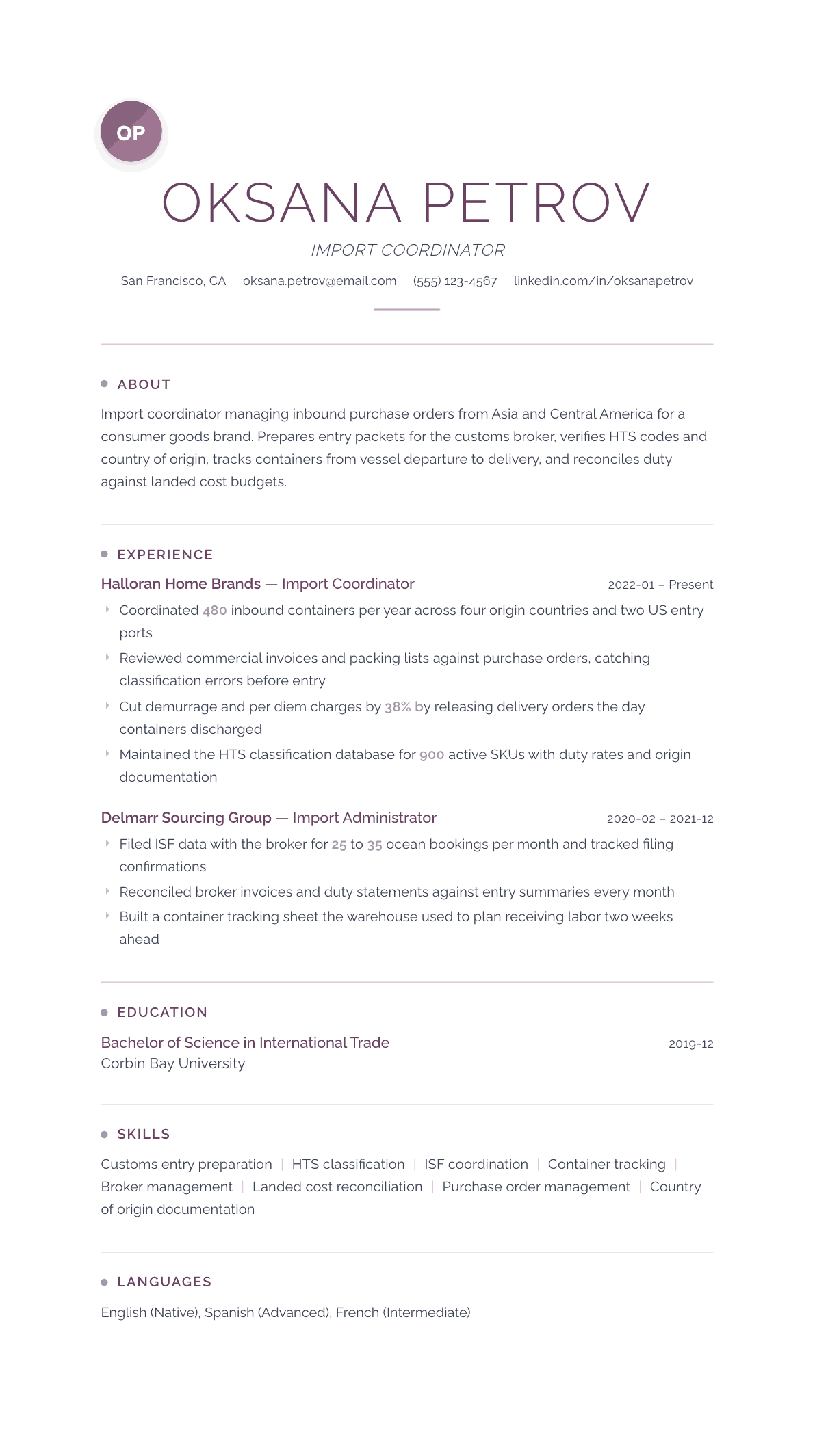
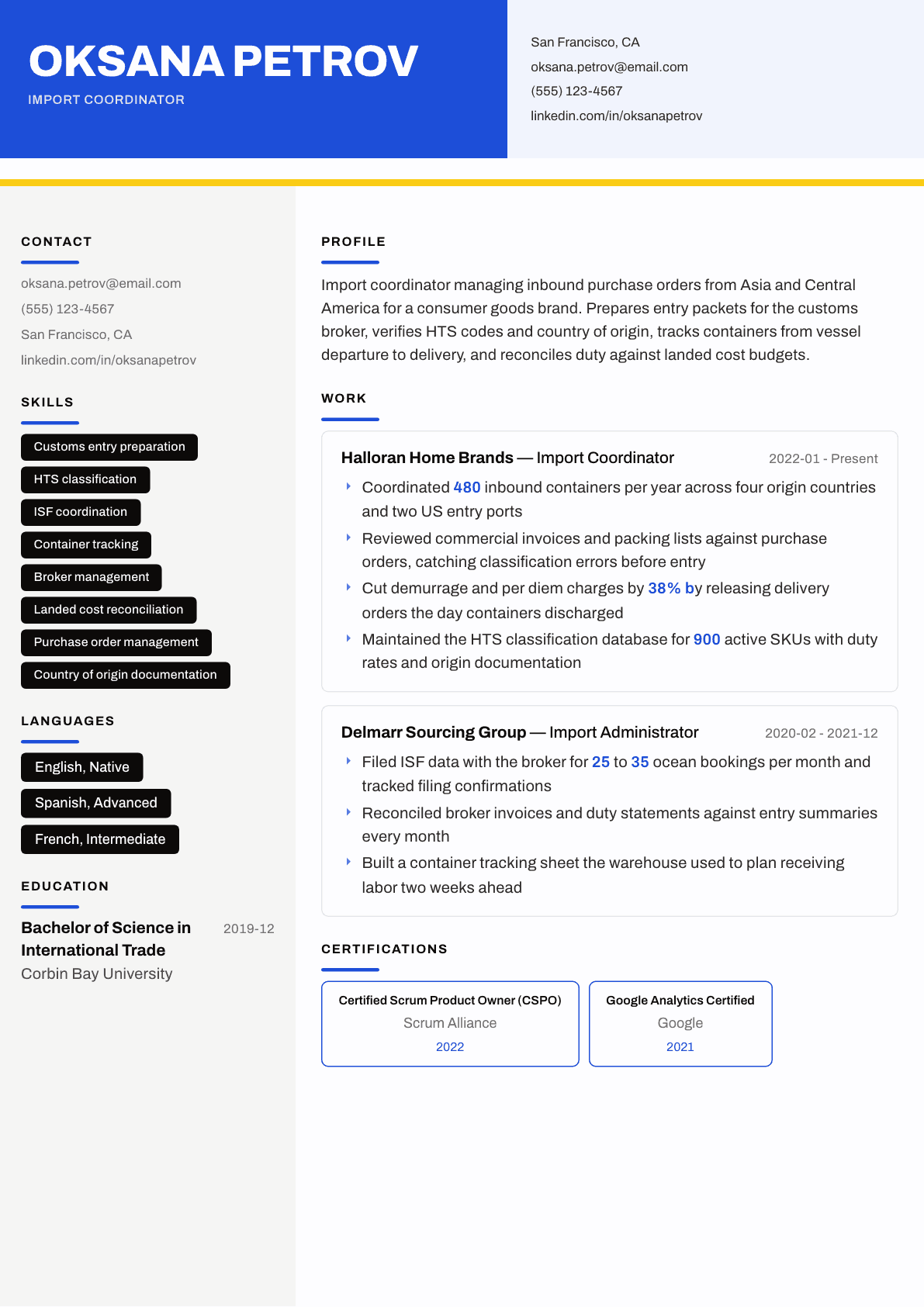
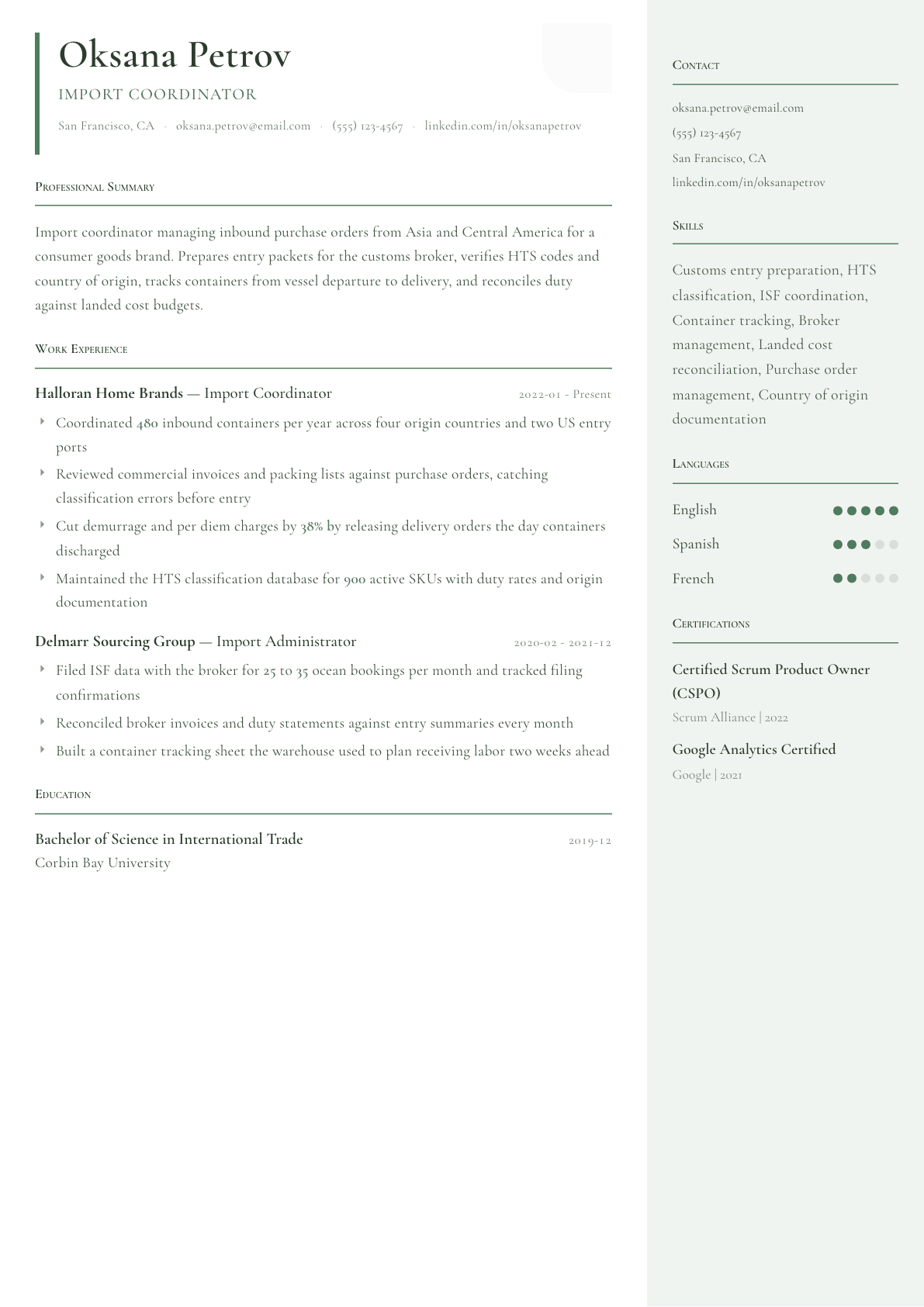
Example Import Coordinator summary
Import coordinator with five years moving inbound ocean and air volume from Asia and Central America for consumer goods programs. Prepares broker entry packets, maintains HTS classification records, tracks containers to the door, and reconciles duty against landed cost. Cut demurrage and per diem sharply by releasing delivery orders on discharge day. Seeking an import role with trade compliance scope.
Skills to list on a Import Coordinator resume
- Import documentation
- HTS classification
- Customs entry review
- ISF filing coordination
- Container tracking
- Demurrage and detention control
- Landed cost analysis
- Free trade agreement claims
- Customs broker liaison
- Purchase order tracking
- SAP
- Incoterms 2020
- Duty and tariff reconciliation
- Supplier document compliance
What actually gets this resume read
- State your origin countries, entry ports and annual container or air waybill volume in the first line of each job.
- Show what you own in the entry process, from document review and classification support to duty reconciliation.
- Give a cost number where you have one: demurrage avoided, per diem reduced or duty recovered on a reclassification.
- Name the systems you use, from the ERP that holds purchase orders to the broker portal that returns entry summaries.
- Mention the trade programs you touched, such as free trade agreement claims, duty drawback or foreign trade zones.
- Make your recordkeeping visible, because import files must stay retrievable for years after the goods arrive.
How to write a import coordinator resume
An import coordinator resume is read by someone who is counting containers and duty. They want to see origin countries, entry ports, annual volume, the systems that hold your purchase orders, and evidence that goods arrive without sitting on a terminal accruing charges. Import work is measured in dates and dollars, and the page should reflect that.
Many candidates write this role as pure administration: tracking orders, working with brokers, updating spreadsheets. That describes a coordinator at any size of company. What distinguishes a strong one is classification accuracy, demurrage control, document review that catches supplier errors before entry, and duty reconciliation that survives an audit years later.
This guide covers each section as an import manager reads it, gives summaries for an import administrator, a working coordinator and a senior one, rewrites five bullets that appear on most import resumes, and answers the questions coordinators ask when they want to move toward trade compliance.
Format: one page, origins and volume in the first line
Reverse chronological, one page. Lead each job with the profile of the import program: origin countries, modes, entry ports, annual container or air waybill volume, and the product category. A reader forms an immediate sense of complexity from that line, because apparel from three countries is a different compliance problem from machinery components from twelve.
Add a systems block early. The ERP holding purchase orders, the broker portal, any visibility platform and your reporting tools all belong within the first half of page one.
- Summary of three lines: origins, modes, annual volume, systems, one cost result.
- Experience with the import program described first, results underneath.
- A systems line: ERP, broker portal, visibility platform, classification database.
- A compliance line naming trade programs you supported.
Summary: program size, entry ports, and control
Give the annual volume plainly. Containers per year, air waybills per month, or purchase orders managed. Then name the entry ports, because port experience carries real knowledge about terminal behavior, drayage capacity and free time that a hiring manager values.
Close the summary with a control statement: demurrage avoided, entries reviewed before filing, classification records maintained, or duty reconciled against landed cost budgets. Import managers are graded on landed cost and on clean records, so speak to at least one of them.
Experience: documents in, containers through, duty reconciled
The first block is document control. Commercial invoices, packing lists and origin documents arrive from suppliers with errors in them, and a coordinator who catches a wrong value, a missing origin statement or an inconsistent quantity before the broker files is preventing an amendment later. Say what you check and what you have caught.
The second block is movement. Booking confirmations, security filing data to the broker, vessel tracking, discharge, customs release, drayage and delivery. This is where charges accrue, so give a demurrage or per diem result if you have one and describe how you got it: watching free time, releasing delivery orders on discharge day, or pre-booking drayage before arrival.
The third block is money and records. Duty reconciliation, broker invoice review, landed cost updates, and the retention file that must remain retrievable long after the goods sell through. Coordinators who can talk about recordkeeping are the ones companies trust with growing import programs.
Classification, trade programs and working with the broker
Say what you own on classification. Maintaining a tariff database for a set of active items, gathering the technical detail a classification decision needs, and challenging a broker code that looks wrong are all real coordinator responsibilities. State plainly whether you supported classification or made the determinations, because overstating this is easy to expose.
Then name the trade programs you touched: free trade agreement claims, duty drawback, foreign trade zone operations, or a customs partnership program. Even supporting one of these tells a hiring manager you understand that imports carry obligations beyond the delivery date.
- Tariff classification records you maintained, with the item count.
- Trade programs you supported and the documents they required.
- How you worked with the customs broker and what you reviewed before filing.
- Recordkeeping practice and where import files lived.
Keywords that pull an import resume out of a database
The searched terms are import coordinator, customs entry, tariff classification, security filing, country of origin, free trade agreement, duty drawback, foreign trade zone, demurrage, per diem, drayage, landed cost, purchase order tracking and the name of your ERP. Use the ones that are true in the summary and again where they carry a fact.
Mirror the posting on product category too. Food, pharmaceuticals, textiles, electronics and machinery each bring different agency requirements, and a reader hiring for a regulated category screens for it directly.
Import Coordinator resume summary examples
Import administrator
Import administrator supporting 25 to 35 ocean bookings a month from two origin countries. Sends security filing data to the broker on schedule, reconciles broker invoices against entry summaries, and built a container tracking sheet the warehouse uses to plan receiving labor two weeks ahead.
Three years coordinating imports
Import coordinator moving 480 containers a year from four origin countries through two entry ports for a consumer goods brand. Reviews supplier documents against purchase orders before entry, maintains tariff records for 900 active items, and cut demurrage and per diem charges by 38%.
Senior import coordinator
Senior import coordinator running an inbound program across ocean and air from nine origin countries. Owns broker oversight, free trade agreement claims and landed cost reconciliation, trains two coordinators, and holds an import file structure that has satisfied every internal audit of the program.
Work experience bullets: before and after
Before: Tracked incoming containers from overseas suppliers.
After: Coordinated 480 inbound containers a year from four origin countries through two entry ports, tracking each from vessel departure to warehouse receipt.
Annual volume, origins and ports let a reader size the program instead of guessing at it.
Before: Worked with the customs broker on entries.
After: Reviewed commercial invoices and packing lists against purchase orders before releasing entry packets to the broker, catching value and origin errors that would have required amendments.
The review step and the errors caught show ownership of entry quality rather than handoff.
Before: Reduced port charges on imports.
After: Cut demurrage and per diem charges by 38% by releasing delivery orders the day containers discharged and pre-booking drayage before vessel arrival.
Two named tactics behind the reduction make the saving repeatable and believable.
Before: Maintained product classification information.
After: Maintained the tariff classification database for 900 active items with duty rates, origin documentation and the technical basis for each code.
Item count and the supporting records prove a maintained system rather than a spreadsheet of codes.
Before: Checked broker invoices each month.
After: Reconciled broker invoices and duty statements against entry summaries monthly and queried discrepancies before they aged past the correction window.
Tying the review to a correction deadline shows understanding of why the reconciliation matters.
Hard skills
- Import documentation review
- Tariff classification support
- Customs entry packet preparation
- Security filing coordination
- Container and air waybill tracking
- Demurrage and detention control
- Landed cost reconciliation
- Free trade agreement documentation
- Purchase order management
- Customs broker oversight
- ERP transaction processing
- Import recordkeeping
Soft skills
- Supplier follow-up across time zones
- Precision with documents
- Escalating a hold early
- Coordinating warehouse and finance
- Written clarity in trade correspondence
- Planning around long lead times
Certifications worth listing
- Certified Customs Specialist (CCS) (National Customs Brokers and Forwarders Association of America)
- Certified in Logistics, Transportation and Distribution (CLTD) (Association for Supply Chain Management)
- Certified Supply Chain Professional (CSCP) (Association for Supply Chain Management)
Mistakes that cost import coordinator candidates the interview
- Writing about tracking orders with no container volume, origin countries or entry ports on the page.
- Ignoring demurrage and per diem, which is the cost an import manager watches most closely.
- Claiming to classify goods when you gathered information for a licensed broker who classified them.
- Leaving trade programs off the page even when you gathered the documents they require.
- Describing the ERP as a system instead of naming the product a recruiter searches for.
- Skipping recordkeeping, which is the part of import work that outlives every shipment.
- Presenting a pure data entry role as program ownership, which unravels in the first technical question.
Import Coordinator resume questions
What is the difference between an import coordinator and a customs broker?
A licensed broker files entries with customs on behalf of the importer. A coordinator prepares and reviews the information the broker needs, tracks the cargo, and reconciles the results. Describe your side accurately, because the distinction is a licensing matter.
Which numbers matter most on an import resume?
Annual containers or air waybills, active item counts you classified or maintained, demurrage and per diem reduction, entry error rate, and duty reconciled. These map directly to the landed cost figures an import manager reports upward.
How do I move from import coordinator into trade compliance?
Put the compliance work you already do at the top: document review, classification maintenance, origin verification and recordkeeping. Then add a recognized customs credential and describe any audit or internal review you supported end to end.
Should I name the countries I import from?
Yes. Origin country experience carries real knowledge about supplier documentation habits, transit times, agency requirements and preferential duty programs. Employers with a defined sourcing footprint screen for candidates who already know those origins.
Do I need to list every product I have imported?
No, list categories instead. Say consumer goods, industrial components, food or apparel, and mention any regulated category that required another agency filing, because that experience is harder to find and worth flagging clearly.
Related resume examples
- Import-Export Specialist Resume example
- Customs Broker Resume example
- Customs Compliance Specialist Resume example
- Supply Chain Coordinator Resume example
- Logistics Specialist Resume example
- Freight Forwarder Resume example