Import-Export Specialist Resume Examples: free ATS score
Go Global with an Import-Export Specialist Resume
By Mustafa Tarabya, founder of CVBooster · Published · Updated
Build an import-export specialist resume highlighting your international trade documentation, compliance, and supply chain coordination expertise.
Sample resumes for a import-export specialist
The same import-export specialist content laid out in three CVBooster templates, so you can see what the finished document looks like before you write a word.
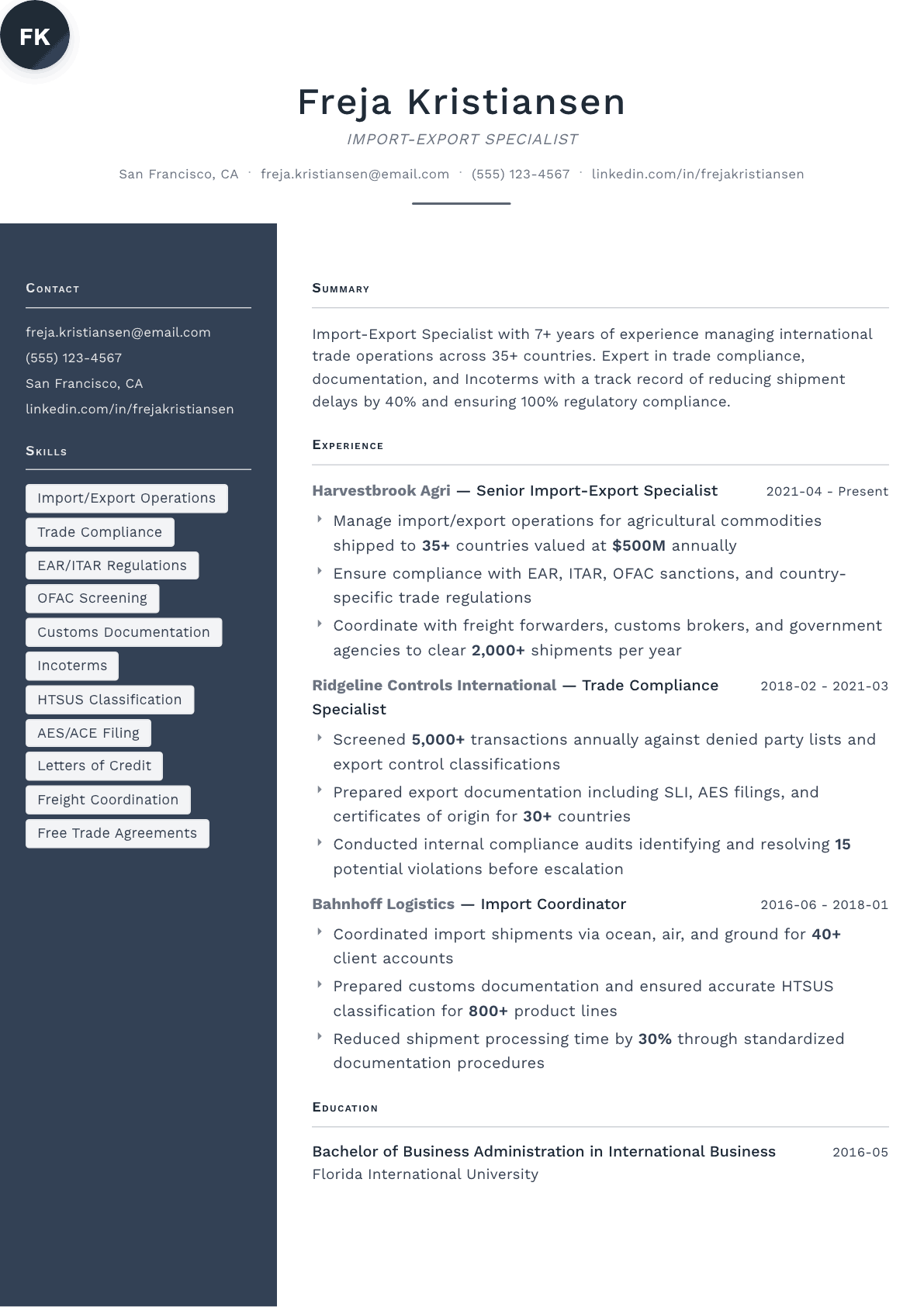
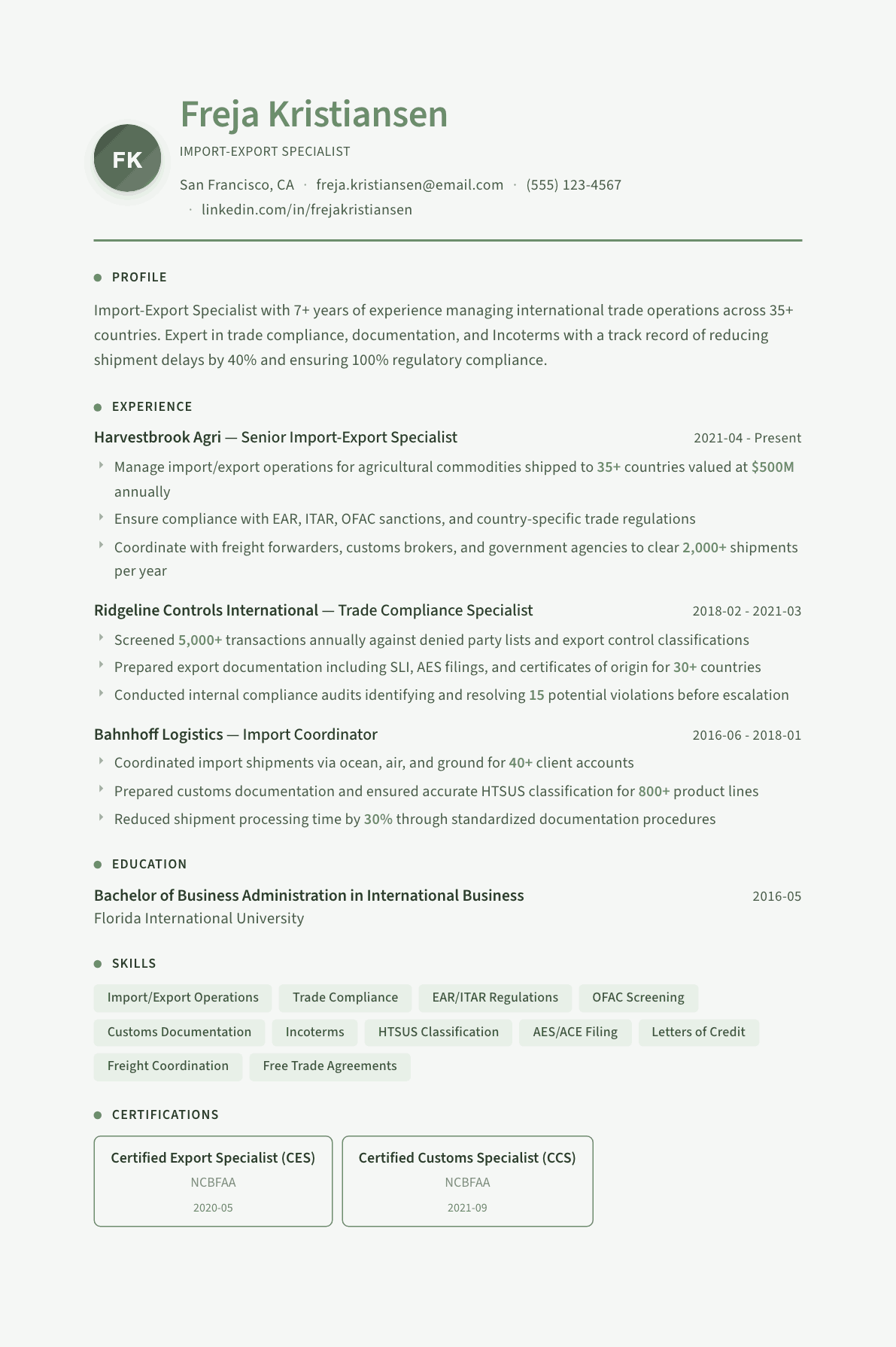
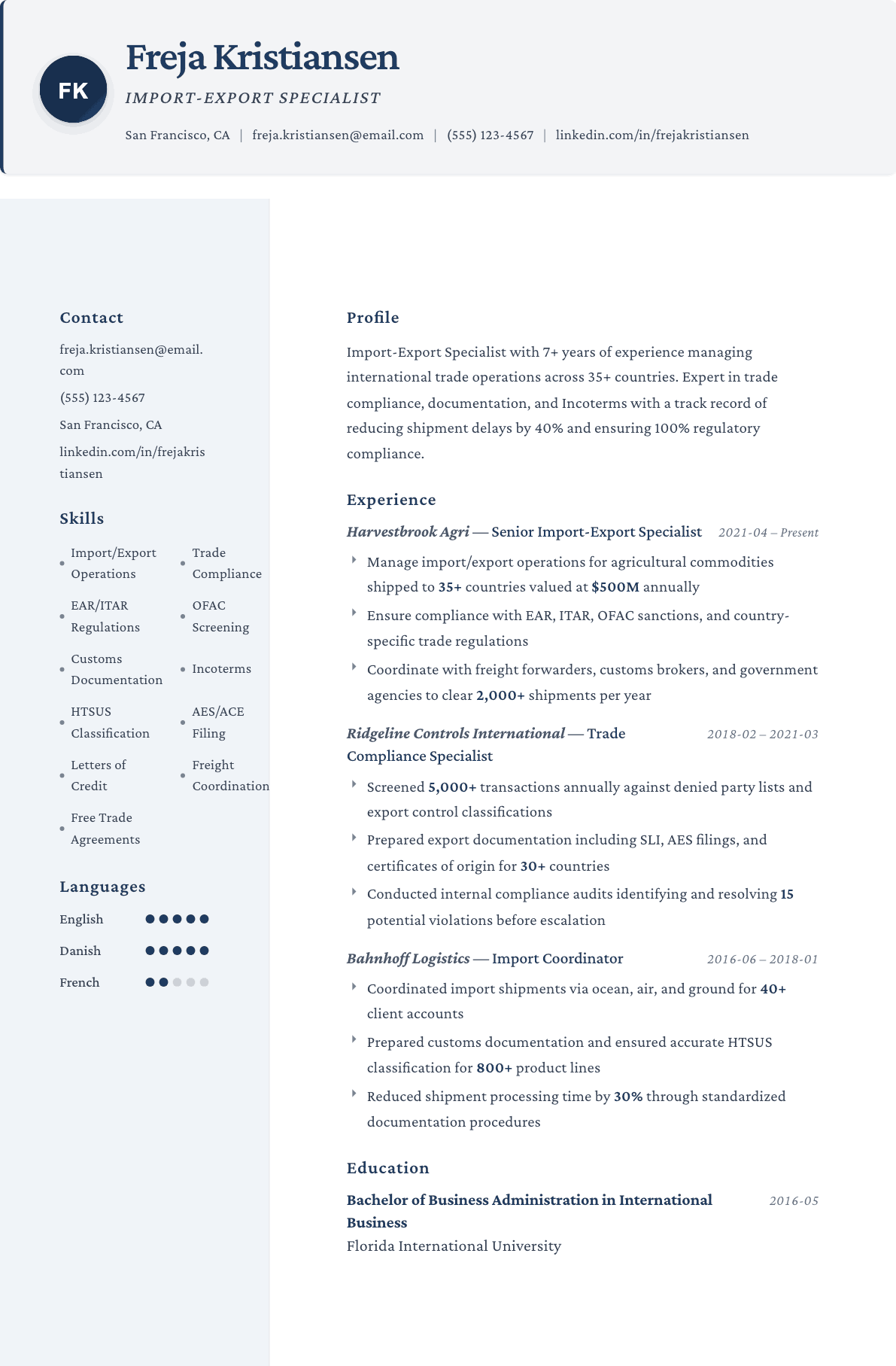
Example Import-Export Specialist summary
Import-Export Specialist with 7 years of experience managing international trade operations across 35+ countries. Expert in EAR, ITAR, and OFAC compliance with a 100% regulatory compliance record. Seeking a trade compliance manager role in a global organization.
Skills to list on a Import-Export Specialist resume
- Import/Export Operations
- Trade Compliance
- EAR / ITAR
- OFAC Sanctions Screening
- Customs Documentation
- Incoterms 2020
- HTSUS / Schedule B
- AES / ACE Filing
- Letters of Credit
- Freight Forwarding
- Free Trade Agreements
- Denied Party Screening
- Country of Origin
- Supply Chain Coordination
What actually gets this resume read
- Highlight compliance expertise with specific regulations: EAR, ITAR, OFAC, BIS, DDTC.
- Quantify your trade volume: number of shipments, countries served, and dollar value of goods handled.
- Include Incoterms knowledge and letter of credit experience for international trade roles.
- Mention denied party screening tools and export classification experience.
- List free trade agreements you have applied: USMCA, EU FTAs, RCEP, CPTPP.
- Include language skills. Multilingual candidates are highly valued in international trade.
How to write a import-export specialist resume
An import-export specialist resume is screened by a trade compliance manager who is thinking about audit exposure. Their real question is whether hiring you raises or lowers the chance of a penalty notice, a denied party violation or a seized container. Everything you write is read through that lens, which makes this one of the few operations roles where compliance detail outranks volume metrics.
So the resume has to be specific about regulation, not just about movement. Which classification systems you have worked in, which agencies you have filed with, which licenses and exceptions you have applied, and which screening tools sat between your desk and a restricted party. A candidate who writes "handled international documentation" has described the job without proving they can do it.
This guide covers document structure, how to write a compliance-weighted experience section, the credentials that carry weight with a trade team, sample summaries at three levels, and the questions specialists ask when they move between import, export and dual roles.
Format: one page early, two once you own a compliance program
Reverse-chronological, single column, plain text. Trade teams sit inside larger companies whose applicant tracking systems parse aggressively, and the regulation acronyms you need are exactly the strings that get mangled when a parser hits a table or a sidebar.
Add a short "Regulatory scope" block under the summary listing the regimes you have worked under. Four or five lines of EAR, ITAR, OFAC sanctions programs, HTSUS classification, Foreign Trade Regulations and the free trade agreements you have claimed under does more for you than any skills bar graph.
- Header: name, city and state, phone, email, and the trade lanes you cover.
- Order: summary, regulatory scope, experience, systems, education, licenses and certifications, languages.
- Language proficiency belongs on the page when your lanes run through markets where you negotiate in that language.
Summary: direction of trade, commodity, regime, scale
Say whether you are import side, export side or both, what commodity families you know, which regulatory regimes apply to them, and the size of the program you support. A specialist moving hazardous chemicals into the European Union is doing a different job from one exporting controlled electronics, and the summary is where you tell the reader which one you are.
Scale belongs here too, expressed as entries or export filings per month, countries served and the number of business units you support. Avoid describing the value of goods moved; managers judge complexity by regime and country mix far more than by cargo value.
Experience: write each bullet as a control, not a task
The strongest bullets name the control you operated and the exposure it managed. Classification of a product line to a specific chapter of the tariff, jurisdiction and classification determinations under the Commerce Control List, license applications through the relevant agency portal, restricted party screening at order entry and again before release, and recordkeeping to the retention period the regulation requires.
Include the failures you cleaned up, because a trade manager values that more than clean quarters. Prior disclosures prepared, post entry amendments filed, protest work, duty recovery through drawback, and internal audits where you found the gap before Customs did.
Give each employer the trade context: manufacturer, distributor, freight forwarder or customs brokerage, the entry volume, and whether the company held a customs bond, an importer self assessment position or a trusted trader membership. That context tells the reader what kind of desk you actually sat at.
Systems and filing platforms
Name the platforms exactly. Filing through the Automated Commercial Environment and the Automated Export System, global trade management software such as SAP Global Trade Services, Oracle Global Trade Management, Descartes or e2open, and the screening tools you ran against denied and restricted party lists. Onboarding cost is real, and a specialist who already knows the house platform starts filing sooner.
Add the document set you produce and check: commercial invoice, packing list, certificate of origin, bill of lading and air waybill, dangerous goods declaration, letters of credit and the document presentation that goes with them. Letter of credit experience is worth calling out separately, because relatively few operations people have handled a discrepant presentation.
Keywords a trade compliance posting reuses
Trade postings draw from a fixed vocabulary: tariff classification, valuation, country of origin, duty drawback, denied party screening, export licensing, jurisdiction determination, embargo and sanctions compliance, Incoterms rules, customs audits, recordkeeping, and trusted trader programs. Use each term once where it is true of your work. A term you cannot defend in an interview costs you more than leaving it off.
Import-Export Specialist resume summary examples
First trade compliance seat
Import-export coordinator with two years at a freight forwarder preparing entry packets and export filings for consumer goods from Asia. Files in the Automated Export System, classifies to the tariff schedule under supervision, and completed the Certified Export Specialist course.
Five years in
Import-export specialist with five years supporting a manufacturer across 22 countries, handling 300 entries a month and export licensing for controlled components. Runs denied party screening at order entry, prepares certificates of origin under USMCA, and recovered duty through a drawback program.
Trade compliance lead
Trade compliance lead with 12 years owning import and export programs for three business units. Built the classification database, led two internal audits and one prior disclosure, and holds a customs broker license alongside the Certified Customs Specialist designation.
Work experience bullets: before and after
Before: Responsible for import and export documentation.
After: Prepared and reviewed entry packets for 300 monthly import entries, checking commercial invoice values, country of origin marking and tariff classification before broker release.
The volume and the specific checks performed show a control being run rather than paperwork being handled.
Before: Made sure the company followed export regulations.
After: Classified a 400 item product line against the Commerce Control List, determined jurisdiction for each, and filed license applications for controlled items through the agency portal.
Naming the classification work and the licensing step proves you can defend a determination in an audit.
Before: Used screening software to check customers.
After: Screened every new customer and consignee against denied, restricted and sanctioned party lists at order entry and again before release, clearing 30 potential matches a month.
Screening at two checkpoints with a match volume is the detail that shows the process was real.
Before: Saved the company money on duties.
After: Built a duty drawback file on exported components and worked with the broker to recover four years of eligible duty, then set a quarterly filing cadence.
The mechanism and the cadence turn a savings claim into a program a manager can picture inheriting.
Before: Helped with a customs audit.
After: Ran an internal audit of 500 entries against the recordkeeping requirement, found a valuation error on assists, and drafted the prior disclosure with outside counsel.
Finding and disclosing your own error is the strongest compliance credential you can put on a page.
Hard skills
- HTSUS and Schedule B classification
- Export Administration Regulations
- International Traffic in Arms Regulations
- OFAC sanctions screening
- Automated Commercial Environment filing
- Automated Export System filing
- Incoterms rules
- Customs valuation and country of origin
- Duty drawback
- Free trade agreement qualification
- Letters of credit and document presentation
- Recordkeeping and internal audit
Soft skills
- Regulatory judgment
- Documentation discipline
- Cross border stakeholder communication
- Escalation to counsel
- Vendor and broker management
- Attention to exception cases
Certifications worth listing
- Certified Export Specialist (CES) (NCBFAA Educational Institute)
- Certified Customs Specialist (CCS) (NCBFAA Educational Institute)
- Customs Broker License (U.S. Customs and Border Protection)
- Certified Global Business Professional (CGBP) (NASBITE International)
- Certified International Trade Professional (CITP) (Forum for International Trade Training)
Mistakes that cost import-export specialist candidates the interview
- Listing regulation acronyms you have never applied, which collapses in the first technical interview question.
- Writing movement metrics with no compliance content, so the resume reads like a freight coordinator rather than a specialist.
- Omitting the filing platforms by name, when platform familiarity is the difference between filing in week one and week six.
- Leaving out audit, disclosure and correction work because it feels like admitting a problem, when it is the strongest evidence you have.
- Using "international trade" as a catch-all instead of naming commodity families, regimes and lanes.
- Forgetting to say whether you sat on the import side, the export side or both, which every posting distinguishes.
Import-Export Specialist resume questions
Do I need a customs broker license for an import-export specialist role?
Not for most corporate trade roles, but it separates you sharply from other candidates because it proves examined knowledge of classification, valuation and entry procedure. Employers in brokerage and freight forwarding often treat it as a requirement rather than a bonus.
Should I include the value of goods I handled?
Usually not. A trade manager sizes your experience by entry or filing volume, country mix and regulatory regime, because a small program of controlled exports is far harder than a large program of unregulated consumer goods.
How do I show export control experience without disclosing anything sensitive?
Describe the process and the regime rather than the product or the customer. Saying you determined jurisdiction and classification for a controlled electronics line and filed license applications tells the reader everything they need without naming a program.
Are language skills worth a section on a trade resume?
Yes when your lanes run through markets where you correspond with suppliers, forwarders or customs authorities in that language. Give the proficiency level honestly, because a hiring manager may switch languages mid interview to check.
How do I move from freight forwarding into corporate trade compliance?
Lead with the compliance parts of the forwarding job: classification work, filing accuracy, document review, restricted party checks and how you handled exceptions. Then push the rate quoting and booking work down the page where it will not define you.
Related resume examples
- Customs Broker Resume example
- Freight Broker Resume example
- Logistics Coordinator Resume example
- Freight Forwarder Resume example
- Import Coordinator Resume example
- Customs Compliance Specialist Resume example