Business Development Manager Resume Examples: free score
Business Development Resume Examples for Managers Who Close Deals
By Mustafa Tarabya, founder of CVBooster · Published · Updated
Business development resume examples for specialists, managers and directors: quota evidence, sourced pipeline and partnership metrics sales leaders trust.
Sample resumes for a business development manager
The same business development manager content laid out in three CVBooster templates, so you can see what the finished document looks like before you write a word.
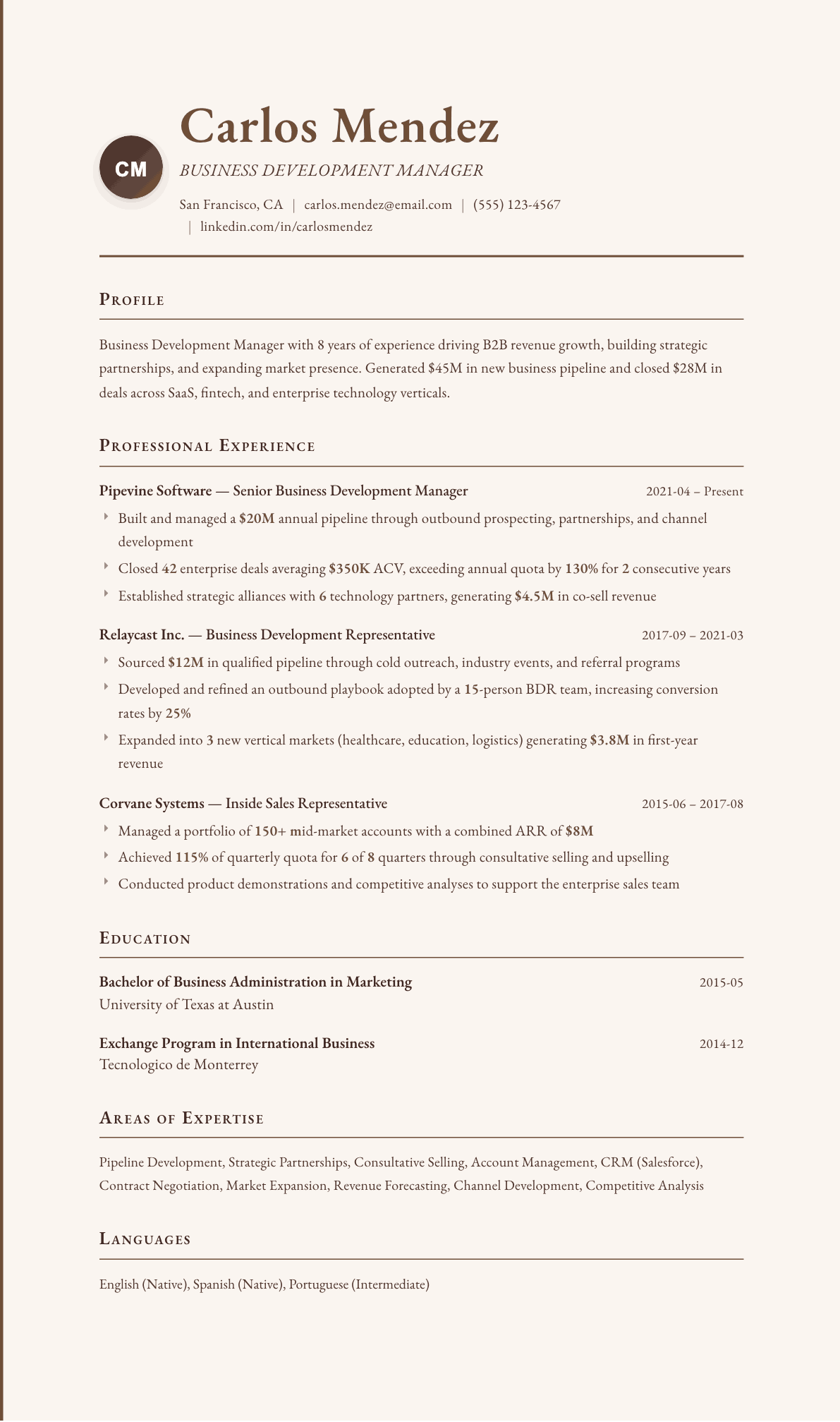
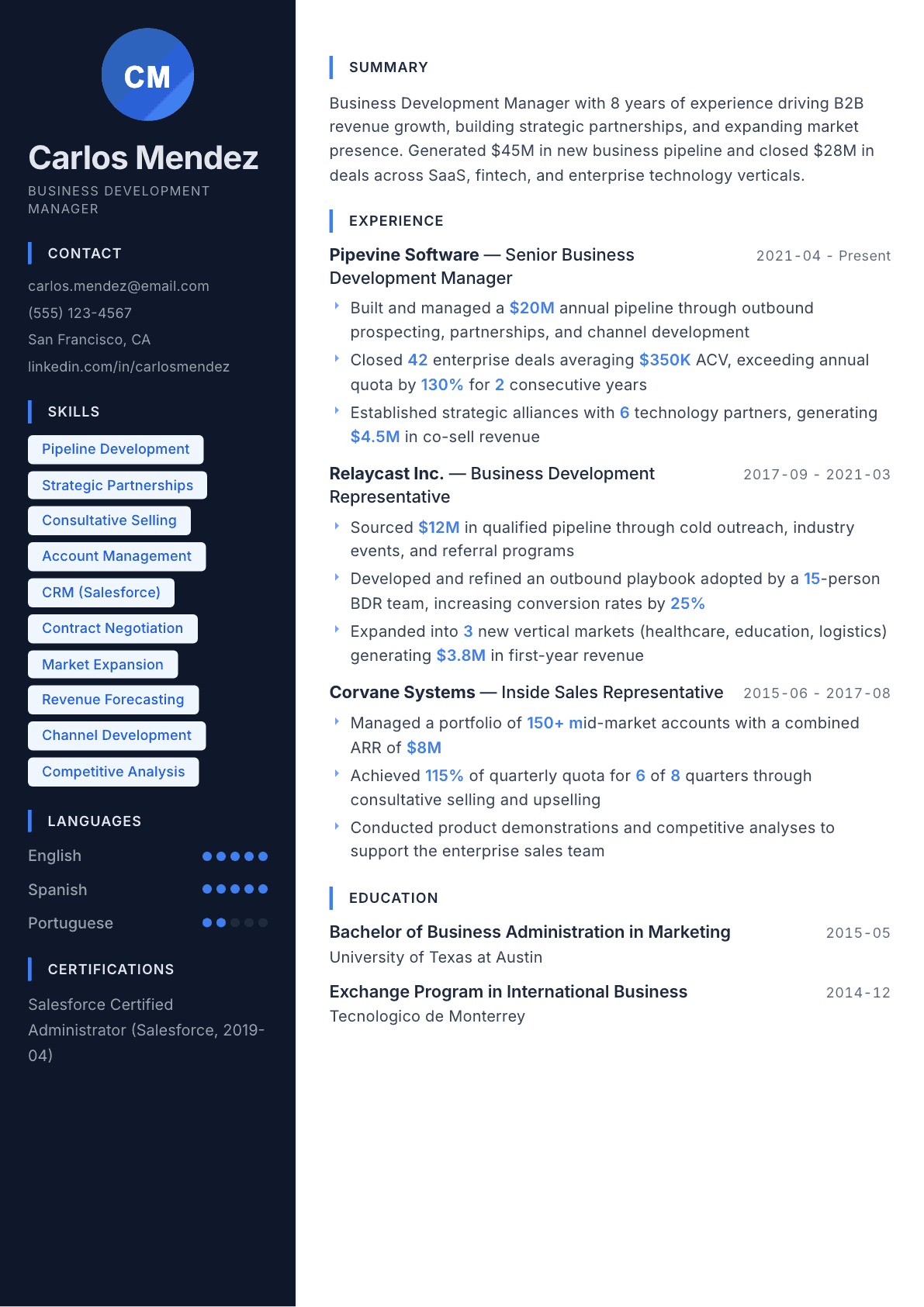
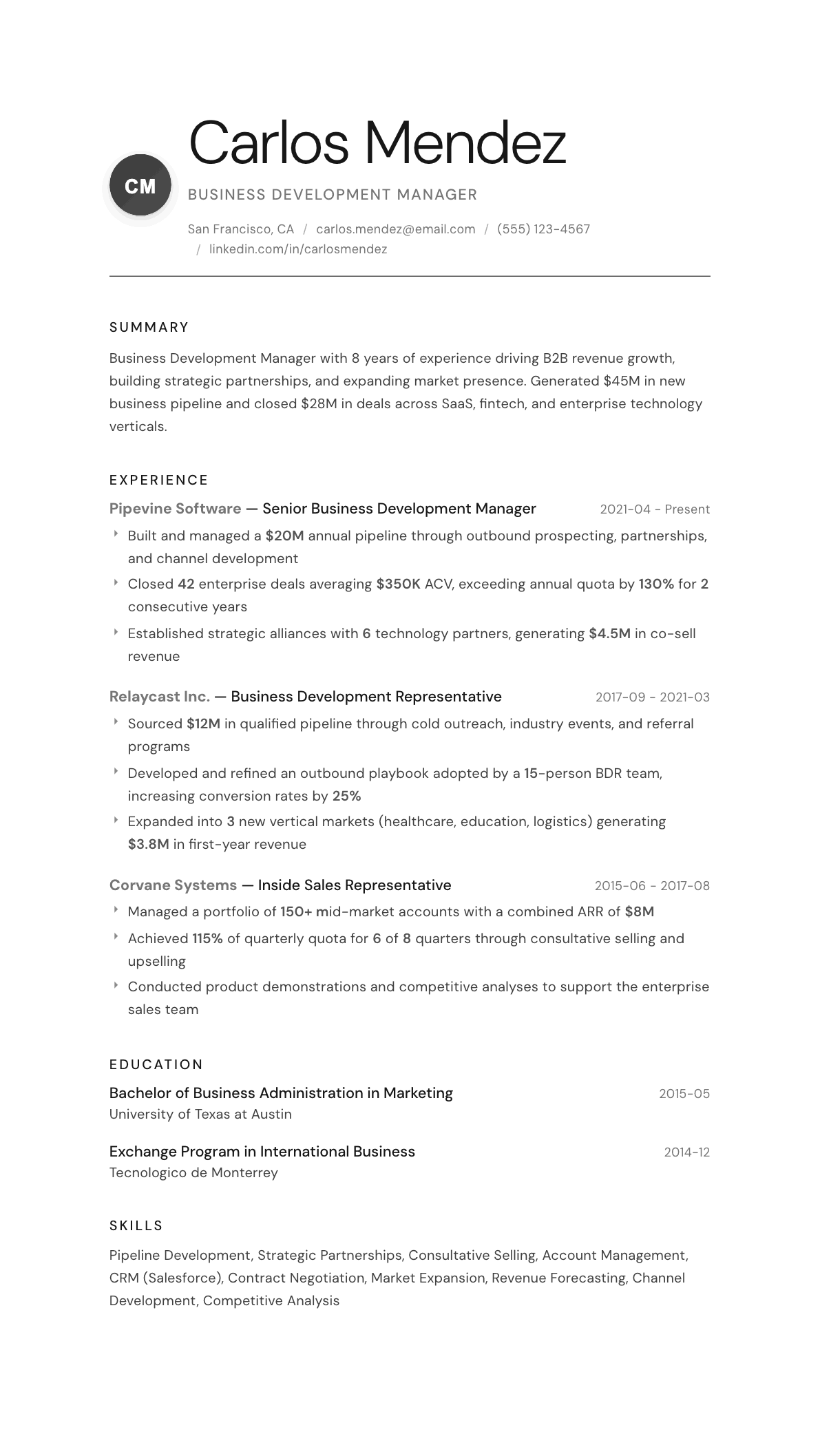
Example Business Development Manager summary
Business Development Manager with 8 years of experience driving B2B revenue growth across SaaS and enterprise technology. Generated $45M in pipeline and closed $28M in deals through strategic partnerships, consultative selling, and market expansion. Bilingual English-Spanish professional seeking a Director of Business Development role to scale revenue at a high-growth company.
Skills to list on a Business Development Manager resume
- Business Development
- Pipeline Generation
- Strategic Partnerships
- Consultative Selling
- Account Management
- Salesforce CRM
- Contract Negotiation
- Market Expansion
- Revenue Forecasting
- Channel Sales
- Competitive Analysis
- Lead Qualification
- Proposal Writing
- Relationship Building
What actually gets this resume read
- Lead with revenue numbers: pipeline generated, deals closed, quota attainment percentages.
- Highlight both hunting (new business) and farming (expansion/upsell) capabilities.
- Show partnership development skills with specific partner names and co-sell revenue.
- Include CRM proficiency and sales methodology training (SPIN, Challenger, MEDDIC).
- Demonstrate market expansion by naming new verticals, geographies, or segments you opened.
- Use action verbs like sourced, closed, negotiated, expanded, and launched.
How to write a business development manager resume
A sales leader reading a business development manager resume is doing arithmetic, not admiring prose. Number carried, number delivered, deal size, sales cycle length, win rate, and how much of the pipeline you created yourself rather than received from marketing. If those figures are absent, the assumption is that they were not good.
The title also hides two very different jobs. In some companies business development means new logo hunting with a personal quota. In others it means partnerships, channel and alliances, where you never sign a customer contract but you build the routes that others sell through. A resume that does not declare which one you do gets screened out by both.
If the posting asks for a CV, as most UK, European and Gulf employers do, the rules do not change: a business development CV carries the same numbers and may run to two pages. Everything here applies to any business development resume, whether your title says specialist, executive, manager or director. This guide covers how to lead with quota evidence, how to describe pipeline you sourced without inflating it, how partnership work should be quantified when there is no direct quota, and the questions people ask when they move between segments, industries or from a hunting seat into an account management one.
Format: one page early, two later, numbers in the first third
Reverse chronological, plain layout, and the numbers high on the page. Sales resumes are the one category where a short results block directly under the summary is genuinely useful, because a sales director wants attainment history before they read anything else.
Under each employer, give the selling context in one line: what was sold, to whom, at what deal size, through what motion. Enterprise software sold to operations leaders at manufacturers, average contract value in the low six figures, a 9-month cycle with a proof of concept, tells a reader more than three bullets of activity.
- Header: name, city, phone, email, professional profile link.
- Sections: summary, results snapshot, experience, tools, education and certifications.
- The results snapshot lists attainment by year or by quarter, plus rank if you have one.
Business development resume by title: specialist, manager, director
Business development titles mean different things at different companies, so the resume has to translate yours. A specialist or executive title usually means an individual quota and outbound prospecting. A manager title can mean a bigger quota, a team of development representatives, or a partner portfolio. A director title should show the plan you wrote, the people you hired and the revenue the function produced, not only your own deals.
Put a one line scope under each title: segment, territory or partner type, quota or target, and team size if you had one. That line lets a recruiter map your title onto theirs before deciding whether you are too junior or too senior, which is the decision a business development resume most often loses on.
- Specialist or executive: meetings booked, opportunities created, deals closed and quota attainment.
- Manager: quota carried, attainment, average deal size, and team or partner portfolio size.
- Director: the annual plan, hires made, function revenue and the sales motion you built or changed.
- Partnerships: partners signed, partner sourced pipeline and partner influenced revenue, each defined in a line.
Summary: segment, motion, deal size and what you carry
Three lines. Name the market segment, the buyer you sell to, the average deal size band, the sales cycle length and the quota you carry. Add the motion: outbound hunting, partner and channel, inbound conversion or expansion inside existing accounts. These four facts let a sales director place you against an open territory in seconds.
If your business development work is partnership rather than direct sales, say so in the first line and change the metrics accordingly: partners recruited and activated, sourced and influenced revenue through the channel, and how long it took a new partner to produce their first deal.
A business development CV profile, written out: Business development manager, logistics software, mid market accounts. Opened 23 new logos in two years against a target of 18, sourced most of my own pipeline through partner referrals and trade events, and run a sales cycle of about four months with procurement and finance at the table. It names the segment, the motion and the attainment before any adjective.
Experience: attainment, pipeline created, and how the deals were won
Lead every job with attainment against quota over consecutive periods, because one strong year reads as luck and three read as a method. Then pipeline creation: how much of your closed business began with your own outbound rather than inbound leads or partner referrals. Sourced pipeline is the number that separates a genuine hunter from a competent closer of other people's leads.
Then show the shape of the sales work: prospecting channels used, the qualification framework you sell with, how many stakeholders were typically in a deal, how you handled procurement and security review, and what happened in the deals you lost. A candidate who can describe a loss honestly is rare and it lands well.
For partner and alliance work, quantify differently but just as hard. Partners signed, partners actually producing, co-selling revenue attributed to the partnership, joint pipeline built at events, and the enablement you ran to get partner sellers competent.
- Quota carried and attainment for each period, plus ranking in the team where known.
- Pipeline sourced by you against total pipeline worked.
- Deal count, average contract value band and sales cycle length.
- New logos closed and any expansion or renewal responsibility.
- Territory or vertical opened, and what it produced in the first year.
Tools, methodology and the operating discipline
Name the customer relationship management platform you live in, the sales engagement tool you sequence with, the data and intelligence sources you prospect from, and anything you use for conversation intelligence or proposal management. These are keywords in the posting and they signal what kind of sales floor you have worked on.
Then the methodology you were trained in and actually apply to qualification, along with your forecasting discipline. Sales leaders are hiring for forecast accuracy as much as for closing, so a line about how you called your number against what landed is more persuasive than another adjective about being results driven.
Keywords, discretion and what you can safely disclose
Business development postings recycle a tight vocabulary: pipeline generation, new logo acquisition, strategic partnerships, channel development, consultative selling, quota attainment, territory planning, contract negotiation and cross-functional collaboration with marketing and product. Mirror the terms you can prove.
Be careful with client names and figures. Naming customers is often restricted by your agreement, so describe them by size and sector instead. Where exact revenue is sensitive, use bands, growth proportions and attainment against quota, which communicate the same thing without breaching anything.
Business Development Manager resume summary examples
From development representative
Business development professional with 2 years generating outbound pipeline for a mid-market software team, booking 18 qualified meetings a month and sourcing pipeline that converted into 11 closed deals. Trained in a structured qualification framework and now moving into a quota-carrying seat.
Quota-carrying manager
Business development manager selling to mid-market operations leaders, carrying a new logo quota and hitting 118%, 104% and 127% across 3 consecutive years. Sources roughly 60% of personal pipeline through outbound, works a 5-month cycle, and closed 34 new logos in the last 2 years.
Head of business development
Senior business development leader running new logo and partner motions for an enterprise segment, managing 6 sellers and a channel of 14 active partners. Opened 2 verticals from zero, and built the outbound playbook and enablement that lifted team attainment from 74% to 101%.
Work experience bullets: before and after
Before: Consistently exceeded sales targets.
After: Delivered 118%, 104% and 127% of a new logo quota across 3 consecutive years, finishing top 3 of 22 sellers in the last 2.
Three periods and a ranking show a repeatable method rather than one favorable year.
Before: Generated new business through prospecting.
After: Sourced 60% of personal pipeline through cold outbound and industry events, producing 34 new logos over 2 years at an average cycle of 5 months.
Separating self-sourced pipeline from inherited leads is the fastest way to prove you can actually hunt.
Before: Built partnerships with other companies.
After: Recruited 14 technology and reseller partners, activated 9 of them to a first closed deal within 2 quarters, and attributed 22% of regional bookings to partner-sourced opportunities.
Partners signed means nothing on its own; activation and attributed revenue are what a channel leader measures.
Before: Expanded into new markets.
After: Opened the logistics vertical from zero: built the target account list, ran 60 discovery calls, adapted the pitch to freight operations buyers, and closed 7 accounts in the first year.
The sequence of work explains how the market was opened, which is what a hiring manager wants to reuse.
Before: Worked closely with marketing and product teams.
After: Fed lost-deal reasons from 40 opportunities back into product planning and reworked the outbound sequence with marketing, lifting reply rates from 4% to 11%.
Collaboration only counts when the resume shows what came out of it.
Hard skills
- Pipeline generation and outbound prospecting
- Territory and account planning
- Qualification frameworks
- Contract and commercial negotiation
- Channel and partner development
- Forecasting and pipeline hygiene
- Customer relationship management platforms
- Sales engagement and sequencing tools
- Market and competitor research
- Proposal and tender response
- Discovery and demonstration
- Sales enablement and playbook design
Soft skills
- Consultative questioning
- Handling objections without discounting
- Persistence across long cycles
- Building trust with senior buyers
- Coaching junior sellers
- Reading a buying committee
Certifications worth listing
- Challenger Sales Training (Challenger)
- SPIN Selling Certification (Huthwaite International)
- Salesforce Certified Administrator (Salesforce)
- HubSpot Sales Software Certification (HubSpot Academy)
Mistakes that cost business development manager candidates the interview
- Leaving quota and attainment off the page, which a sales leader reads as an admission that the numbers were poor.
- Presenting total pipeline as if you created it, when the first interview question is how much of it you sourced yourself.
- Failing to say whether the role was direct selling or partnership work, so neither hiring manager can place you.
- Filling bullets with activity such as calls made and emails sent, with no meetings, opportunities or revenue attached.
- Naming customers that your agreement does not allow you to disclose, instead of describing them by sector and size.
- Skipping the sales cycle length and deal size band, which are how a leader judges whether your experience transfers to their market.
- Writing the same resume for a hunting role and an account management role, when the two are judged on opposite evidence.
Business Development Manager resume questions
What numbers belong on a business development manager resume?
Quota carried and attainment for each period, pipeline you personally sourced, deal count, average deal size band, sales cycle length, win rate and ranking within the team. Give at least three periods so a reader can see consistency rather than a single strong year.
How do I write this resume if my role is partnerships rather than direct sales?
Say so in the first line, then measure the partnership the way a channel leader does: partners recruited, partners activated to a first deal, time to that first deal, sourced and influenced revenue through the channel, and the enablement you delivered to partner sellers.
How is a business development resume different from a sales resume?
A sales resume usually shows closing inside a defined territory or book of accounts. A business development resume shows opening something new: new logos, a new segment, new partners or a new channel. If your role did both, lead with the half the posting asks for and keep attainment figures right under it, because both readers want them.
What if I missed quota because of a territory or product problem?
Show the periods honestly and add one line of context, such as a territory rebuild or a product withdrawal, then point to what you controlled: pipeline created, meetings booked, new logos landed. Sales leaders have all lived through a bad year and respect a clear account of one.
Is a business development CV different from a business development resume?
Mostly in name and length. A US resume is one or two pages; in the UK, Europe, the Gulf and much of Asia the same document is called a CV and often runs to two pages with a short profile on top. The content does not change: segment, motion, deal size, attainment against target and the pipeline you created. If you are moving up from a development representative seat, the CV should show meetings that became closed deals, not just meetings booked.
Related resume examples
- Consultant Resume example
- General Manager Resume example
- Franchise Manager Resume example
- Partnerships Manager Resume example
- Revenue Operations Manager Resume example
- Startup Founder Resume example