Assistant Manager Resume Examples: the lines they read
Write an Assistant Manager Resume That Reads as Ready to Lead
By Mustafa Tarabya, founder of CVBooster · Published · Updated
Assistant manager resume example with sample bullets, a skills list, ATS keywords and a guide to proving you already do the manager job.
Sample resumes for a assistant manager
The same assistant manager content laid out in three CVBooster templates, so you can see what the finished document looks like before you write a word.
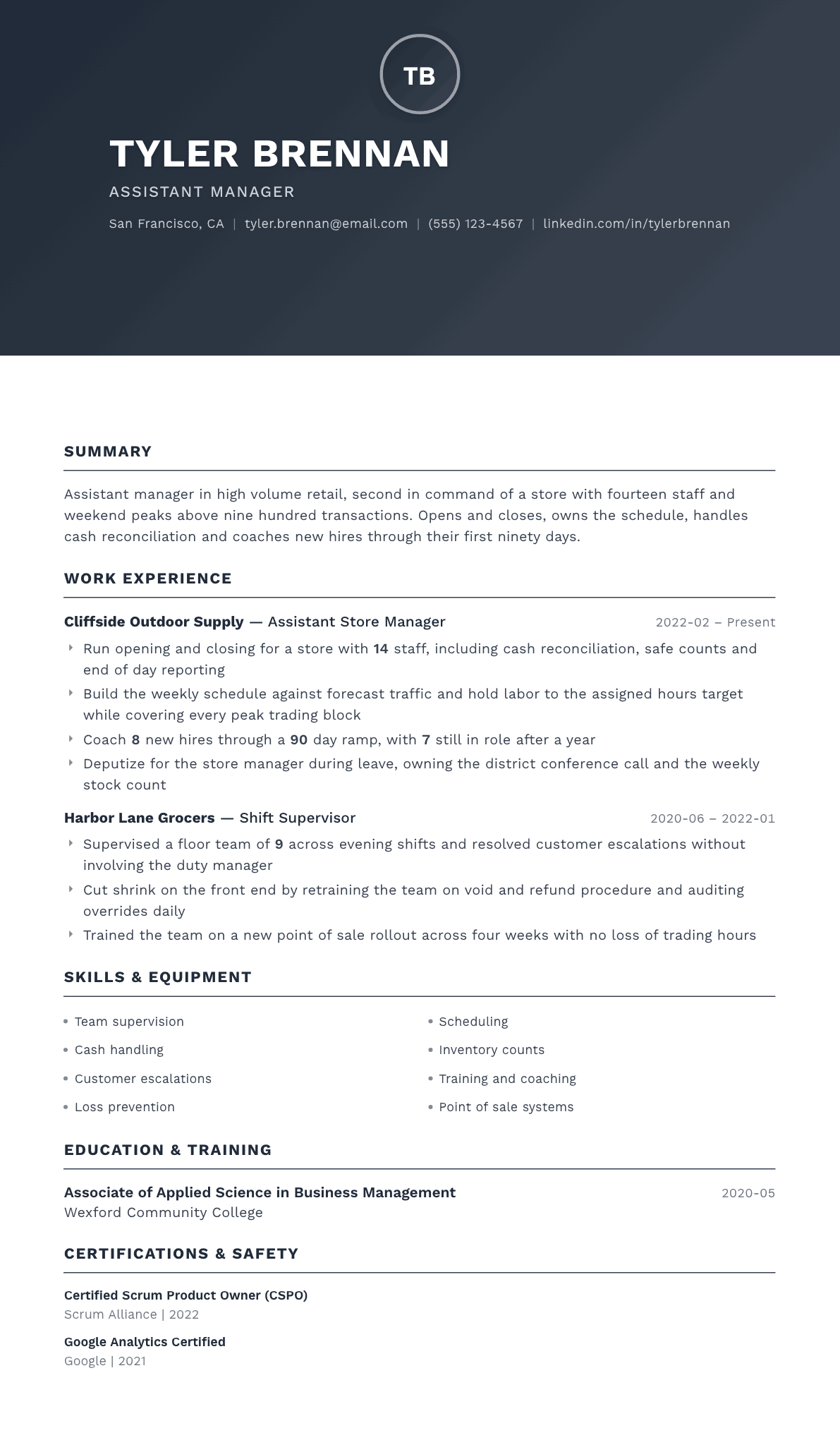
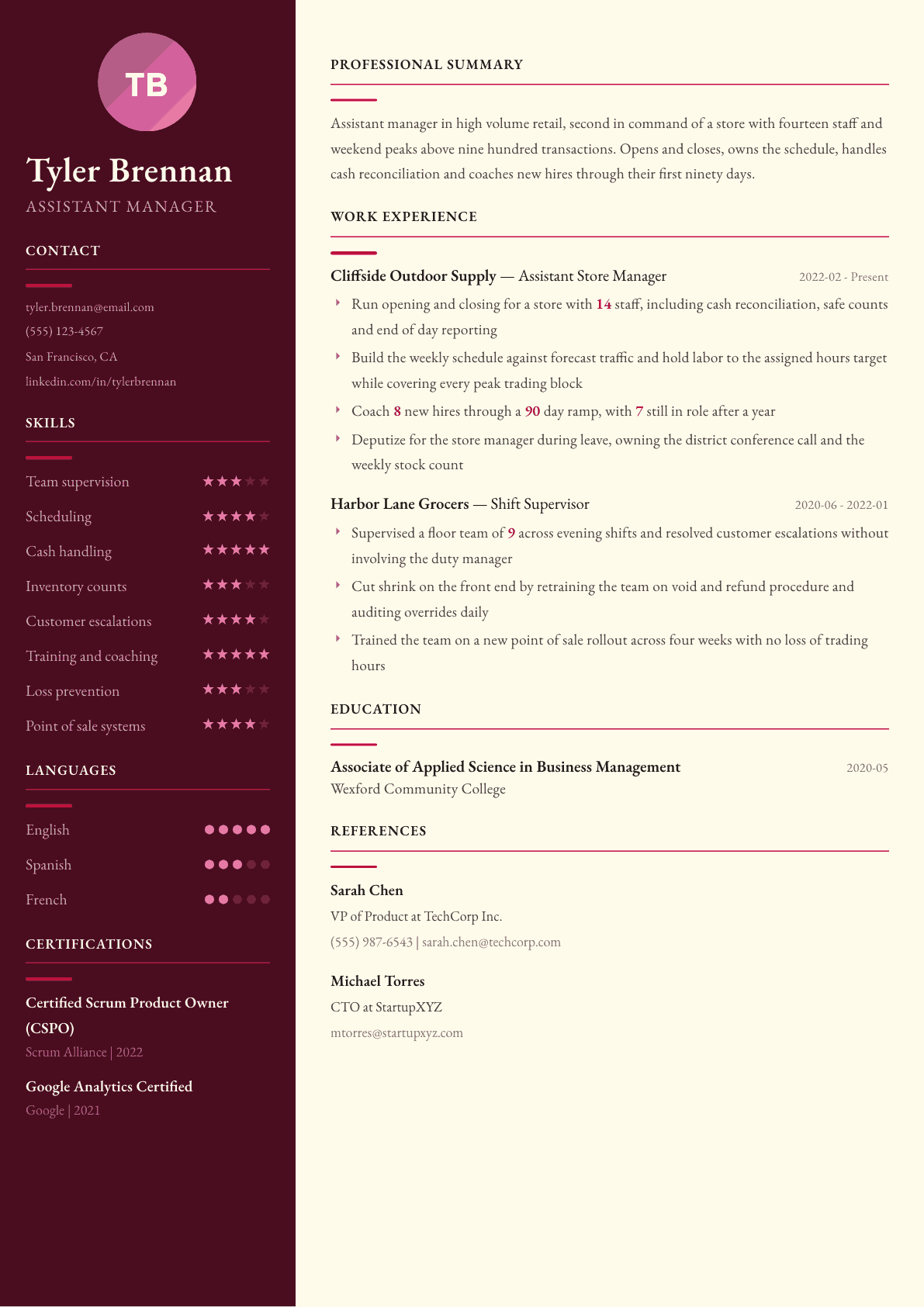
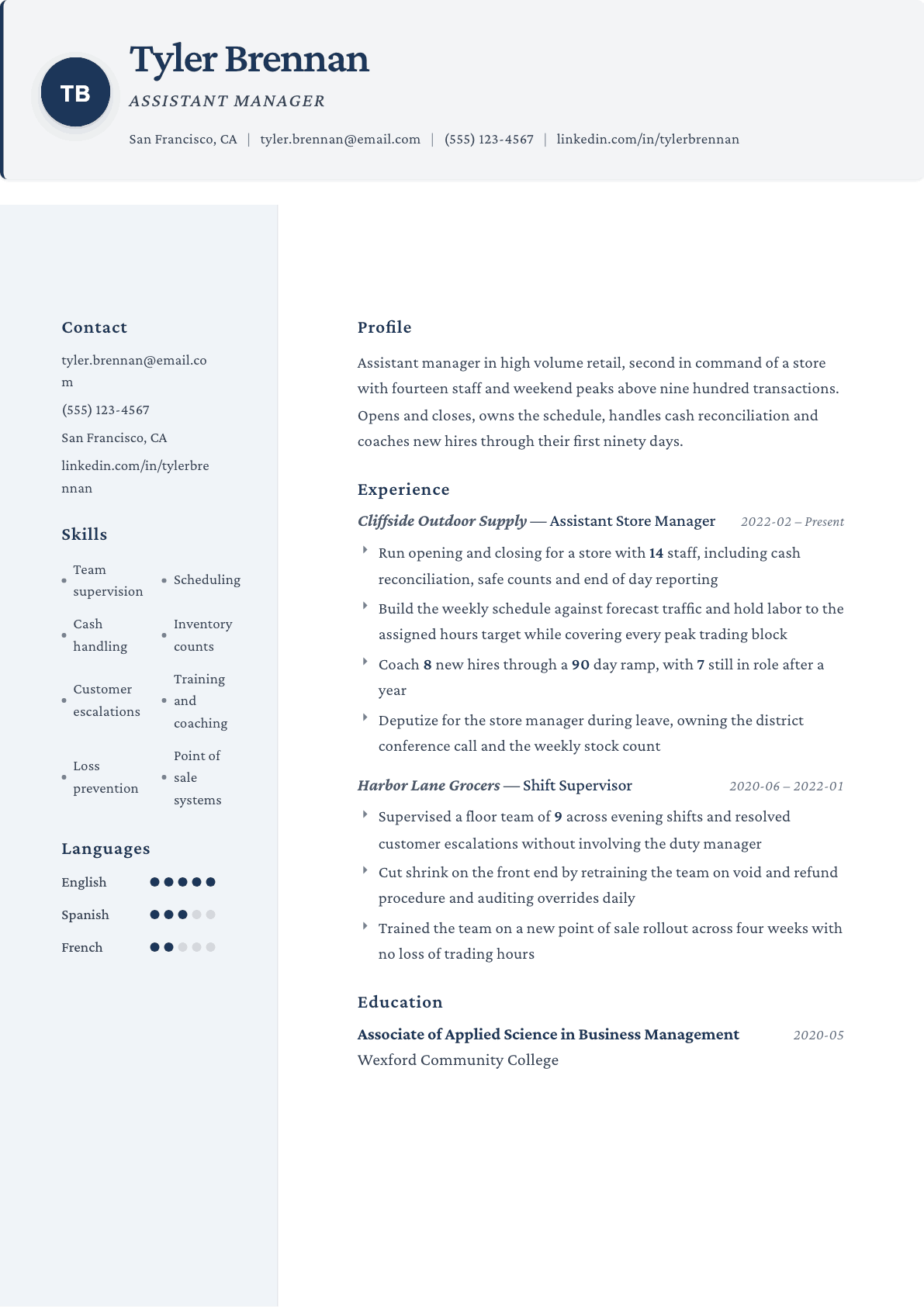
Example Assistant Manager summary
Assistant manager with four years as second in command of a fourteen person retail team, holding keys, banking and the weekly schedule. Runs the floor through peak trading, coaches new hires through their first ninety days, and covers the store manager during leave including district reporting. Ready to step into a store manager role with full accountability for sales, labor and shrink.
Skills to list on a Assistant Manager resume
- Team supervision
- Shift scheduling
- Labor hour control
- Cash reconciliation
- Inventory management
- Shrink reduction
- Customer escalation handling
- Staff training
- Merchandising standards
- Point of sale systems
- Health and safety compliance
- Opening and closing procedures
- Performance coaching
- Sales target tracking
What actually gets this resume read
- Lead with the responsibilities you hold alone, such as opening, closing, banking and covering the manager during leave.
- Give the store or site numbers: headcount supervised, weekly transactions, square footage or average weekly takings.
- Show coaching outcomes rather than coaching activity, for example how many new hires you ramped and how many stayed.
- Use the employer's own vocabulary for labor hours, shrink, conversion and basket size so the screen matches your file.
- Include one bullet on a rollout you delivered, since assistant managers are usually the ones who make change stick on the floor.
- Keep the resume to one page and put a promotion history under a single employer heading if you moved up internally.
How to write a assistant manager resume
The person reading an assistant manager resume is almost always a store or site manager who needs a deputy they can leave the keys with. They are not looking for potential. They are looking for evidence that you already carry the manager's duties on the days the manager is not there, and that nothing broke.
That is why the strongest assistant manager resumes are built around unsupervised responsibility. Opening and closing alone. Banking and safe counts. Building the schedule against a labor hours target. Running the district call while the manager is on leave. Those lines answer the only real question in the screen, which is whether you can be trusted with the site.
This guide covers how to structure the file, how to write floor level bullets that carry numbers, how to present an internal promotion history, which words retail and hospitality employers screen on, and what to do when you want the manager job rather than another deputy job.
Format: one page, promotions grouped under one employer
One page is right for almost every assistant manager. Site level hiring moves quickly and the manager reading your file is doing it between deliveries. Two pages only makes sense after eight or more years across several formats.
If you were promoted inside one company, group the roles under a single employer heading with the dates for each title beneath it. Splitting them into separate entries hides the promotion, which is the most persuasive thing on the page.
- Header: name, city and state, phone, email. No photo, and no full street address.
- Sections in this order: summary, key strengths, experience, education, certifications.
- Group internal promotions under one employer with a title and date line for each step.
Summary: what you hold alone, and the size of the site
Say what you are second in command of and how big it is: headcount, weekly transactions, weekly takings or square footage. Then name the responsibilities you hold without supervision. Keys, banking, the schedule, stock counts, and cover for the manager.
One line at the end should point where you are going. If you want a store manager role, say it. Deputies who never state the ambition tend to keep getting deputy offers, because the reader assumes the current level suits you.
Experience: labor, stock, service and people, with numbers
Site management runs on four levers and your bullets should touch all of them. Labor: building the schedule against forecast traffic and holding the hours target while still covering peak. Stock: counts, shrink, availability, ordering. Service: complaints resolved at your level rather than escalated, queue and wait times, mystery shop or customer satisfaction results. People: recruiting, ramping new hires, and how many stayed.
Give the numbers you actually have access to. Headcount supervised, transactions on a Saturday, number of new hires coached, shrink movement, hours variance against plan. If your employer used a scorecard, borrow its metric names, because the next employer probably uses similar ones.
Include a change you delivered on the floor. Assistant managers are usually the ones who make a new point of sale system, a new planogram or a new safety routine actually stick, and that is a management act rather than a task.
- Open the job with the site profile: headcount, trading pattern, and your reporting line.
- Cover all four levers: labor hours, stock and shrink, service, and people development.
- Name the systems you used for scheduling, point of sale and stock, since chains screen on them.
People development: the part most deputies leave out
Coaching is the difference between a supervisor and an assistant manager, and it is the easiest section to make concrete. Say how many new hires you took through their ramp, what the ramp involved, and how many were still in role a year later. Retention after coaching is a number the reader will believe because it is unusual for anyone to fabricate.
If you have run any part of a formal process, say so plainly: recruitment interviews, probation reviews, return to work conversations, or a first written warning under manager supervision. Employers promoting to store manager want to know you will not freeze the first time a formal conversation is needed.
Keywords retail and hospitality employers screen on
Postings repeat a narrow vocabulary: labor cost control, shrink, conversion rate, average transaction value, availability, compliance, opening and closing procedures, cash reconciliation, visual merchandising, health and safety. Use the employer's own version of each term once in the strengths block and once inside a bullet.
Keep the language grounded in the format you worked in. Grocery talks about waste and availability, fashion talks about conversion and units per transaction, hospitality talks about covers and speed of service. Matching the register signals you have worked that trading pattern rather than an adjacent one.
Assistant Manager resume summary examples
First deputy role
Shift supervisor with two years leading a nine person evening team, keyholder for opening and closing, and cover for cash reconciliation during manager absence. Retrained the front end on void and refund procedure, cutting till overrides by half. Seeking a first assistant manager position in specialty retail.
Established assistant manager
Assistant store manager for a fourteen person team with weekend peaks above nine hundred transactions. Owns the weekly schedule against the labor hours target, runs banking and end of day reporting, and coached eight new hires through a 90 day ramp with seven retained past a year.
Ready for store manager
Senior assistant manager covering a flagship site of twenty-two staff, deputizing for the store manager across district calls, stock takes and payroll sign off. Led a point of sale rollout with no lost trading hours and reduced shrink by 0.4 points through daily override audits. Targeting a store manager role.
Work experience bullets: before and after
Before: Opened and closed the store.
After: Ran opening and closing five days a week for a fourteen person site, including safe counts, banking, alarm setting and the end of day sales and cash report.
Listing the controlled tasks inside opening and closing shows unsupervised accountability rather than an unlocked door.
Before: Made the staff schedule each week.
After: Built the weekly schedule against forecast traffic and held total hours within the assigned labor target while fully covering every peak trading block.
The constraint, forecast traffic against a labor target, is the actual skill, and the bullet now shows both sides of it.
Before: Trained new employees.
After: Coached eight new hires through a structured 90 day ramp covering till, floor standards and stockroom, with seven still in role after twelve months.
A defined ramp plus a retention figure gives evidence of coaching quality instead of a training claim.
Before: Helped reduce losses in the store.
After: Cut front end shrink by retraining the team on refund and void procedure and auditing every manager override daily against the receipt journal.
Naming the loss source and the daily control shows a method a new employer can expect you to repeat.
Before: Covered for the manager when needed.
After: Deputized for the store manager across four weeks of leave, owning the district conference call, the weekly stock count and payroll sign off with no escalations.
Specifying what the cover included, and that nothing escalated, is what convinces a reader to hand over keys.
Hard skills
- Shift scheduling and labor hour control
- Cash reconciliation and banking
- Stock counts and inventory accuracy
- Shrink and loss prevention controls
- Point of sale system administration
- Visual merchandising standards
- Health and safety compliance
- Recruitment and induction
- Sales target and scorecard tracking
- Customer complaint resolution
- Opening and closing procedures
- Waste and markdown management
Soft skills
- Leading a shift under pressure
- Coaching on the floor
- De-escalating customers
- Delegation
- Reliability as a keyholder
- Handover discipline
Certifications worth listing
- ServSafe Food Protection Manager Certification (National Restaurant Association)
- Certified Manager (CM) (Institute of Certified Professional Managers)
- First Aid and CPR (American Red Cross)
- OSHA 10-Hour General Industry (OSHA Training Institute)
Mistakes that cost assistant manager candidates the interview
- Writing a duty list that any team member could claim, with no keys, banking or manager cover mentioned anywhere.
- Splitting an internal promotion into separate employer blocks so the progression disappears from the page.
- Leaving out the site size, which makes a twenty-two person flagship look identical to a four person kiosk.
- Talking about coaching without a single number for how many people you ramped or how many stayed.
- Ignoring the labor hours target, which is the constraint every site manager is judged on and asks about.
- Never stating that you want the manager job, which leaves the reader assuming you are content deputizing.
Assistant Manager resume questions
How do I show I am ready to be a store manager?
Lead with the manager duties you already perform alone: banking, scheduling to a labor target, stock takes, payroll sign off and district reporting during leave. Then close the summary by naming the store manager role as your target.
What numbers should an assistant manager put on a resume?
Headcount supervised, weekly transactions or covers, labor hours against target, shrink movement, new hires coached and retained, and complaint resolution at your level. Use whatever your employer measured, since the next one measures something similar.
Do I need a degree to be an assistant manager?
Usually not. Site level employers weigh keyholder responsibility, team size and trading results far above education. Include any qualification you hold, but build the file around unsupervised responsibility rather than around the education section.
How do I write the resume when moving between sectors?
Keep the four management levers and swap the vocabulary. Covers becomes transactions, waste becomes markdown, speed of service becomes queue time. Then add one bullet showing you learn a new format quickly, such as a system or brand rollout you led.
Should I list every product or brand I have sold?
No. Name the format and the trading pattern instead, such as high volume grocery or specialty outdoor retail, because that is what tells a hiring manager whether your experience transfers to their floor and their peak.
Related resume examples
- Store Manager Resume example
- Retail Manager Resume example
- Shift Manager Resume example
- Assistant Store Manager Resume example
- Management Trainee Resume example
- Small Business Owner Resume example