Regional Manager Resume Examples: the lines they read
Write a Regional Manager Resume That Shows Territory Results
By Mustafa Tarabya, founder of CVBooster · Published · Updated
A regional manager resume with territory size, store or branch counts, revenue and the leaders you built, plus a sample resume and a writing guide.
Sample resumes for a regional manager
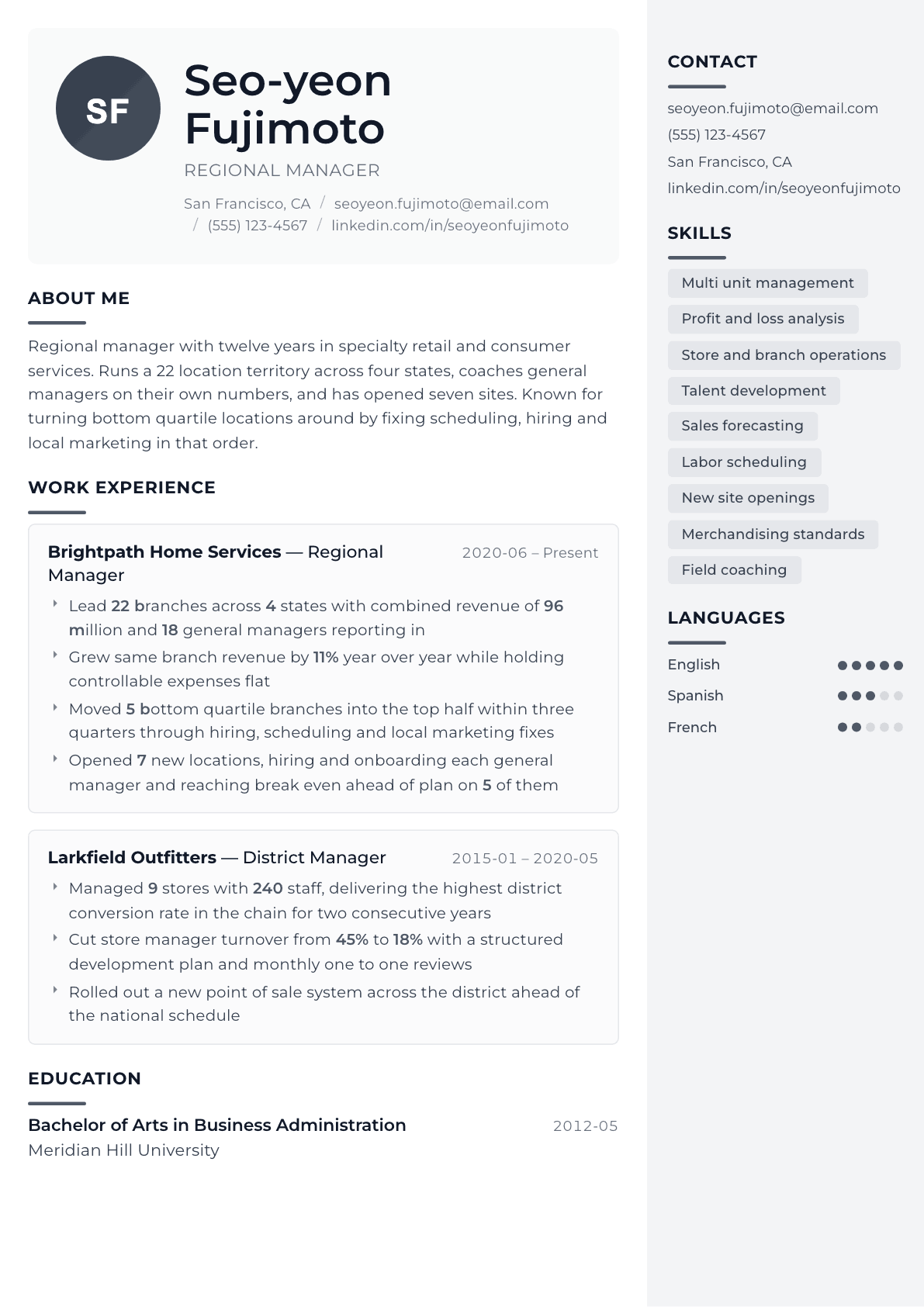
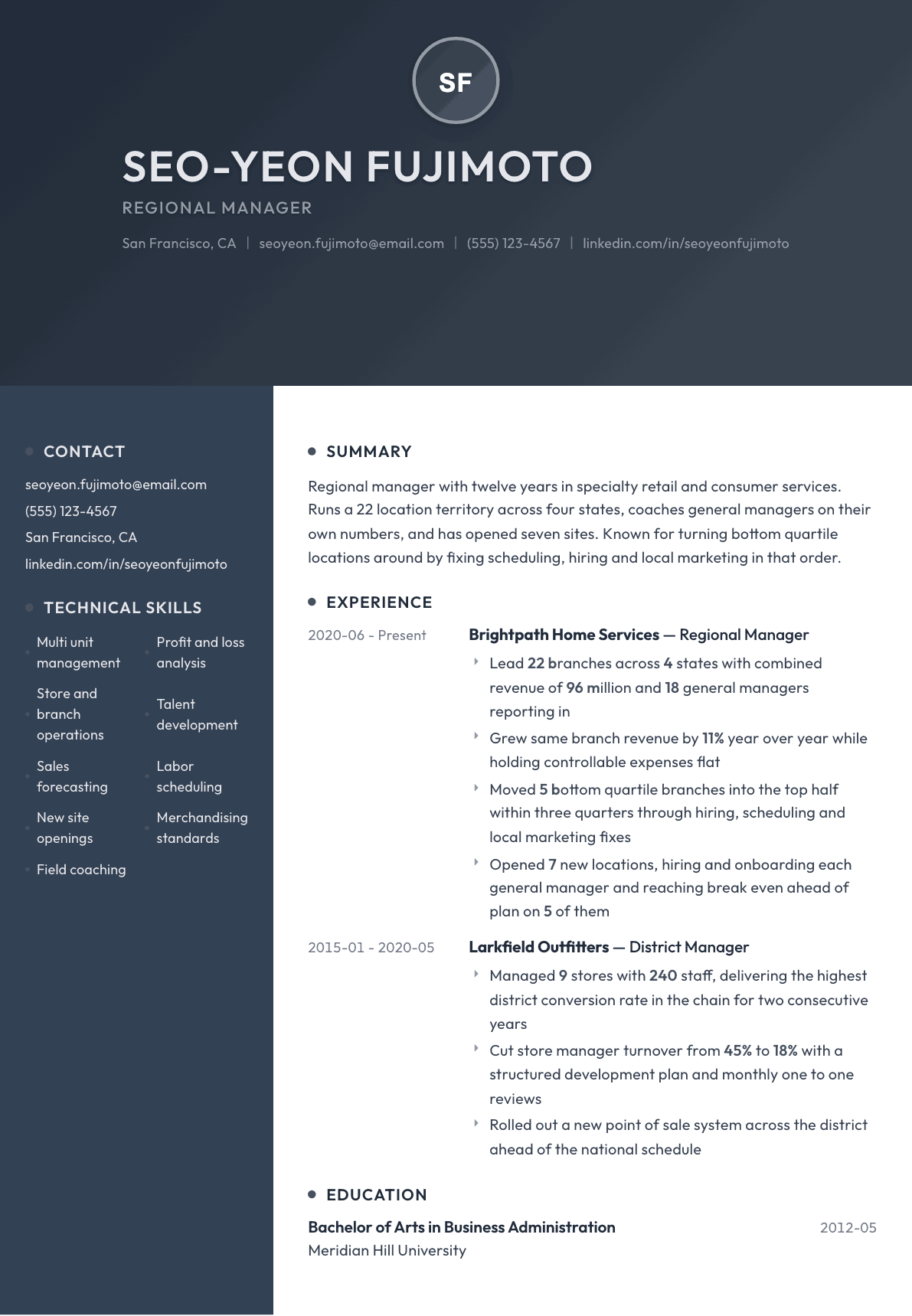
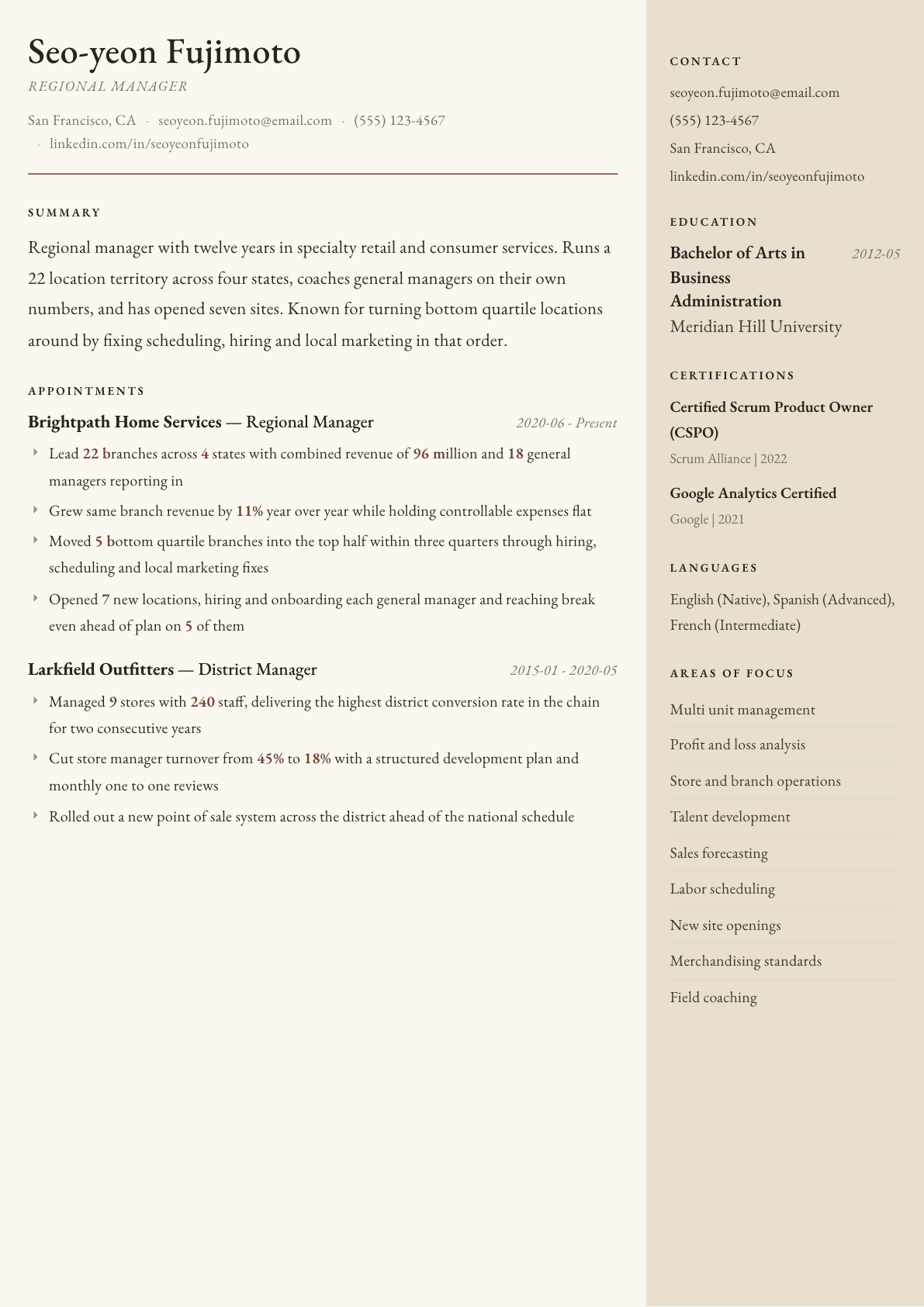
The same regional manager content laid out in three CVBooster templates, so you can see what the finished document looks like before you write a word.
Example Regional Manager summary
Regional manager with twelve years in specialty retail and consumer services, currently leading twenty-two locations across four states with eighteen general managers reporting in. Grew same branch revenue while holding controllable costs flat, moved five bottom quartile sites into the top half, and opened seven new locations with most reaching break even ahead of plan.
Skills to list on a Regional Manager resume
- Multi unit management
- Profit and loss analysis
- Same store sales growth
- Field coaching
- Talent development and succession
- Labor scheduling and payroll control
- New location openings
- Sales forecasting
- Inventory control
- Customer experience standards
- Loss prevention
- Merchandising execution
- Territory planning
- Performance management
What actually gets this resume read
- State the territory in the first line of each role: how many locations, how many states, how much revenue and how many direct reports.
- Show turnaround work explicitly, because most regional manager openings exist to fix underperforming locations.
- Report same store or same branch growth rather than total revenue, since that is the number a field leader is measured on.
- Count the location leaders you hired, developed and promoted, as building a bench is half of the job.
- Include new site openings with the ramp result, which separates an operator from a caretaker of existing locations.
- Mention the travel pattern and geography you covered, because employers screen for willingness to run a dispersed territory.
How to write a regional manager resume
A regional manager resume is judged on territory and turnaround. The reader wants to know how many locations you carried, over what geography, with how much revenue, and what happened to the underperforming ones while you had them. Most multi unit openings exist because a territory is not performing, so a page describing steady state supervision loses to a page describing repair.
The other thing a field leader looks for is whether you develop location managers or babysit them. A regional manager who visits stores and reviews numbers is doing the visible half of the job. The half that keeps a territory healthy is hiring general managers who can run without weekly rescue, and that shows up in retention and promotion numbers.
This guide covers how to state territory scope, which field measures belong on the page, three example summaries from district manager upward, before and after bullets, and the questions candidates ask when moving between retail, restaurants and service businesses.
Format: territory line first, then the results
Two pages once you have carried a district and a region, one page earlier than that. Reverse chronological, single column, no graphics, because field applications frequently pass through screening software before a district director sees the file.
Under each employer, open with a territory line: number of locations, states or metro areas, combined revenue, number of direct reports and the level they sit at. That single line does more for a field application than any summary paragraph.
- Header: name, home base city, phone, email, and travel availability if the territory is dispersed.
- Sections: summary, territory scope, professional experience, awards, education.
- Territory line: locations, geography, revenue, direct reports, reporting line.
The measures a field organization runs on
Use same store or same branch performance rather than total revenue, because a territory can grow simply by adding locations. Comparable growth is the number a field leader is actually measured on and the one an interviewer will ask about first.
Then pick from the rest of the field scorecard: controllable expense, labor as a share of revenue, conversion rate, average transaction, customer satisfaction or complaint volume, inventory shrink, and location level profitability. Two or three of these with real movement beat a full dashboard.
Where you have a ranking, use it. Highest conversion rate in the chain for two consecutive years is a comparative fact a hiring manager can trust more easily than a percentage without context.
Turnarounds and new openings
Give underperforming locations their own bullets. Say how many were in the bottom quartile, how long the recovery took, and what you actually changed. In field operations the sequence usually matters: hiring or replacing the manager, fixing the schedule, then local marketing. A reader who has done this work recognizes the sequence and trusts you more for showing it.
New openings are the other differentiator. Say how many you opened, what you owned in the process, whether you hired the general manager yourself, and whether the site reached break even ahead of or behind plan. Opening experience separates an operator from a caretaker of an existing estate.
Building the bench
Count the location leaders you hired, developed and promoted, and give the manager turnover figure before and after. A territory with stable general managers costs less and performs better, and that is the argument you are making.
Describe the routine you used, because field leadership is a rhythm: a structured visit format, a monthly one to one against a written development plan, a peer group for new managers. Naming the routine shows how the results were produced rather than asserting that you coached your team.
Keywords and the geography question
Recurring phrases in multi unit postings are multi unit management, district manager, same store sales, profit and loss, field operations, labor scheduling, inventory control, loss prevention, customer experience, talent development and new store openings. Use the posting wording once where the work is shown.
State the geography and travel honestly near the top. Employers screen hard on whether a candidate can run a dispersed territory, and a resume that hides the question invites a rejection that a single clear line would have prevented.
Regional Manager resume summary examples
District manager
District manager with 5 years in specialty retail, running 9 stores and 240 staff. Delivered the highest district conversion rate in the chain for two consecutive years, cut store manager turnover from 45% to 18%, and rolled out a new point of sale system ahead of the national schedule.
Running a region
Regional manager with 12 years in specialty retail and consumer services, leading 22 branches across 4 states with combined revenue of 96 million and 18 general managers reporting in. Grew same branch revenue by 11% while holding controllable expenses flat, and opened 7 new locations.
Multi region leader
Divisional leader with 18 years in multi unit operations, responsible for 60 locations across two regions and 4 regional managers. Rebuilt the field visit and review structure used across the division, standardized manager onboarding, and returned a division that had missed plan for two years to growth.
Work experience bullets: before and after
Before: Managed multiple locations in the region.
After: Lead 22 branches across 4 states with combined revenue of 96 million and 18 general managers reporting in, covering the territory on a four week visit cycle.
Location count, geography, revenue, reports and the visit rhythm establish territory scope that a general statement leaves invisible.
Before: Increased sales across the region.
After: Grew same branch revenue by 11% year over year while holding controllable expenses flat, so the growth converted to location level profit rather than added cost.
Comparable growth with a cost constraint is the field measure that matters, and the phrasing shows you understand the difference.
Before: Turned around underperforming stores.
After: Moved 5 bottom quartile branches into the top half within three quarters by replacing two general managers, rebuilding weekly schedules against demand and funding targeted local marketing.
Naming the count, the timeframe and the three levers in sequence shows a repeatable method rather than a lucky recovery.
Before: Helped open new locations.
After: Opened 7 new locations, personally hiring and onboarding each general manager, with 5 reaching break even ahead of the plan set at approval.
Opening count, the hiring ownership and the ramp result prove you led the openings instead of supporting someone else who did.
Before: Developed and coached store managers.
After: Cut store manager turnover from 45% to 18% using a written development plan for each manager, monthly one to one reviews and a peer group for anyone in their first year.
A retention figure with the routine that produced it converts coaching from a claim into a system a new employer could copy.
Hard skills
- Multi unit operations management
- Profit and loss analysis
- Same store sales growth
- Labor scheduling and payroll control
- Sales forecasting
- Inventory control and shrink reduction
- New location openings
- Merchandising and brand standards execution
- Loss prevention
- Customer experience programs
- Territory and route planning
- Performance management
Soft skills
- Field coaching
- Hiring judgment
- Remote leadership
- Difficult conversations
- Prioritization across locations
Certifications worth listing
- Certified Professional in Talent Development (CPTD) (Association for Talent Development)
- Certified Professional (SHRM-CP) (Society for Human Resource Management)
- ServSafe Food Protection Manager (National Restaurant Association)
- Project Management Professional (PMP) (Project Management Institute)
Mistakes that cost regional manager candidates the interview
- Reporting total territory revenue instead of comparable growth, which hides whether the locations you had actually improved.
- Leaving out the geography and travel pattern, when employers screen hard for the ability to run a dispersed territory.
- Describing visits and reviews as achievements rather than the routine behind a measurable retention or sales result.
- Skipping turnaround work, when repairing underperforming locations is usually the reason the position exists.
- Never mentioning manager retention or promotions, so the reader cannot tell whether you build a bench or rely on one.
- Using the same resume for retail, restaurants and services without adjusting the measures each field organization tracks.
Regional Manager resume questions
What is the difference between a district manager and a regional manager resume?
Scale and layer. A district resume shows locations and their managers. A regional resume shows a larger territory, often multiple states, and increasingly leaders who themselves supervise others, along with responsibility for openings and territory planning.
Which sales figure should I use?
Comparable growth for locations you held through the full period, since total revenue can rise simply because sites were added. If you must quote total revenue, use it to describe territory size rather than as evidence of performance.
How do I show turnaround experience?
Give the number of underperforming locations, where they ranked before, how long recovery took, and the specific levers you pulled in order. Hiring managers recognize a credible sequence and treat it as evidence of a repeatable method.
Should I list awards from my company?
Yes, when the award is comparative and named, such as a district ranked first in the chain for a stated measure. Internal awards with no explanation carry little weight, so add one clause saying what was measured.
Can I move from retail to restaurants or field services?
Frequently yes, because labor scheduling, manager development, profit and loss control and standards execution transfer across formats. Rewrite the measures in the target sector language and be explicit about the operational differences you would be learning.
Related resume examples
- Operations Manager Resume example
- General Manager Resume example
- Branch Manager Resume example
- Operations Director Resume example
- Franchise Manager Resume example
- Assistant Manager Resume example