Operations Manager Resume Examples: the lines they read
Operations Manager Resume Format and Examples That Show Impact
By Mustafa Tarabya, founder of CVBooster · Published · Updated
Operations resume example, operation manager resume format and a management sample: specialist to manager entries, metric families and keywords.
Sample resumes for a operations manager
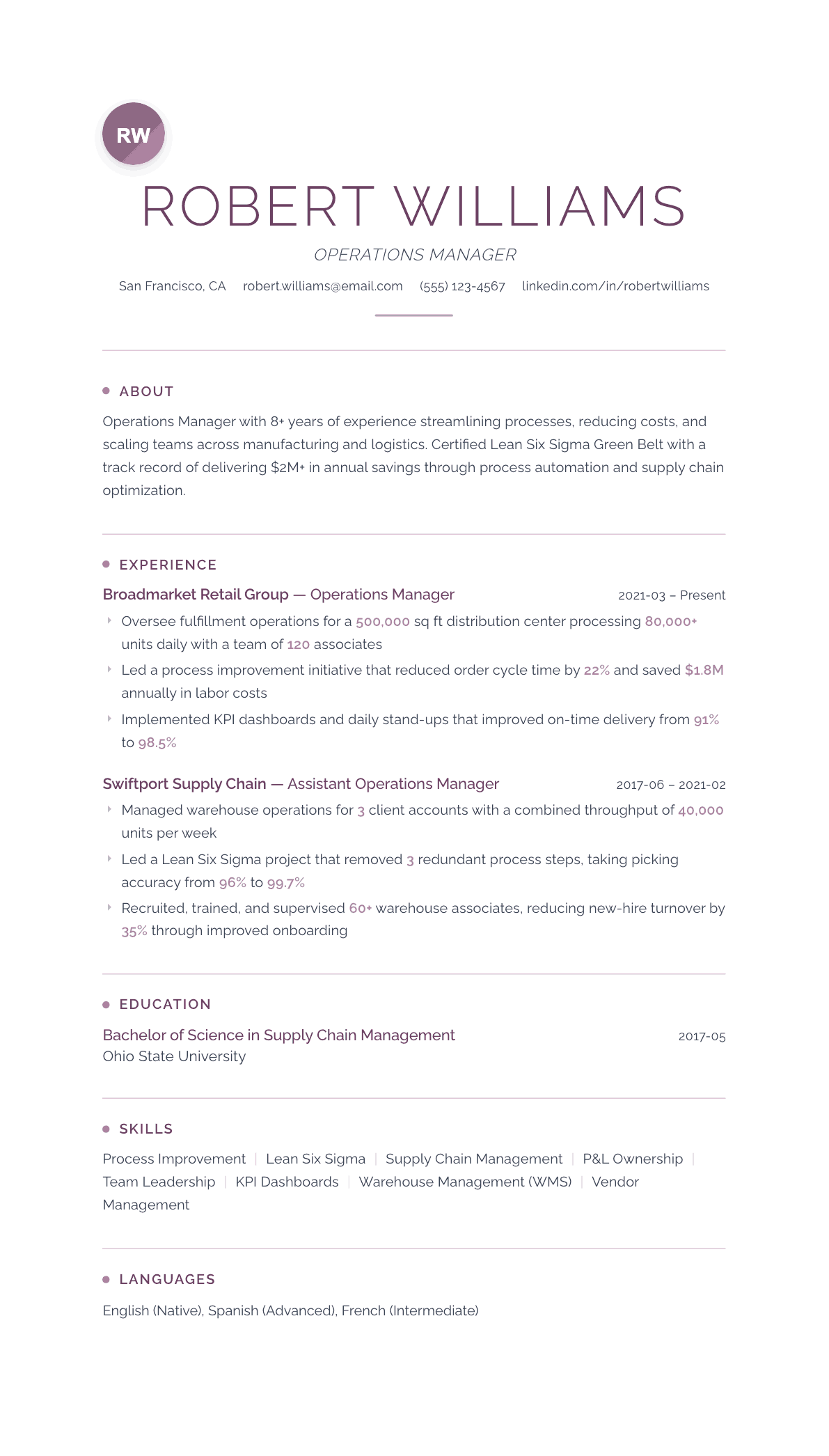
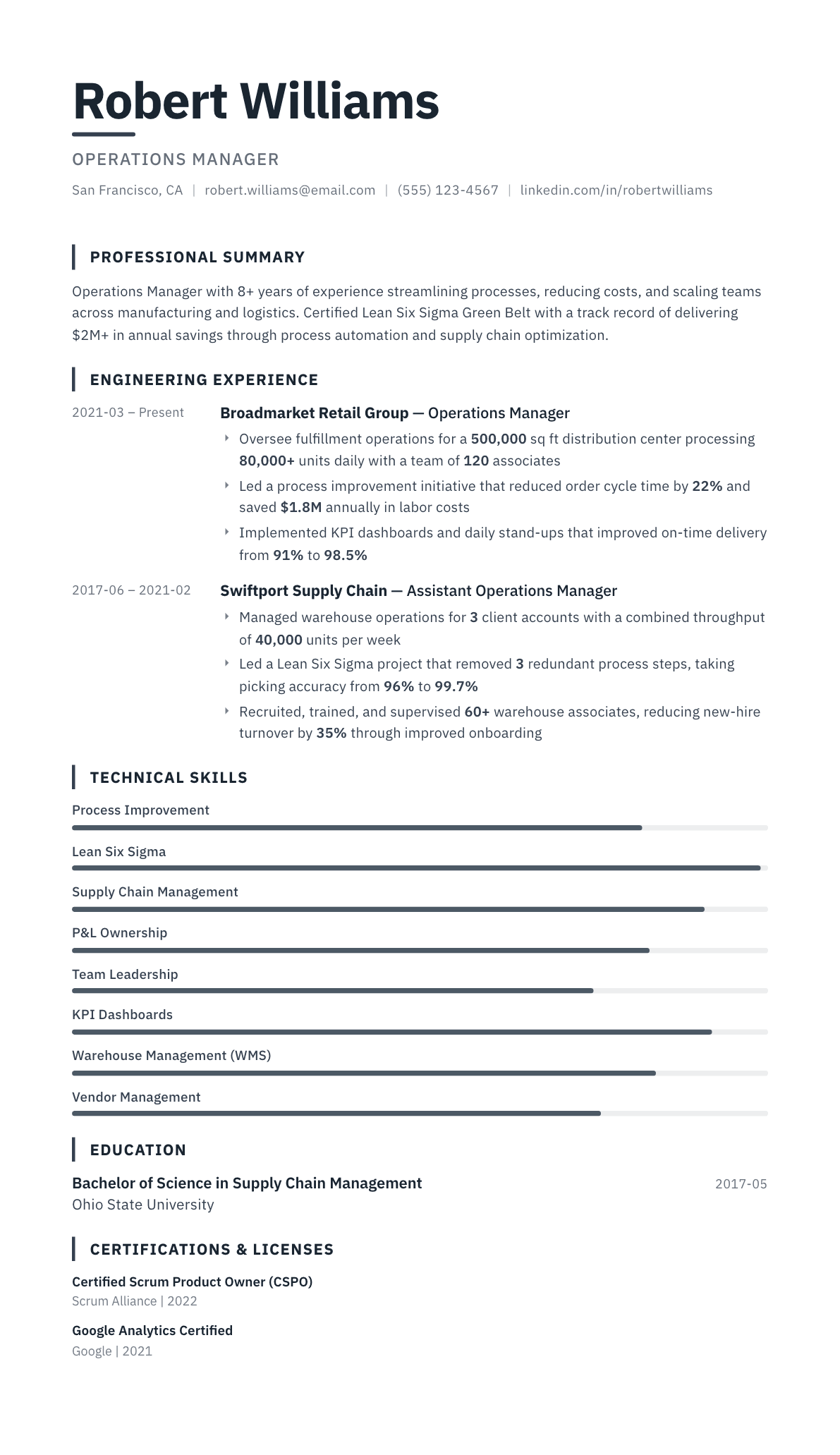
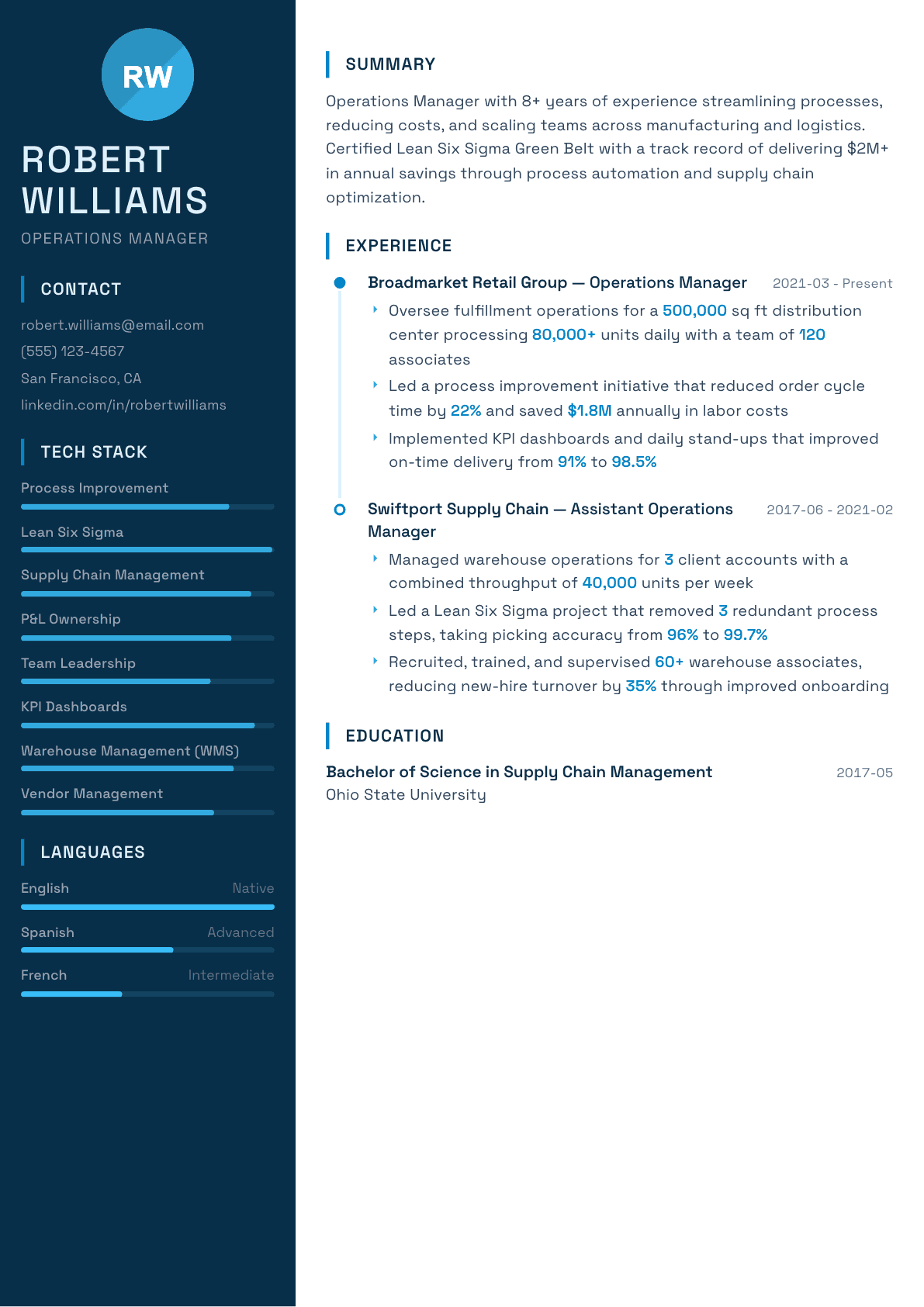
The same operations manager content laid out in three CVBooster templates, so you can see what the finished document looks like before you write a word.
Example Operations Manager summary
Operations manager, 8 years in fulfillment and logistics, currently a 500,000 square foot distribution center moving 80,000 units a day with 120 associates. Cut order cycle time 22% and $1.8M of annual labor cost, took on-time delivery from 91% to 98.5%, and holds a Lean Six Sigma Green Belt used on picking accuracy and process waste.
Skills to list on a Operations Manager resume
- Process Improvement
- Lean Six Sigma
- Supply Chain Management
- P&L Ownership
- Team Leadership
- KPI Dashboards & Reporting
- Warehouse Management (WMS)
- ERP Systems (SAP / Oracle)
- Vendor & Supplier Management
- Budget Planning & Forecasting
- Health & Safety (OSHA)
- Change Management
What actually gets this resume read
- Quantify operational improvements: cycle time reductions, cost savings, throughput increases, or error rate decreases.
- Highlight Lean Six Sigma, Kaizen, or other process improvement certifications and specific projects you led.
- Include P&L responsibility with dollar amounts to show financial acumen alongside operational expertise.
- Showcase technology and tools: WMS, ERP systems (SAP, Oracle), BI dashboards, or automation platforms.
- Demonstrate leadership scope: team sizes, number of facilities, geographic regions, or cross-functional departments managed.
- Mention compliance and safety: OSHA compliance, incident rate improvements, or quality certifications (ISO 9001).
How to write a operations manager resume
The person hiring an operations manager is usually a director or a general manager who is short handed and needs a site to run without them in it. They read your resume for span of control, for the systems you have run the site on, and for whether you have owned a budget rather than reported into one. Everything else is secondary.
The commonest failure in this field is a resume written from the job description you were given rather than from the operation you ran. Oversaw daily operations, managed a team and ensured efficiency appear on almost every operations manager file in the stack, and none of them tell the reader whether you ran a nine person office or three shifts of 200 associates across two buildings. Postings use operations manager, operational manager and ops manager for the same job, so put the exact title from the posting in your headline and let the scope lines do the rest.
This guide sets out the header block that answers the scope question immediately, an operations management resume sample of the top half page, how to write about safety, cost and service without turning the page into a dashboard, summaries for a first time supervisor, an established site manager and a multi site leader, and the questions operations managers ask when they are moving industries.
Operations resume example and operations management resume sample
An operations resume example looks different at each level, so three short entries follow. The operations specialist owns one process, the coordinator keeps several teams moving, and the manager owns the site and its numbers. Pick the one closest to the advert and copy its shape.
Operations specialist summary: Operations specialist with three years running order processing for an online retailer, owning the daily exception queue and the carrier claims process in NetSuite.
Operations coordinator summary: Operations coordinator at a regional logistics company, scheduling drivers and warehouse shifts for two depots and keeping the daily performance report.
Operations manager summary: Operations manager for a distribution center of one hundred and twenty staff over three shifts, accountable for safety, on time dispatch, labor cost and inventory accuracy. The manager entry for this sample reads as the bullets below.
An operations management resume is decided on its first half page, so this sample shows only that part, written for an operations manager running one distribution site. The order holds for manufacturing, logistics, healthcare and service operations. The nouns change, the order does not.
Below the top half, each role opens with its scope line, then four to six bullets drawn from the four metric families, then one line on the change you led. Older roles shrink to the scope line and two bullets.
- Run a distribution center of one hundred and twenty staff across three shifts, through four shift supervisors.
- Raised on time dispatch from the low nineties to above ninety eight in a year by rebuilding the pick waves.
- Own the site labor budget and cut overtime by moving to a demand based shift plan.
- Led the move to a new warehouse management system with no lost dispatch days.
- Chair the weekly safety walk and closed every open action from the last audit.
- Header: name, city, phone, email, LinkedIn, and the target title exactly as the posting writes it.
- Headline: Operations Manager, multi shift distribution and fulfillment.
- Summary: Operations manager with eight years in distribution, running a three shift site with 140 associates and five supervisors. Owns the site budget, the safety program and service levels to retail customers, and led the move from paper picking to a warehouse management system.
- Scope line under the current role: site size, shifts, headcount, direct reports, budget ownership and the customers or product lines served.
- Core skills line: the systems you run the site on, such as the WMS, ERP and labor management tools, plus Lean or Six Sigma training if you have actually used it on the floor.
Operation manager resume format: scope in the first six lines
Reverse chronological, one page under ten years, two pages after. Under each job title put a scope line before any bullets: the facility type, the headcount you were accountable for including indirect reports, the shift pattern, the annual operating budget you controlled expressed as a level rather than an exact figure, and the volume the site moved. A hiring director can then rank you against the other files in under ten seconds, which is the entire purpose of the first read.
The best operation manager resume format is reverse chronological with the sections in this order: header, headline, summary, a core skills line, experience, systems, certifications, education. A combination format with a skills block on top only helps when you are moving in from a different function, such as a supply chain analyst or a military logistics officer, and even then the experience section stays in date order.
Keep the layout plain. Distribution, manufacturing and healthcare employers push resumes through applicant tracking systems that mangle two column layouts and drop text sitting inside a header or footer, so keep your contact details in the body of the document.
- Scope line: facility type, headcount and reporting depth, shifts, budget level, throughput.
- Systems line: the enterprise resource planning system, the warehouse or manufacturing system, the labor management tool, the reporting stack.
- Bullets: three to five per role, each anchored to a metric the business already reported.
- A short section for safety and compliance results if you carry a regulated environment.
The four metric families that carry the resume
Operations leadership is judged on safety, quality, delivery and cost, in that order, and a strong resume touches all four. Safety means recordable incident rate, near miss reporting and audit outcomes. Quality means error rate, damage, rework or complaint volume. Delivery means on time performance, fill rate, cycle time and backlog. Cost means cost per unit, cost per case, labor as a share of the operating budget, and overtime.
Pick the two your target employer cares about most and lead with them. A parcel or fulfillment operation reads delivery and cost first. A regulated manufacturer or a healthcare operation reads safety and quality first. A resume that leads with cost savings for a hospital sterile processing role has misread the room.
People: the part most operations resumes underweight
The hardest part of running a site is staffing it. Write the numbers that prove you can: headcount hired in a peak ramp, turnover before and after you changed the onboarding, absenteeism, supervisors you promoted, and how you covered an unplanned absence rate. Employers running high turnover operations screen specifically for that experience because it is what breaks their sites.
If you have managed under a collective bargaining agreement, say so and name the kind of contract environment rather than the union. Grievance handling, shift bidding and stewards are a distinct skill set and an employer with a represented workforce will not hire someone who has never worked in one.
Systems, projects and the change you led
Name the systems you have actually operated in: the enterprise resource planning suite, the warehouse management system, the labor management system, the transport system, the maintenance system, and the tool you build reports in. Then attach at least one bullet to a system change you led: a go live, a module rollout, a cutover weekend, a barcode or scanning deployment. Implementations are where operations managers prove they can run a site and a project at the same time.
Continuous improvement belongs here too, but only with the result. A Green Belt project that removed a duplicate scan step and returned labor hours a week is worth more than a paragraph on your improvement philosophy.
Keywords the postings repeat
Operations manager postings recycle a short list: process improvement, standard operating procedures, key performance indicators, budget and forecast, capacity planning, vendor management, inventory accuracy, health and safety compliance, workforce scheduling and continuous improvement. Mirror each once in a scope line, a bullet or the skills block.
Add the sector vocabulary too. Fulfillment postings say units per hour, dock to stock and cycle count. Manufacturing postings say schedule adherence, downtime and first pass yield. Facilities and services postings say service level agreement, uptime and preventive maintenance. Using the employer vocabulary is the cheapest relevance signal available.
Operations Manager resume summary examples
Newly promoted supervisor
Operations supervisor with three years in a regional distribution center, running an inbound shift of 28 associates across receiving and putaway. Improved dock to stock from 26 hours to 14 by resequencing trailer unload, and completed a Green Belt project on cycle count accuracy.
Site operations manager
Operations manager running a two shift fulfillment site of 190 associates and six supervisors with full accountability for labor budget, safety and service. Held on time dispatch above 98% through two peak seasons and cut recordable incidents by half after rebuilding the onboarding and floor coaching routine.
Multi site operations leader
Multi site operations leader with twelve years across manufacturing and distribution, currently accountable for three facilities, 540 employees and a represented workforce. Led an enterprise system cutover across all three sites with no missed customer shipments and promoted five supervisors into site manager roles.
Work experience bullets: before and after
Before: Managed daily operations of the warehouse.
After: Ran two shifts across receiving, pick, pack and dispatch in a 190 associate fulfillment site, owning the daily labor plan, the dispatch cutoff and the escalation path to the transport carrier.
The reader learns the functions, the headcount and the decisions you personally held rather than a title restatement.
Before: Reduced costs through process improvements.
After: Removed a duplicate scan at putaway after a four week time study, returning 62 labor hours a week and cutting cost per unit by 9% without reducing headcount.
Naming the method, the hours recovered and the constraint you respected makes the saving verifiable.
Before: Improved safety on site.
After: Cut recordable incidents from eleven to four in a year by moving pallet jack traffic off the pick aisles, introducing a daily pre shift safety brief and coaching supervisors to close near miss reports within 48 hours.
Safety claims need the mechanism, because a number alone reads as luck or reclassification.
Before: Responsible for hiring and training staff.
After: Hired and onboarded 85 seasonal associates over a nine week peak ramp, rebuilt the four day training plan around scan accuracy, and held 90 day retention at 78% against a prior year figure of 54%.
Ramp size, training design and a before and after retention figure prove you can staff a site, not just fill shifts.
Before: Involved in the implementation of a new WMS.
After: Led the site side of a warehouse management system cutover, running four weekend test cycles, training 12 supervisors as floor superusers, and going live over a weekend with no missed customer orders.
The specifics show project ownership and the outcome the business actually cared about during the go live.
Hard skills
- Workforce scheduling and labor planning
- Budget ownership and variance analysis
- Standard operating procedure design
- Inventory accuracy and cycle counting
- Capacity and throughput planning
- Warehouse management systems
- Enterprise resource planning systems
- Lean and continuous improvement
- Vendor and carrier management
- Health and safety compliance
- Root cause analysis
- Power BI and Excel reporting
Soft skills
- Frontline coaching
- Conflict handling on the floor
- Decision making under peak pressure
- Cross shift handover discipline
- Holding suppliers to commitments
Certifications worth listing
- Certified in Planning and Inventory Management (CPIM) (Association for Supply Chain Management)
- Certified Supply Chain Professional (CSCP) (Association for Supply Chain Management)
- Certified Six Sigma Green Belt (CSSGB) (American Society for Quality)
- OSHA 30-Hour General Industry (OSHA Outreach Training Program)
- Project Management Professional (PMP) (Project Management Institute)
Mistakes that cost operations manager candidates the interview
- Leaving out headcount and budget level, which forces a hiring director to assume the smallest possible scope.
- Filling bullets with duties from the job description instead of the results the site posted while you ran it.
- Leading with cost savings when the target employer is a regulated site that screens on safety and quality first.
- Ignoring hiring, turnover and absenteeism, the numbers that actually break an operation.
- Listing systems you have only seen reports from rather than systems you have configured, queried or gone live on.
- Using a two column template with icons that applicant tracking systems reorder and strip.
- Claiming an improvement with no measurement window, so the reader cannot separate a real gain from a good month.
Operations Manager resume questions
How do I show scope on an ops manager resume if my sites were small?
Give the real numbers and add the breadth instead. A small site manager often owns more functions personally: receiving, inventory, maintenance, hiring, safety and the customer relationship. List those functions explicitly, because breadth of ownership is a genuine selling point against a narrow role at a large site.
What format and sections should an operations resume use?
Reverse chronological in a single column, one page under ten years and two after. Open with a summary that states your level and scope, then bullets from the four metric families: safety, quality, delivery and cost. Add the systems you run, such as an ERP or a warehouse management system, and the people you lead. A skills section helps if it names tools; the three entries above show the shape at each level.
How do I switch industries as an operations manager?
Lead with the parts of operations that travel: labor planning, safety systems, budget control, throughput analysis and supervisor development. Then translate your metrics into the target industry vocabulary, and name any exposure you already have to their regulatory environment or their customer service commitments.
Do I need Lean or Six Sigma certification for operations management roles?
It is not required everywhere, but a Green Belt with a real project behind it is a common screening preference in manufacturing and distribution. If you have run improvement work without the certificate, describe the projects and the method used, which counts for more than the badge alone.
How far back should an operations manager resume go?
Detail the last ten to twelve years fully and compress everything older into a short earlier career line with titles, employers and dates. Keep an older role in full only when it holds something the target employer wants and your recent work does not, such as a plant startup or a union environment.
Related resume examples
- Store Manager Resume example
- Project Manager Resume example
- Office Manager Resume example
- VP Operations Resume example
- Operations Consultant Resume example
- Business Manager Resume example