Fraud Investigator Resume Examples: the lines they read
Write a Fraud Investigator Resume That Survives the Case File
By Mustafa Tarabya, founder of CVBooster · Published · Updated
Fraud investigator resume example, keyword list and writing guide covering case volumes, recovery, SAR filings, interviews and referral outcomes.
Sample resumes for a fraud investigator
The same fraud investigator content laid out in three CVBooster templates, so you can see what the finished document looks like before you write a word.
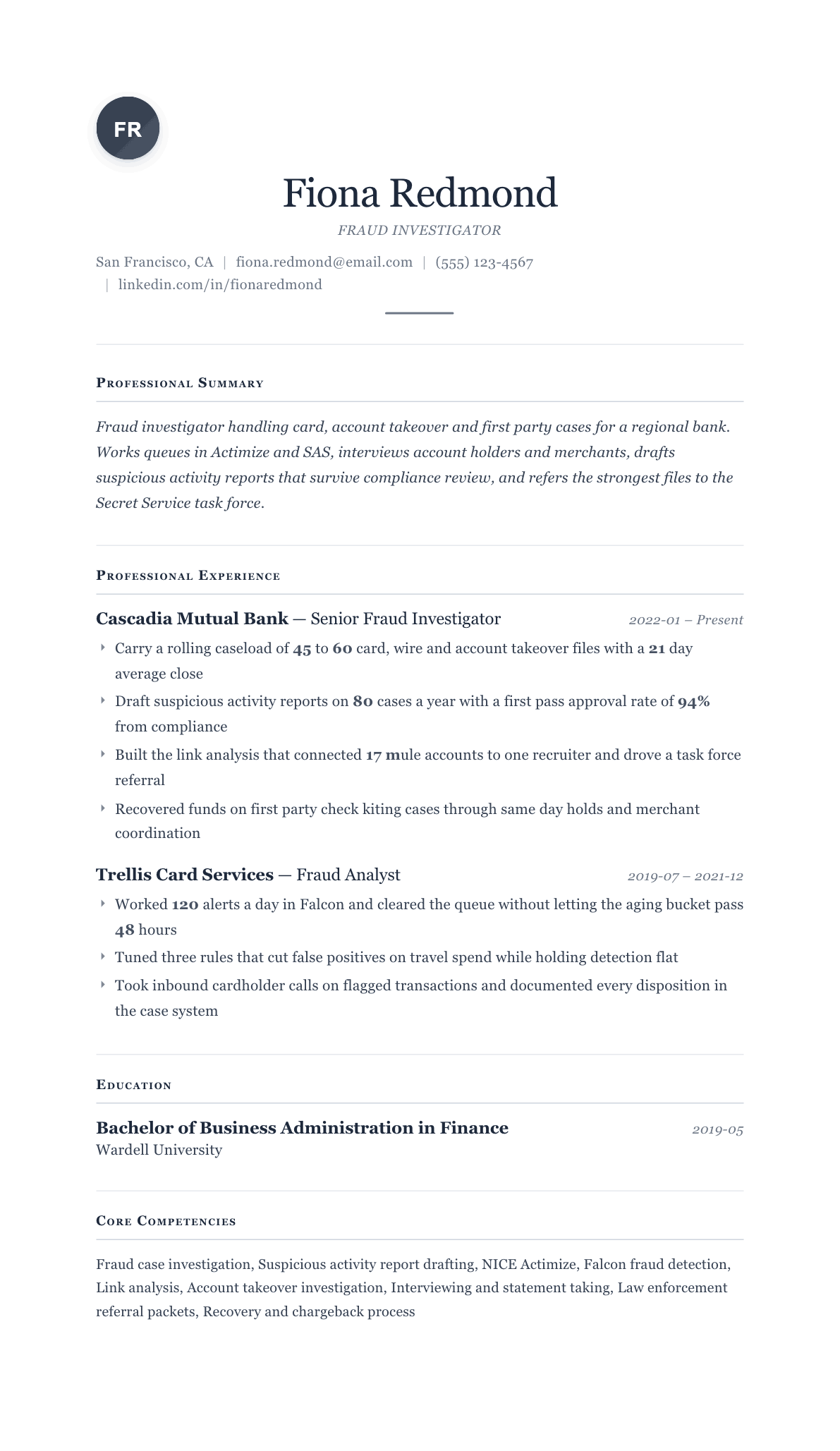
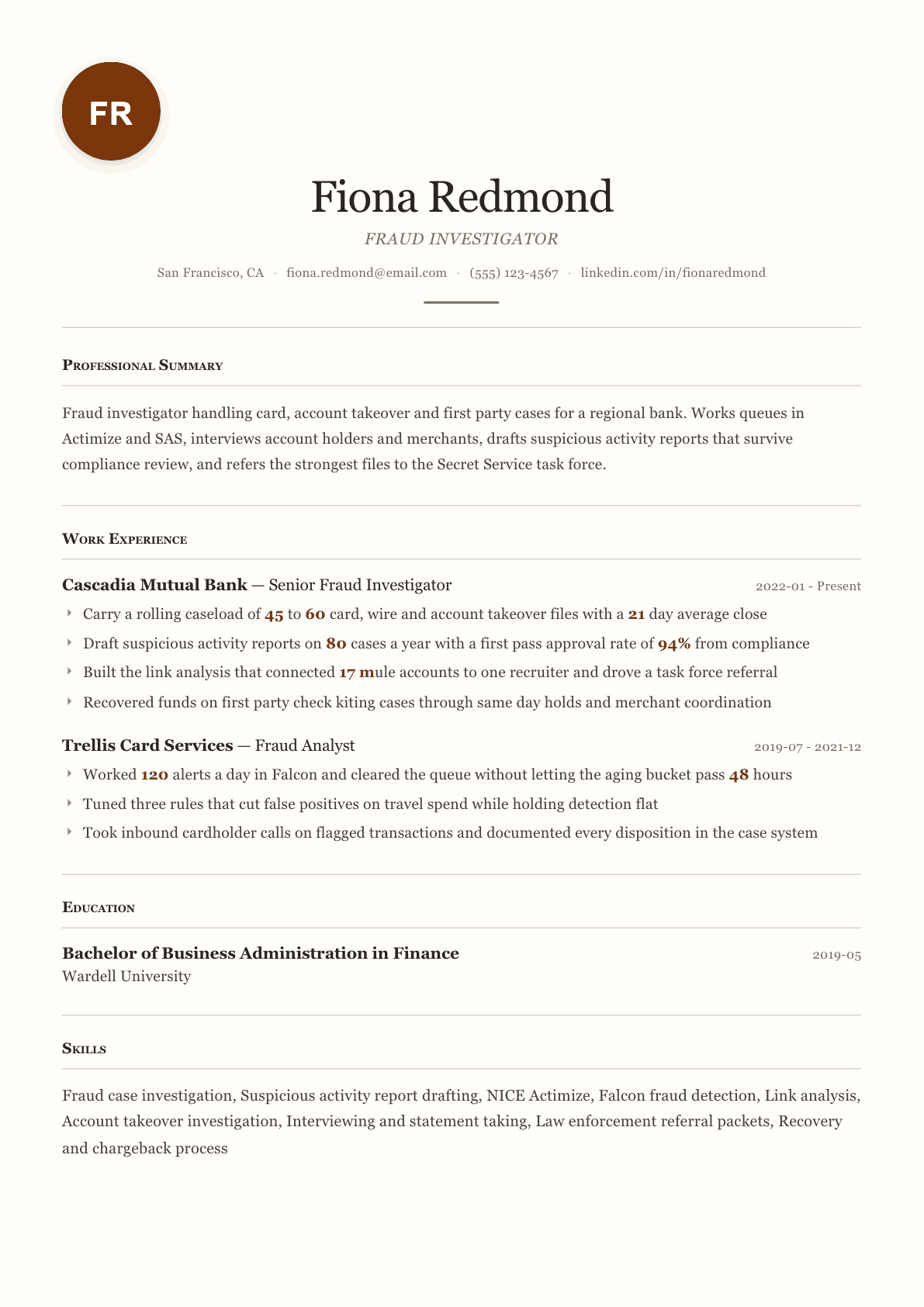
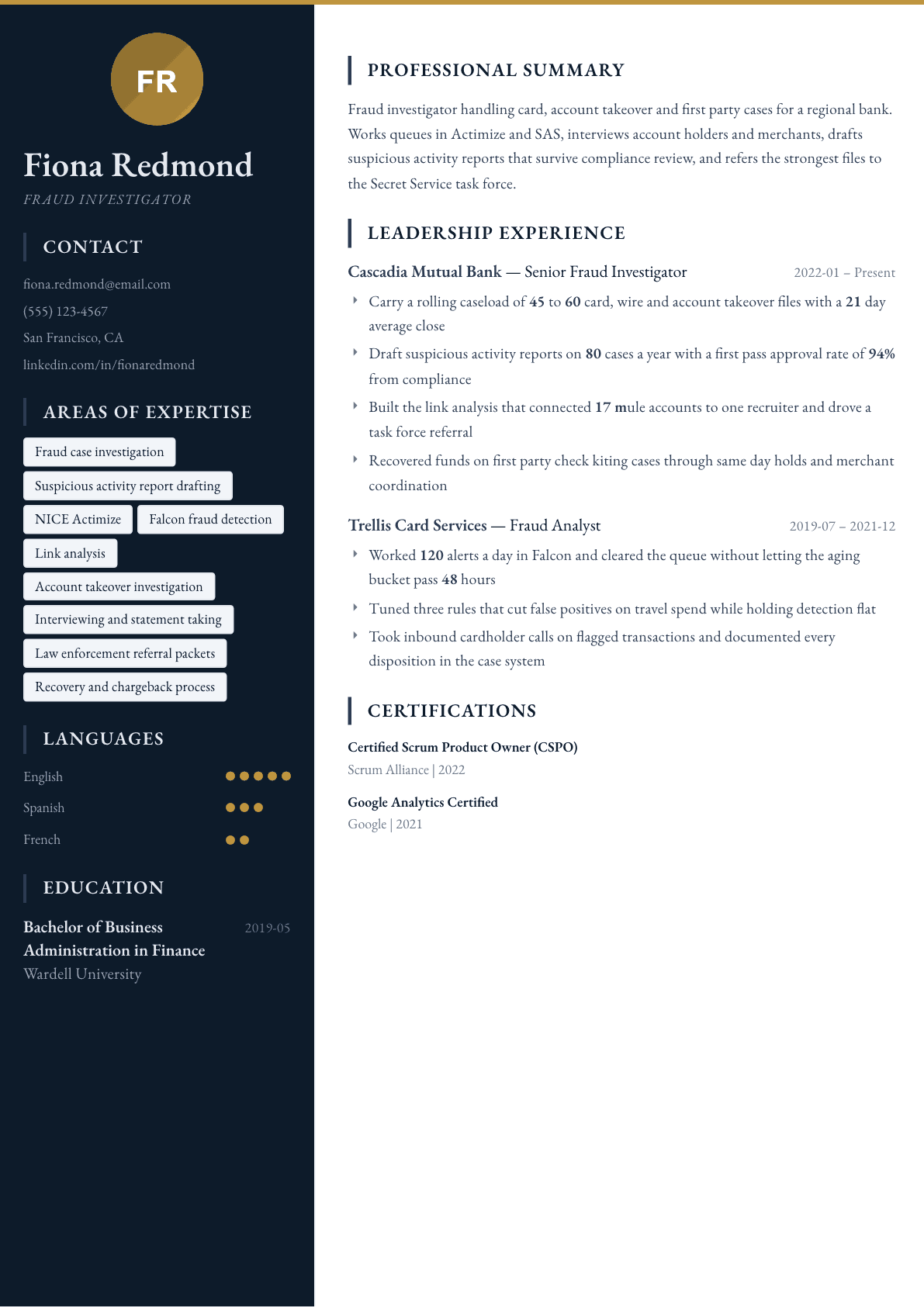
Example Fraud Investigator summary
Fraud investigator working card, wire, account takeover and first party cases for a regional bank. Carries a rolling caseload near sixty files, drafts suspicious activity reports that clear compliance on the first pass, and builds link analysis that turns scattered alerts into one named ring. Interviews account holders and merchants, packages referrals the task force accepts, and recovers funds through same day holds and merchant coordination.
Skills to list on a Fraud Investigator resume
- Fraud investigation
- Account takeover cases
- Card and wire fraud
- First party and synthetic identity fraud
- Suspicious activity report writing
- NICE Actimize
- Falcon and Featurespace platforms
- Link and network analysis
- Interview and statement taking
- Evidence handling
- Law enforcement referral packets
- Chargeback and recovery process
- Anti money laundering rules
- Case management systems
- SQL query writing
What actually gets this resume read
- Give your caseload, your close rate and your average days to close, because those three size you instantly.
- Name the detection and case platforms you work in, since queue tooling varies wildly between institutions.
- Say how many suspicious activity reports you draft and what share clear compliance on the first pass.
- Show one case where link analysis turned scattered alerts into a single ring, and where the referral went.
- Separate first party, third party and internal fraud on the page, because hiring managers screen for one.
- Put recovered funds on the resume with the mechanism, whether holds, chargebacks, restitution or seizure.
How to write a fraud investigator resume
A fraud manager at a bank, an insurer or a marketplace is looking at a queue that never empties and a regulator who expects every decision documented. She needs an investigator who can carry a caseload, close files on schedule, and write a narrative that survives a compliance review and a subpoena without her having to rewrite it.
What she reads first is throughput and quality together. Caseload, days to close, and the share of your regulatory filings that clear review on the first pass tell her more in one line than a paragraph about analytical thinking ever will. Investigators who leave those numbers off are asking her to guess, and she guesses low.
This guide covers the resume structure a financial crime team reads, how to write case work when everything is confidential, three summaries across career stages, before and after bullets, and the questions investigators ask when they move between banking, insurance, marketplace and corporate roles.
Format: one page early, two later, fraud types named at the top
Reverse chronological. One page until you have around eight years, then two. Under your summary, put a fraud typology line naming the case types you have worked: card present and card not present, account takeover, first party, synthetic identity, wire and business email compromise, check kiting, claims fraud, merchant fraud. Managers hire for one or two of those and scan for them directly.
Keep a platform block near the top as well. Detection engines, case management systems and query tools vary hugely between institutions, and an investigator who already knows the stack saves a manager a full onboarding cycle. List the products by name, not the category.
- Typology line under the summary: the fraud types you have investigated, with the two you carry unsupervised marked first.
- Platform block: detection engine, case management system, core banking or claims system, and any query language you write yourself.
- Each job opens with the institution type and portfolio size, then caseload, close time and filing volume.
- Credential block: fraud, anti money laundering or financial crime certifications with the issuing body, plus any interview training.
Caseload, close rate and the throughput numbers a manager schedules on
Give three figures for every investigative job: the rolling caseload you carry, the average days to close, and the annual volume you complete. Those numbers size you instantly and they are the ones a manager compares between candidates. If your close time improved because you changed something, name the change, because process improvement is what gets an investigator promoted to senior.
Alert work belongs on the page too if you have done it, but keep it separate from case work. Clearing a hundred alerts a day is a queue skill. Carrying fifty open files with subpoena responses and interviews attached is an investigation skill. A resume that blurs the two makes an experienced investigator look like an analyst and undersells the whole page.
Regulatory filings, quality and the review nobody sees
Suspicious activity reporting is where investigative writing meets regulatory risk. Say how many filings you draft a year and what share clear compliance review on the first pass. A high first pass rate means your narratives already contain the who, what, when, where and why in the order a reviewer expects, and that saves the second line team hours nobody budgets for.
Add anything that shows you understand the wider obligation: filing deadlines, continuing activity reviews, escalation to the anti money laundering team, and the boundary between fraud and money laundering typologies. Investigators who understand that boundary are the ones institutions move into financial crime leadership.
Link analysis, interviews and the cases that become referrals
The work that distinguishes an investigator from a queue worker is turning scattered alerts into one named scheme. Describe a ring you built: how many accounts, what tied them together, what tool you used to visualize it, and where the file went. Mule networks, merchant collusion, staged claims and bust out schemes all read strongly because they are hard to fake.
Interviewing deserves its own bullets. Say whether you have interviewed account holders, merchants, claimants or employees, whether you record, and whether you have training in a structured model. Then close the loop with outcomes: referrals accepted by a task force or prosecutor, restitution agreements, funds recovered through holds, chargebacks or seizure. Recovery with a mechanism attached is far more credible than a bare number.
If you have ever briefed law enforcement or testified, put it on the page with the level. Institutions value an investigator who can hand a file to an agent and have it accepted without a week of rework.
Skills and the vocabulary financial crime postings screen against
Postings recycle a fixed set of terms: suspicious activity report, know your customer, transaction monitoring, account takeover, first party fraud, synthetic identity, chargeback representment, link analysis, case management, escalation. Mirror them exactly and evidence at least four inside your bullets rather than leaving them stranded in a skills list.
Add the technical edge that separates candidates. Writing your own database queries, building a report rather than requesting one, and tuning detection rules are all things fraud teams need and rarely find. If you have reduced false positives without losing detection, that single sentence will get you an interview at most institutions.
Fraud Investigator resume summary examples
Moving from analyst to investigator
Fraud analyst with two years working card alerts in a detection queue, clearing 120 alerts a day and holding the aging bucket under 48 hours. Tuned three travel spend rules in 2024 that cut false positives while detection held flat, and now handles escalated cases end to end.
Five years investigating
Fraud investigator carrying 45 to 60 open card, wire and account takeover files with a 21 day average close. Drafts 80 suspicious activity reports a year with a 94% first pass approval rate from compliance, interviews account holders and merchants, and packages referrals the task force accepts.
Lead investigator
Senior fraud investigator leading a five person unit across first party, synthetic identity and mule network cases. Built the link analysis method the team now uses, owns the law enforcement relationship, reviews every filing before it leaves, and briefs the financial crime committee each quarter.
Work experience bullets: before and after
Before: Investigated fraud cases and reported findings.
After: Carried a rolling caseload of 45 to 60 card, wire and account takeover files with a 21 day average close and full documentation in the case system on every disposition.
Caseload, case types and close time are the three numbers a fraud manager uses to compare candidates.
Before: Filed suspicious activity reports as required.
After: Drafted 80 suspicious activity reports a year with a 94% first pass approval rate from compliance, each narrative sequenced so a reviewer could follow the activity without a second conversation.
A quality figure on regulatory writing tells a manager how much second line rework you generate.
Before: Identified a large fraud ring.
After: Linked 17 mule accounts to a single recruiter through shared device fingerprints, funding patterns and beneficiary overlap, and packaged the set as one referral the task force took forward.
The linking evidence and the referral outcome make the ring verifiable rather than a claim.
Before: Reduced false positives in the detection system.
After: Tuned three transaction monitoring rules covering travel spend, cutting false positives on the queue while detection volume held flat across the following two quarters.
Naming the rules and holding detection steady shows tuning judgment instead of loosened thresholds.
Before: Recovered money lost to fraud.
After: Recovered funds on first party check kiting cases through same day holds, merchant coordination and reversal requests filed inside the network deadline.
The mechanism makes recovery credible, since a bare number could mean anything.
Hard skills
- Fraud case investigation
- Account takeover and identity theft cases
- Card and wire fraud investigation
- First party and synthetic identity fraud
- Suspicious activity report drafting
- Transaction monitoring and alert disposition
- Link and network analysis
- Structured interview and statement taking
- Evidence handling and case documentation
- Law enforcement referral packages
- Chargeback and recovery process
- SQL query writing and reporting
- Detection rule tuning
Soft skills
- Holding a neutral tone with a customer who is either a victim or a suspect
- Writing a narrative a regulator can follow cold
- Managing a queue without letting the hard files rot
- Knowing when a hunch is not yet a case
- Working with compliance without treating them as an obstacle
Certifications worth listing
- Certified Fraud Examiner (CFE) (Association of Certified Fraud Examiners)
- Certified Anti-Money Laundering Specialist (CAMS) (ACAMS)
- Certified Financial Crime Specialist (CFCS) (Association of Certified Financial Crime Specialists)
Mistakes that cost fraud investigator candidates the interview
- Blending alert queue volume with investigative caseload so an experienced investigator reads as an analyst.
- Omitting days to close, which is the throughput figure every fraud manager compares.
- Quoting a filing count with no quality measure attached, when first pass approval is the number that matters.
- Naming no detection engine or case management system, forcing a manager to assume full retraining.
- Describing a fraud ring without saying what linked the accounts or where the referral went.
- Claiming recovered funds with no mechanism, which reads as a number chosen rather than earned.
Fraud Investigator resume questions
How do I write about cases that are confidential?
Describe the typology, the scale and the method without identifying customers or specific institutions. A referral covering seventeen linked accounts and a shared recruiter is fully anonymous and still shows exactly what you can do, which is all a hiring manager needs to see.
Which certification helps most for a fraud investigator?
A recognized fraud examination credential carries weight everywhere, and an anti money laundering credential opens the financial crime side of the house. Put the issuing body next to each one, and list any structured interview training separately since that is screened for on its own.
Can I move from an insurance claims background into banking fraud?
Yes, because the investigative core transfers: caseload management, interviewing, documentation and referral packaging are the same craft. Rewrite your claims work in banking vocabulary, name the typologies that overlap such as first party and organized rings, and be honest about the systems you would need to learn.
Should I list SQL or reporting skills on a fraud resume?
Absolutely, because investigators who pull their own data are rare and valuable. Say what you query, whether you build recurring reports, and whether you have used your own analysis to change a detection rule, since that is where analytical skill turns into money the institution keeps.
How much detail should go into interview experience?
Enough to show it is trained rather than improvised. Name the model if you have one, say who you interview, whether sessions are recorded, and how the statement is documented. Then attach an outcome such as an admission, a restitution agreement or a referral that was accepted.
Related resume examples
- Forensic Accountant Resume example
- Compliance Officer Resume example
- Fraud Analyst Resume example
- Anti-Money Laundering Analyst Resume example
- Criminal Justice Graduate Resume example
- Criminal Investigator Resume example