Geriatric Social Worker Resume Examples: free ATS score
Craft a Geriatric Social Worker Resume for Aging Services Hiring
By Mustafa Tarabya, founder of CVBooster · Published · Updated
A geriatric social worker resume guide with long-term care keywords, care planning examples, capacity and guardianship detail, and a full sample.
Sample resumes for a geriatric social worker
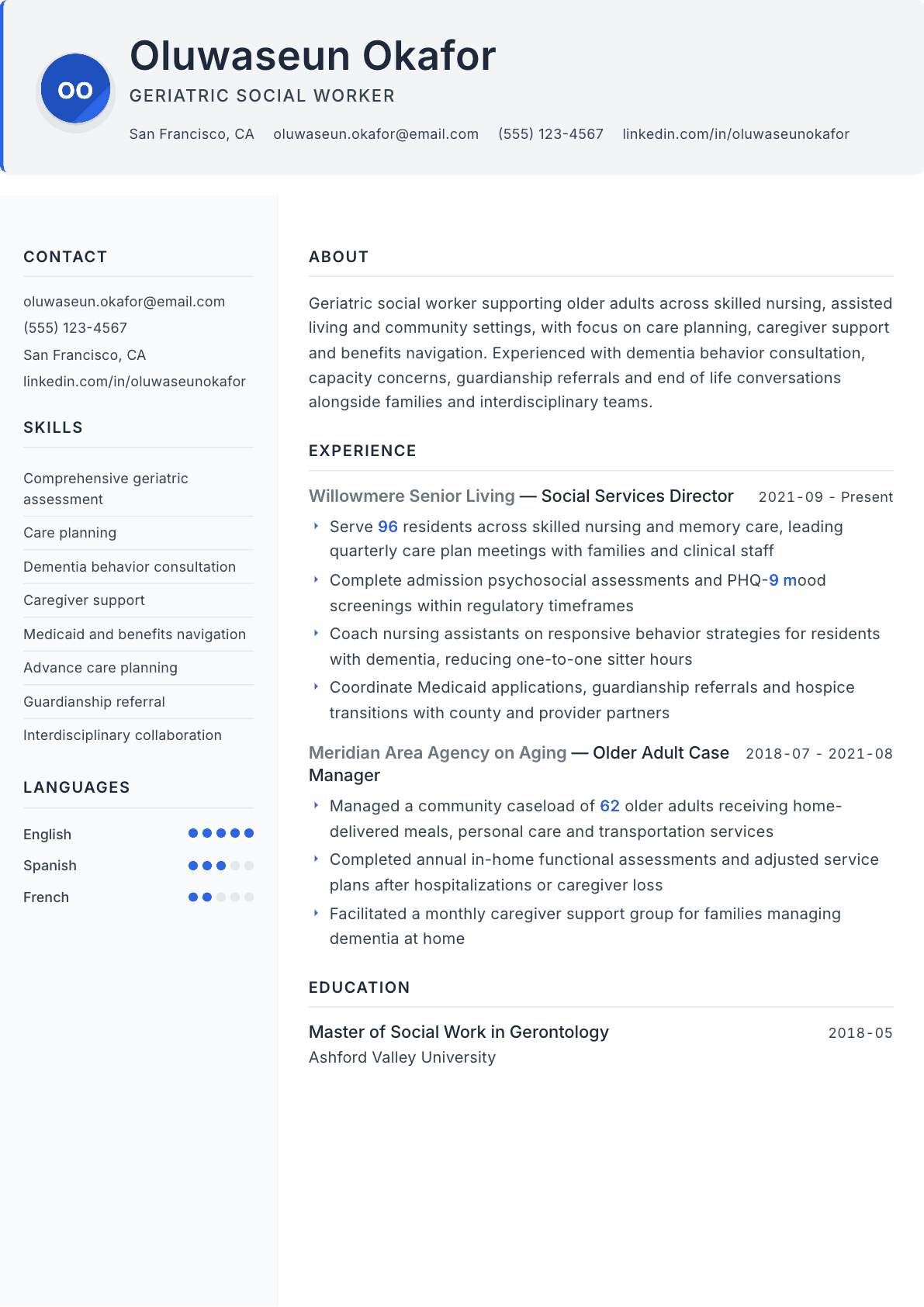
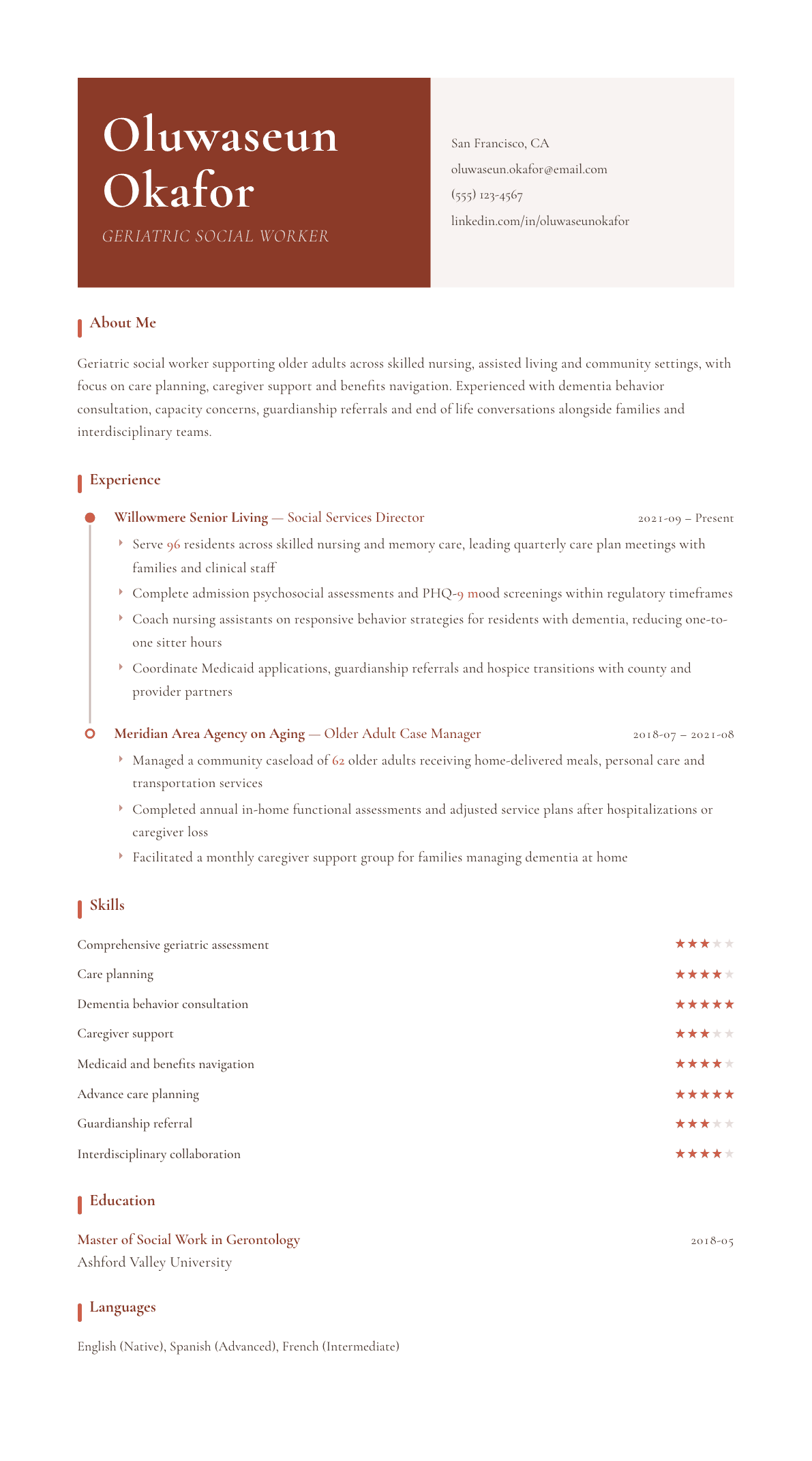
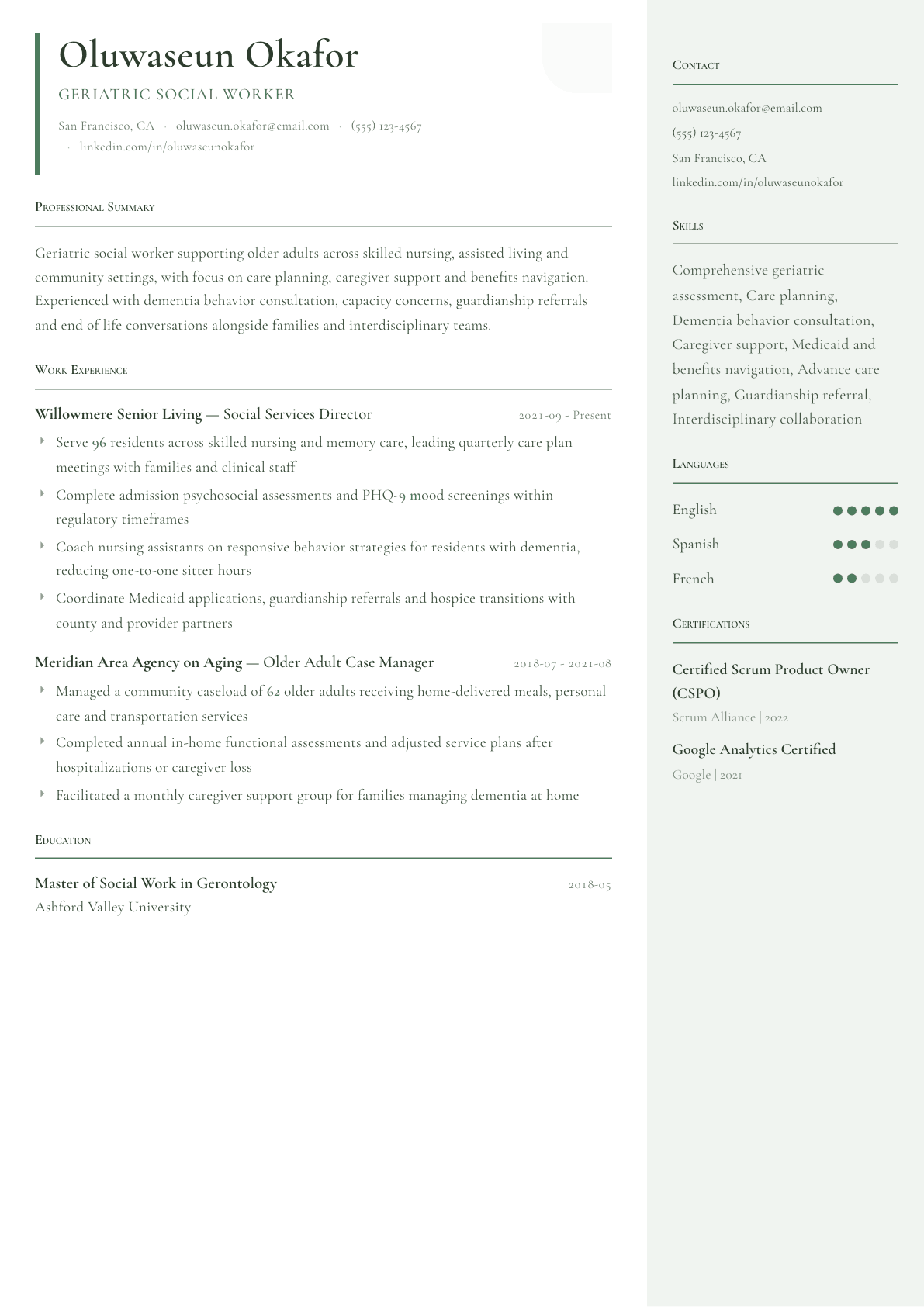
The same geriatric social worker content laid out in three CVBooster templates, so you can see what the finished document looks like before you write a word.
Example Geriatric Social Worker summary
Geriatric social worker with seven years across skilled nursing, memory care and community aging services. Leads care plan conferences, completes psychosocial and mood assessments on regulatory timelines, and guides families through Medicaid, guardianship and hospice decisions. Coaches direct care staff on dementia behavior support and keeps transitions between home and facility from breaking down. Seeking a senior aging services role with program oversight.
Skills to list on a Geriatric Social Worker resume
- Comprehensive geriatric assessment
- Person-centered care planning
- Dementia and responsive behavior support
- Caregiver education and support
- Medicaid and waiver navigation
- Long-term care regulations
- Advance care planning
- Hospice and palliative referral
- Capacity and guardianship referral
- Elder abuse reporting
- Depression screening
- Discharge and transition coordination
- Family conference facilitation
- Community resource linkage
What actually gets this resume read
- Name the setting precisely: skilled nursing, assisted living, memory care, adult day, hospice or community case management.
- Give resident or client volume and the assessment cycle you were responsible for maintaining.
- Show regulatory fluency by naming the assessment instruments and care conference schedule your setting required.
- Describe dementia work concretely: behavior consultation, environmental changes, and family education sessions.
- Include benefits navigation experience such as Medicaid applications, waiver programs and area agency services.
- Mention advance care planning and end of life conversations, because supervisors ask how you handle them.
How to write a geriatric social worker resume
Aging services covers settings that barely resemble each other. A social services director in a skilled nursing facility works inside survey requirements and care conference cycles. A case manager at an area agency on aging drives to homes and builds service plans around a waiver budget. A hospice team social worker sits with families at the end. All three are geriatric social work, and a hiring manager reads your resume to find out which one you have actually done.
The second thing they check is whether you can handle the decisions that cluster around older adults: a resident whose capacity is slipping, a son holding a power of attorney he is misusing, a family that cannot agree on hospice, a discharge home to an apartment with no elevator. These are the situations that consume a director week, and a resume that shows you have worked them is worth more than a longer one that does not.
This guide lays out how to structure the page for aging services hiring, what to say about caseload and setting, which credentials employers recognize, three summaries across a geriatric social work career, and rewritten bullets that make the judgment visible.
Format: setting first, because the settings are not interchangeable
One to two pages, reverse-chronological. Under the summary, put a short line naming every setting you have worked in: skilled nursing, assisted living, memory care, adult day, hospice, home and community based services, or hospital geriatrics. A director scanning for facility experience should not have to infer it from an employer name.
License and certification go under your name. In long-term care the social services position often has specific qualification requirements tied to facility size, so the reader is checking that line before anything else on the page.
- Header: name with credentials, city and state, phone, email, license type and state.
- Order: summary, licensure and certification, aging services experience by setting, other social work experience, education.
- Note whether roles were facility-based, community-based or both, since the driving and documentation differ.
Summary: population served, census carried, decisions owned
Name the setting, the census or caseload, and the decisions you carried. A social services director serving ninety-six residents across skilled nursing and memory care who leads quarterly care conferences, completes admission assessments on regulatory timelines and coordinates Medicaid conversions has described the whole job in two sentences.
Add the dementia dimension explicitly if you have it. Behavior consultation, environmental adjustment, staff coaching and family education around a diagnosis are separate competencies from general care planning, and almost every aging services employer is short of people who have them.
Experience: assessment cycles, care conferences, and transitions
Open with census or caseload, then write bullets around the cycle your setting runs on. In a facility that means admission psychosocial assessment, mood screening, quarterly and annual reviews, care plan conferences with families, and the documentation the survey process examines. In the community it means annual functional assessment, service plan authorization, reassessment after a hospitalization and the reauthorization paperwork that keeps services flowing.
Transitions are where geriatric social work earns its keep. Hospital to facility, facility to home, home to memory care, and any setting to hospice. Describe how you prepared families, what you coordinated, and what happened when a transition failed and had to be rebuilt. Employers know these break often and want someone who catches them.
The financial and legal strand belongs on the page too. Medicaid applications and spend-down, waiver program enrollment, representative payee arrangements, advance directives, capacity concerns raised to a physician, and guardianship referrals. These are the tasks that a new social worker cannot do without training, so having done them is worth stating.
- Give census or caseload and the assessment cycle you were accountable for.
- Name the mood and cognitive screening tools your setting used.
- Include family conference facilitation and how disagreement between family members was handled.
- Show benefits work by naming the programs, not by writing that you assisted with paperwork.
Regulation, survey and quality: say what you have survived
In long-term care the survey process shapes the job. If you have prepared documentation for a state survey, responded to a deficiency, or written a plan of correction for a social services item, put it on the resume. Administrators hire for that experience because it is expensive to learn during an actual survey.
The community equivalent is contract monitoring and quality review. Annual case file reviews, funder monitoring visits and corrective action responses all show a worker who can keep records to an external standard rather than a personal one.
Keywords aging services employers search for
The vocabulary is stable across the field: comprehensive geriatric assessment, person-centered care plan, care conference, activities of daily living, cognitive screening, depression screening, responsive behaviors, caregiver burden, advance care planning, elder abuse reporting, Medicaid waiver, area agency on aging, hospice referral and transitions of care. Mirror the posting phrasing.
Add the documentation system your setting used and any minimum data set involvement, since facility roles often expect participation in that process.
Geriatric Social Worker resume summary examples
New to aging services
Master of social work graduate with a placement at an area agency on aging, completing in-home functional assessments alongside a case manager and co-facilitating a caregiver support group. Trained in dementia communication and elder abuse recognition. Seeking a community case management position serving older adults aging in place.
Facility social services
Social services coordinator serving 96 residents across skilled nursing and memory care. Completes admission psychosocial assessments and mood screenings within regulatory timeframes, leads quarterly care conferences with families, and coordinates Medicaid conversions and hospice transitions. Coaches nursing assistants on responsive behavior strategies for residents with dementia.
Aging services director
Aging services director with fourteen years across community case management and long-term care, now overseeing a team of seven serving roughly four hundred older adults. Owns waiver contract compliance, the annual case file review cycle and the partnership with two hospital transition teams. Led the social services response to three state surveys with no deficiency cited.
Work experience bullets: before and after
Before: Worked with residents and their families in a nursing home.
After: Served 96 residents across skilled nursing and memory care, leading quarterly care plan conferences with families, nursing and therapy to set person-centered goals.
Census, unit types and the conference role show the scope and the regulatory cycle a facility runs on.
Before: Completed assessments for new residents.
After: Completed admission psychosocial assessments and PHQ-9 mood screenings within required timeframes, documenting mood and behavior findings for the interdisciplinary care plan.
The named instrument and the regulatory timing prove familiarity with the documentation a surveyor reviews.
Before: Helped staff manage difficult resident behaviors.
After: Coached nursing assistants on responsive behavior strategies for residents with dementia, adjusting routines and environment, which reduced one-to-one sitter hours on the memory care unit.
Naming the intervention and the staffing outcome converts behavior support into a result an administrator can price.
Before: Assisted families with paperwork and benefits.
After: Coordinated Medicaid applications and spend-down documentation for 18 residents in one year and enrolled community clients in a home and community based waiver.
Named programs and volume show benefits competence that takes months to develop and cannot be assumed.
Before: Talked with families about end of life care.
After: Facilitated goals of care conversations with residents and families, documented advance directives in the medical record, and coordinated 12 hospice admissions with the attending physician.
The sequence from conversation to documentation to admission shows a complete process rather than a difficult talk.
Hard skills
- Comprehensive geriatric assessment
- Person-centered care planning
- Care conference facilitation
- Cognitive and mood screening
- Dementia and responsive behavior support
- Caregiver education and support groups
- Medicaid and waiver enrollment
- Long-term care documentation requirements
- Advance care planning
- Hospice and palliative referral
- Capacity concern escalation and guardianship referral
- Elder abuse and self-neglect reporting
- Transition and discharge coordination
- Community resource linkage
Soft skills
- Patience with cognitive impairment
- Family conflict mediation
- Advocacy inside an interdisciplinary team
- Comfort with grief and dying
- Clear explanation of complex benefits
- Coaching direct care staff
Certifications worth listing
- Certified Social Worker in Gerontology (SW-G) (National Association of Social Workers)
- Advanced Social Worker in Gerontology (ASW-G) (National Association of Social Workers)
- Certified Dementia Practitioner (CDP) (National Council of Certified Dementia Practitioners)
- Certified Case Manager (CCM) (Commission for Case Manager Certification)
Mistakes that cost geriatric social worker candidates the interview
- Treating all aging settings as one, so a facility administrator cannot tell whether you have worked under survey requirements.
- Leaving out census or caseload, which makes a twenty-bed unit read the same as a two-hundred-bed campus.
- Describing dementia work as patience rather than naming the behavior strategies and staff coaching you delivered.
- Omitting benefits and legal navigation, when Medicaid, waivers and guardianship referrals are much of the daily work.
- Never mentioning survey or monitoring experience, which is the fastest way to reassure a long-term care administrator.
- Writing about older adults in language that flattens them into a single frail population, which reads poorly to anyone in the field.
Geriatric Social Worker resume questions
What qualifications do I need for a nursing facility social services position?
Requirements are tied to facility size and state rules, and range from a bachelor degree in a human services field to a licensed social worker. Read the posting carefully, state your degree and license precisely, and note any long-term care specific training you have completed.
How do I move from hospital social work into long-term care?
Lead with discharge planning to skilled nursing, the assessments you completed and the family conferences you ran, since those transfer directly. Then acknowledge the difference: facility work runs on a longer relationship and a regulatory cycle. Naming that shift shows you understand the change in pace.
Should I list continuing education on dementia care?
Yes, if it was substantive training rather than a one-hour refresher. Name the program and the provider. Employers running memory care units screen for it specifically, and a recognized dementia credential often moves a candidate ahead of one with more general years.
How do I describe caseload in community aging services?
Give the number of active clients, the reassessment interval and the service types you authorized or coordinated. Community caseloads vary widely, so the number alone means little without the cycle attached. Add the geography if you covered a large rural area.
Is it worth listing support group facilitation?
Yes. Running a caregiver group takes preparation, group management and content knowledge, and many employers want a group started but have nobody able to lead one. Give the topic, the frequency, the typical attendance and how long you sustained it.
Related resume examples
- Social Worker Resume example
- Case Manager Resume example
- Hospital Social Worker Resume example
- Community Health Worker Resume example
- School Social Worker Resume example
- Family Support Worker Resume example