Case Manager Resume Examples: free ATS score and gap list
Case Manager Resume and Case Management Resume Sample
By Mustafa Tarabya, founder of CVBooster · Published · Updated
A case management resume guide with a full case manager resume sample, caseload and documentation bullets, summaries and keywords for every setting.
Sample resumes for a case manager
The same case manager content laid out in three CVBooster templates, so you can see what the finished document looks like before you write a word.
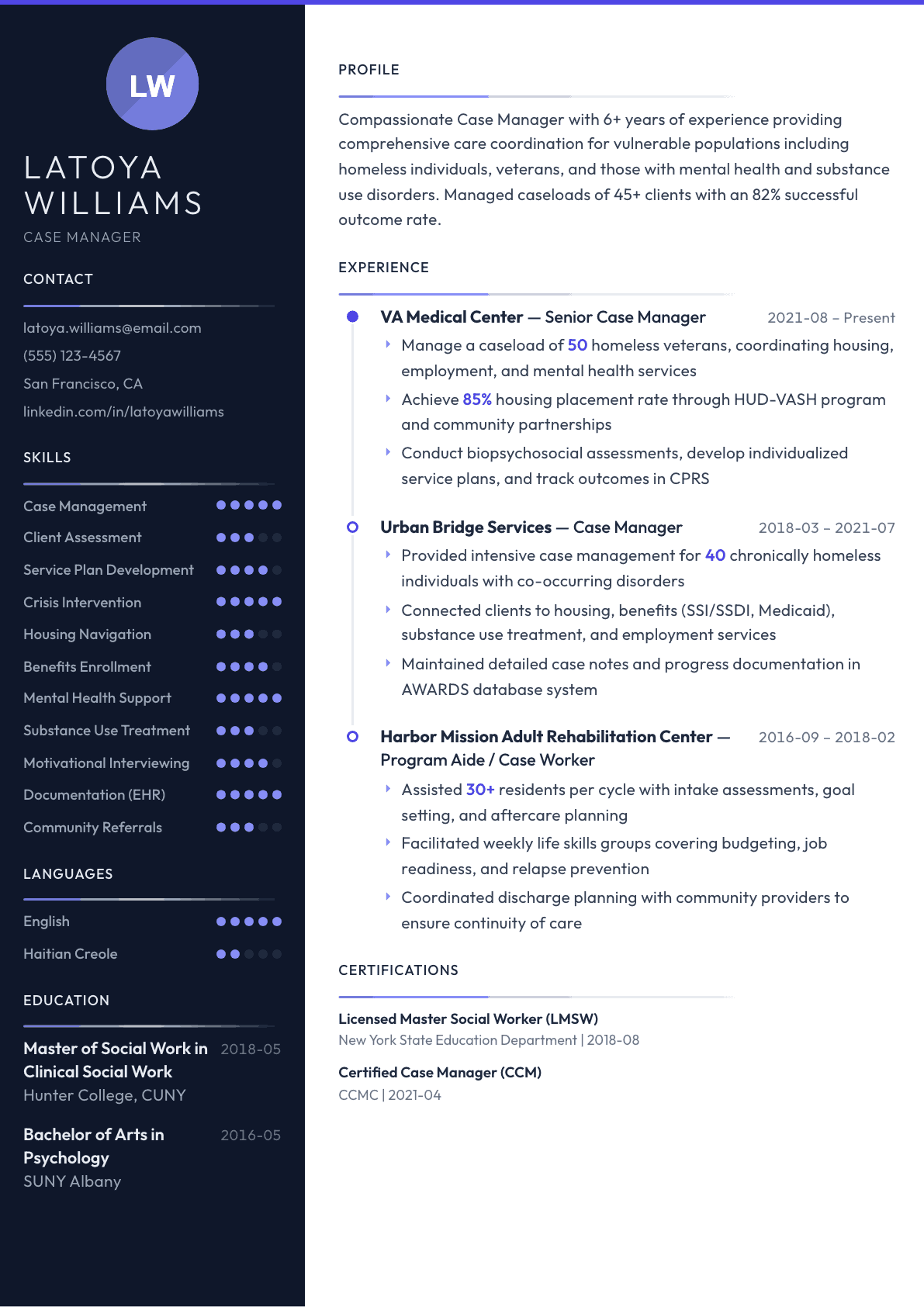
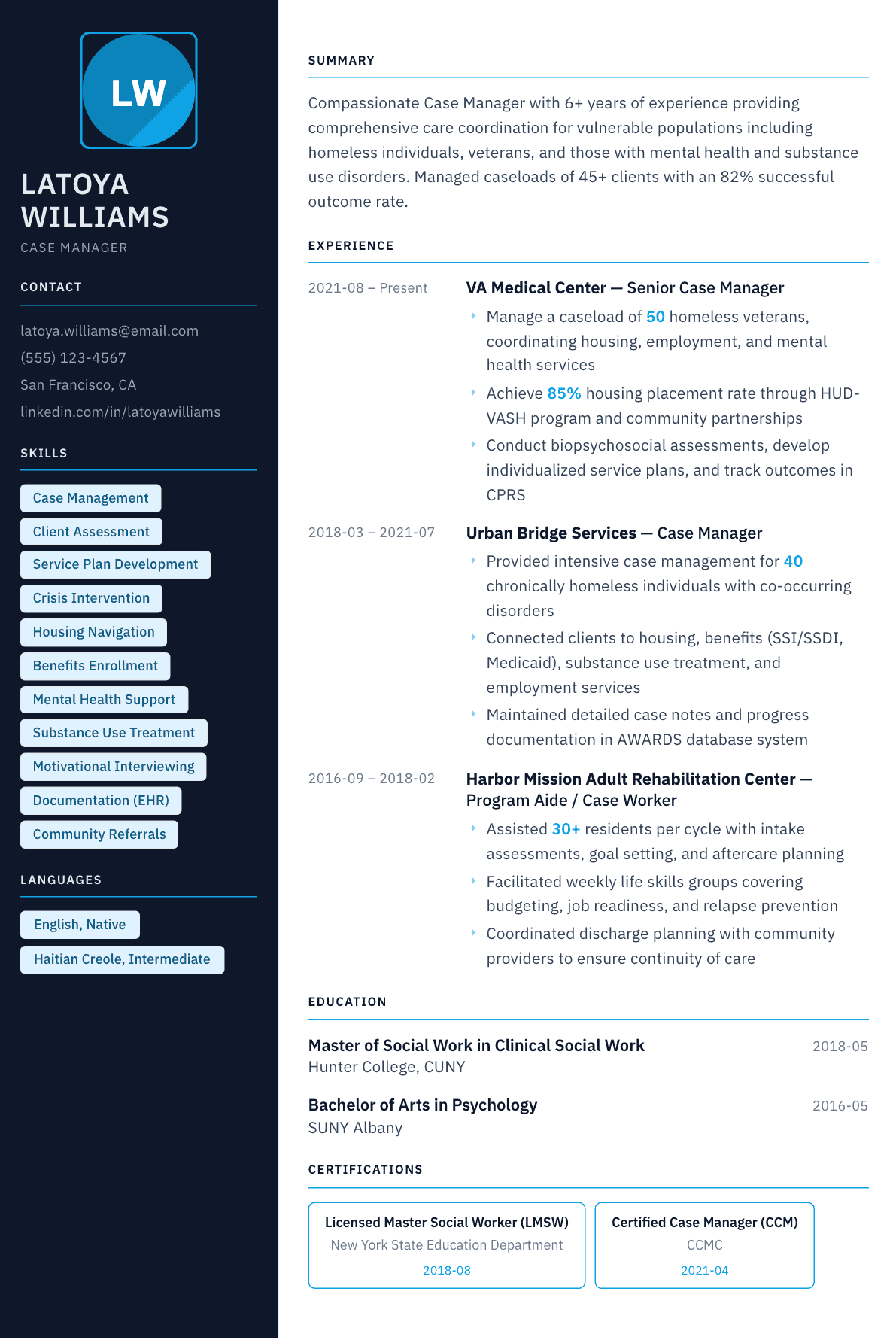
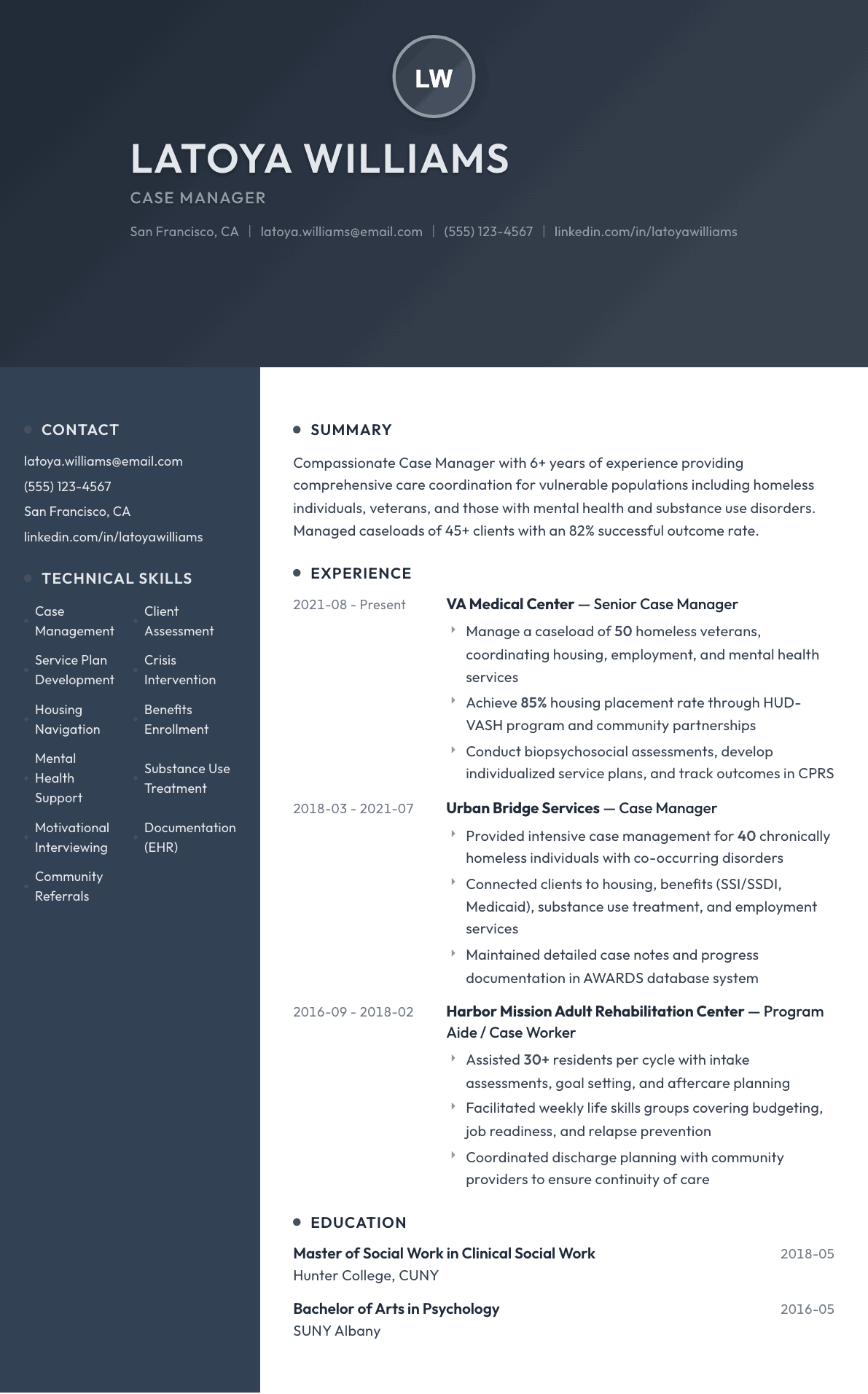
Example Case Manager summary
Compassionate Case Manager with 6 years of experience coordinating services for homeless veterans and individuals with co-occurring disorders. Managed caseloads of 50+ with an 85% housing placement rate. Seeking a senior case manager or program coordinator role.
Skills to list on a Case Manager resume
- Case Management
- Client Assessment
- Service Planning
- Crisis Intervention
- Housing Navigation
- Benefits Enrollment
- Mental Health Support
- Substance Use Counseling
- Motivational Interviewing
- Trauma-Informed Care
- Documentation (EHR)
- Community Referrals
- Group Facilitation
- Discharge Planning
What actually gets this resume read
- Highlight your caseload size and successful outcome rates (housing placement, employment, sobriety).
- Include your social work license (LMSW, LCSW) and CCM certification prominently.
- Specify the populations you serve: homeless, veterans, children, elderly, mental health, substance use.
- Show your knowledge of community resources and benefits systems (SSI/SSDI, Medicaid, SNAP, HUD-VASH).
- Mention evidence-based practices: motivational interviewing, trauma-informed care, harm reduction.
- Include EHR and database systems: AWARDS, CPRS, HMIS, Apricot, CaseWorthy.
How to write a case manager resume
Case manager is one title covering several distinct jobs, and the first task of the resume is to say which one you do. Social services case management coordinates housing, benefits and treatment for a caseload of clients. Hospital and health plan case management handles discharge planning, utilization review and care coordination against medical necessity criteria. Child welfare, probation and refugee resettlement each add their own mandates. A program director reading your file needs to place you inside two lines.
Once placed, the reader checks three things: caseload size, the population you served, and whether you can document. Documentation is the part candidates undersell and supervisors care most about, because in this field the case note is the legal record, the billing basis and the audit trail all at once.
This guide covers the case management resume section order supervisors expect, three summaries from a residential aide stepping up through a supervising case manager, before-and-after bullets that show coordination rather than kindness, and the questions that come up when the outcomes belong partly to the client.
Format: caseload and population before duties
One page under six years, two after. Reverse chronological, plain layout, clean dates, and licensure or certification stated near the top since many positions are funded on the assumption that the holder is credentialed.
Under each job title, write a caseload line: number of clients carried, the population, the program model and the funding stream. A line reading "Caseload of 50 homeless veterans, HUD-VASH permanent supportive housing" tells a supervisor the acuity, the paperwork and the partner agencies in a single sentence.
- Header: name, city and state, phone, email, and your license or credential in the credential position.
- Order: summary, licenses and certifications, case management experience, training, education, languages.
- Name the electronic record and the homeless management information system you have charted in.
Summary: population, caseload, model, outcomes
Three or four lines. Name the population, the caseload you carried, the model you worked inside, and the outcome measure your program tracked. Housing first, assertive community treatment, harm reduction, wraparound, and trauma-informed care are model names a supervisor recognizes immediately, and each implies a different daily practice.
Avoid opening with compassionate and dedicated. Everyone applying for case management roles is compassionate, and the summary space is better spent on the population and the acuity you can handle without burning out in three months.
Experience: assessment, plan, coordination, documentation
Structure the bullets along the case management cycle. Assessment: the instruments you used, biopsychosocial intake, risk and vulnerability screening, and the acuity of what you screened for. Planning: individualized service plans with measurable goals, how often you reviewed them, and how the client shaped them.
Coordination is the heart of the job, so make it concrete. Name the systems you navigated and the partners you worked with: housing authorities and landlords, benefits offices, substance use treatment providers, behavioral health clinics, probation, schools, hospitals and managed care plans. A case manager is judged on whether the referral actually landed, not on whether it was made.
Documentation deserves real space. Case note timeliness, chart audit results, the electronic record you worked in, service authorization and eligibility documentation, and the reporting you produced for funders. If you passed a state or funder audit on your charts, say so plainly.
Include crisis work honestly. Safety planning, risk assessment, de-escalation, mandated reporting, hospitalization coordination and after-hours response. Supervisors need to know you can hold a crisis without either freezing or overstepping your scope.
Credentials, models and systems
List licensure and certification precisely with the issuing body and the state. Social work licensure at any level, the certified case manager credential, alcohol and drug counselor credentials, and peer support certification all appear as requirements or preferences in these postings.
Name the training you completed with the model attached: motivational interviewing, trauma-informed care, mental health first aid, nonviolent crisis intervention, and the assessment tools used in your system such as coordinated entry vulnerability screening. Naming the tool rather than the concept is what makes the training credible.
Name the systems: the electronic health record, the homeless management information system, the state benefits portal, and the case management database. Supervisors hiring into a specific system read this as reduced training time.
Keywords case management postings repeat
The recurring terms are case management, biopsychosocial assessment, individualized service plan, care coordination, crisis intervention, discharge planning, housing navigation, benefits enrollment, community referrals, motivational interviewing, harm reduction, documentation and continuity of care. Mirror the posting phrasing once in the summary and once inside a bullet with evidence behind it. Match the vocabulary of the setting you are applying to, since hospital and social service programs use different words for similar work.
Case management resume sample, start to finish
Case management resumes samples are easiest to use when they are complete, so here is a full page for a community case manager. The person and agencies are invented; the order is what to copy. Hospital and nurse case managers keep the same order and put their license and utilization review work in the profile.
Profile: Marcus Hill, Case Manager. Five years in community behavioral health, carrying a caseload of about thirty adults with serious mental illness. Works in a recovery model, coordinates housing, benefits and medical care, and documents every contact in the electronic record within one business day.
- Current role, Case Manager II, Bridgeway Community Services, three years: caseload of about thirty adults, including clients leaving hospital stays and shelters.
- Complete intake assessments and write person centered service plans with each client, reviewed every ninety days.
- Coordinated housing applications with the local housing authority and landlords, and helped eleven clients move into stable housing last year.
- Link clients to primary care, psychiatry and benefits, and follow up after every hospital discharge within two business days.
- Previous role, Case Aide, Hope Street Shelter, two years: intake, resource referrals and daily check ins for shelter guests.
- Skills: needs assessment, service planning, motivational interviewing, crisis response, benefits applications, electronic health records, trauma informed care.
- Education and credentials: BA in Social Work; CPR and mental health first aid; state driver license with insured car.
Case Manager resume summary examples
Residential staff stepping up
Residential program staff supporting 30 residents per cycle with intake assessments, goal setting and aftercare planning. Facilitates weekly life skills groups on budgeting, job readiness and relapse prevention, and coordinates discharge with community providers. Seeking a full case management caseload.
Six years in case management
Case Manager carrying 45 to 50 clients experiencing homelessness with co-occurring mental health and substance use conditions. Completes biopsychosocial assessments, builds individualized service plans, and connects clients to housing, benefits and treatment while keeping case notes current within 48 hours.
Supervising case manager
Supervising case manager overseeing six case managers on a permanent supportive housing team. Carries a small complex caseload, runs weekly clinical supervision and chart review, manages the funder reporting cycle, and led the program through its last state audit with no chart deficiencies.
Work experience bullets: before and after
Before: Managed a caseload of clients and provided support services.
After: Carried a caseload of 50 veterans experiencing homelessness, coordinating housing placement, mental health treatment and employment services under a permanent supportive housing program.
Caseload size, population and program model give a supervisor the acuity and the paperwork load in one line.
Before: Helped clients find housing.
After: Achieved an 85% housing placement rate by building a landlord network of 20 property owners, preparing documentation packets in advance and accompanying clients to unit viewings.
The placement rate plus the mechanism shows a repeatable method rather than a favorable caseload.
Before: Completed assessments and service plans for clients.
After: Completed biopsychosocial assessments at intake and built individualized service plans with measurable goals, reviewing and updating each plan with the client every 90 days.
Naming the instrument and the review cycle proves the plan was a working document, not an intake formality.
Before: Kept case notes and records up to date.
After: Documented all client contacts in the electronic record within 48 hours and passed two consecutive funder chart audits with no deficiencies across a caseload of 45.
Timeliness and an audit result turn documentation from an assumed duty into verified compliance.
Before: Helped clients in crisis situations.
After: Conducted risk assessments and built safety plans during client crises, coordinating voluntary hospitalization when needed and following up within 24 hours of discharge.
The steps and the follow-up window show scope-appropriate crisis practice rather than a general willingness to help.
Hard skills
- Biopsychosocial assessment
- Individualized service plan development
- Care coordination and referral follow-through
- Housing navigation and landlord engagement
- Benefits enrollment and eligibility documentation
- Crisis intervention and safety planning
- Motivational interviewing
- Harm reduction practice
- Discharge and transition planning
- Electronic health record documentation
- Homeless management information system entry
- Funder and grant outcome reporting
- Group facilitation
Soft skills
- Building trust with guarded clients
- Boundaries that prevent burnout
- Advocacy inside slow systems
- Cultural humility
- Collaboration across agencies
Certifications worth listing
- Certified Case Manager (CCM) (Commission for Case Manager Certification)
- Licensed Social Worker or Licensed Clinical Social Worker (State social work licensing board)
- Certified Alcohol and Drug Counselor (CADC) (State certification board)
- Mental Health First Aid (National Council for Mental Wellbeing)
- Nonviolent Crisis Intervention (Crisis Prevention Institute)
- Certified Community Health Worker (State certification program)
Mistakes that cost case manager candidates the interview
- Leaving out caseload size, which is the single fastest way for a supervisor to judge whether you can carry their program.
- Describing the population vaguely as clients in need instead of naming the acuity and the systems involved.
- Underselling documentation, when case notes are the legal record, the billing basis and the audit trail.
- Listing referrals made rather than referrals that landed, which is the difference between coordination and paperwork.
- Claiming outcome rates with no denominator, so a strong placement rate cannot be distinguished from a small sample.
- Skipping the model name, when housing first, wraparound and harm reduction each imply a different daily practice.
- Omitting the electronic record and reporting systems you know, which is often what decides between two similar candidates.
Case Manager resume questions
What does a case management resume sample look like?
One page with a profile naming the population, caseload size and care model, then experience with bullets for assessment, planning, coordination and documentation, each tied to a client outcome where you can show one. Skills and credentials come last. The complete community case manager resume on this page shows the order.
How do I show outcomes when the client controls the result?
Report what your practice produced across the caseload rather than any single story: placement rate, engagement or retention rate, benefits secured, treatment entries. Then name the mechanism you used, since a supervisor is evaluating your method more than any individual outcome.
Should I put my caseload size on the resume?
Always. Caseload size, combined with population acuity, is how case management experience is measured in this field. A caseload of fifty in permanent supportive housing reads very differently from a caseload of fifteen in intensive clinical work, and both are legitimate.
Do I need a social work license to be a case manager?
Many positions do not require it, especially in housing, benefits and community health programs. Clinical and hospital roles often do, and the certified case manager credential opens health plan and utilization work. List whatever you hold with the issuing body and state.
How do I move from social services case management into a hospital setting?
Translate your work into the clinical vocabulary: discharge planning, care transitions, medical necessity, utilization review and interdisciplinary rounds. Lead with your assessment and documentation discipline, then add any health-related training, since hospital supervisors screen hardest on charting rigor.
Related resume examples
- Social Worker Resume example
- Outreach Coordinator Resume example
- Program Coordinator Resume example
- Victim Advocate Resume example
- Refugee Resettlement Caseworker Resume example
- Foster Care Case Manager Resume example