Social Worker Resume Examples: free ATS score and gap list
Social Worker Resume With the Social Work Skills Supervisors Screen For
By Mustafa Tarabya, founder of CVBooster · Published · Updated
Social Worker resume examples with expert tips, ATS keywords, and professional templates. See exactly what a winning licensed clinical social worker resume looks like.
Sample resumes for a social worker
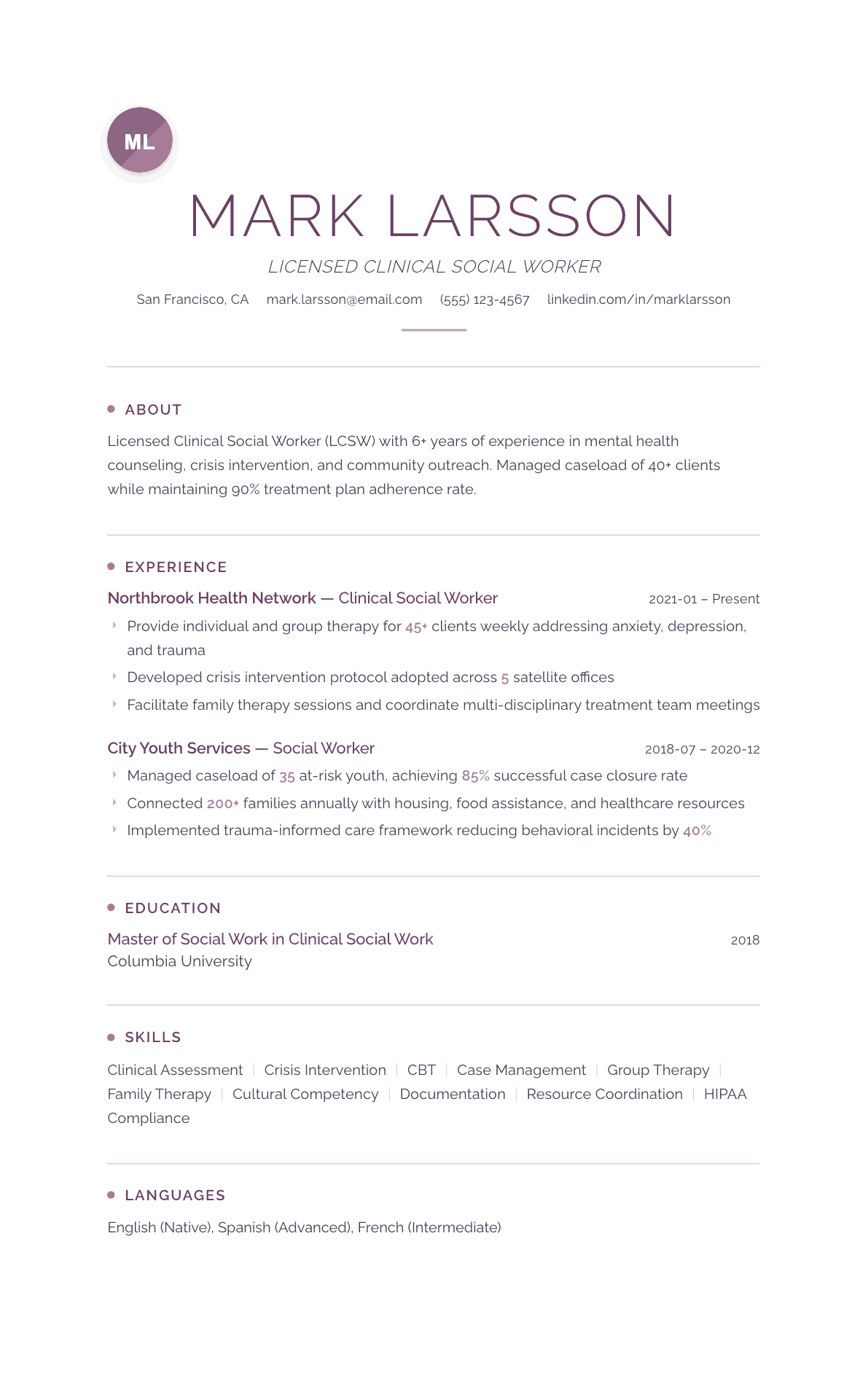
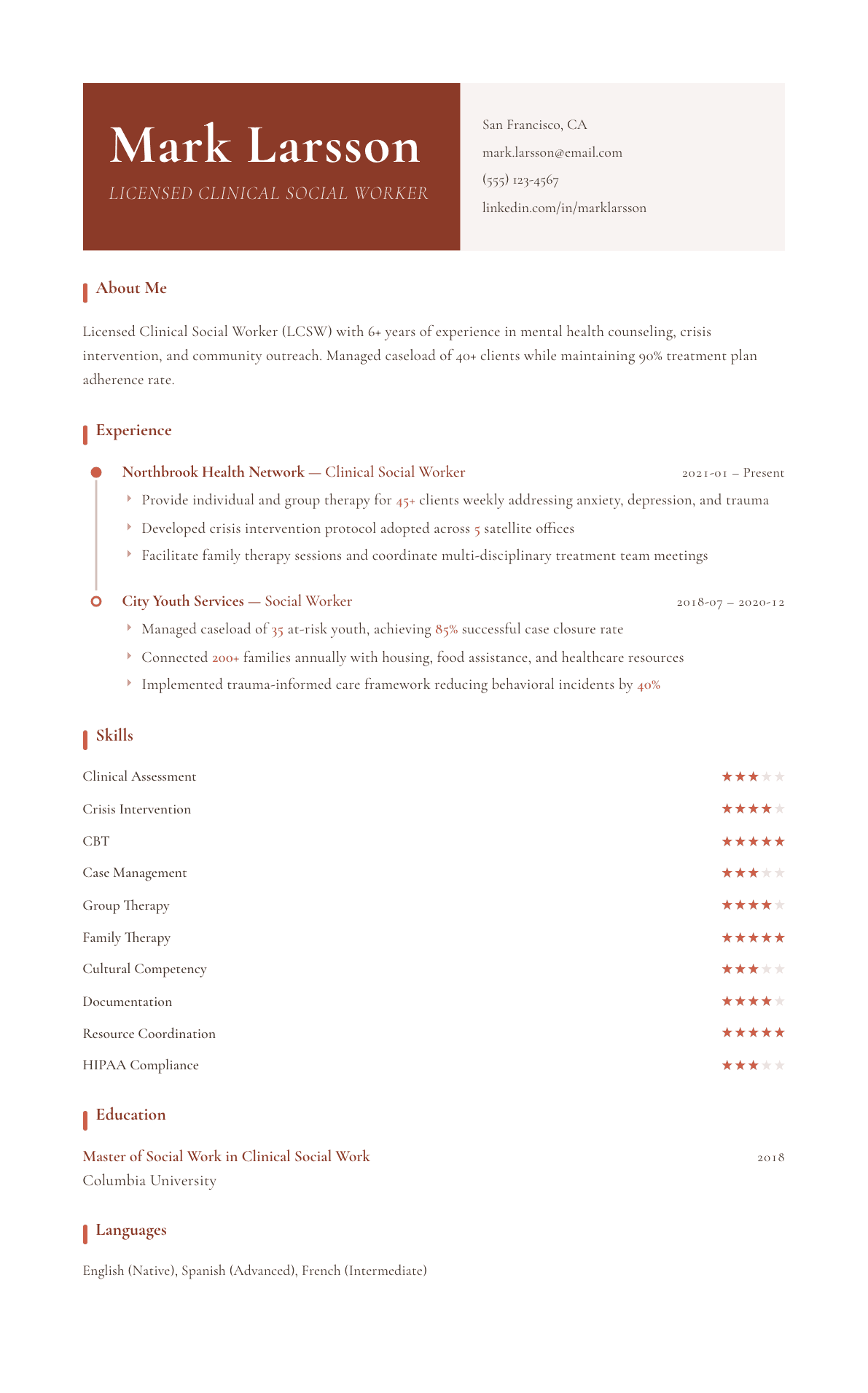
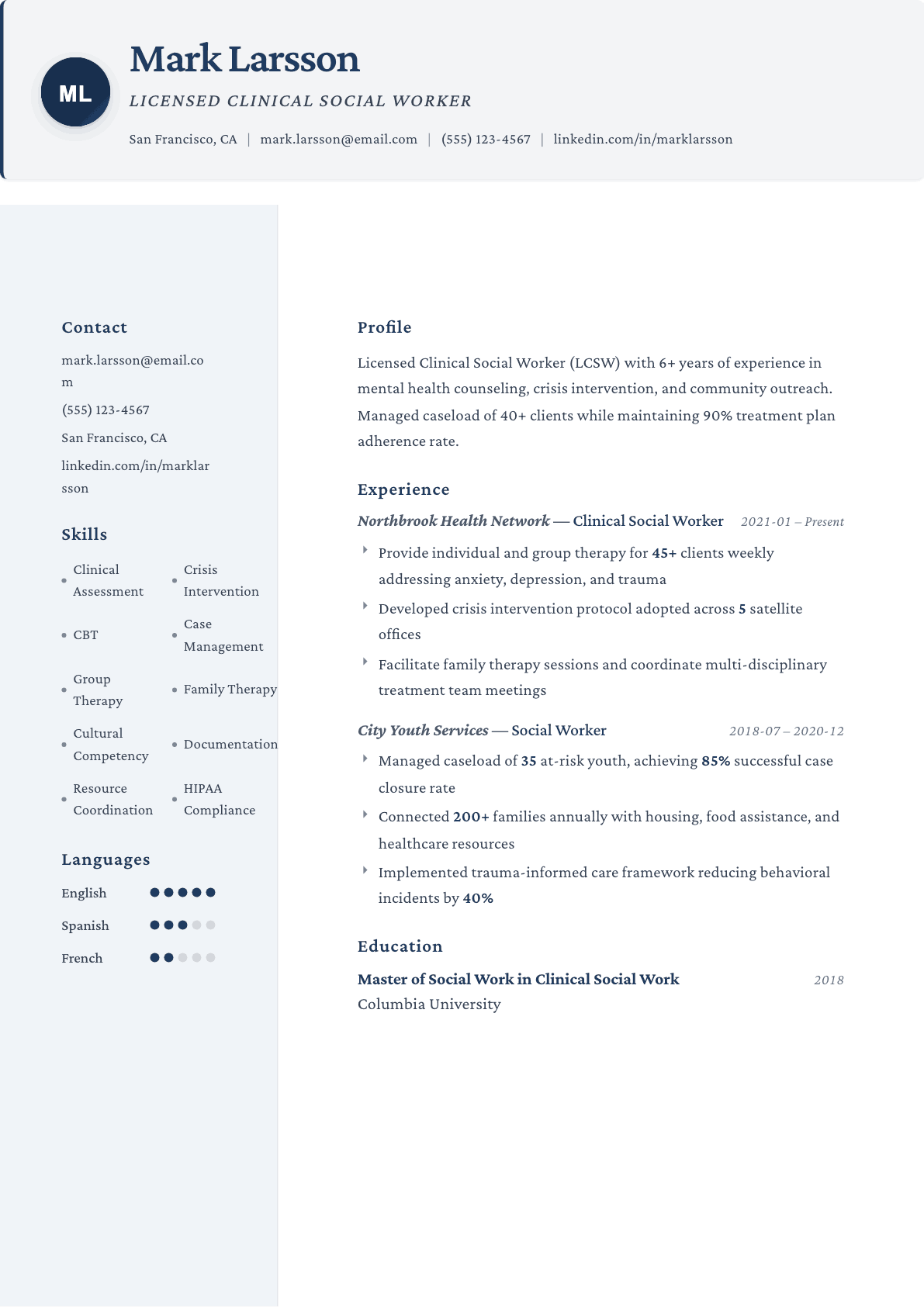
The same social worker content laid out in three CVBooster templates, so you can see what the finished document looks like before you write a word.
Example Social Worker summary
LCSW with 6 years in community mental health, currently 45 clients a week in individual, group and family therapy for anxiety, depression and trauma. Wrote the crisis intervention protocol now used across five offices, and previously carried 35 at-risk youth cases to an 85% successful closure rate.
Skills to list on a Social Worker resume
- Clinical Assessment
- Crisis Intervention
- CBT
- Case Management
- Group Therapy
- Family Therapy
- Cultural Competency
- Documentation
- Resource Coordination
- HIPAA Compliance
What actually gets this resume read
- List your license (LCSW, LMSW) and any specialized certifications.
- Quantify caseload sizes, outcome rates, and client populations served.
- Highlight specific therapeutic modalities (CBT, DBT, EMDR).
- Show community partnership and resource coordination skills.
- Include crisis intervention and de-escalation experience.
How to write a social worker resume
A social worker resume is filtered on licensure before anything else. Human resources checks whether you hold the credential the posting requires in the right state, whether it is current, and whether you are supervised or independent. A clinical role that requires an LCSW will not advance an LMSW no matter how strong the clinical writing is, so the license line is the single most important line on the page.
After that, the hiring supervisor reads for setting and population. Child welfare, school social work, hospital discharge planning, community mental health, hospice, corrections and integrated primary care are distinct practice worlds with different documentation, different acuity and different legal exposure. Naming yours precisely is what makes the rest of your experience legible.
This guide covers where credentials go, which social work skills belong on a resume and how to write them out, how to write caseload and clinical bullets that show judgment rather than task completion, summaries for a new MSW graduate through a clinical supervisor, and the mistakes that keep strong practitioners from getting interviews.
Format: license in the header, one page early, two later
Put your credentials after your name in the standard order: degree, then license, then any specialty certification. Then repeat the license in its own section near the top with the type, the state and the expiration. If you hold licenses in more than one state, list them all, since agencies near a state line filter on exactly that.
Keep the layout plain and avoid columns. Hospital and county systems run applicant tracking software that reads a single column reliably and a two-column design unpredictably, and losing your license line to a parsing error is a costly way to learn that.
- Header: name with credentials, city and state, phone, email.
- Order: summary, licenses and certifications, clinical or practice experience, field placements for new graduates, education, skills.
- New graduates put education and field placements above employment history.
Summary: license, setting, population, modality
Three lines. State the license and state, the practice setting, the population and age range, and the modalities you actually practice rather than the ones you read about. A supervisor filling a role in community mental health for adults with serious mental illness is looking for a specific match, and generic language about helping people delays them finding it.
If you are pre-licensure and accruing supervised hours, say so with the numbers. Being two hundred hours from clinical licensure is useful information for an employer planning coverage.
Experience: caseload, acuity, and the decisions you made
Every job needs the setting, the caseload size and the population. A caseload of eighteen intensive outpatient clients is different work from a caseload of ninety in child welfare, and the number is the fastest way to communicate the pace and the risk you carried.
Then write bullets that show clinical or practice judgment. Biopsychosocial assessment and treatment planning, risk assessment and safety planning, mandated reporting decisions, crisis intervention and involuntary hold evaluation, discharge planning against a bed deadline, and coordination with courts, schools, probation or managed care. These are the moments a supervisor is trying to picture you in.
Name the modalities and be exact about your training. Cognitive behavioral therapy, dialectical behavior therapy, motivational interviewing, trauma-focused approaches, solution-focused brief therapy and family systems approaches all appear in postings. If you completed formal training in one, say who trained you.
- Setting, caseload size, population and age range for each role.
- Assessment and treatment planning, with the tools or screeners used.
- Risk and safety work: suicide risk assessment, safety plans, crisis response.
- Systems coordination: courts, schools, probation, insurers, housing, medical teams.
- Documentation: the electronic record used and the standards you met.
Documentation and compliance: say it plainly
Documentation is a large share of the job and a common reason people are let go, so treat competence there as an asset. Name the electronic health record, the note format you write in, the timeliness standard you held, and any audit or utilization review you passed. Meeting medical necessity criteria for continued authorization is a real skill and rarely appears on a resume.
Add the legal and ethical frame: confidentiality practice, mandated reporting, informed consent, release of information, and the standards that govern protected health information. Supervisors read these as evidence you will not create liability.
Social work skills on a resume, written out
A skills section for a social worker resume works best in three short groups: clinical skills, systems and case management skills, and documentation and compliance skills. A flat list of twenty words such as empathy and communication tells a supervisor nothing, while a grouped list that matches the posting tells her you know what the job is made of. Each skill you list should also appear inside at least one experience bullet, where it sits on real work.
Here is a skills section written out for an invented hospital social worker, Renata Okafor, LCSW, so you can see the level of detail that reads as practice rather than vocabulary.
- Clinical: biopsychosocial assessment, suicide risk assessment with the Columbia scale, safety planning, motivational interviewing, crisis intervention.
- Systems and case management: discharge planning, skilled nursing and home health referrals, adult protective services reports, insurance authorization.
- Documentation and compliance: Epic notes within the shift, medical necessity language, release of information, mandated reporting.
- Experience bullet that proves the list: Completed discharge plans for an average of 9 medical floor patients a day, coordinating placements with families, payers and community agencies before the bed deadline.
Supervision, field education and the path to independence
If you provide clinical supervision, say how many supervisees and whether you are approved by your state board, because supervision capacity is scarce and agencies hire for it. If you receive supervision, name the hours accrued and the target license.
Field instruction counts too. Supervising MSW interns, serving as a task supervisor, or acting as a field liaison for a school of social work shows a level of standing that a job title alone does not.
Social Worker resume summary examples
New MSW graduate
MSW graduate and licensed LMSW with 2 field placements totaling 900 hours in a school district and an adult outpatient clinic. Trained in motivational interviewing and safety planning, experienced with biopsychosocial assessment, and accruing supervised hours toward clinical licensure.
Five years in
LCSW with 5 years in community mental health carrying a caseload of 32 adults with serious mental illness and co-occurring substance use. Practices CBT and motivational interviewing, completes annual assessments and treatment plans, and covers the crisis line rotation.
Clinical supervisor
LCSW and board-approved supervisor with 12 years across hospital and outpatient behavioral health, currently supervising 6 clinicians and 2 MSW interns. Built the intake and risk screening protocol, and led the transition of the clinical record to a new documentation system.
Work experience bullets: before and after
Before: Provided case management services to clients.
After: Carried a caseload of 32 adults with serious mental illness and co-occurring substance use, completing annual biopsychosocial assessments, monthly treatment plan reviews and same-week crisis follow-up.
Caseload size, population and the review rhythm tell a supervisor exactly what pace you have sustained.
Before: Conducted risk assessments when needed.
After: Completed suicide risk assessments using a structured screening tool, developed written safety plans with clients and named supports, and initiated 9 emergency evaluations over 2 years with documented rationale.
Naming the tool, the safety plan and the documented rationale demonstrates defensible clinical judgment.
Before: Coordinated with outside agencies on behalf of clients.
After: Coordinated care with probation, the county housing authority and a primary care team, attended 20 court hearings a year, and secured supportive housing placements for 14 clients on my caseload.
Naming the systems and the placements shows systems work with an outcome rather than a round of phone calls.
Before: Maintained client documentation in a timely manner.
After: Documented all sessions in Epic within 24 hours, met medical necessity criteria for continued authorization on every utilization review, and passed 2 chart audits with no corrective action.
The record system, the authorization standard and the audit result turn timeliness into a verifiable claim.
Before: Supervised interns and newer staff.
After: Provided weekly clinical supervision to 6 clinicians and 2 MSW interns as a board-approved supervisor, and built a case consultation group that reviewed high-risk cases every other week.
Board approval, the number supervised and a named structure prove supervision rather than informal mentoring.
Hard skills
- Biopsychosocial assessment
- Treatment planning and review
- Suicide risk assessment and safety planning
- Crisis intervention and de-escalation
- Cognitive behavioral therapy
- Motivational interviewing
- Trauma-informed practice
- Case management and resource coordination
- Discharge and transition planning
- Mandated reporting and confidentiality practice
- Clinical documentation in Epic and Cerner
- Utilization review and medical necessity criteria
Soft skills
- Clinical judgment under pressure
- Boundaries with high-need clients
- Advocacy inside systems
- Difficult family conversations
- Nonjudgmental engagement
- Self-care and burnout management
Certifications worth listing
- Licensed Clinical Social Worker (LCSW) (State social work licensing boards)
- Licensed Master Social Worker (LMSW) (State social work licensing boards)
- Academy of Certified Social Workers (ACSW) (National Association of Social Workers)
- Certified Clinical Trauma Professional (CCTP) (Evergreen Certifications)
- Certified Case Manager (CCM) (Commission for Case Manager Certification)
Mistakes that cost social worker candidates the interview
- Leaving the license type, state and expiration off the resume, which stalls the file at the first human resources screen.
- Writing about helping people rather than the assessments, safety plans and coordination that make up the actual practice.
- Omitting caseload size, so a supervisor cannot judge whether you have carried their volume and acuity.
- Claiming a modality you have read about instead of one you were trained in and can discuss in an interview.
- Skipping documentation and audit results, when documentation failure is a common reason clinicians lose jobs.
- Using a two-column template with icons, since county and hospital parsers frequently misread the columns.
- Sending the same resume to a child welfare posting and a hospice posting rather than reordering for the setting.
Social Worker resume questions
Where should I put my social work license on a resume?
After your name in the header, then again in a dedicated section near the top with the license type, the issuing state and the expiration date. Multi-state licensure belongs there too, because agencies near a border and telehealth employers screen for it directly.
Should a new MSW graduate list field placements?
Yes, and treat them as experience. Give each placement the agency, the setting, the population, the total hours and two or three bullets on the clinical work you did. Drop them once you have a couple of years of paid practice behind you.
What social work skills should I put on a resume?
List the skills the posting names that you can prove: assessment, risk and safety planning, crisis intervention, the modalities you were trained in, case management and the record system you document in. Group them as clinical, systems and documentation skills, and back each one with an experience bullet.
How much clinical detail is safe to include?
Describe practice patterns, never individual clients. Caseload size, populations, modalities, assessment tools and systems coordination are all appropriate. Anything that could identify a person is a confidentiality problem and a supervisor will notice immediately.
How do I change practice settings, for example from child welfare to hospital social work?
Name the move in the summary and lead each job with the transferable clinical work: risk assessment, crisis response, family engagement, interdisciplinary coordination and documentation under deadline. Then add any relevant training that closes the setting-specific gap.
Related resume examples
- Counselor Resume example
- Human Resources Resume example
- Nurse Resume example
- Case Manager Resume example
- Licensed Professional Counselor Resume example
- Licensed Clinical Social Worker Resume example