Community Health Worker Resume Examples: free ATS score
Build a Community Health Worker Resume Around Reach and Outcomes
By Mustafa Tarabya, founder of CVBooster · Published · Updated
Community health worker resume sample with outreach numbers, chronic disease examples, language skills and a complete writing guide.
Sample resumes for a community health worker
The same community health worker content laid out in three CVBooster templates, so you can see what the finished document looks like before you write a word.
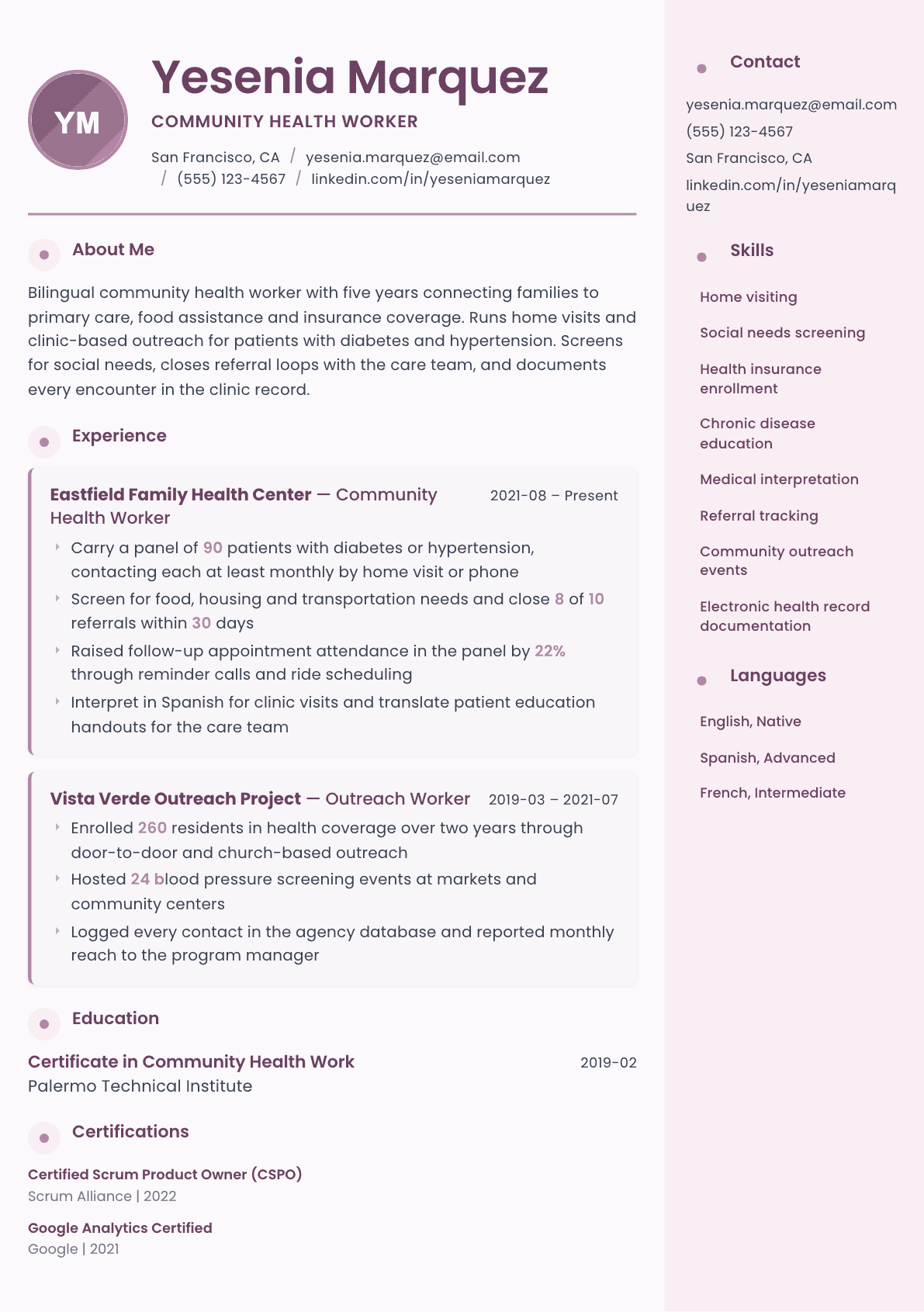
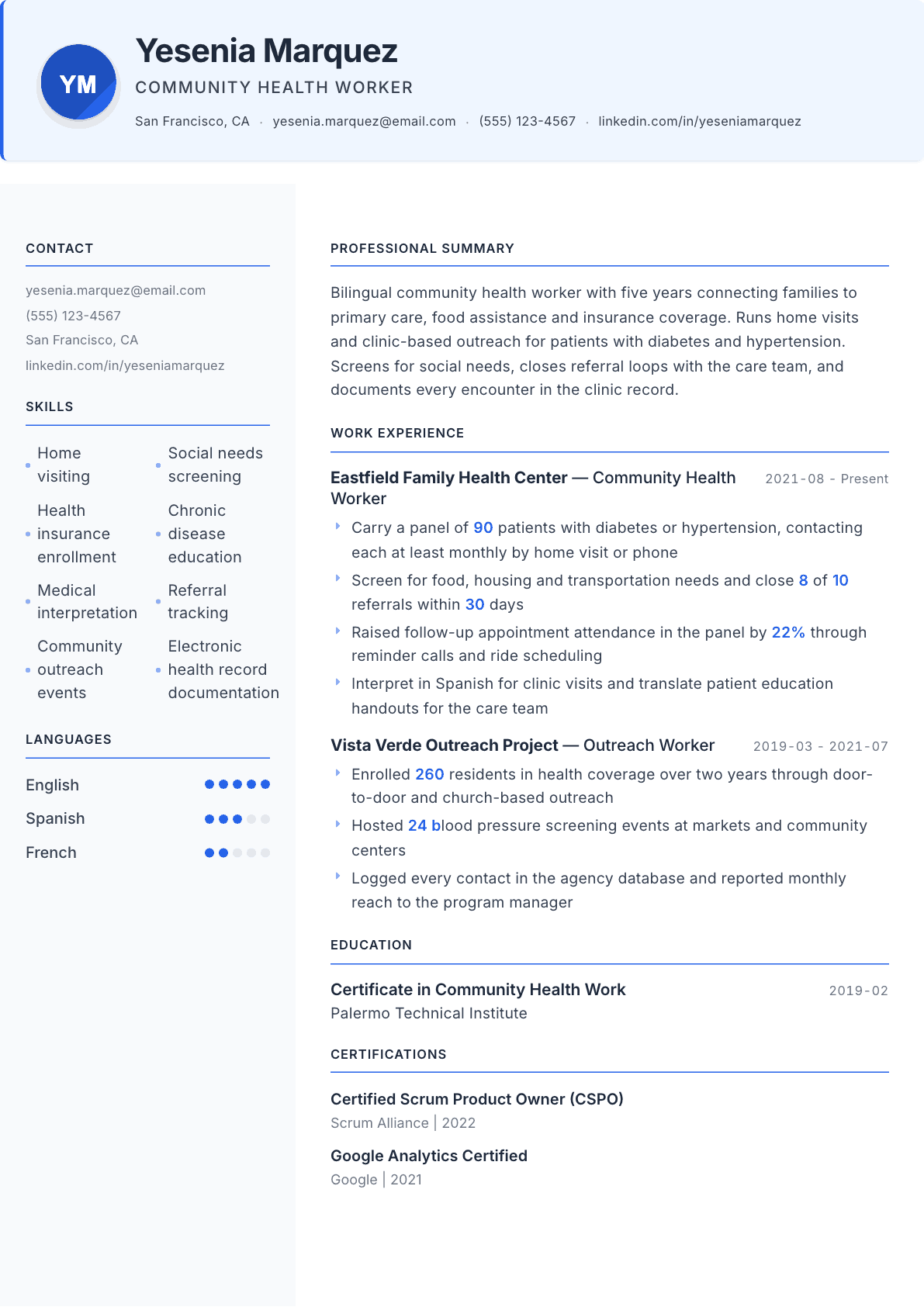
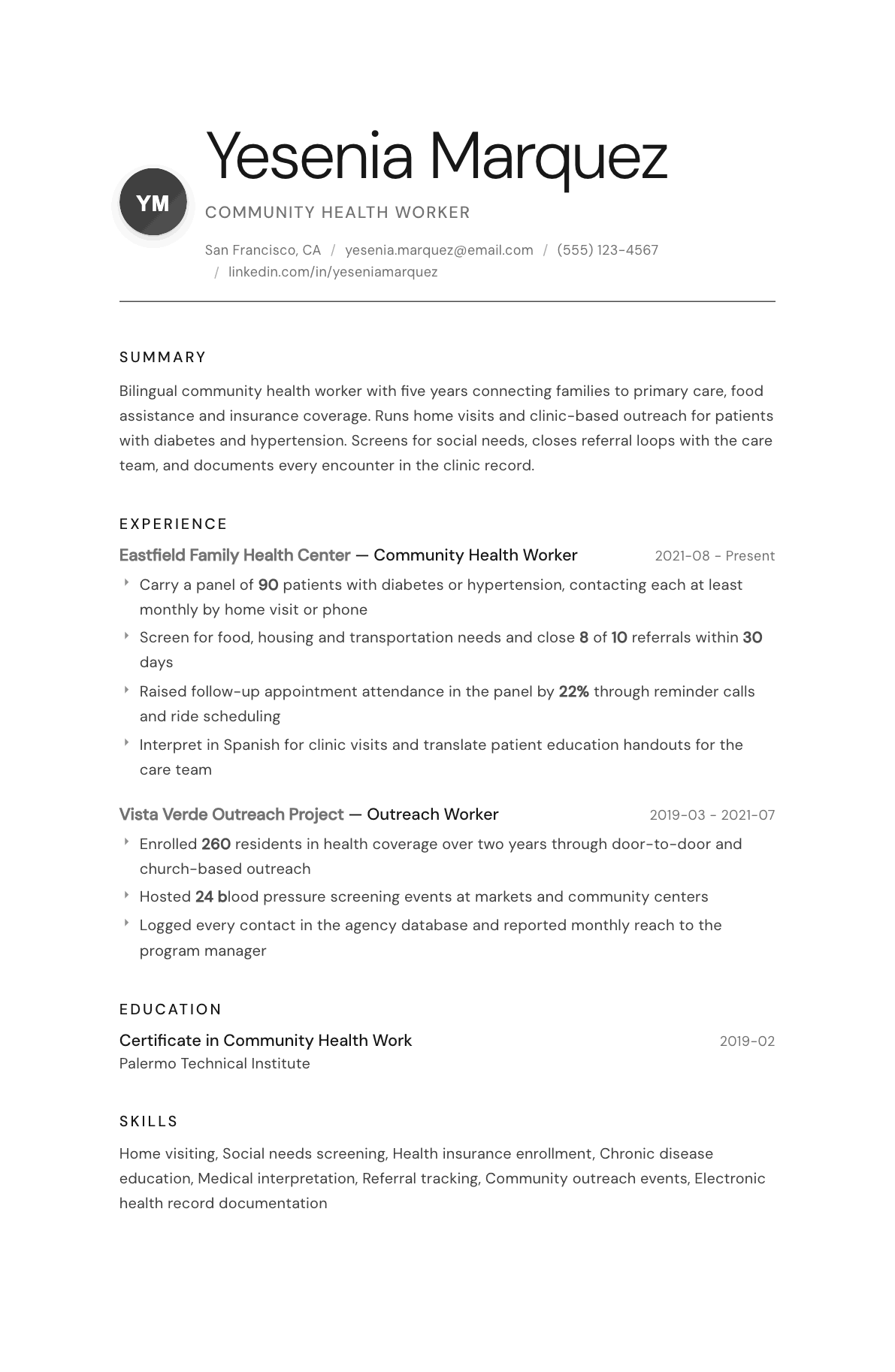
Example Community Health Worker summary
Bilingual community health worker with five years in clinic outreach and home visiting for families managing diabetes and hypertension. Carries a panel of 90 patients, screens for food, housing and transportation needs, and closes most referrals within a month. Enrolls residents in coverage, interprets in Spanish during visits and documents each encounter in the clinic record.
Skills to list on a Community Health Worker resume
- Community outreach
- Home visiting
- Social determinants screening
- Health insurance enrollment
- Chronic disease self-management support
- Motivational interviewing
- Medical interpretation
- Referral coordination
- Care team collaboration
- Health education workshops
- Patient navigation
- Appointment adherence follow-up
- Electronic health record documentation
- Community asset mapping
What actually gets this resume read
- Open with the population you serve and the condition focus, because clinics hire for a specific patient panel.
- Give panel size and contact frequency so a supervisor can judge the caseload you are used to carrying.
- Count closed referrals, not referrals made, since closing the loop is what the role is funded to do.
- List every language you speak and whether you interpret formally, because bilingual reach is often the deciding factor.
- Name the record system you document in and any registry or outreach tracker you kept up to date.
- Show community trust work such as church, market or school partnerships that produced measurable enrollment.
How to write a community health worker resume
A community health worker is hired for reach, not for clinical skill. The program manager reading your resume wants to know whether patients who ignore the clinic will answer your call, whether you can get to a home in a neighborhood staff avoid, whether you speak the language the panel speaks, and whether the referral you make will actually close. Clinical language on the page does not answer any of that.
The second reader is often a grant coordinator, because most community health worker positions are funded by a specific award with specific numbers attached: enrollments, screenings, home visits, closed referrals, appointment adherence. A resume that carries those units already speaks the language of the report the coordinator has to file.
This guide builds the page around panel, contact and closure, with example summaries for a new worker, an experienced one and a senior worker leading a team, before and after bullets that show the difference specifics make, and the questions that come up when people move from volunteer outreach into a paid clinic role.
Name the population, the setting and the condition focus in the first line
Community health work is population specific. A worker on a diabetes panel in a federally qualified health center does different daily work from one doing maternal home visits, one supporting people leaving incarceration, or one enrolling families in coverage at a mobile unit. Put the population, the setting and the condition focus into the summary and into each job line.
Then say where the contact happens, because that is the real skill divide. Home visiting, street outreach, clinic based navigation, phone panel management and community event work each require different comfort and different logistics. A manager staffing a home visiting team screens hard for candidates who have already knocked on doors.
- Job line: employer, program focus, the panel or caseload size, and the neighborhoods or catchment served.
- Say whether contacts were in the home, on the street, in clinic, by phone or through group education.
- List every language you speak and whether you interpreted formally during medical visits.
Panel size and contact frequency give the reader your capacity
Say how many patients you carried and how often you touched each one. A panel of ninety contacted monthly is a different job from a panel of three hundred contacted quarterly, and both are real. Add the mix, since a worker who does eight home visits a week plus phone follow-up has a schedule a manager can immediately picture.
Engagement rate deserves a line of its own. Community health workers exist because clinics cannot reach certain patients, so the share of assigned patients you actually reached, and how many attempts it took, is the clearest proof of value you can put on a page.
Count closed referrals, not referrals made
Anyone can hand out a phone number. The job is closing the loop: confirming the patient reached the food pantry, got the utility assistance, kept the specialist appointment, or was enrolled in coverage. Report closures and the window they closed in, and name the resources you worked with often enough to know the intake staff by name.
Social needs screening belongs here too. Say which screening tool your clinic used, how many screenings you completed, and what you did with a positive result. Health systems are building this workflow constantly, and a candidate who has already run it saves months of training.
Show that you belong on the care team
A community health worker who cannot document or cannot speak in a huddle stays outside the team, and program managers know it. Say which record system you chart in, what your note looks like, and whether you present patients in daily huddle or weekly case review with nurses and providers.
Add the coaching side: chronic condition education, medication adherence support, blood pressure or glucose monitoring taught in the home, and motivational interviewing training. Be careful to stay inside scope. Describing education and support rather than clinical assessment shows you understand where your role ends, which is exactly what a supervising nurse checks for.
- Name the electronic health record or outreach tracker and your documentation turnaround.
- Say how you participate in huddle, case conference or care team rounds.
- List the health education curricula you were trained to deliver and the group sizes you led.
Trust, community roots and the keywords programs screen for
The part of this job that cannot be trained is standing in a community that already knows you. If you grew up in the catchment, worship there, or have run events with a tenant association, a barbershop or a church, say so in a way that stays professional. Programs hire for that credibility openly.
For keywords, match the vocabulary the posting uses: social determinants of health, patient navigation, care coordination, health coaching, outreach and enrollment, closed loop referral, chronic disease self-management, and the specific condition names. Use each once where it describes work you did rather than in a stacked list.
Community Health Worker resume summary examples
First clinic role
Bilingual community health worker with one year of outreach and enrollment experience, having signed up 260 residents for health coverage through door-to-door and church-based canvassing. Hosts blood pressure screening events, logs every contact in the agency database, and completed a community health work certificate program.
Four years on a panel
Community health worker with four years supporting a panel of 90 patients living with diabetes or hypertension, contacting each monthly by home visit or phone. Screens for food, housing and transportation needs, closes most referrals within thirty days, and interprets in Spanish during clinic visits.
Senior worker and trainer
Senior community health worker with eight years across street outreach and clinic navigation, now mentoring five workers and running the social needs screening workflow for three sites. Built the closed loop referral process with local pantries and utility programs, and reports monthly reach to the grant coordinator.
Work experience bullets: before and after
Before: Connected patients to community resources.
After: Screened a panel of 90 patients for food, housing and transportation needs and closed 8 of 10 referrals within thirty days by confirming intake directly with each partner agency.
Closing a referral is the actual job, and the closure rate plus the confirmation method proves you did it.
Before: Did home visits for patients with chronic conditions.
After: Completed eight home visits a week for patients with uncontrolled diabetes, teaching glucose logging and reviewing medication routines against the discharge instructions in the chart.
Visit volume, condition focus and the specific teaching content show what happens inside the home, not just that you went.
Before: Helped people sign up for insurance.
After: Enrolled 260 residents in health coverage over two years through evening canvassing, church partnerships and a standing table at the weekend market, verifying documents on site.
Enrollment volume with the channels and the on-site verification detail shows an outreach strategy rather than a task.
Before: Improved patient appointment attendance.
After: Raised follow-up appointment attendance across the panel by 22% using reminder calls two days out, ride scheduling through the transportation benefit, and same-day rebooking after a missed visit.
Naming the three interventions behind the number lets a manager reproduce the result with her own team.
Before: Worked with doctors and nurses at the clinic.
After: Presented panel patients in daily care team huddle, flagged barriers the provider could not see from the chart, and documented every encounter in the health record the same day.
Huddle participation and same-day charting show you function inside the care team rather than alongside it.
Hard skills
- Community outreach and canvassing
- Home visiting
- Social needs screening
- Closed loop referral tracking
- Health coverage enrollment support
- Chronic disease self-management education
- Blood pressure and glucose monitoring education
- Motivational interviewing
- Medical interpretation
- Care team huddle participation
- Electronic health record documentation
- Community asset mapping
Soft skills
- Trust building in the neighborhood
- Persistence with unreachable patients
- Cultural humility
- Plain language explanation
- Boundary awareness within scope
- Reliability across a route
Certifications worth listing
- Certified Health Education Specialist (CHES) (National Commission for Health Education Credentialing)
- Community Health Worker Certification (Texas Department of State Health Services)
- Mental Health First Aid (National Council for Mental Wellbeing)
- Basic Life Support (BLS) (American Heart Association)
Mistakes that cost community health worker candidates the interview
- Writing the resume in clinical language, which makes a program manager wonder whether you understand the limits of the role.
- Listing referrals made instead of referrals closed, the difference that funders and grant coordinators actually count.
- Hiding language skills at the bottom, when bilingual capacity is frequently the reason one candidate is chosen over another.
- Leaving out panel size and contact frequency, so nobody can judge the caseload you are used to carrying.
- Skipping documentation entirely, when unentered visits mean unbilled and unreported work for the program.
- Describing community ties vaguely instead of naming the partnerships that produced measurable enrollment or attendance.
Community Health Worker resume questions
Do I need a certification to work as a community health worker?
Requirements vary widely. Some states run a formal certification and some employers only require a training certificate plus community experience. List whatever you hold with the issuing body, and name the training hours if your state has an approved curriculum.
How do I turn volunteer outreach into resume experience?
Treat it like a job entry with an organization, dates and numbers. Count the residents reached, the events you staffed, the enrollments you completed and the follow-up you handled. Unpaid outreach counts when it is written with the same units as paid work.
Should I mention that I live in the community I serve?
Yes, if you can state it professionally. Say that you are rooted in the catchment and name the partnerships that grew from it, such as a congregation, a tenant association or a market. Programs hire community health workers specifically for that credibility.
How do I show impact when the clinic tracks outcomes, not me?
Use the process measures you control: patients reached, visits completed, screenings finished, referrals closed and appointments kept. If your panel improved on a clinic measure and you contributed, describe your interventions rather than claiming the whole result.
What length should a community health worker resume be?
One page in nearly every case. This role is judged on reach, languages, community ties and documentation habits, all of which fit comfortably. A second page usually means daily tasks were listed instead of outcomes and coverage.
Related resume examples
- Outreach Coordinator Resume example
- Social Worker Resume example
- Peer Support Specialist Resume example
- Case Manager Resume example
- Social Services Assistant Resume example
- Family Support Worker Resume example