Hospital Social Worker Resume Examples: read this first
Write a Hospital Social Worker Resume Built for Discharge Planning
By Mustafa Tarabya, founder of CVBooster · Published · Updated
A hospital social worker resume guide covering discharge planning keywords, unit detail, psychosocial assessment examples, and an acute care sample.
Sample resumes for a hospital social worker
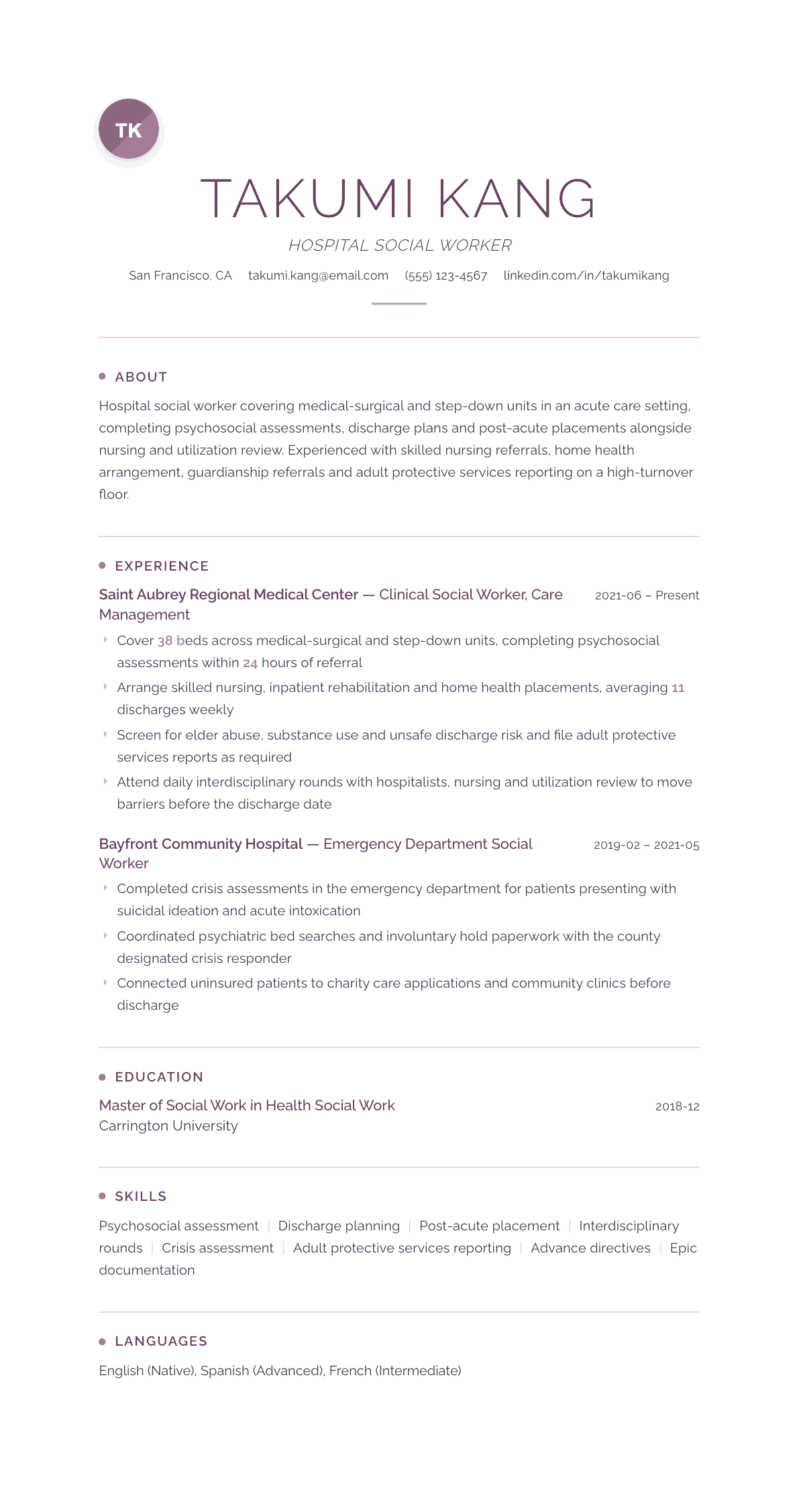
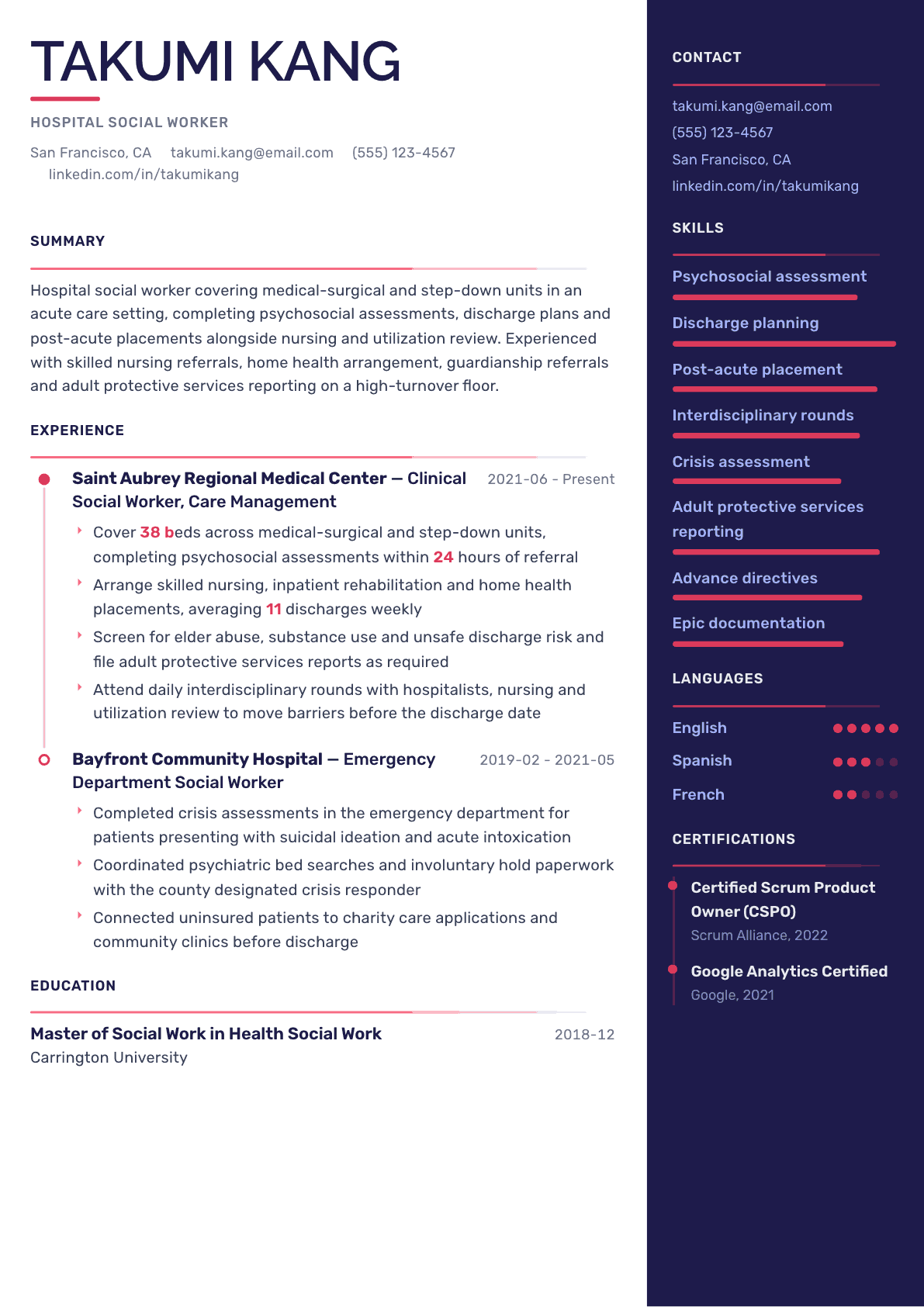
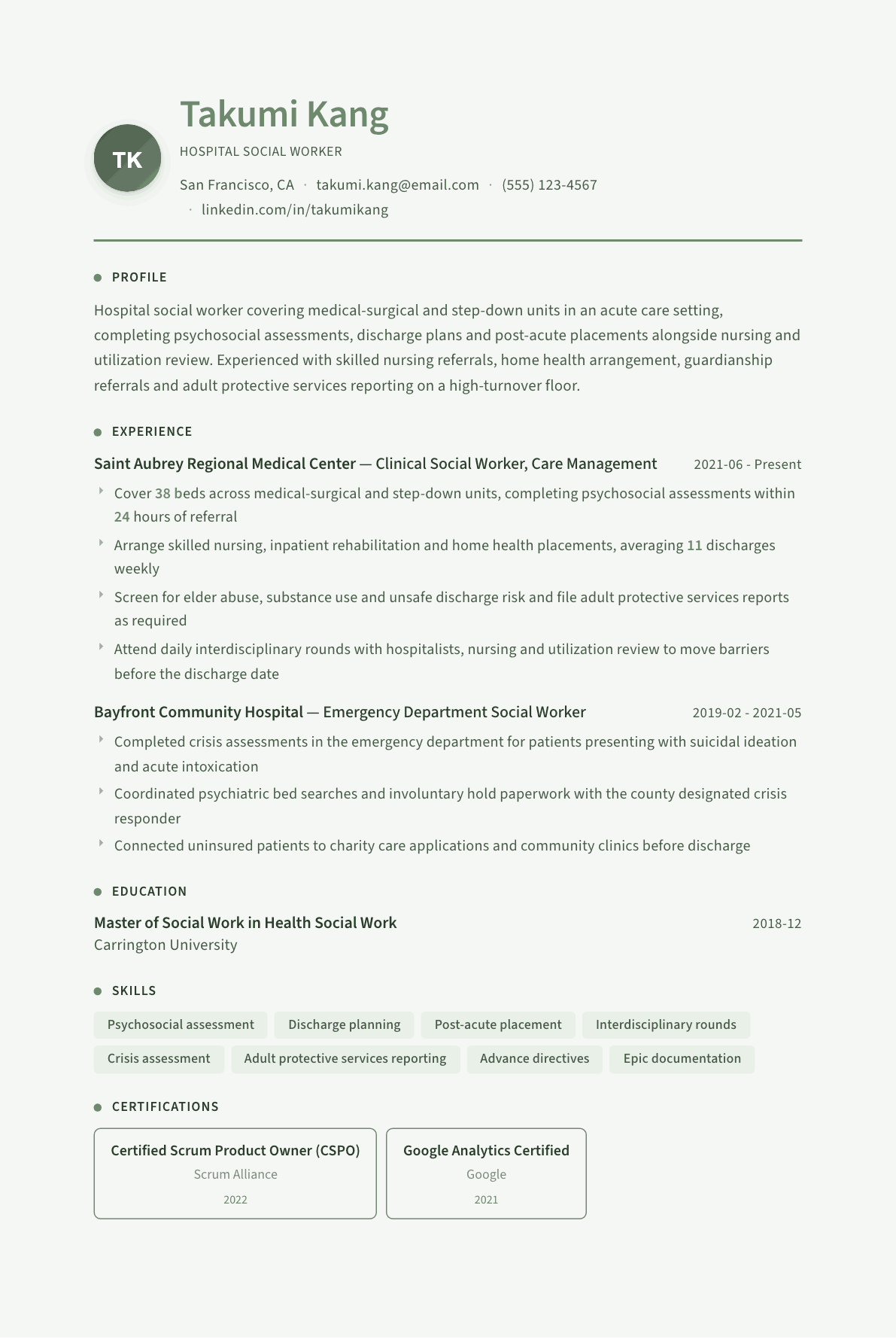
The same hospital social worker content laid out in three CVBooster templates, so you can see what the finished document looks like before you write a word.
Example Hospital Social Worker summary
Hospital social worker with six years in acute care, covering medical-surgical, step-down and emergency department referrals. Completes psychosocial assessments on tight timelines, arranges skilled nursing and home health placements, and screens for unsafe discharge, elder abuse and substance use. Works closely with hospitalists and utilization review to clear discharge barriers early. Seeking a care management role in a larger trauma center.
Skills to list on a Hospital Social Worker resume
- Psychosocial assessment
- Discharge planning
- Post-acute care placement
- Skilled nursing referral
- Home health coordination
- Hospice and palliative referral
- Advance directives and POLST
- Adult protective services reporting
- Crisis and suicide risk assessment
- Substance use screening and referral
- Interdisciplinary rounds
- Utilization review collaboration
- Guardianship referral
- Epic documentation
What actually gets this resume read
- Name the units you covered and the bed count, because an emergency department and an oncology floor need different skills.
- Give discharge volume: assessments completed, discharges arranged weekly, and average length of stay pressure.
- List the post-acute settings you placed into, from skilled nursing to inpatient rehabilitation and hospice.
- Show the interdisciplinary side by naming rounds, utilization review partnership and physician communication.
- Include the electronic health record and any readmission reduction work you contributed to.
- State your license type and level, since acute care postings often require independent clinical licensure.
How to write a hospital social worker resume
Acute care runs on discharge, and a hospital social worker resume is read through that lens. The care management director hiring you is watching length of stay, avoidable days and readmission penalties. They are not looking for a therapist. They are looking for someone who can complete a psychosocial assessment before rounds, find a skilled nursing bed for a patient with no insurance and no family, and do it again eleven times that week without the floor backing up.
The second thing they check is whether you can hold your ground in an interdisciplinary conversation. Hospitalists want the patient out, families want another day, utilization review wants the documentation, and the patient wants to go home to a house with stairs and no railing. A resume that shows you have lived inside that pressure, with the unit types and the volumes to prove it, moves to the top.
This guide sets out the section order a care management director reads, how to describe unit coverage and discharge volume, the credentials that matter in acute care, three summaries across a hospital social work career, and bullets rewritten to show clinical decisions rather than tasks.
Format: license level, then units and bed coverage
One to two pages, reverse-chronological. Put your license type and state under your name, because many acute care postings require independent clinical licensure and some units require it by policy. Directly under the summary, list the units you have covered with bed counts.
Hospitals run large applicant systems that parse plain text well and complex layouts badly. Keep the unit list as simple lines rather than a graphic, and never put your license in a header or footer where the parser drops it.
- Header: name with credentials, location, phone, email, and the clinical license type with its state.
- Order: summary, licensure and certifications, hospital experience by setting, other clinical experience, education.
- Note shift coverage and weekend rotation experience, since acute care staffs seven days.
Summary: setting, units, volume, and the hard discharges
Name the hospital type, the units, the bed coverage and the weekly discharge volume. A social worker covering thirty-eight beds across medical-surgical and step-down units, completing psychosocial assessments within a day of referral and arranging eleven discharges a week, has described the job in one sentence a director recognizes.
Then add the discharges nobody wants. Uninsured patients needing post-acute care, patients without decision-making capacity and no proxy, homelessness at discharge, guardianship referrals, and patients declining a safe plan. Those are the cases that fill the director inbox, and experience with them is the differentiator.
Experience: assessment timing, placement, and barrier clearing
Lead each position with unit coverage and volume, then write bullets around the discharge process. Psychosocial assessment turnaround from referral, the screening tools used, placement types arranged from skilled nursing through inpatient rehabilitation, home health, hospice and shelter, and how insurance authorization was handled for each.
Barrier clearing deserves its own bullets. Daily interdisciplinary rounds, escalation to the attending when a plan stalls, coordination with utilization review on avoidable days, family meetings when goals of care shift, and the negotiation with a post-acute facility that has already declined the patient once. This is where the job actually is.
Include the protective and crisis work. Adult protective services reports, suicide risk assessment in the emergency department, substance use screening and warm handoffs to treatment, involuntary hold paperwork, and child protective reporting from the pediatric or obstetric units. Acute settings expect all of it.
- Give assessment turnaround in hours and discharge arrangements per week.
- Name the post-acute settings you placed into, not just the word discharge.
- Show interdisciplinary practice: rounds attendance, physician escalation, utilization review partnership.
- Include readmission or avoidable day work if you contributed to a project on either.
Regulatory and payer knowledge that carries weight
Acute care social work sits on top of specific requirements: discharge planning notice, patient choice in post-acute referral, observation status conversations, advance directive documentation and the reporting duties that come with abuse and neglect concerns. Name the ones you handled routinely, because a director wants to know what they will not have to teach.
Payer literacy matters too. Understanding what insurance will authorize for skilled nursing versus inpatient rehabilitation, and what happens when authorization is denied, shapes whether a discharge plan is realistic. Say that you worked with authorization rather than leaving the reader to assume it.
Keywords hospital applicant systems screen on
Hospital postings reuse the same set: psychosocial assessment, discharge planning, care management, transitions of care, post-acute placement, length of stay, avoidable days, readmission, interdisciplinary rounds, advance directives, adult protective services, crisis assessment, patient choice and utilization review. Match the posting wording once in your skills block and once in a bullet.
Name the electronic health record. A director estimating orientation time reads that line and moves you up or down accordingly.
Hospital Social Worker resume summary examples
New to acute care
Master-level social worker with a hospital field placement on a medical-surgical floor, completing psychosocial assessments, arranging home health referrals and observing daily rounds. Trained in suicide risk screening and comfortable charting in an electronic health record. Seeking a care management position with structured orientation on a general medicine unit.
Five years on the floors
Hospital social worker covering 38 beds across medical-surgical and step-down units, completing psychosocial assessments within 24 hours of referral and arranging about 11 discharges weekly. Places into skilled nursing, inpatient rehabilitation and home health, and files adult protective services reports when a discharge is unsafe. Comfortable escalating stalled plans in rounds.
Care management lead
Care management lead with eleven years in acute care spanning emergency, intensive care and oncology coverage. Supervises four social workers, runs the weekly avoidable days review with utilization review, and owns the guardianship and unfunded placement escalation path. Built the transitions of care handoff used by two post-acute partners.
Work experience bullets: before and after
Before: Completed assessments for patients on the unit.
After: Covered 38 beds across medical-surgical and step-down units, completing psychosocial assessments within 24 hours of referral and flagging discharge barriers before the anticipated discharge date.
Bed coverage, turnaround and early barrier identification tell a director whether the floor will keep moving.
Before: Arranged placement for patients leaving the hospital.
After: Arranged skilled nursing, inpatient rehabilitation and home health placements averaging 11 discharges weekly, including insurance authorization and patient choice documentation for each referral.
Placement types, weekly volume and the authorization step show the whole process rather than the word placement.
Before: Worked with doctors and nurses on patient care.
After: Attended daily interdisciplinary rounds with hospitalists, nursing and utilization review, escalating stalled discharge plans to the attending the same day a barrier appeared.
Naming who is in the room and what you do when a plan stalls demonstrates the escalation behavior a director needs.
Before: Reported concerns about patient safety.
After: Screened for elder abuse, self-neglect and unsafe discharge risk, filed adult protective services reports where indicated, and documented capacity concerns for guardianship referral.
The specific concern types and the actions taken show a worker who recognizes and acts, not one who merely reports.
Before: Helped patients without insurance find resources.
After: Connected uninsured patients to charity care applications, county clinics and medication assistance before discharge, cutting repeat emergency department returns among that group.
Named resources and the downstream effect make the work legible to a director watching return visits.
Hard skills
- Psychosocial assessment
- Discharge planning
- Post-acute placement
- Skilled nursing and rehabilitation referral
- Home health and durable medical equipment coordination
- Hospice and palliative referral
- Advance directive and POLST documentation
- Adult protective services reporting
- Suicide risk assessment
- Substance use screening and warm handoff
- Interdisciplinary rounds
- Utilization review collaboration
- Guardianship referral process
- Electronic health record charting
Soft skills
- Rapid rapport with families in crisis
- Assertiveness with physicians
- Triage under competing demands
- Difficult conversation about goals of care
- Composure in the emergency department
- Negotiation with post-acute partners
Certifications worth listing
- Certified Case Manager (CCM) (Commission for Case Manager Certification)
- Accredited Case Manager, Social Work (ACM-SW) (American Case Management Association)
- Advanced Certified Hospice and Palliative Social Worker (ACHP-SW) (National Association of Social Workers)
- Basic Life Support (BLS) (American Heart Association)
Mistakes that cost hospital social worker candidates the interview
- Presenting the role as counseling, when the position being filled is discharge planning under length of stay pressure.
- Leaving out unit types and bed counts, so an oncology floor and an emergency department read as the same assignment.
- Skipping placement volume, which is the one number a care management director uses to compare candidates.
- Never mentioning payer authorization, which suggests you have only worked where someone else handled it.
- Omitting weekend and holiday coverage history, when the hardest shifts to staff are exactly those.
- Using agency terminology such as client throughout, which signals no acute care experience to a hospital reader.
Hospital Social Worker resume questions
Do hospitals require clinical licensure for social work positions?
It varies by hospital and unit. Emergency and behavioral health roles often require independent clinical licensure, while general care management positions may accept a master-level license. List exactly what you hold with the state, and note if you are accruing supervised hours toward the clinical license.
How do I move from community social work into a hospital?
Lead with assessment speed, documentation discipline and coordination across agencies, which are the transferable pieces. Then name any exposure you have to discharge planning, home health referral or hospice. The gap directors worry about is pace, so any evidence of high-volume turnaround matters.
What does a hospital social worker resume need that other social work resumes do not?
Unit types with bed counts, assessment turnaround time, weekly discharge volume, post-acute placement settings and rounds participation. Those five items describe the operational reality of acute care and are missing from almost every resume written in agency language.
Should I include emergency department experience separately?
Yes, list it as its own position or its own block. Emergency work carries different skills: crisis assessment, psychiatric bed search, involuntary hold paperwork and rapid safety planning. Hospitals staffing an emergency social work role screen for that specifically and will not infer it from floor coverage.
How do I show readmission work without claiming credit for hospital results?
Describe your contribution rather than the institutional number. Say you completed follow-up calls within a set window, built a handoff form with a post-acute partner, or joined the readmission review committee. That is honest, specific, and still tells a director you understand what the metric is for.
Related resume examples
- Social Worker Resume example
- Case Manager Resume example
- Geriatric Social Worker Resume example
- Housing Case Manager Resume example
- Community Health Worker Resume example
- Chaplain Resume example