Insurance Broker Resume Examples: the lines they read
Craft an Insurance Broker Resume That Wins Placement Work
By Mustafa Tarabya, founder of CVBooster · Published · Updated
Insurance broker resume example with book of business, commission revenue and market submission bullets, plus ATS keywords and a full writing guide.
Sample resumes for a insurance broker
The same insurance broker content laid out in three CVBooster templates, so you can see what the finished document looks like before you write a word.
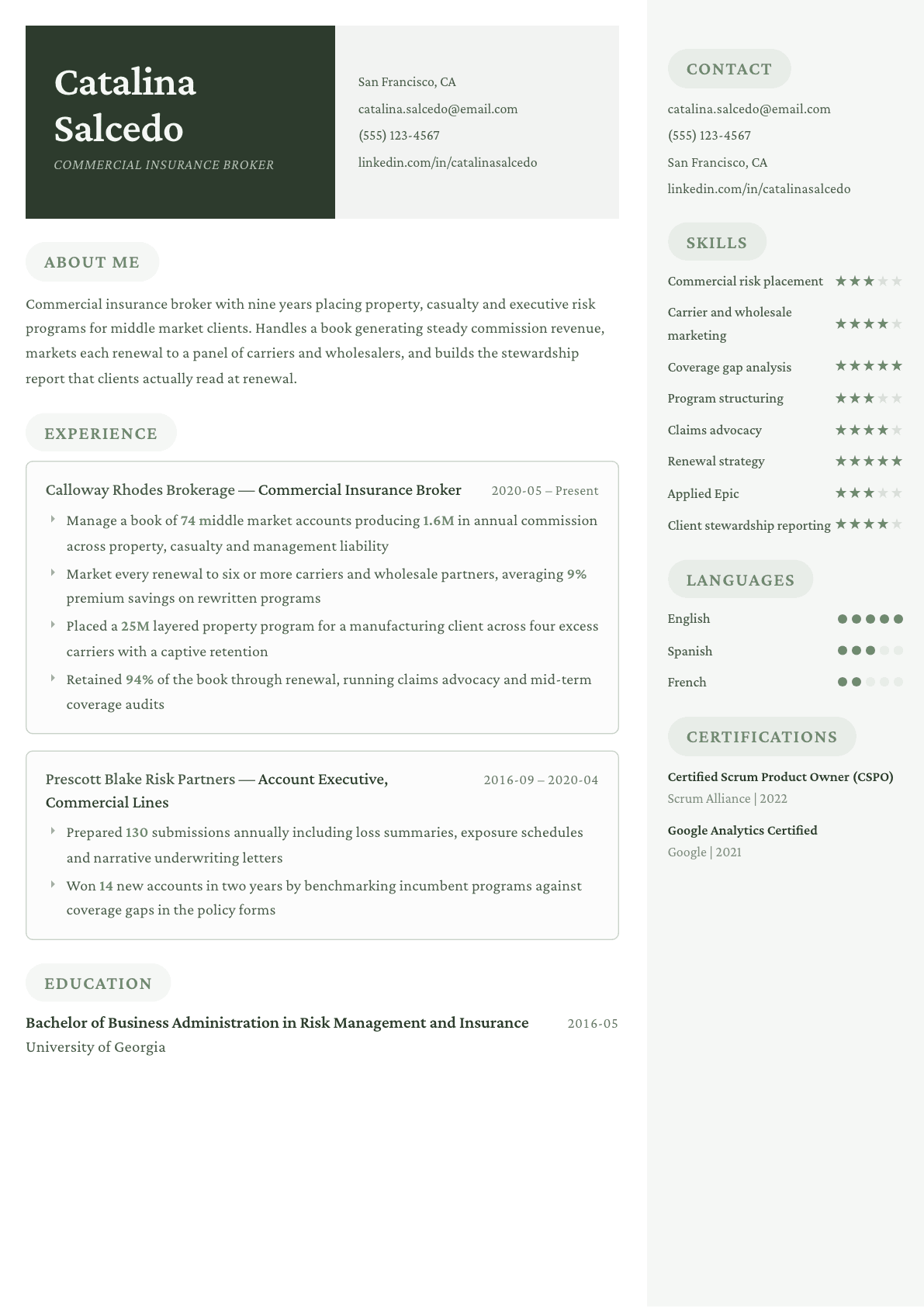
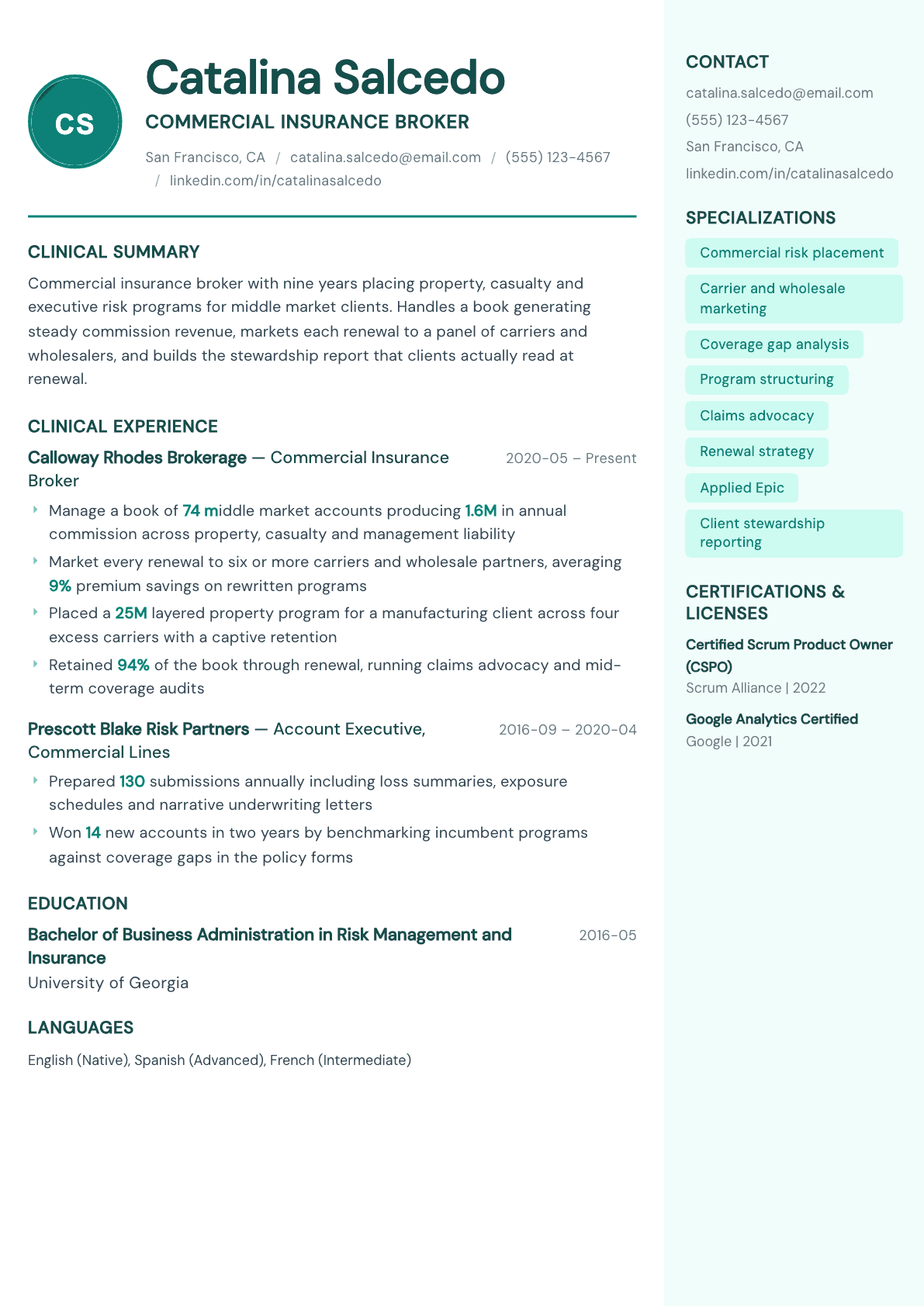
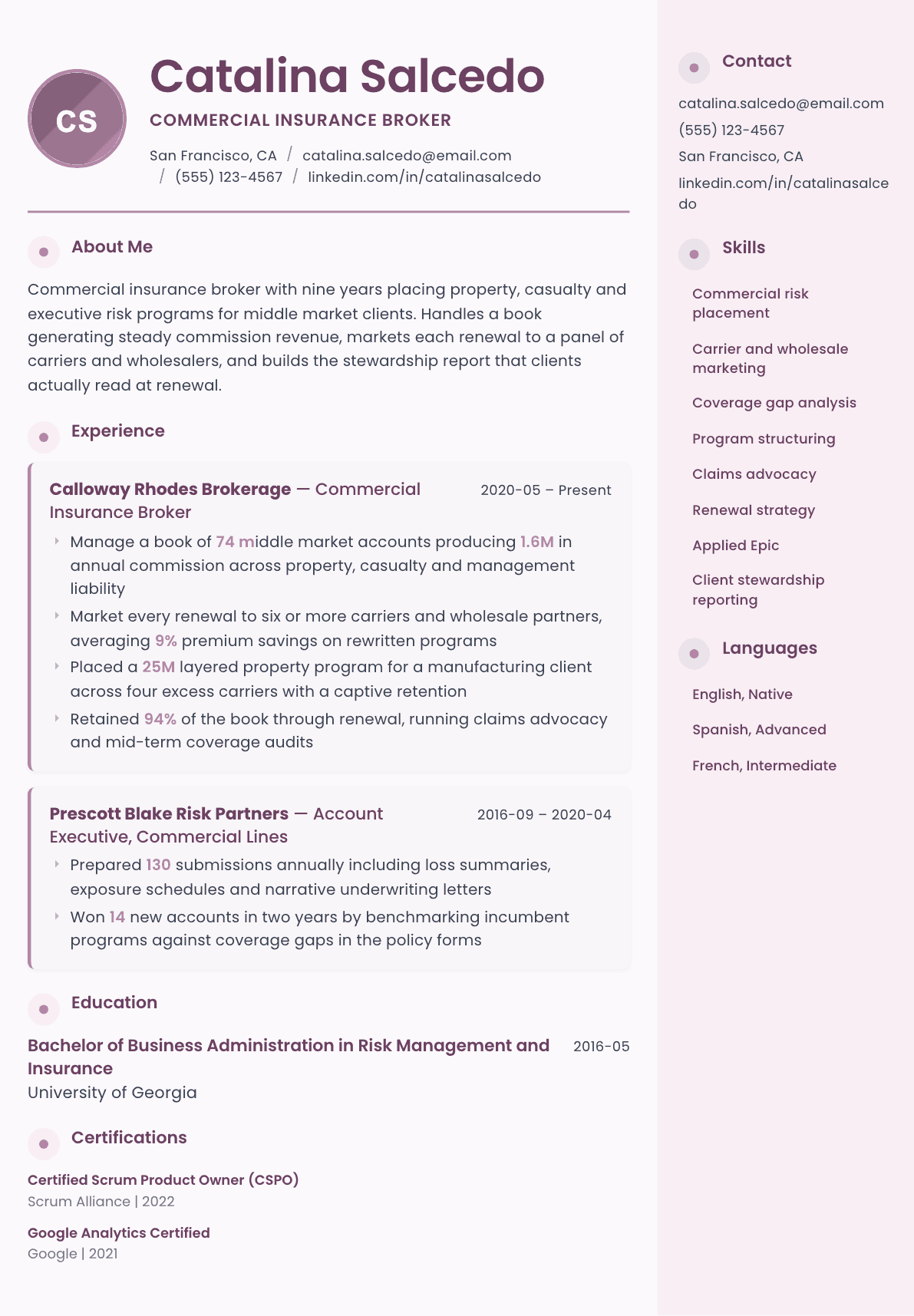
Example Insurance Broker summary
Commercial insurance broker with nine years placing property, casualty and management liability programs for middle market clients. Handles a book of seventy-four accounts, markets each renewal to at least six carrier and wholesale partners, and has retained more than nine in ten accounts through renewal. Structured a layered property tower with a captive retention, and runs claims advocacy and stewardship reporting for every named account.
Skills to list on a Insurance Broker resume
- Commercial risk placement
- Carrier and wholesale marketing
- Submission preparation
- Coverage gap analysis
- Program and tower structuring
- Excess and surplus lines
- Claims advocacy
- Renewal and retention strategy
- Loss summary analysis
- Contract and certificate review
- Stewardship reporting
- New business development
- Applied Epic
- Surplus lines compliance
What actually gets this resume read
- Open every job with the book size in accounts and commission revenue, since brokerage leadership reads production before anything else.
- Name the lines and industries you place, whether construction casualty, real estate property, cyber or management liability programs.
- Show how you market a renewal: the number of carriers approached, the wholesalers used, and the premium or coverage result you delivered.
- Describe one complex placement in detail, a layered tower or a captive structure, because structure work separates brokers from order takers.
- Include retention percentage and new business won, and say whether you sourced the accounts yourself or serviced a house book.
- List your resident license, surplus lines authority if you hold it, and real designations such as CPCU, ARM or CIC with the issuing body.
How to write a insurance broker resume
Brokerage leadership reads a resume as a revenue document. The first questions are how large your book is, what it produces in commission and fee income, how much of it you sourced yourself, and whether it will follow you. Everything else, the coverage knowledge and the market relationships, is the explanation for those numbers.
The second read is about placement skill. Anyone can send a submission to five markets. A broker earns the title by structuring a program: choosing retentions, building a layered tower, deciding when a captive or a group program beats the open market, and negotiating wording rather than accepting the form the carrier offered.
This guide sets out how an insurance broker resume should be ordered, how to present the book and the placements without overstating them, three summaries across career stages, before and after bullets, and the questions brokers ask when they move between firms.
Format: production first, then the placements that prove it
One page works until you have a decade of accounts, then two. Single column, plain type. Put a production block immediately under the summary: account count, commission and fee revenue, retention rate, and new business written in the last full year.
Then open each role with the book description: segment, industries, average account size and revenue range of the clients. A broker on middle market construction and one on small commercial packages are not interchangeable, and the reader should never have to work that out.
- Header: name, city and state, phone, email, resident license and surplus lines authority.
- Order: summary, production highlights, experience, notable placements, systems, education, designations.
- Say whether the book was inherited, house-assigned or self-produced.
Summary: book, revenue, and one program you built
Four lines at most. Name the lines you place, the segment, the revenue your book carries, and one structural placement that shows range. A broker who mentions a layered property tower or a loss-sensitive casualty program in the summary has already answered the technical question a producer interview will circle back to.
If you are moving from a carrier underwriting seat to brokerage, use the summary to say it and to name the advantage: you know how the market prices the risk you are about to market. That is a real argument and few candidates make it explicitly.
Experience: marketing, structuring, and retention
Write bullets in three groups. Marketing: how many carriers and wholesalers you approach on a renewal, what the submission package contains, and the result in premium, coverage or terms. Structuring: the towers, retentions, deductible buy-downs, captive layers and manuscript endorsements you negotiated. Retention and service: renewal retention percentage, claims advocacy, contract and certificate review, and the stewardship reporting you deliver.
One placement told in detail is worth five generic bullets. Give the client industry, the exposure, the structure you built, the markets involved and the outcome. That single bullet is what a brokerage principal will ask about in the interview.
Leave out the administrative lines. Issuing certificates, processing endorsements and maintaining client files belong to an account manager resume, and using them here reads as a step down.
Markets, wholesalers and coverage depth
Name the retail and wholesale markets you work, the excess and surplus lines carriers you access, and the programs or facilities you can place into. Access is part of what a firm is buying when it hires a broker.
Show coverage depth through the forms. Additional insured wording, waiver of subrogation, primary and noncontributory status, anti-indemnity limitations, cyber and management liability towers, and the difference between claims-made and occurrence triggers are the details that prove you read policies rather than proposals.
Licensing, systems and keywords
Keep the resident license, nonresident appointments and surplus lines authority near the top with the states. List the agency management system by name and any analytics or benchmarking tool you use to build client proposals. Then mirror the posting language once each: risk placement, carrier marketing, book of business, renewal retention, claims advocacy, program structuring, submission preparation and new business development.
Insurance Broker resume summary examples
Account manager stepping into broking
Commercial account manager with three years servicing a 40 account middle market book, preparing submissions, loss summaries and renewal proposals. Licensed in property and casualty and completing the second CIC institute. Seeking a producer track seat where I can market renewals and build my own accounts.
Nine years, middle market
Commercial insurance broker managing 74 middle market accounts producing 1.6M in annual commission across property, casualty and management liability. Markets every renewal to six or more carrier and wholesale partners, retains 94% of the book, and placed a 25M layered property tower with a captive retention.
Producer and practice lead
Senior broker and construction practice lead with eighteen years placing wrap-up, contractors casualty and surety programs. Self-produced a book generating 3.2M in revenue, leads a service team of five, and negotiates manuscript wordings directly with London and domestic excess markets.
Work experience bullets: before and after
Before: Managed a book of commercial insurance clients.
After: Managed 74 middle market accounts producing 1.6M in annual commission across property, casualty and management liability, with an average account size near 22K in revenue.
Account count, revenue and average size let a principal value the book instead of imagining it.
Before: Shopped renewals to multiple insurance carriers.
After: Marketed every renewal to six or more carriers and two wholesale partners with a full submission package of loss summaries, exposure schedules and a narrative underwriting letter, averaging 9% premium savings on rewritten programs.
The market count, the package contents and the result show a disciplined process rather than casual shopping.
Before: Placed a large property program for a manufacturing client.
After: Structured a 25M layered property program for a four-plant manufacturer across four excess carriers with a captive retention on the primary layer, closing the placement inside a six-week renewal window.
The structure, the market count and the timeline demonstrate program design, which is the core of the role.
Before: Helped clients with their insurance claims.
After: Ran claims advocacy on 30 open matters a year, including two disputed property losses where policy wording arguments recovered coverage the adjuster had initially denied.
Advocacy becomes credible when it names volume and a contested outcome rather than good intentions.
Before: Kept most of my clients each year.
After: Retained 94% of the book through renewal by delivering a stewardship report each year and running mid-term coverage audits after any material change in operations.
A retention figure plus the two service practices behind it turns a claim into a repeatable method.
Hard skills
- Commercial risk placement
- Carrier and wholesale marketing
- Submission and loss summary preparation
- Program and layered tower structuring
- Excess and surplus lines placement
- Captive and loss-sensitive structures
- Coverage gap and policy form review
- Contract and certificate review
- Claims advocacy
- Renewal strategy and retention
- Stewardship and benchmarking reports
- Applied Epic and agency management systems
Soft skills
- New business prospecting
- Negotiating with underwriters
- Client presentation to boards
- Managing a service team
- Explaining coverage trade-offs
- Working a renewal calendar under pressure
Certifications worth listing
- Chartered Property Casualty Underwriter (CPCU) (The Institutes)
- Associate in Risk Management (ARM) (The Institutes)
- Certified Insurance Counselor (CIC) (The National Alliance for Insurance Education and Research)
- Certified Risk Manager (CRM) (The National Alliance for Insurance Education and Research)
- Registered Professional Liability Underwriter (RPLU) (Professional Liability Underwriting Society)
Mistakes that cost insurance broker candidates the interview
- Giving premium volume instead of commission and fee revenue, which is the number brokerage leadership budgets against.
- Failing to say whether the book was self-produced or house-assigned, since the two carry very different value.
- Filling the page with service tasks that belong on an account manager resume and reading as a lateral step down.
- Describing renewals without naming markets, structures or outcomes, so the placement work is invisible.
- Omitting surplus lines authority when a large part of your book sits in the excess market.
- Naming client companies that are confidential, which raises a professional judgment concern before the interview.
Insurance Broker resume questions
Should I name my clients on a broker resume?
Describe them instead. Give the industry, the revenue band and the exposure profile, for example a four-plant food manufacturer or a mid-rise habitational portfolio. Naming accounts can breach client confidentiality and firms notice when a candidate does it.
How do I show my book will move with me?
You should not promise it in writing. Show that the relationships are yours by describing how the accounts were sourced, the stewardship you deliver and your retention record, then discuss any restrictive covenants in conversation rather than on the page.
What is the difference between a broker resume and an agent resume?
A broker resume emphasizes market access, program structuring and negotiation on behalf of the client, while an agent resume emphasizes production within a carrier appetite. If you place through wholesalers and design retentions, write the broker version.
How do I present a book I inherited from a retiring producer?
Say so plainly and then show what you added: retention on the inherited accounts, coverage improvements, cross-sold lines and new business you produced separately. A candidate who is straight about the source is more credible than one who is not.
Do designations help a broker more than production numbers?
Production comes first, but a designation such as CPCU, ARM or CIC matters when you are entering a technical practice like management liability or construction. List the credential with the issuing body and the completion status.
Related resume examples
- Account Executive Resume example
- Risk Manager Resume example
- Insurance Agent Resume example
- Insurance Underwriter Resume example
- Underwriter Resume example
- Financial Advisor Resume example