Insurance Underwriter Resume Examples: read this first
Write an Insurance Underwriter Resume That Shows Risk Judgment
By Mustafa Tarabya, founder of CVBooster · Published · Updated
Insurance underwriter resume example with authority limits, loss ratio and submission volume bullets, plus keywords and a guide to every section.
Sample resumes for a insurance underwriter
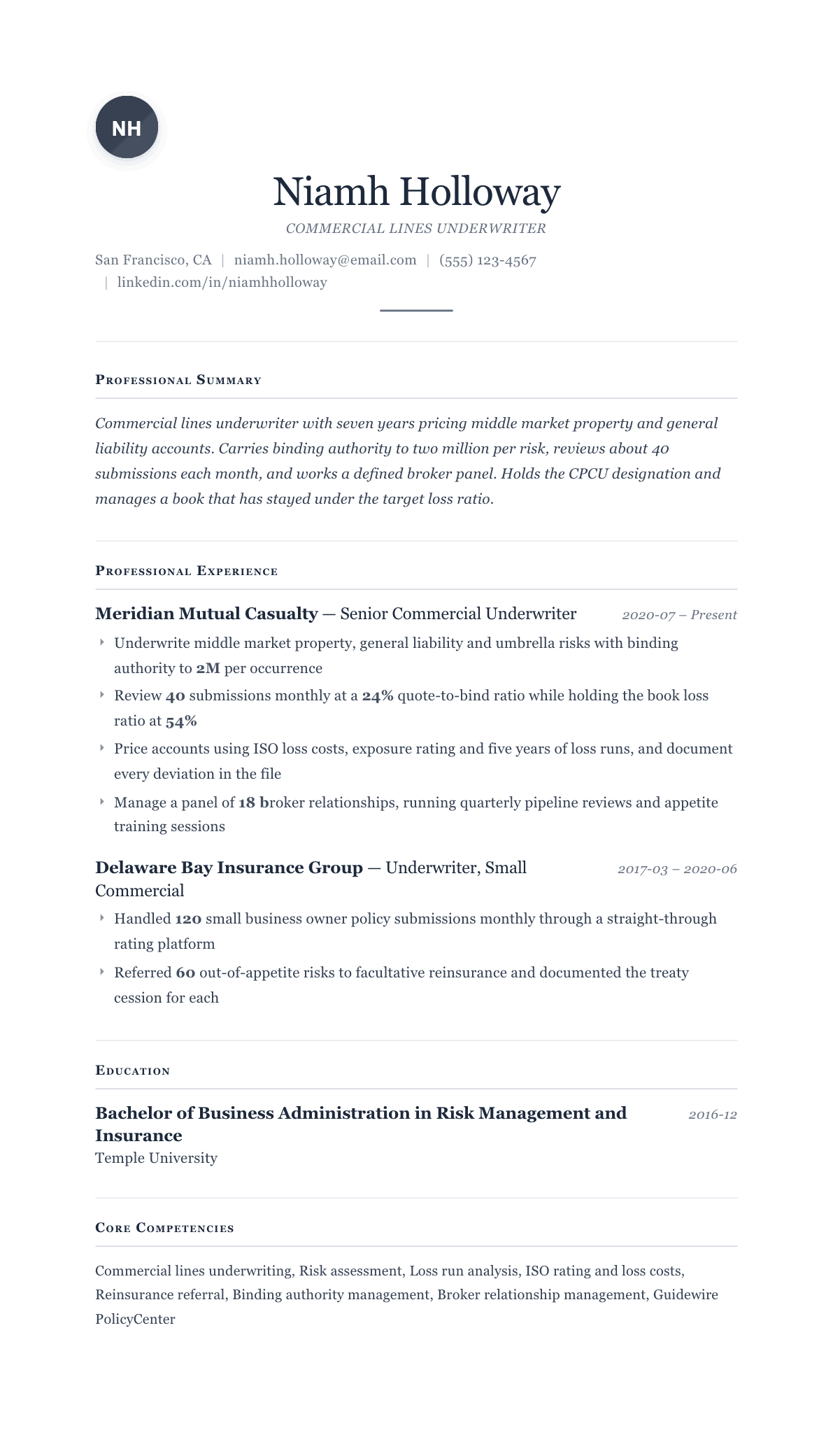
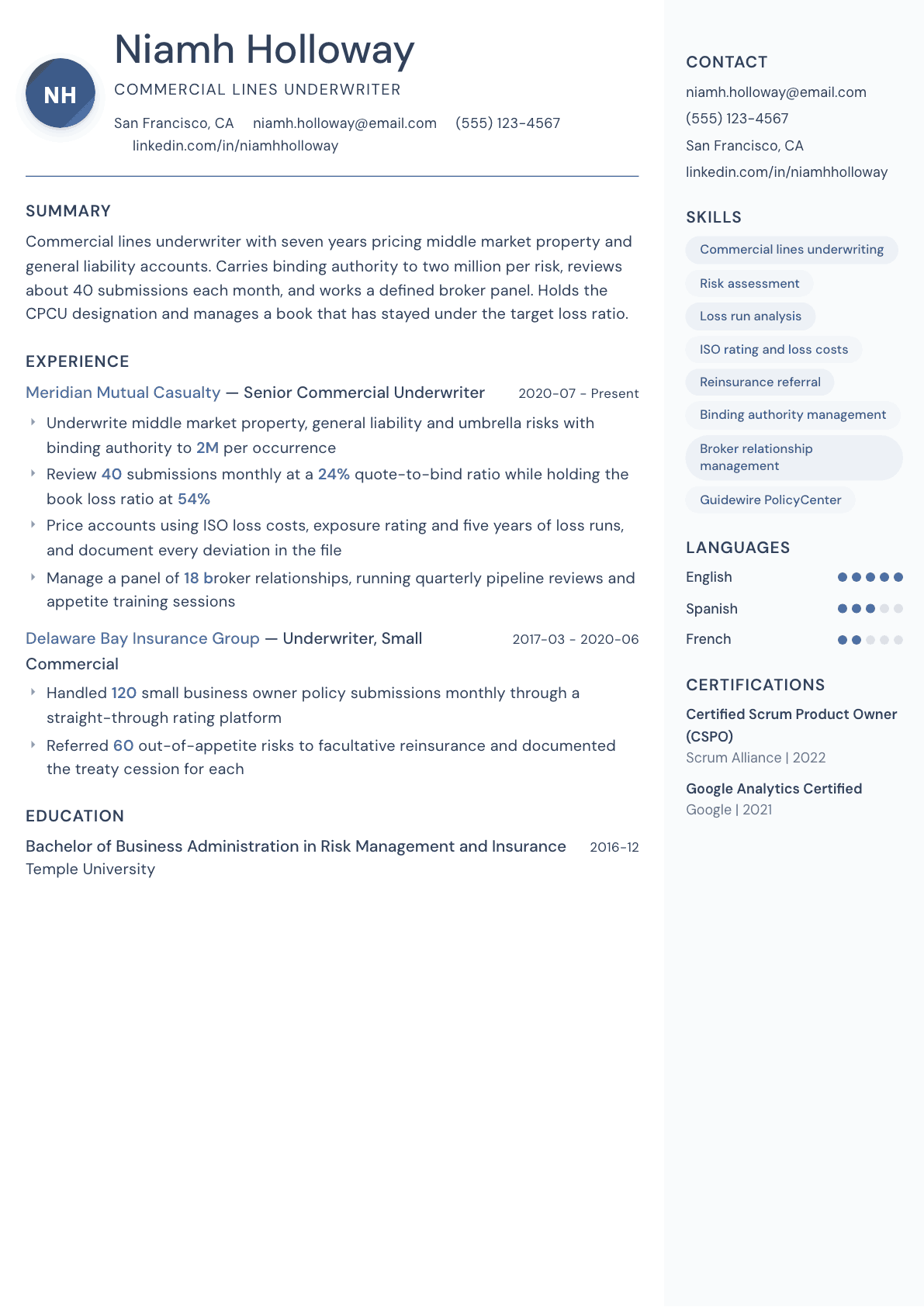
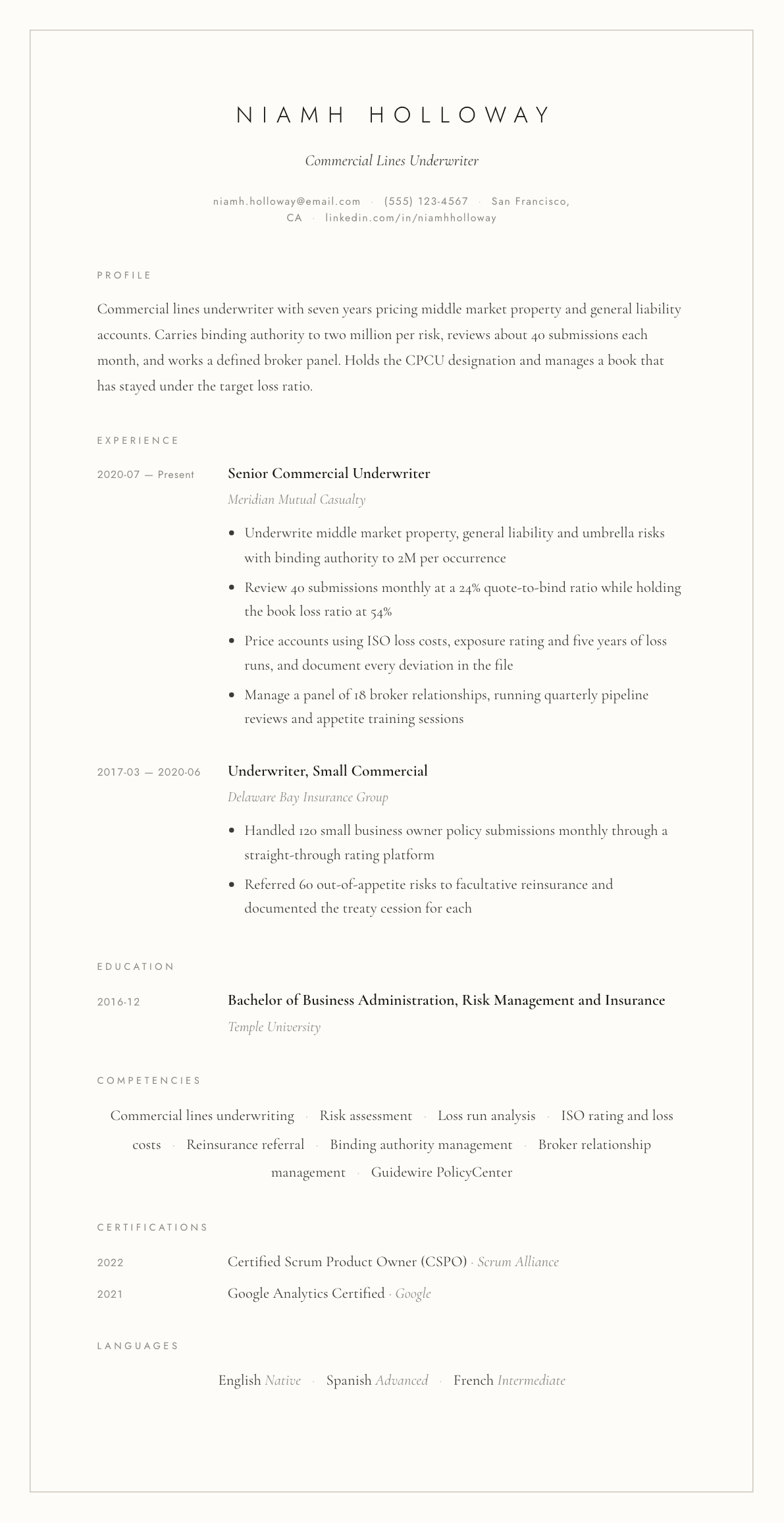
The same insurance underwriter content laid out in three CVBooster templates, so you can see what the finished document looks like before you write a word.
Example Insurance Underwriter summary
Commercial lines underwriter with seven years pricing middle market property, general liability and umbrella risks. Holds binding authority to two million per occurrence, reviews about forty submissions a month, and has kept the book loss ratio below the portfolio target for three straight years. Prices from ISO loss costs and five years of loss runs, and manages an eighteen-broker panel with quarterly appetite reviews.
Skills to list on a Insurance Underwriter resume
- Commercial lines underwriting
- Risk selection and appetite
- Loss run and claims analysis
- Exposure and experience rating
- ISO loss costs
- Schedule rating credits
- Binding authority
- Reinsurance and facultative referral
- Policy wording and endorsements
- Broker and agency management
- Portfolio loss ratio monitoring
- Guidewire PolicyCenter
- Duck Creek
- Regulatory filing compliance
What actually gets this resume read
- State your binding authority limit and the lines you underwrite, because that single fact places you at the right level instantly.
- Give submission volume, quote-to-bind ratio, hit rate and loss ratio on your book, the four numbers an underwriting manager checks.
- Name the classes of business you know well, contractors, habitational, manufacturing or transportation, rather than saying commercial lines only.
- Describe how you priced, whether by ISO loss costs, experience and exposure rating, schedule credits or a proprietary model.
- List the policy administration and rating platforms by name, for example Guidewire PolicyCenter, Duck Creek or Majesco, in your skills block.
- Include real designations such as CPCU or AU from The Institutes, with the completion status, since carriers screen on them directly.
How to write a insurance underwriter resume
Underwriting resumes are read for authority and appetite. The underwriting manager wants to know what you can bind without a referral, which classes of business you have priced, and what your book did over the last few years. Those three facts place you on a grade ladder faster than any list of responsibilities.
The second thing a manager checks is whether you can say no in writing. Underwriting is a documented judgment, so a resume that shows referral discipline, file rationale and clean deviation records reads as lower risk than one full of production language borrowed from the sales side of the house.
This guide walks through the sections an insurance underwriter resume needs, how to state authority and book performance without overclaiming, three summaries at different grades, before and after bullets from real files, and the questions underwriters ask when they move between carriers.
Format: one page early, two once you carry a book
Single column, reverse chronological, no charts. Carriers screen through applicant tracking systems built around class codes, lines of business and system names, so keep the layout parsable and put a skills band under the summary.
Open each role with a scope line: lines underwritten, segment, territory, premium volume and binding authority. An underwriter who writes middle market habitational in three states is a different hire from one handling small business owner policies at high volume, and the reader needs that in the first line.
- Header: name, city and state, phone, email, designations after your name.
- Order: summary, lines and authority, experience, systems, education, designations.
- Name the segment: small commercial, middle market, national accounts, personal lines, specialty or excess.
Summary: authority, lines, and the book result
Three or four lines carrying your years, the lines you price, your binding authority, and one measured book outcome. Loss ratio is the strongest single fact if you can state it fairly, and if you cannot, use growth against plan, hit ratio, or renewal retention on a defined portfolio.
Be honest about the boundary of your authority. Referring above a limit is normal and expected, and an underwriter who states the limit accurately reads as more credible than one who implies unlimited discretion.
Experience: pricing decisions, not submission counts
Bullets should show how you priced and why. Name the inputs: loss runs across five years, exposure schedules, property valuations and construction class, experience modification factors, financial condition of the insured, and any engineering or loss control report you relied on. Then say what you did with them, applied schedule credits, tightened a deductible, added an exclusion, declined the risk, or referred it.
Volume still matters, so give submission count, quote-to-bind ratio and renewal retention. Pair them with the loss ratio so the reader can see whether growth was bought with poor selection. Two underwriters can write the same premium with completely different outcomes.
Add the relationship work. Broker and agency management, appetite training, pipeline reviews and stewardship of a distribution panel are a real part of the job at middle market and above, and they are missing from most underwriting resumes.
Classes, forms and reinsurance
Name the classes you know well rather than claiming all of commercial lines. Contractors, habitational, food processing, transportation, technology, and social services each carry a different hazard profile and a manager is hiring for one of them.
Show that you work at the level of the policy form. ISO forms and endorsements, manuscript wordings, additional insured status, primary and noncontributory language, and anti-stacking provisions are what separates underwriting from rating. If you handled facultative placements or treaty cessions, say which and for what limits.
Systems and screening keywords
List the policy administration and rating platforms you have used, such as Guidewire PolicyCenter, Duck Creek, Majesco or a proprietary carrier system, and any analytics tools you priced with. Then mirror the posting vocabulary once each: risk selection, underwriting guidelines, binding authority, loss ratio, exposure rating, referral, endorsement, renewal retention and appetite. Support each with a bullet rather than repeating it.
Insurance Underwriter resume summary examples
Underwriting assistant moving up
Underwriting assistant with two years supporting small commercial, rating 120 submissions a month in a straight-through platform and ordering loss control reports. Completed three CPCU courses and the Associate in Underwriting core. Seeking an underwriter seat with binding authority on business owner policies.
Seven years, middle market
Commercial lines underwriter pricing middle market property, general liability and umbrella with binding authority to 2M per occurrence. Reviews 40 submissions monthly at a 24% quote-to-bind ratio while holding the book loss ratio at 54%. Manages a panel of 18 brokers across three states.
Senior or lead underwriter
Senior underwriter with fourteen years in specialty casualty, authority to 10M and referral responsibility for a regional team of six. Grew a construction wrap-up book by 18% over three years while improving the accident year loss ratio. Holds the CPCU designation and leads appetite training for distribution partners.
Work experience bullets: before and after
Before: Reviewed and underwrote commercial insurance applications.
After: Underwrote middle market property, general liability and umbrella submissions with binding authority to 2M per occurrence, reviewing 40 accounts a month across three states.
Lines, authority limit, volume and territory place the candidate on the grade ladder immediately.
Before: Priced accounts using company guidelines.
After: Priced accounts from ISO loss costs, five years of loss runs and exposure schedules, applying schedule credits within guideline bands and documenting every deviation in the underwriting file.
Naming the inputs and the documentation habit shows judgment rather than adherence to a rate table.
Before: Maintained a profitable book of business.
After: Held the book loss ratio at 54% over three accident years while growing written premium 9%, achieved by nonrenewing 22 loss-driven accounts and tightening habitational deductibles.
Two numbers moving together plus the specific actions prove selection rather than luck.
Before: Worked with brokers to get new business.
After: Managed a panel of 18 broker relationships with quarterly pipeline reviews and two appetite training sessions a year, lifting the quote-to-bind ratio from 17% to 24%.
The distribution work becomes measurable when it is tied to a hit ratio.
Before: Referred risks that were outside my authority.
After: Referred 60 out-of-appetite risks a year to facultative reinsurance, documenting the treaty cession and the retained limit for each so the ceded balance reconciled at quarter close.
It turns a routine referral into evidence of reinsurance literacy and file discipline.
Hard skills
- Commercial lines underwriting
- Risk selection and appetite management
- Loss run and claims trend analysis
- Exposure and experience rating
- ISO loss costs and class codes
- Schedule rating and credits
- Policy forms and endorsements
- Binding authority administration
- Facultative and treaty reinsurance
- Loss control report interpretation
- Portfolio loss ratio monitoring
- Guidewire PolicyCenter and Duck Creek
Soft skills
- Written underwriting rationale
- Declining a risk without losing the broker
- Negotiating terms and conditions
- Prioritizing a submission queue
- Mentoring assistants
- Cross-functional work with claims and actuarial
Certifications worth listing
- Chartered Property Casualty Underwriter (CPCU) (The Institutes)
- Associate in Commercial Underwriting (AU) (The Institutes)
- Associate in Reinsurance (ARe) (The Institutes)
- Certified Insurance Counselor (CIC) (The National Alliance for Insurance Education and Research)
- Associate in Risk Management (ARM) (The Institutes)
Mistakes that cost insurance underwriter candidates the interview
- Omitting binding authority, which is the fastest signal of level and forces the reader to guess low.
- Claiming all commercial lines instead of naming the classes you have actually priced and declined.
- Reporting premium growth with no loss ratio, which reads as production rather than underwriting.
- Describing the submission workflow instead of the pricing decision, so the resume could belong to an assistant.
- Leaving out the policy administration system, which many carrier postings screen on directly.
- Listing a designation as complete when only some courses are finished, since carriers verify with the issuing body.
Insurance Underwriter resume questions
Should I put my loss ratio on an underwriting resume?
Yes when you can state it accurately and describe the period and the book it covers. If the number was shaped by one large loss or by a portfolio you inherited late, say so in the bullet rather than presenting a figure you cannot defend.
How do I move from personal lines to commercial underwriting?
State the goal in the summary and pull forward anything transferable: exposure analysis, endorsement work, referral handling and any small commercial you touched. Add an Institutes course in progress, because carriers treat formal underwriting education as evidence of intent.
What if my carrier used a proprietary rating system?
Name it anyway and describe what it did, straight-through rating, model-driven pricing or a referral engine. Then list the industry standard platforms you have seen, so a hiring manager can judge how quickly you would convert.
How many submissions per month should I report?
Report your real average and pair it with account size. Forty middle market accounts a month is heavy, while forty small business owner policies is light, so the volume only makes sense next to the segment and the average premium.
Do underwriters need to show broker relationship work?
At middle market and above, yes. Distribution management is part of the role, so name the number of agencies on your panel, the cadence of pipeline reviews, and any measurable movement in submission flow or hit ratio that followed.
Related resume examples
- Actuary Resume example
- Risk Manager Resume example
- Insurance Broker Resume example
- Claims Examiner Resume example
- Underwriter Resume example
- Insurance Agent Resume example