Account Executive Resume Examples: the lines they read
Win More Deals with Your Account Executive Resume
By Mustafa Tarabya, founder of CVBooster · Published · Updated
Account executive resume examples written out for inside sales, mid market and enterprise sellers, with quota bullets, pipeline proof and ATS keywords.
Sample resumes for a account executive
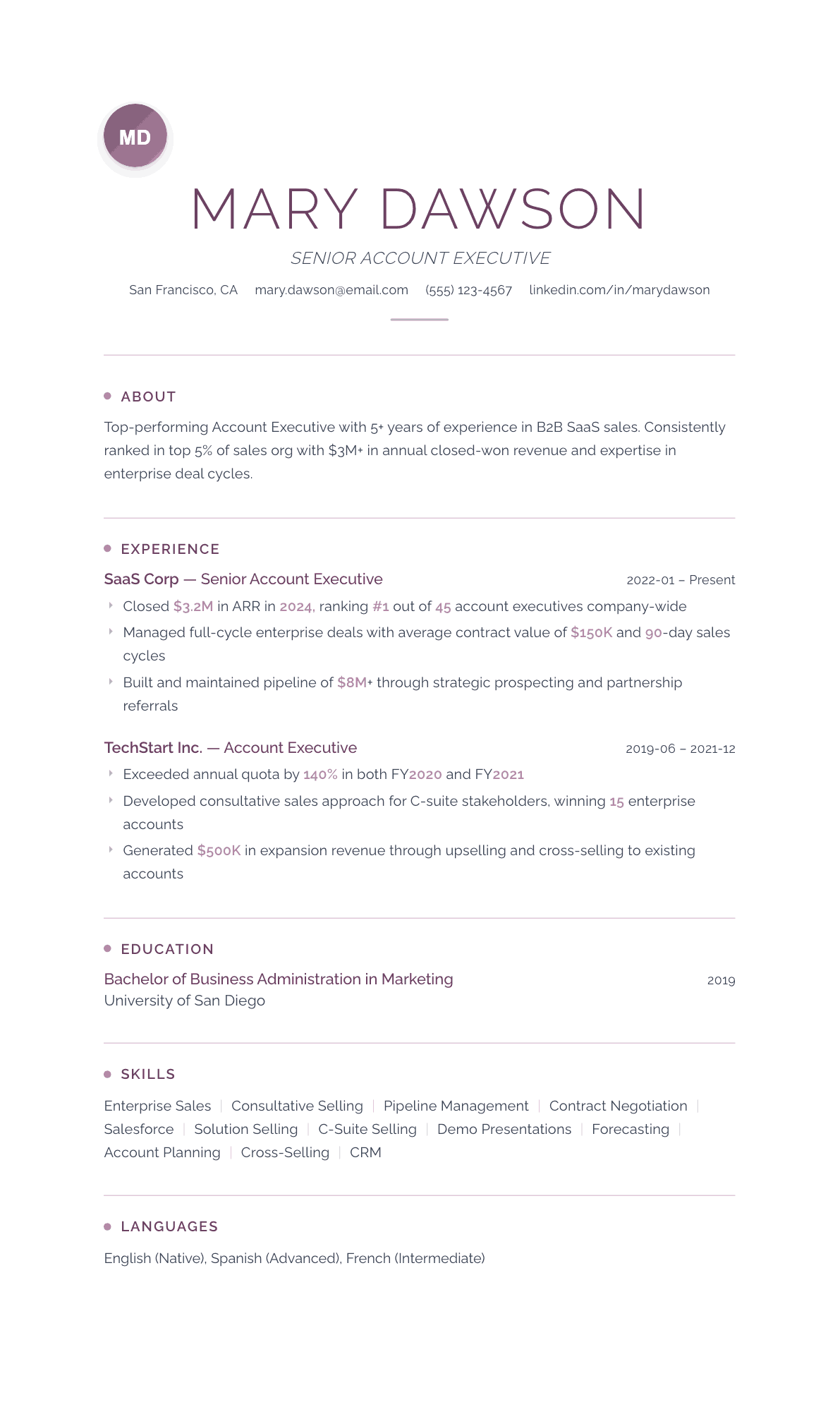
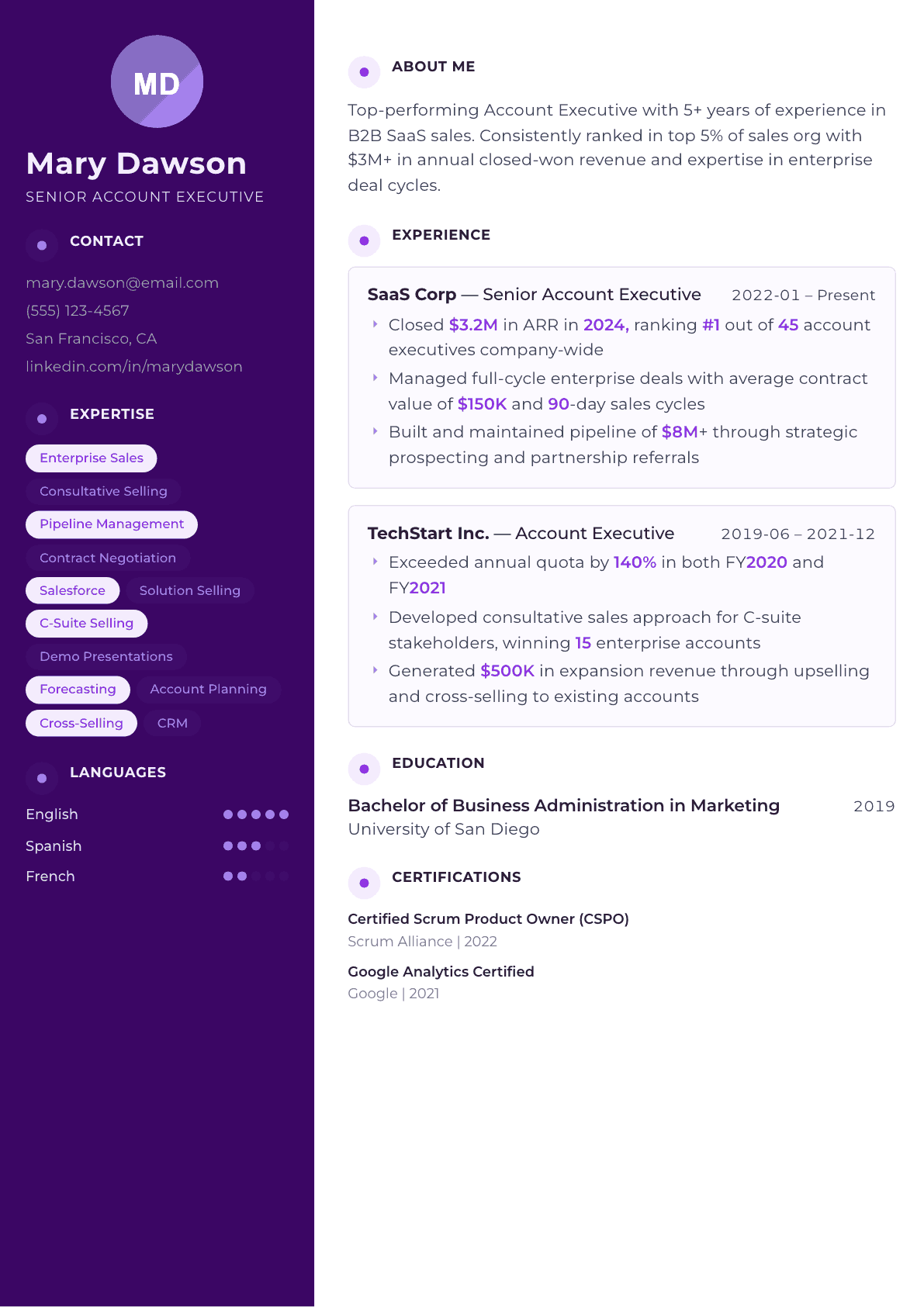
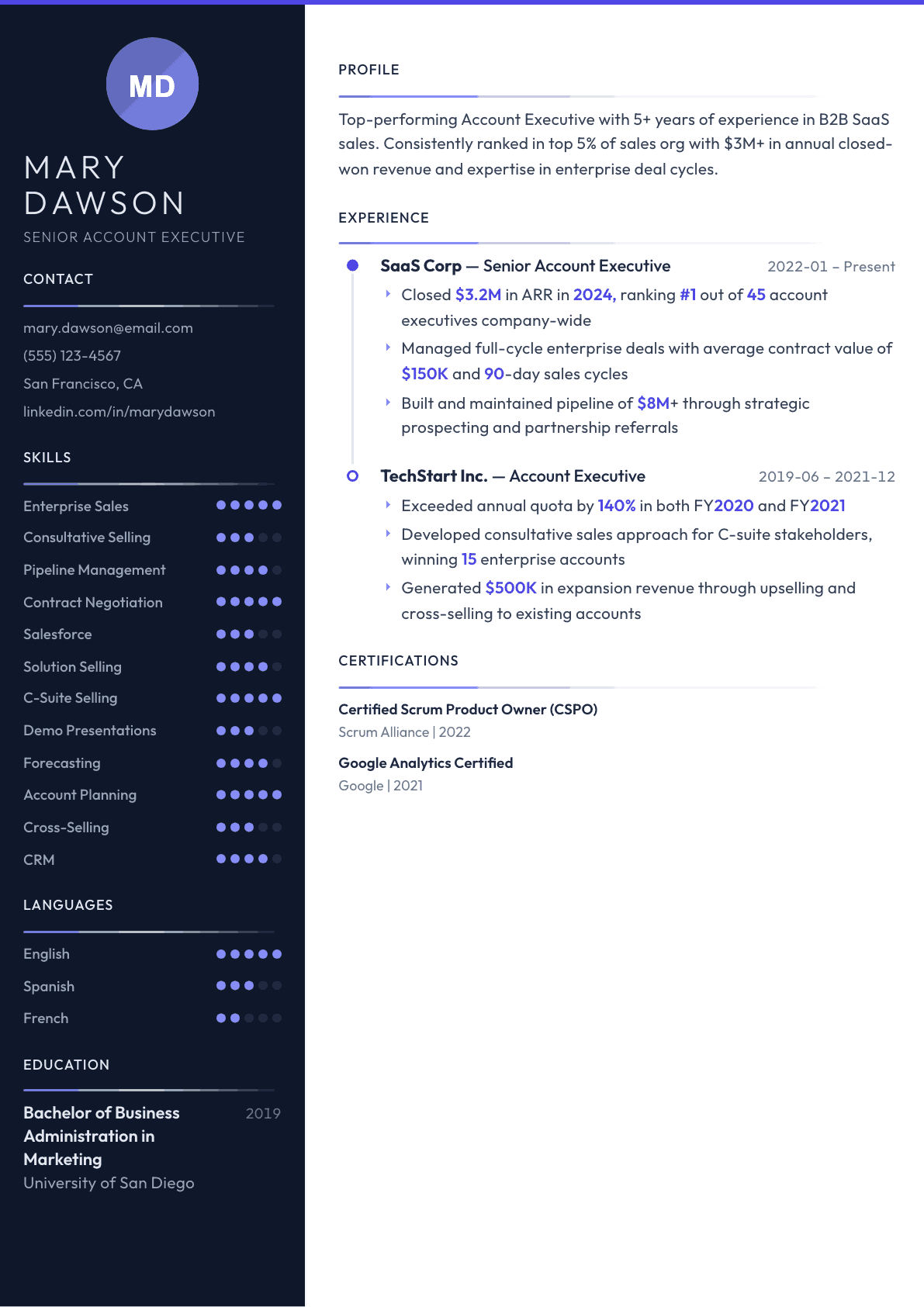
The same account executive content laid out in three CVBooster templates, so you can see what the finished document looks like before you write a word.
Example Account Executive summary
Enterprise account executive, 5 years in B2B software, closed $3.2M of annual recurring revenue last year and finished first of 45 sellers. Runs 90-day cycles at a $150K average contract value, holds an $8M pipeline, and sells to C-suite committees rather than single champions.
Skills to list on a Account Executive resume
- Enterprise Sales
- Consultative Selling
- Pipeline Management
- Contract Negotiation
- Salesforce
- Solution Selling
- C-Suite Selling
- Demo Presentations
- Forecasting
- Account Planning
- Cross-Selling
- CRM
What actually gets this resume read
- Put your quota attainment percentage and ranking front and center.
- Show average deal sizes and sales cycle lengths.
- Highlight enterprise and C-suite selling experience.
- Include specific sales methodologies (MEDDIC, SPIN, Challenger).
- Demonstrate progression from SDR/BDR to AE if applicable.
How to write a account executive resume
An account executive resume is a quota document. The sales leader reading it wants four numbers before anything else: your quota, your attainment against it, your ranking on the team, and the length of time you held that number. Everything else on the page exists to make those four believable.
The second layer is deal shape. A candidate closing many small transactional deals in a short cycle is not interchangeable with one running six month enterprise cycles through a procurement and security review. Segment, average contract value, cycle length, the number of stakeholders in a typical deal, whether you sourced your own pipeline or worked inbound, and whether you sold new business or expansion all change which seat you fit.
This guide covers how to build the quota block, how to write deal work so a sales leader can imagine you in their motion, summaries for a first sales role, an experienced closer and an enterprise seller, before and after bullets, and the questions people ask when a year was missed or a territory was changed underneath them.
Format: the quota block sits at the top
One page under ten years, reverse chronological, single column. Directly under the summary put a performance block: for each recent year, the quota, the attainment, the rank and the team size. Three lines of that block do more work than any paragraph you could write, and its absence is the first thing a sales leader notices.
Then give the territory. Segment by company size or revenue band, industry vertical, geography, whether it was a named account list or an open territory, and whether you inherited an existing book or built from nothing. Inheriting a mature territory and building a greenfield one produce very different attainment, and a good leader knows it.
- Header: name, city and state or remote, phone, email, professional profile link.
- Section order: summary, performance block, experience, sales methodology and stack, education, awards.
- Per role: quota, attainment, rank, segment, average contract value, cycle length, and inbound to outbound mix.
Writing the deal motion so a leader recognizes it
Describe the full cycle you ran. Prospecting method and the share of pipeline you sourced yourself, discovery and how you qualified, the demo or evaluation stage, the business case or proof of value, the stakeholders you engaged, procurement and legal negotiation, and the handoff after signature. Sales leaders hire for the stages they are weak in, so being explicit about all of them widens the seats you fit.
Name the methodology and show it in a sentence rather than as a badge. Anyone can list a framework. A candidate who says they qualified on economic buyer access, quantified pain and a documented decision process is showing the discipline behind the acronym. That distinction is the most common thing separating two similar looking resumes.
Cover multi-threading explicitly, because it is the single biggest predictor of enterprise deal survival. How many stakeholders you typically engaged, which functions, how you got to the economic buyer, and how you handled a champion leaving mid cycle. Almost nobody writes this and it reads as real experience when they do.
Pipeline discipline and forecast accuracy
Attainment tells a leader what happened. Pipeline and forecast tell them whether it will happen again. Give pipeline coverage against quota, the share of pipeline you self sourced, win rate from qualified opportunity, and average cycle length. If you improved any of those, say what you changed.
Forecast accuracy is undervalued and rarely claimed. A seller whose commit calls land close to actual over several quarters is worth more to a leader than one whose big quarters arrive as surprises. If your forecast held, put a number on it. If you managed a formal pipeline review cadence or ran a deal desk process, name it.
For expansion sellers, keep new business and expansion separate. A closer who books new logos is measured differently from one growing an installed base, and blending the two into a single revenue figure invites a question you would rather answer on your terms.
Product, segment and stack
State what you sold in a way a stranger can price. Software subscription, professional services, hardware plus service contract, advertising, logistics or a regulated financial product all have different sales physics. Add whether the buyer was a technical function, a business function or a procurement led committee, and whether a security review or compliance approval sat in the cycle.
Then the stack: the customer relationship management platform and how you kept it, the sales engagement tool, conversation intelligence, prospecting data sources, proposal and contract tooling, and the forecasting layer. Hiring managers filter on the platform, and a seller who keeps a clean record in the system is a genuinely easier hire to manage.
Keywords the screener is scanning for
Sales postings repeat a narrow vocabulary: quota attainment, new logo acquisition, annual recurring revenue, pipeline generation, full cycle sales, discovery, multi-threading, executive engagement, negotiation, forecast accuracy, win rate and the methodology names. Use the ones you can defend, and use them where you can prove them.
The wording changes by motion. A product led company wants trial conversion, usage signals and expansion within an account. A field enterprise team wants complex evaluations, procurement navigation and multi-year agreements. A transactional inside team wants call volume, speed to first meeting and monthly quota rhythm. Read the posting and rewrite the top third of the page.
Account executive resume examples, written out
Many searches for an accountant executive resume mean the sales role, the account executive who owns a territory and a quota. If you mean an accounts executive in finance, the job that handles ledgers and month end, our accountant resume page covers that work. The three account executive resume examples below show an inside sales seat, a mid market closer and an enterprise seller, written the way the summary and first bullets read on the page.
Each example names the segment, the deal size range, the sales cycle and the quota result in the first lines, because that is what a sales leader reads before anything else.
- Example one, first closing role: Account Executive, inside sales, software for small dental practices. Promoted from SDR after booking the most qualified meetings on the team for three quarters. Runs about forty demos a month on a fourteen day cycle and closed above quota in each of the first four quarters in the seat.
- Example one, bullet: Built a follow up sequence for no show demos that recovered roughly one in four missed meetings, now used by the whole inside team.
- Example two, mid market: Account Executive, mid market, logistics software. Owns a territory of manufacturers with two hundred to two thousand employees, a sixty to ninety day cycle and deals that involve operations, finance and IT. Ranked second of eleven sellers last fiscal year.
- Example two, bullet: Sourced more than half of personal pipeline through outbound to plant managers, and closed the largest new logo in the region that year after a security review and a paid pilot.
- Example three, enterprise: Senior Account Executive, enterprise, payroll and HR software. Sells to companies with five thousand employees or more on six to twelve month cycles with procurement and legal review, and manages a named list of twenty five accounts.
- Example three, bullet: Led a multi year agreement with a national retailer from first meeting to signature, coordinating a solutions engineer, a security team and two executive sponsors across four business units.
Account Executive resume summary examples
First closing role
Account Executive promoted from a business development seat after two years booking meetings for the mid-market team. Carried a first full-cycle quota and finished at 103% of target on deals averaging around twelve thousand in annual value with a 30-day cycle.
Mid-market closer
Account Executive selling into mid-market operations teams with a quota in the low seven figures, finishing at 128% and 114% of target in the last two years and ranking third of 22 sellers. Self-sourced roughly 60% of closed pipeline through outbound into a named account list.
Enterprise account executive
Enterprise Account Executive covering 40 named accounts in financial services, running nine month cycles with an average contract value near six figures and eight stakeholders per deal. Closed three multi-year agreements last year and finished at 117% against a seven figure quota.
Work experience bullets: before and after
Before: Consistently exceeded my sales quota.
After: Finished at 128% and 114% of an annual quota in the low seven figures across two years, ranking third of 22 account executives on the mid-market team.
Attainment, quota size, two years of it and a rank make the claim verifiable instead of aspirational.
Before: Prospected for new business and built pipeline.
After: Self-sourced about 60% of closed pipeline through outbound sequences and event follow-up into a 200-account named list, maintaining coverage above 3 times quota through every quarter.
The self-sourced share and coverage ratio prove you can create pipeline rather than harvest it.
Before: Sold to enterprise customers and worked with executives.
After: Ran nine month enterprise cycles with an average of eight stakeholders, reaching the economic buyer in every closed deal and holding security and procurement review inside the original timeline.
Cycle length, stakeholder count and buyer access describe a motion a sales leader can match to their own.
Before: Used Salesforce to manage my opportunities.
After: Kept every opportunity staged against a documented decision process in Salesforce, and closed the year with commit calls landing within 6% of actual across four quarters.
Forecast accuracy is the operational skill leaders most want and almost no seller puts a number on it.
Before: Negotiated contracts with customers.
After: Negotiated multi-year agreements through procurement and legal, trading term length and payment schedule instead of discount, and closed the year with average discount below the team norm.
Naming the levers traded shows you protect price rather than buy the deal with margin.
Hard skills
- Full cycle new business sales
- Outbound pipeline generation
- Discovery and qualification
- MEDDIC and value based selling
- Business case and proof of value
- Multi-threading and executive engagement
- Contract and procurement negotiation
- Forecasting and pipeline management
- Salesforce and HubSpot CRM
- Sales engagement platforms
- Conversation intelligence tools
- Territory and account planning
Soft skills
- Resilience through a slow quarter
- Curiosity in discovery
- Executive presence
- Coachability
- Time discipline across a pipeline
- Honest forecasting
Certifications worth listing
- Challenger Selling Certification (Challenger Inc.)
- MEDDIC Core Methodology Certification (MEDDIC Academy)
- Salesforce Certified Administrator (Salesforce)
- Sandler Sales Certification (Sandler Training)
- RAIN Selling Certification (RAIN Group)
Mistakes that cost account executive candidates the interview
- Giving attainment without the quota behind it, which makes an impressive number impossible to interpret.
- Reporting a single strong year and hiding the two around it, a pattern experienced sales leaders spot immediately.
- Leaving out segment, average contract value and cycle length, so a leader cannot tell whether your motion matches theirs.
- Listing a methodology as a badge without a sentence showing how you actually qualified a deal.
- Blending new business and expansion revenue into one figure, which invites a question you will have to answer badly.
- Never stating how much pipeline you sourced yourself, the difference between a closer and an order taker on inbound.
- Filling the page with responsibilities when a sales resume is judged almost entirely on numbers.
Account Executive resume questions
How do I explain a year where I missed quota?
State it with the context and move on: a territory change, a product transition, a hiring freeze in your segment or a mid-year quota reset. Then show the attainment on either side of it. Leaders distrust unexplained gaps far more than an honest miss.
Should I put my quota on the resume?
Yes. Attainment without the quota behind it is unreadable, since beating a small number and narrowly clearing a large one are very different achievements. Give quota, attainment and rank together for each year you can support.
How do I move from an SDR or BDR role into an account executive seat?
Lead with meetings booked and, more importantly, pipeline that converted to closed business, since that is the number that predicts closing ability. Add any deals you ran end to end, and name the discovery and qualification framework you already use.
Is an accountant executive resume the same as an account executive resume?
Usually yes: most people searching for an accountant executive resume mean the account executive sales role, which is judged on quota, pipeline and deal size. An accounts executive in finance is a different job built on ledgers, reconciliations and month end close, and that resume should look like an accountant resume. Use the exact title from the posting either way.
How do I show enterprise capability when I have only sold mid-market?
Show the enterprise-shaped work you have done: your longest cycles, deals with the most stakeholders, any security or procurement review you navigated, and multi-year agreements. Then be candid about the step up rather than dressing mid-market deals as enterprise ones.