Insurance Agent Resume Examples: the lines they read
Create an Insurance Agent Resume That Shows Real Production
By Mustafa Tarabya, founder of CVBooster · Published · Updated
Insurance agent resume example with premium production, retention and cross-sell bullets, state license placement, keywords, and a full writing guide.
Sample resumes for a insurance agent
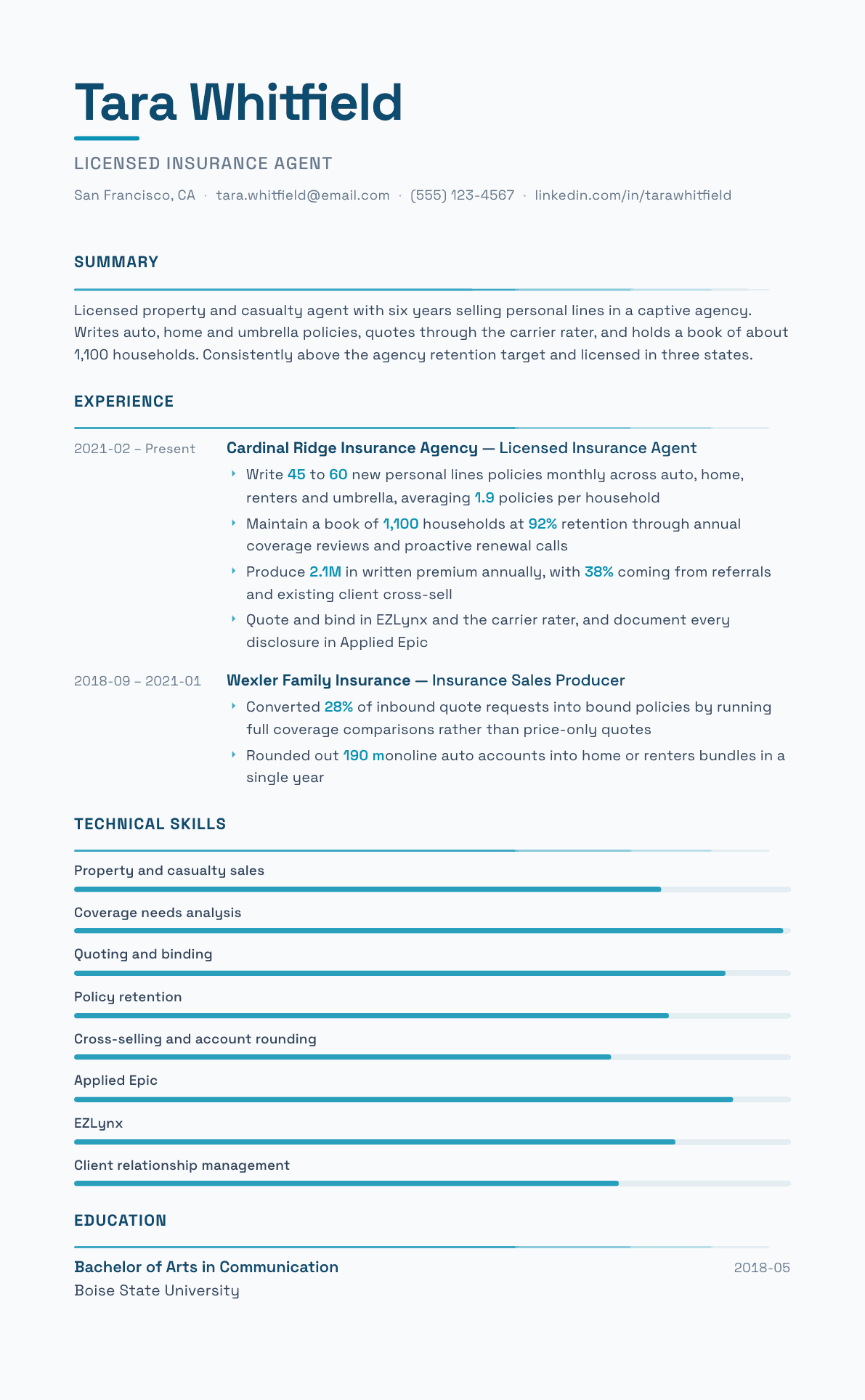
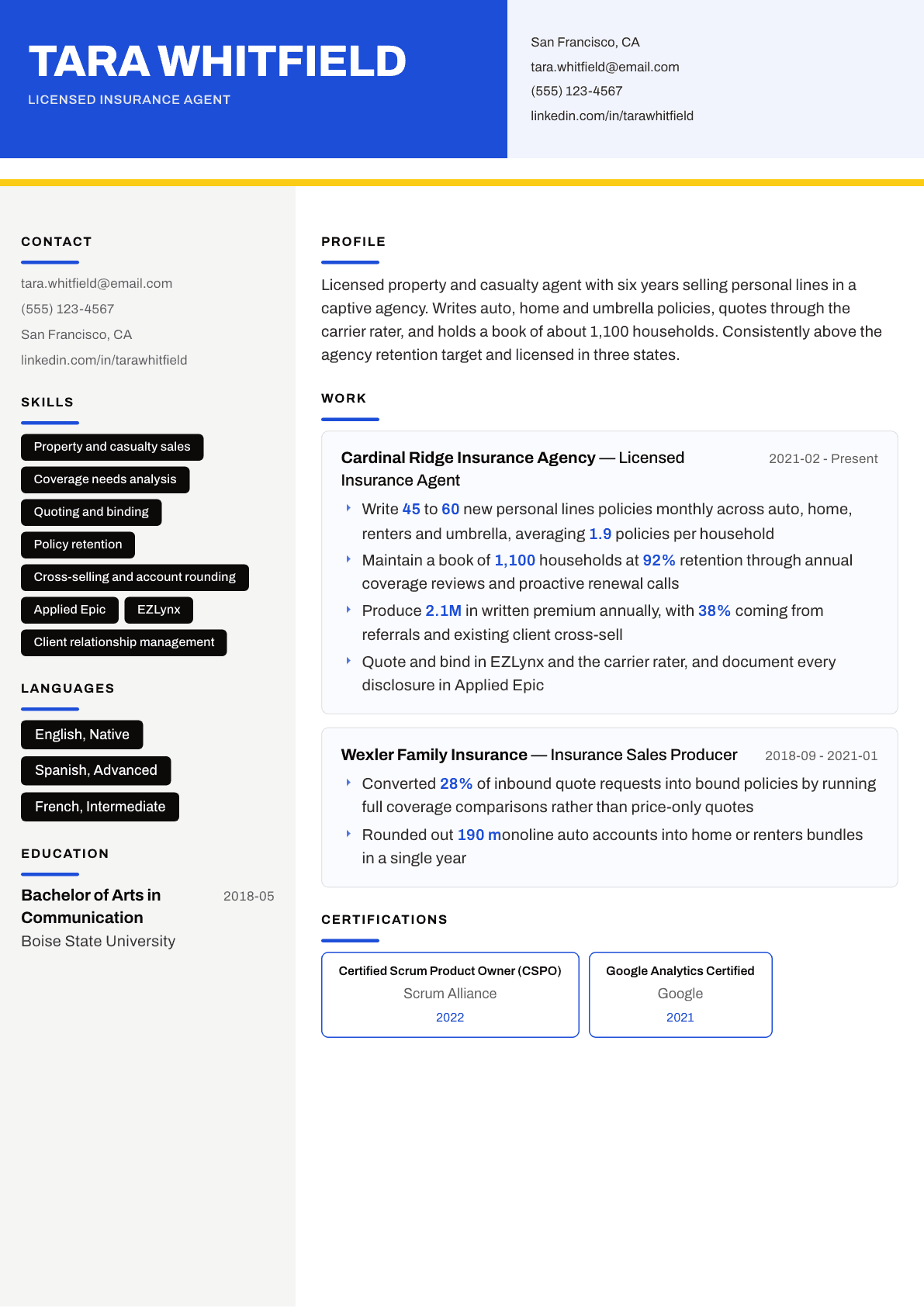
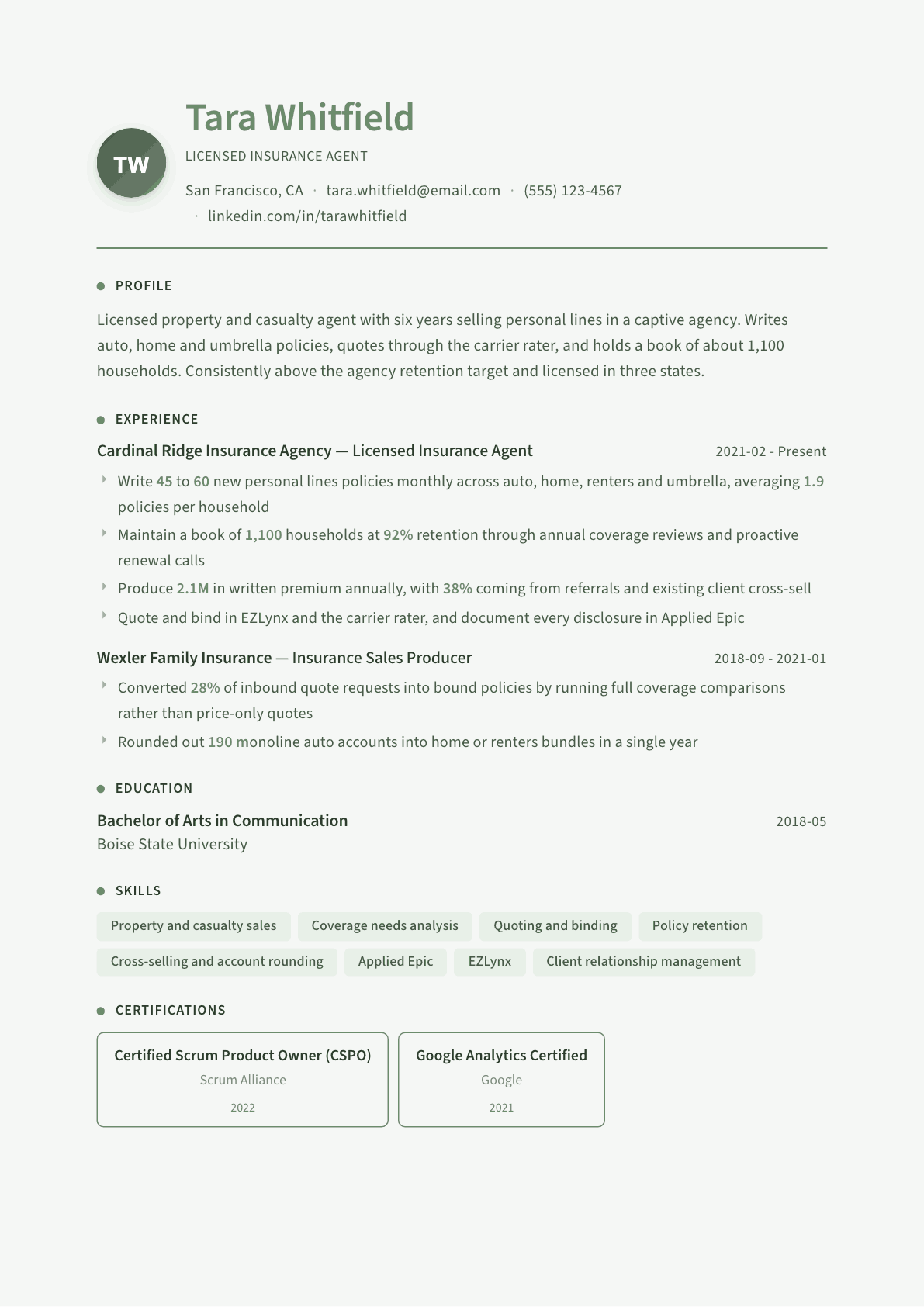
The same insurance agent content laid out in three CVBooster templates, so you can see what the finished document looks like before you write a word.
Example Insurance Agent summary
Licensed property and casualty agent with six years in personal lines, writing auto, home, renters and umbrella coverage for a book of roughly 1,100 households. Produces more than two million in written premium a year and holds retention above the agency target through annual coverage reviews. Quotes and binds in Applied Epic and EZLynx, and carries active resident and nonresident licenses in three states.
Skills to list on a Insurance Agent resume
- Property and casualty insurance
- Personal lines underwriting guidelines
- Coverage needs analysis
- Quoting and binding
- Account rounding and cross-sell
- Policy retention
- Renewal reviews
- Claims intake support
- Referral generation
- Applied Epic
- AMS360
- EZLynx
- Client relationship management
- State licensing and continuing education
What actually gets this resume read
- Put your state licenses and their lines, property and casualty or life and health, in the header where a screener finds them immediately.
- Lead with production numbers an agency owner recognizes: written premium, policies per household, close rate and retention percentage.
- Say which lines you write, personal auto and home or commercial packages, because agencies hire for one and not the other.
- Name your agency management system and rater, for example Applied Epic, AMS360, EZLynx or HawkSoft, so the posting keywords match.
- Show where your business came from, referrals, cross-sell, purchased leads or walk-ins, since lead source tells an owner how you will ramp.
- Add continuing education and carrier product certifications, and keep appointment states current so a multistate agency can place you.
How to write a insurance agent resume
An agency owner reading an insurance agent resume is doing arithmetic. How much premium did this person write, how many policies per household, what did the book retain, and how long before the seat pays for itself? A resume that opens with a paragraph about being personable and dedicated gives them nothing to calculate with.
The other half of the read is licensing. Before anything else, a recruiter checks the resident license, the lines it covers, the states of appointment and whether continuing education is current. If those facts are buried on page two the file gets set aside, not because you are unqualified but because verifying you is slower than verifying the next candidate.
This guide covers where licenses go, how to write production numbers that survive an interview, three summaries for different stages of an insurance sales career, before and after bullets, and the questions agents ask when their resume stops getting calls.
Format: one page, licenses in the header, production up top
One page is standard for insurance sales, two only after fifteen years or an agency ownership history. Use a single column so the tracking system reads it cleanly, and put the license line directly under your name, listing the type and the states.
Follow the summary with a production block: written premium, policy count, close rate, retention, and policies per household or per client. Agency leaders compare candidates on those figures, so making them hunt is a self-inflicted wound.
- Header: name, license lines and states, city, phone, email.
- Order: summary, production highlights, experience, systems, education, continuing education and carrier training.
- Every job names the agency type: captive, independent, direct writer or call center.
Summary: lines written, book size, and one production fact
Three lines. Say which lines you sell, personal property and casualty, commercial lines, life and health, or a mix, then the size of the book you handle and one measured result. Agencies hire against a specific gap, and the fastest way to be dismissed is to look like a generalist who could be sold anything.
If you are new to insurance, use the summary to name the license you already hold and the sales background you are transferring from. A candidate with a fresh property and casualty license and three years in retail finance is a real prospect. A candidate who buries both facts is not.
Experience: write the book, not the routine
Lead each role with the book you handled: household or account count, premium volume, and the lines. Then bullets on new business written, on cross-sell and account rounding, on retention, and on where your leads came from. Lead source matters because an agent who built a referral pipeline ramps differently from one handed inbound calls all day.
Retention deserves its own bullet. Write the percentage and the practice behind it, an annual coverage review, a renewal call before the notice arrives, a rewrite when a carrier took a rate increase. Owners lose more money to churn than to slow new business, and few resumes address it.
Skip lines like quoting policies, answering client questions and processing endorsements. Those are the job description, not your record inside it.
Systems, carriers and product knowledge
Name the agency management system and the comparative rater, since an agent already fluent in Applied Epic or AMS360 costs less to onboard. Add the carriers you were appointed with or trained on, and any carrier product certifications you completed.
Show coverage depth, not just sales activity. Umbrella placement, replacement cost versus actual cash value, scheduled personal property, flood and earthquake endorsements, and commercial general liability limits are the details that mark an agent who advises rather than quotes.
Keywords a posting will screen on
Insurance postings repeat a short list: licensed agent, property and casualty, life and health, written premium, new business production, policy retention, cross-selling, account rounding, quoting and binding, coverage review and client retention. Place each once in the skills band and again in a bullet where it is supported. A term used twice with evidence beats a term used ten times without any.
Insurance Agent resume summary examples
Newly licensed
Recently licensed property and casualty agent with four years in retail banking sales, closing 22 consumer accounts a month against a team-high referral rate. Trained on the carrier rater and comfortable with coverage comparisons. Seeking a personal lines producer seat in an independent agency.
Six years producing
Licensed property and casualty agent writing 45 to 60 personal lines policies a month across auto, home, renters and umbrella. Holds a book of 1,100 households at 92% retention and produces 2.1M in annual written premium, with 38% of new business coming from referrals and account rounding.
Agency producer and mentor
Senior agent with thirteen years across personal and small commercial lines, licensed in five states for property, casualty, life and health. Built a 3.4M premium book from referrals and community networking, and trains new producers on coverage review and objection handling for a four-office agency.
Work experience bullets: before and after
Before: Sold auto and home insurance policies to new clients.
After: Wrote 45 to 60 new personal lines policies monthly across auto, home, renters and umbrella, averaging 1.9 policies per household at bind.
Monthly volume, the lines and the bundling ratio give an owner a production profile instead of a job title.
Before: Maintained good relationships with existing customers.
After: Held a book of 1,100 households at 92% retention by running an annual coverage review and calling every client 45 days before renewal.
A retention figure attached to two named practices shows repeatable behavior rather than goodwill.
Before: Worked to increase sales through cross-selling.
After: Rounded out 190 monoline auto accounts into home or renters bundles in one year, lifting average household premium and reducing single-policy churn.
The account count and the direction of the effect make the cross-sell claim measurable.
Before: Quoted insurance and explained coverage options.
After: Converted 28% of inbound quote requests into bound policies by running side-by-side coverage comparisons on limits, deductibles and endorsements rather than price alone.
A close rate paired with the sales method explains why the number is what it is.
Before: Used the agency software to manage client files.
After: Quoted and bound in EZLynx and documented every coverage rejection and disclosure in Applied Epic, keeping the file audit-ready for carrier reviews.
Naming the systems and the documentation habit signals both speed and errors and omissions discipline.
Hard skills
- Personal lines property and casualty
- Coverage needs analysis
- Quoting, rating and binding
- Account rounding and cross-sell
- Policy retention and renewal reviews
- Umbrella and endorsement placement
- Claims intake and client advocacy
- Referral pipeline development
- Applied Epic and AMS360
- EZLynx comparative rating
- State licensing and appointments
- Continuing education compliance
Soft skills
- Consultative questioning
- Objection handling
- Follow-up discipline
- Explaining coverage in plain language
- Community networking
- Handling rate increase conversations
Certifications worth listing
- Chartered Property Casualty Underwriter (CPCU) (The Institutes)
- Certified Insurance Counselor (CIC) (The National Alliance for Insurance Education and Research)
- Accredited Advisor in Insurance (AAI) (The Institutes)
- Chartered Life Underwriter (CLU) (The American College of Financial Services)
- Life Underwriter Training Council Fellow (LUTCF) (The American College of Financial Services)
Mistakes that cost insurance agent candidates the interview
- Hiding the license line at the bottom, which slows the only verification a recruiter must do before calling you.
- Giving activity counts such as calls made instead of premium written, which is the number an owner budgets against.
- Leaving retention off entirely, so the reader assumes the book you wrote did not stay.
- Failing to say whether the agency was captive, independent or a direct writer, since the selling motion differs sharply.
- Listing every carrier you ever quoted rather than the ones you were appointed with and actually placed business through.
- Writing a generic sales resume that never names a coverage, an endorsement or a rating factor.
Insurance Agent resume questions
Where do state insurance licenses belong on the resume?
Directly under your name in the header, with the line of authority and each state. Repeat them in a licensing section at the bottom with license numbers if you are comfortable, along with your continuing education status.
What if I am licensed but have never written a policy?
Lead with the license and the sales record you do have, whether retail, telecom, automotive or banking. Convert that experience into the numbers an agency understands: monthly closes, conversion rate, referral generation and average ticket.
Should I list the carriers I sold for?
List the carriers you held appointments with and placed real business through, grouped by line. Skip the long roster of every market you once quoted, because it reads as padding and invites a question you cannot answer well.
How do I write a resume for moving from personal lines to commercial?
Say the target directly in the summary, then pull forward anything commercial you touched: small business owner policies, workers compensation quotes, certificates of insurance, or contractor accounts. Add any commercial coursework or a designation in progress.
Does an insurance agent resume need a separate skills section?
Yes, because that is where the screening software finds the license type, the management system and the coverage terms. Keep it to systems, lines of authority and coverage specialties, and leave personality traits to the experience bullets where they are demonstrated.
Related resume examples
- Financial Advisor Resume example
- Claims Adjuster Resume example
- Insurance Broker Resume example
- Insurance Underwriter Resume example
- Personal Banker Resume example
- Underwriter Resume example