Claims Examiner Resume Examples: the lines they read
Build a Claims Examiner Resume That Shows Coverage Judgment
By Mustafa Tarabya, founder of CVBooster · Published · Updated
Claims examiner resume example with coverage analysis bullets, reserve and severity keywords, plus tips for liability, property and workers comp files.
Sample resumes for a claims examiner
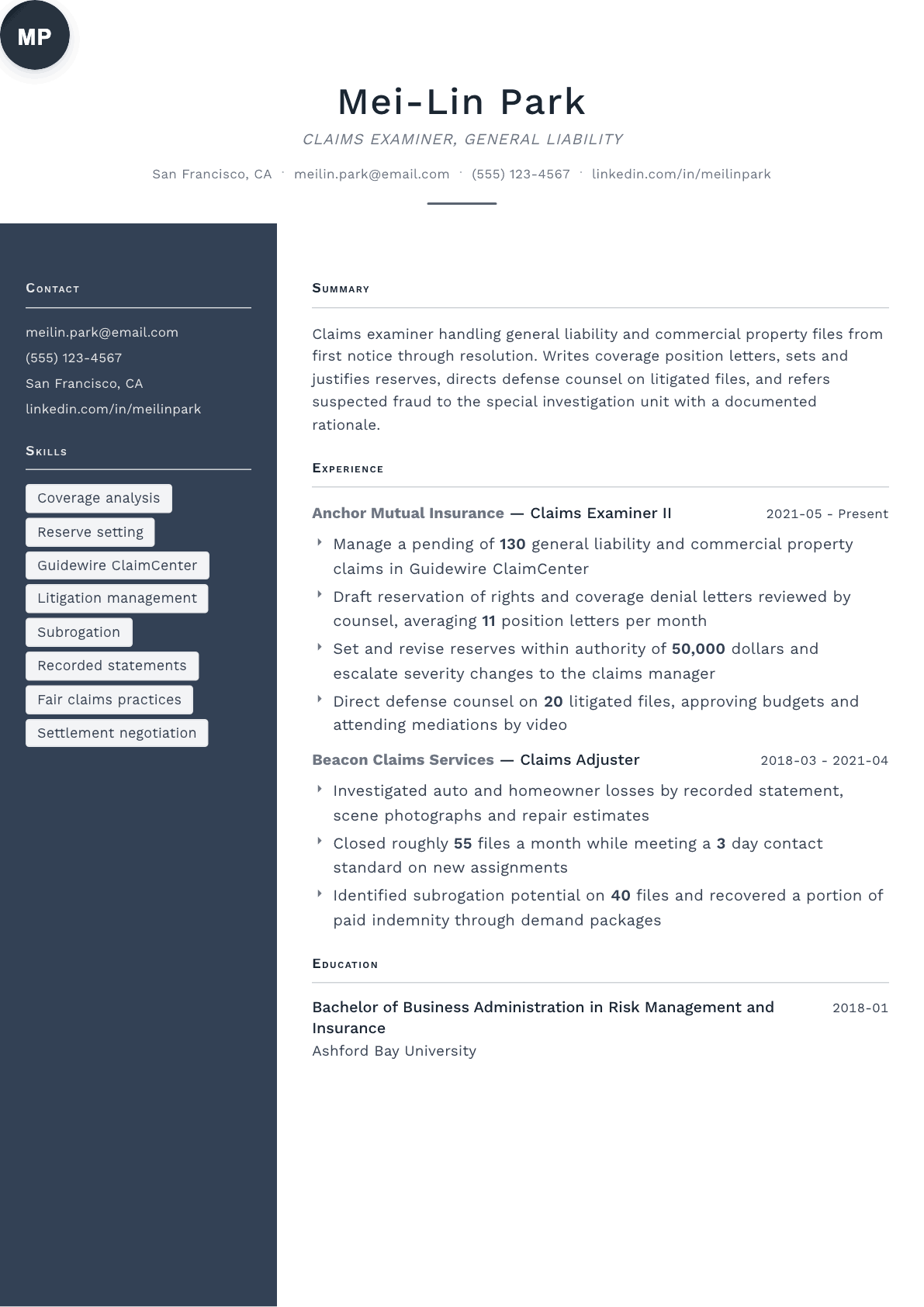
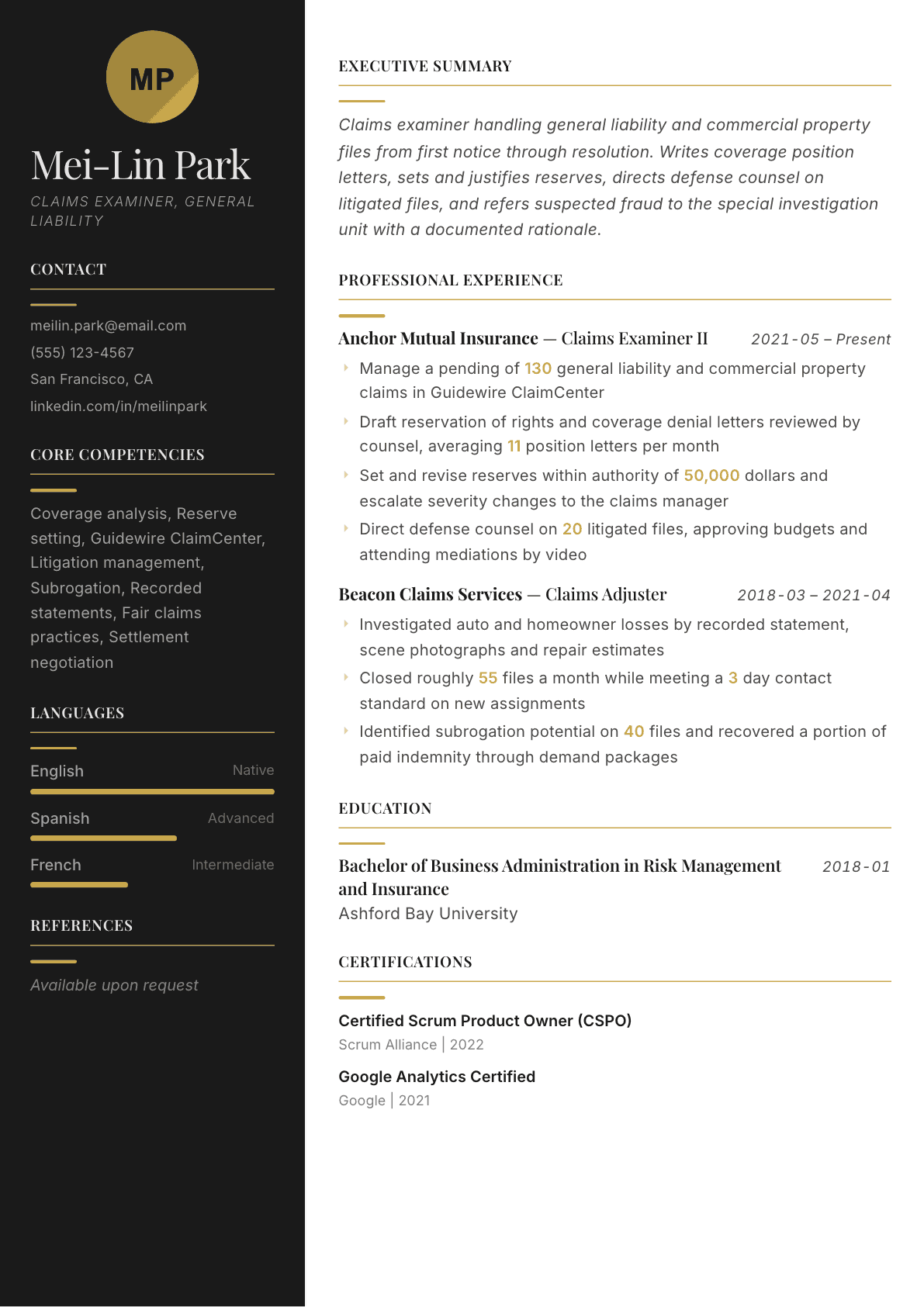
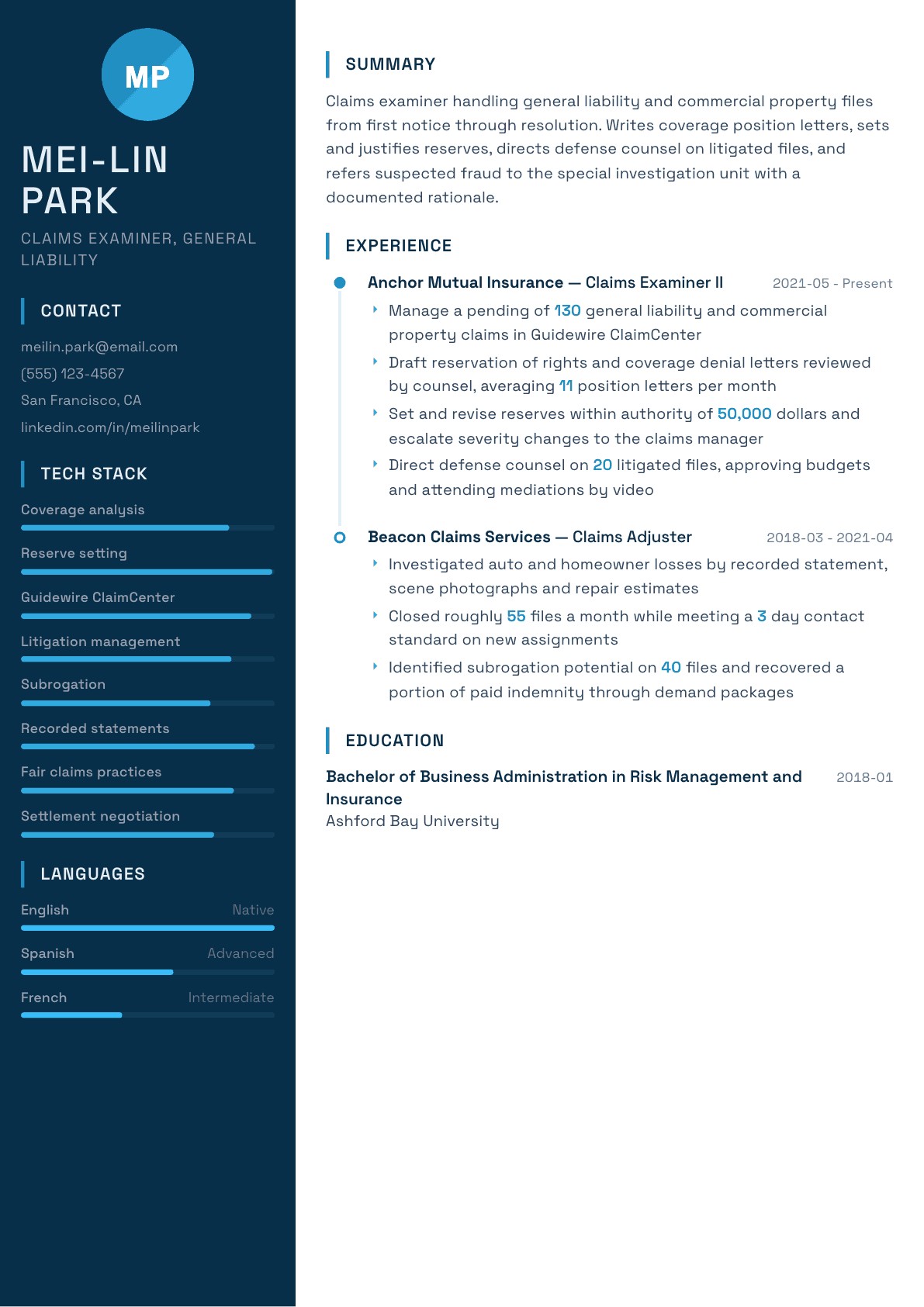
The same claims examiner content laid out in three CVBooster templates, so you can see what the finished document looks like before you write a word.
Example Claims Examiner summary
Claims examiner with six years on general liability and commercial property, currently carrying a pending of over one hundred files. Writes reservation of rights and denial letters, sets reserves within authority, directs defense counsel on litigated matters, and refers suspected fraud with a documented basis. Seeking a complex casualty desk with broader settlement authority.
Skills to list on a Claims Examiner resume
- Coverage determination
- Reservation of rights letters
- Reserve adequacy
- Liability investigation
- Recorded statement taking
- Litigation management
- Subrogation and recovery
- Fraud referral and SIU
- Settlement negotiation
- Guidewire ClaimCenter
- Medical record review
- Damage evaluation
- Fair claims regulations
- File documentation standards
What actually gets this resume read
- Name the lines of business you examine, since liability, property and workers compensation hire from different pools.
- State your pending count and your settlement authority, because both define the level a manager is hiring for.
- Show coverage work explicitly: reservation of rights letters, denials, and how many you write in a typical month.
- List the claims system by name, since employers screen on Guidewire, Xactimate or their own platform before reading further.
- Describe litigation management with counsel budgets, mediation attendance and the outcomes you negotiated on file.
- Mention the states you are licensed in and any adjuster licenses, with the issuing department of insurance.
How to write a claims examiner resume
The person hiring a claims examiner is usually a claims manager who has read the file notes of everyone she ever supervised. She knows that the difference between a good examiner and an expensive one is coverage judgment: reading the policy first, reserving honestly, and saying no in writing when the policy says no.
A resume cannot show a coverage letter, but it can show the conditions under which you write them. Line of business, pending count, settlement authority, litigation involvement and the systems you document in. Those five facts place you on a ladder the manager already has in her head.
What follows is the structure that puts those facts where they are found, three summaries at different authority levels, before and after bullets from investigation and litigation work, and answers to the questions examiners ask when they move between lines.
Format: line of business, authority, pending
Reverse chronological, one page under six years and two pages beyond. Put a short profile block under the header: lines of business handled, current pending count, settlement authority level, states you are licensed in, and the claims platform you work in daily.
Carriers use applicant tracking systems tuned to insurance vocabulary, so write the line of business the way the industry does: general liability, commercial property, auto physical damage, workers compensation, professional liability, first party or third party.
- Header: name, city and state, phone, email, adjuster license states and numbers.
- Order: summary, licenses and designations, claims experience, education, systems and skills.
- Candidates crossing from adjusting to examining should highlight coverage and litigation work first.
Summary: what you handle and how far you can go alone
Three lines that answer the manager silently: which claims land on your desk, how many of them at once, how much you can settle without a signature, and whether you direct counsel. Authority level is the single most useful number an examiner can give, and most resumes omit it.
If you are targeting a step up in complexity, name it. An examiner moving from auto to complex casualty should say so and point to the bodily injury files, the medical review and the litigation management already in the record.
Experience: coverage, investigation, reserve, resolution
Give every job the same four part shape. Coverage: policy interpretation, reservation of rights letters, declinations and how many you draft in a month. Investigation: recorded statements, scene work, expert retention, medical record review, fraud indicators referred to a special investigation unit. Reserves: how you set them, when you revise them, and what triggers escalation. Resolution: negotiation, mediation, and outcomes.
Reserve discipline deserves its own bullet because it is where managers lose sleep. Describe your practice, such as reserving to probable outcome within a fixed window after receipt of damages information, and revising when severity changes rather than at the eve of trial.
For litigated files, name the volume, the budget approvals, whether you attend mediations and how you evaluate exposure. Directing defense counsel is a different job from adjusting, and it is what separates the examiner title from the adjuster title on most carrier ladders.
Licenses, designations and regulatory work
List every adjuster license with the state and the license number if the posting asks for it. Designations belong in their own line with the awarding body, because carriers use them for internal justification and sometimes for promotion criteria.
Mention the regulatory environment you have handled: prompt contact and acknowledgment standards, unfair claims settlement practice requirements, and any state specific bad faith exposure you have managed. Do not cite statutes you cannot discuss in an interview.
Systems and the keywords a carrier indexes
Name the claims platform, the estimating tool and the document system. Carriers screen hard on platform experience because retraining an examiner on a new claims system costs weeks of production.
Then mirror the posting language: coverage determination, reservation of rights, reserve adequacy, subrogation, salvage, contribution, indemnity, expense management, diary handling, file quality review.
Claims Examiner resume summary examples
First examiner desk
Property adjuster with 3 years handling first party homeowner losses, now licensed in 4 states and completing the Associate in Claims curriculum. Comfortable with recorded statements, estimate review and coverage referrals, and seeking a first examiner desk on a low complexity liability pending.
Six years, general liability
Claims examiner carrying a pending of 130 general liability and commercial property files with settlement authority in the tens of thousands. Writes reservation of rights and declination letters, directs defense counsel on 20 litigated matters, and refers suspected fraud with documented indicators.
Complex casualty
Senior casualty examiner with 12 years and a complex bodily injury pending of 45, including construction defect, premises liability and excess exposure files. Manages defense counsel budgets, attends mediation, evaluates policy limits demands, and mentors 4 examiners on coverage analysis and reserve practice.
Work experience bullets: before and after
Before: Handled insurance claims from start to finish.
After: Managed a pending of 130 general liability and commercial property claims from first notice through resolution, documenting every file in the carrier claims platform on a 30 day diary.
Pending count, lines of business and diary discipline describe the desk rather than the industry.
Before: Determined coverage on claims.
After: Drafted 11 reservation of rights and declination letters a month after policy analysis, with each position reviewed by coverage counsel before issue.
Volume and review process show a repeatable coverage practice instead of an occasional decision.
Before: Set reserves on files.
After: Set reserves to probable outcome within 30 days of receiving damages documentation and revised on severity change, escalating movement above authority to the claims manager same day.
A stated reserve method is the clearest evidence of the financial discipline a manager is hiring for.
Before: Worked with attorneys on lawsuits.
After: Directed defense counsel on 20 litigated files, approving litigation budgets, setting discovery limits and attending mediations with evaluated ranges prepared in advance.
Naming the control activities proves you managed the litigation rather than watching it happen.
Before: Spotted fraud on some claims.
After: Referred 14 claims to the special investigation unit on documented indicators including inconsistent recorded statements and prior loss history, supporting 5 declinations.
Referral counts with the basis and the outcome show a defensible fraud process rather than a hunch.
Hard skills
- Policy interpretation and coverage analysis
- Reservation of rights drafting
- Reserve setting and severity review
- Liability investigation
- Recorded statement taking
- Medical record and bill review
- Litigation and counsel management
- Settlement negotiation
- Subrogation and contribution
- Special investigation unit referral
- Claims platform documentation
- Fair claims practice compliance
Soft skills
- Written reasoning
- Negotiation composure
- Empathy with claimants
- Diary discipline
- Saying no in writing
Certifications worth listing
- Associate in Claims (AIC) (The Institutes)
- Chartered Property Casualty Underwriter (CPCU) (The Institutes)
- Senior Claim Law Associate (SCLA) (American Educational Institute)
- Resident Adjuster License (State department of insurance)
Mistakes that cost claims examiner candidates the interview
- Omitting settlement authority, which leaves a manager unable to place you on her own grade ladder.
- Describing claims generically without naming the line of business, so property and casualty work blur together.
- Listing the claims system nowhere on the page when carriers screen on platform experience before anything else.
- Writing about customer service on a file where the reader wants coverage reasoning and reserve accuracy.
- Leaving adjuster licenses off or stating them without states, which stalls a file that could have moved.
- Claiming litigation management when the actual work was forwarding suit papers to a supervisor.
Claims Examiner resume questions
What is the difference between an adjuster and an examiner on a resume?
Adjusters investigate and evaluate, examiners own coverage, reserves and litigation direction. If you do both, say so and put the coverage and reserve work first, because that is what the examiner posting is buying.
How do I show reserve accuracy without carrier data?
Describe your method and your escalation rule rather than a hit rate you cannot verify. A manager reading a clear reserving practice will trust it more than an unsupported claim about reserve accuracy across a book.
Should I list every state adjuster license?
Yes, in one compact line with the state abbreviations. Multi state licensing is a real hiring advantage for carriers handling catastrophe volume, and it costs you a single line to show it.
Do designations matter more than experience?
Experience wins, but a designation from a recognized body removes doubt about your technical grounding and is often used for internal promotion criteria. List progress toward one if you have not completed it yet.
How do I move from auto claims to complex casualty?
Lead with the bodily injury files you already handle, the medical review you perform and any litigated matters you have directed. Then say the target plainly in the summary so the reader is not left guessing at your intent.