Actuary Resume Examples: free score, then the gap list
Build an Actuary Resume That Calculates Success
By Mustafa Tarabya, founder of CVBooster · Published · Updated
Create an actuary resume highlighting risk modeling, pricing analysis, and reserving expertise with exam progress and quantified business outcomes.
Sample resumes for a actuary
The same actuary content laid out in three CVBooster templates, so you can see what the finished document looks like before you write a word.
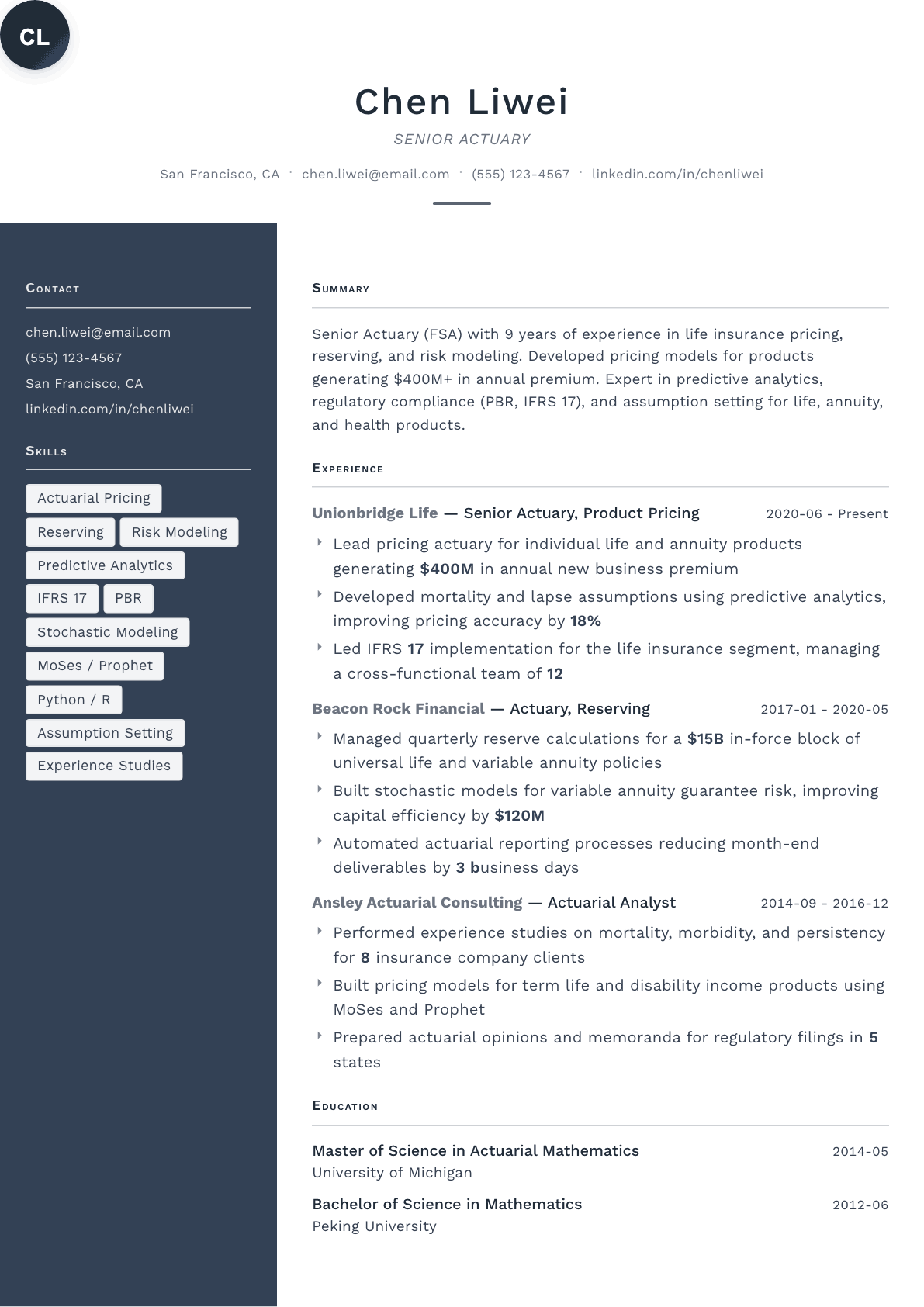
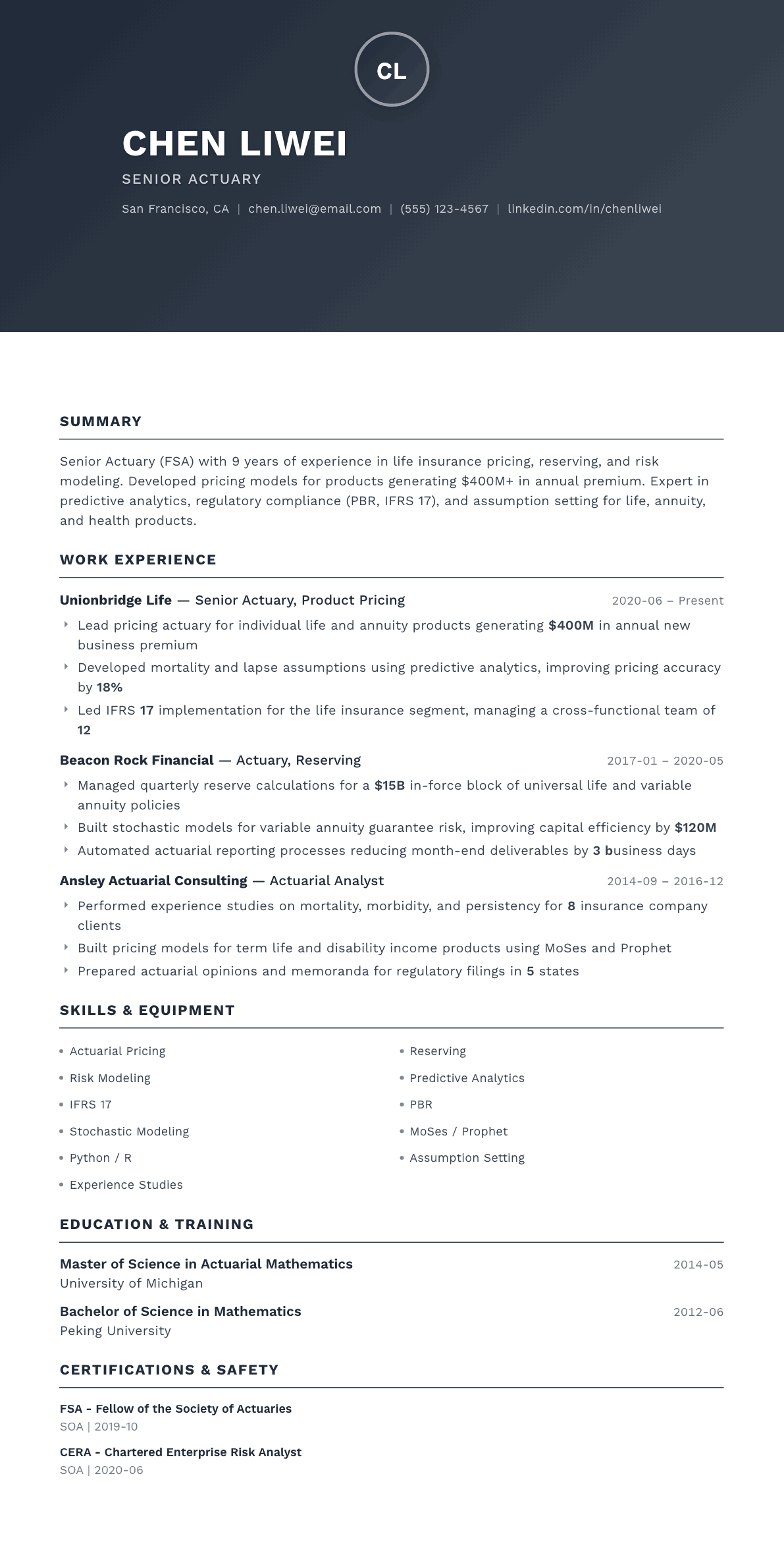
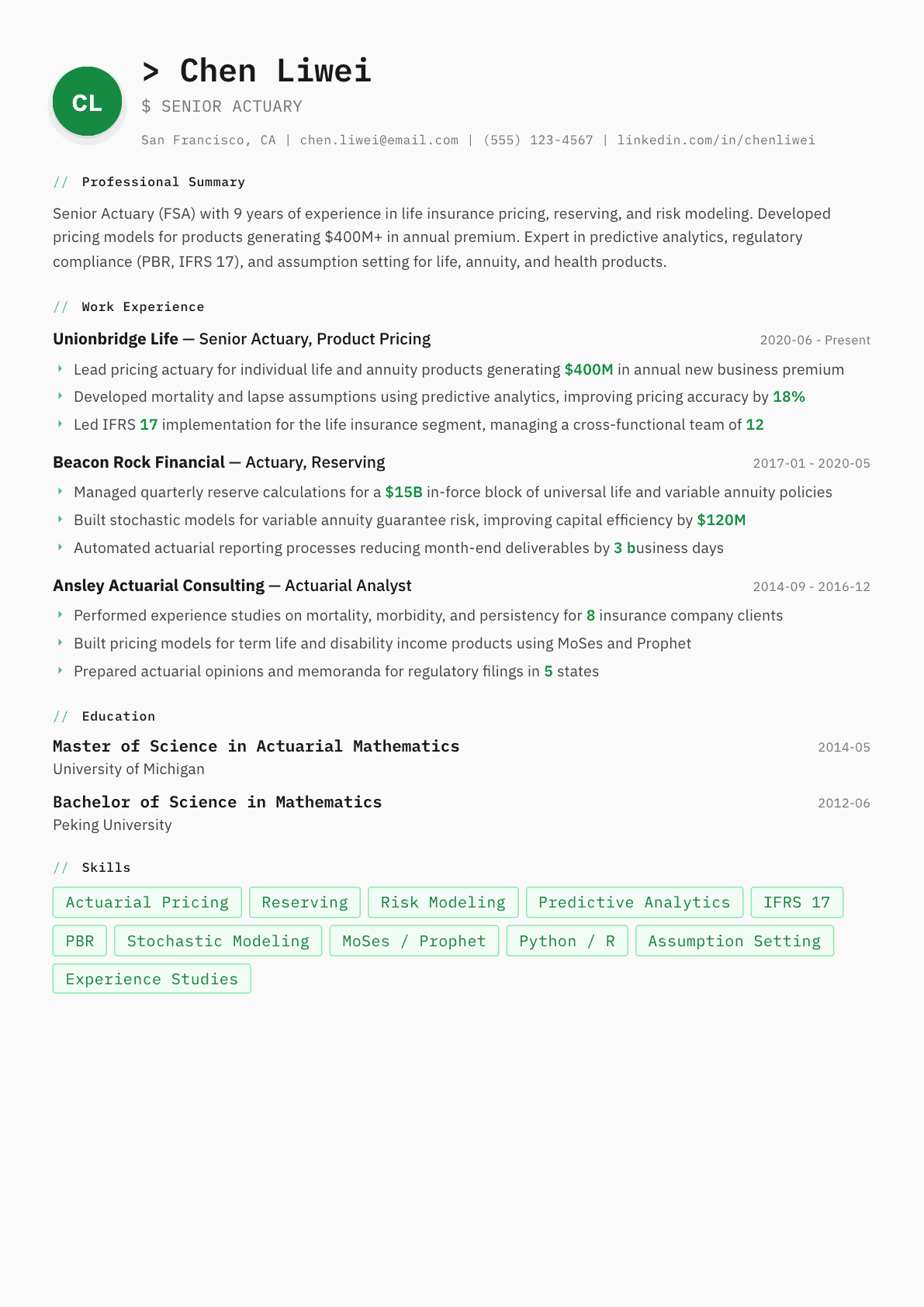
Example Actuary summary
FSA and Senior Actuary with 9 years of experience in life insurance pricing, reserving, and risk modeling. Developed pricing models for $400M+ in annual premium and improved capital efficiency by $120M through stochastic modeling. Expert in IFRS 17, PBR, and predictive analytics. Seeking a Chief Actuary or VP Actuarial role at a leading insurer.
Skills to list on a Actuary resume
- Actuarial Pricing
- Reserving
- Risk Modeling
- Predictive Analytics
- IFRS 17
- PBR (Principle-Based Reserving)
- Stochastic Modeling
- MoSes
- Prophet
- AXIS
- Python
- R
- Assumption Setting
- Experience Studies
What actually gets this resume read
- Display actuarial credentials (FSA, FCAS, ASA, ACAS) next to your name.
- List all exams passed with dates to show progression.
- Quantify premium volumes, reserve blocks, and capital impacts from your work.
- Highlight software proficiency: MoSes, Prophet, AXIS, GGY, R, Python, SAS.
- Show regulatory knowledge: PBR, IFRS 17, Solvency II, state requirements.
- Include both technical actuarial work and business leadership capabilities.
How to write a actuary resume
An actuary resume is read first for exam progress and second for everything else. The chief actuary or hiring manager wants to see, in the top inch of the page, which society you are credentialing through, how many exams you have passed, which ones, and whether the associateship or fellowship is complete. A student actuary who buries the exam list on page two is asking the reader to hunt for the only fact that determines the interview.
After exams, the reader is looking for practice area and model contact. Life pricing, annuity valuation, property and casualty reserving, health trend, pension funding and reinsurance are different jobs with different software, and the resume needs to make clear which one you have actually sat in. Naming the valuation or pricing platform you built in, whether that is Prophet, AXIS, MG-ALFA, ResQ, Arius or a set of internal models in R and Python, is what turns a general analyst into a credible actuarial candidate.
This guide covers where the exam block belongs, how to write actuarial experience so a reviewing actuary can judge the difficulty of your work, three summaries for a student, a new associate and a credentialed actuary, and the questions candidates ask when they move between practice areas or from consulting into a carrier.
Format: exams above experience until you are credentialed
One page until fellowship, two pages after. Reverse-chronological, plain single column, no graphics. Until you hold the associateship, the exam and Validation by Educational Experience block sits directly under the summary, ahead of work history, because that is the screen. Once you are a fellow, the designation goes after your name and the exam list collapses into a single credential line.
List each exam by its actual name and the sitting, and include exams you are registered for as upcoming. Do not list a failed attempt. If you switched tracks between the Society of Actuaries and the Casualty Actuarial Society, say so plainly, since a reader will otherwise read the exam list as inconsistent.
- Header: name with ASA, FSA, ACAS or FCAS when held, city and state, phone, email.
- Order for students: summary, exams and VEE, experience, technical skills, education.
- Order once credentialed: summary, experience, credentials and committee work, technical skills, education.
Summary: practice area, credential path, model ownership
Say the practice area, the product line, the credential status and the model you own. An actuary working on individual life pricing in a stochastic environment has almost nothing in common day to day with one running workers compensation reserve reviews, and a generic summary about analytical modeling hides that difference from a hiring manager who cares about it deeply.
For students, one line on what you have built matters more than adjectives. Having rebuilt an experience study, coded a cash flow projection or automated a reserving roll forward beats any claim about being detail oriented and quantitatively minded.
Experience: the model, the block, the decision it fed
Every actuarial bullet should answer three questions: what block of business, what analysis, and what decision it supported. Reviewing an assumption is uninteresting; setting a mortality assumption for a term block after an experience study, and having it accepted into the valuation basis, is the work an actuary is paid for.
Name the exercise by its real name so a peer can gauge difficulty. Experience studies, assumption setting, reserve adequacy testing, cash flow testing and asset adequacy analysis, loss development triangles and tail factor selection, rate indications and filings, reinsurance pricing, embedded value, capital modeling and stress testing all carry a known weight to a reviewing actuary.
Mention the regulatory or reporting frame the work sat inside, since it defines the standard applied: statutory versus GAAP reserving, principle-based reserving, IFRS 17 measurement models, Solvency II pillars, or a state department of insurance rate filing. Include the actuarial memorandum or opinion you drafted or supported.
Technical skills: model platform, then the language
Split modeling platforms from programming. Platforms carry practice area signal: Prophet, AXIS, MG-ALFA, PolySystems and MoSes on the life side, ResQ, Arius, Igloo and Emblem on the property and casualty side, and internal spreadsheet-driven models everywhere. Programming and data skills follow: R, Python, SQL, SAS and VBA, plus whichever visualization layer the team reports through.
Be honest about depth. There is a real difference between running a model someone else built, changing assumptions inside it, and coding new liability logic or building a validation harness. Say which one you did, because the interview will find out in the first ten minutes.
Keywords in actuarial postings
Actuarial postings reuse a narrow vocabulary: pricing, valuation, reserving, experience study, assumption setting, loss reserving, rate indication, profitability analysis, capital modeling, predictive modeling, actuarial memorandum, and the credential letters themselves. Match the exact wording of the posting once in the skills area and once inside a bullet, and always write out both the abbreviation and the phrase behind it the first time so both forms are searchable.
Actuary resume summary examples
Actuarial student
Actuarial student with 3 exams passed and all VEE requirements complete, plus a year of internship experience building loss development triangles and automating a quarterly reserving roll forward in R. Strong SQL and Excel, and seeking an entry actuarial analyst position in property and casualty reserving.
New associate
Associate of the Society of Actuaries with 4 years in individual life pricing, building and validating Prophet models for term and universal life products. Ran the mortality experience study that reset the assumption basis for a closed block, and supports the annual asset adequacy analysis.
Credentialed actuary
Fellow of the Casualty Actuarial Society with 12 years in commercial lines, currently signing reserve opinions for three subsidiaries and leading rate indications for general liability and commercial auto. Built the reserving platform migration to Arius and manages a team of five actuarial analysts and students.
Work experience bullets: before and after
Before: Assisted with quarterly reserving work.
After: Produced quarterly indications for four commercial auto segments using paid and incurred development, selected tail factors with the reserving actuary, and documented the changes in the reserve memorandum.
Naming the methods, the segments and the memorandum lets a reviewing actuary judge the difficulty of the work.
Before: Worked on pricing models in Prophet.
After: Rebuilt the universal life pricing model in Prophet, added a stochastic interest scenario generator, and reconciled projected profit measures to the prior model within a tolerance agreed with the pricing lead.
The reconciliation detail proves model ownership, which is the difference between running a model and building one.
Before: Did an experience study.
After: Completed a five year lapse experience study across roughly 200 thousand policies in SQL and R, credibility weighted the results by duration and issue age, and recommended the assumption change adopted in the valuation basis.
Data size, method and the fact that the recommendation was adopted turn a routine study into a decision you influenced.
Before: Helped prepare rate filings.
After: Prepared rate indications and supporting exhibits for filings in nine states, responded to two department of insurance objection letters, and secured approval of the filed change without a hearing.
The regulatory back and forth is the hard part of filing work, and naming it shows you handled it rather than watched it.
Before: Automated reporting tasks.
After: Replaced a manual valuation reporting pack with a Python and SQL pipeline that rebuilt every exhibit from the source extract, cutting a three day close task to a single overnight run.
The mechanism and the time change make an automation claim verifiable, and it shows engineering discipline inside an actuarial team.
Hard skills
- Reserving and loss development triangles
- Pricing and rate indications
- Statutory and GAAP valuation
- Experience studies and assumption setting
- Asset adequacy and cash flow testing
- Stochastic scenario modeling
- Prophet, AXIS and MG-ALFA
- ResQ and Arius
- R and Python
- SQL and large policy data extracts
- Predictive modeling and generalized linear models
- Reinsurance structures and treaty analysis
Soft skills
- Explaining a model to non-actuaries
- Documentation discipline
- Peer review of another actuary work
- Defending an assumption change
- Study and exam time management
Certifications worth listing
- Associate of the Society of Actuaries (ASA) (Society of Actuaries)
- Fellow of the Society of Actuaries (FSA) (Society of Actuaries)
- Associate of the Casualty Actuarial Society (ACAS) (Casualty Actuarial Society)
- Fellow of the Casualty Actuarial Society (FCAS) (Casualty Actuarial Society)
- Member of the American Academy of Actuaries (MAAA) (American Academy of Actuaries)
- Chartered Enterprise Risk Analyst (CERA) (Society of Actuaries)
Mistakes that cost actuary candidates the interview
- Burying the exam list on the second page, when exam count is the first filter almost every actuarial recruiter applies.
- Writing analytical and detail oriented instead of naming the block of business, the method and the model platform.
- Claiming a modeling platform after only viewing output from it, which collapses under one technical question.
- Leaving out whether the work was statutory, GAAP or filed with a regulator, so the reader cannot judge the standard applied.
- Describing a study without saying what changed because of it, which reduces months of work to a task performed.
- Mixing Society of Actuaries and Casualty Actuarial Society exams in one list without explaining a track change.
Actuary resume questions
How many exams do I need before an actuary resume gets interviews?
Two passed exams is the usual threshold for an entry analyst role, with internships or strong programming work compensating at one. List upcoming sittings as registered so the reader can see momentum, and keep the exam block above your work history until you are credentialed.
Should I list exams I am still studying for?
List exams you are registered to sit with the sitting month, and label them clearly as upcoming. Do not list attempts you did not pass. Hiring teams plan around exam support budgets and want to know where you are in the sequence.
How do I switch from life to property and casualty actuarial work?
Say the move in the summary, then lead with transferable technical work: data handling at scale, model building, assumption setting and validation. Note any casualty exams you have started, since a track change is a credible signal only when the exam path follows it.
What if my job title is analyst rather than actuary?
Keep the real title and let the bullets carry the actuarial content. Reserving, pricing, experience studies and valuation support read as actuarial work regardless of title, and inventing an actuary title you did not hold is checked easily in a reference call.
Do actuarial resumes need programming skills listed separately?
Yes. Modeling platforms and programming languages answer different questions for a hiring manager. Platforms show practice area exposure, while R, Python and SQL show whether you can work with the raw policy and claims data before it reaches the model.
Related resume examples
- Underwriter Resume example
- Financial Analyst Resume example
- Risk Manager Resume example
- Revenue Analyst Resume example
- Auditor Resume example
- Pricing Analyst Resume example