Audit Manager Resume Examples: free ATS score and gap list
Write an Audit Manager Resume That Shows Engagement Ownership
By Mustafa Tarabya, founder of CVBooster · Published · Updated
Audit manager resume example with engagement portfolio, budget realization and staff development bullets, plus keywords and a full writing guide.
Sample resumes for a audit manager
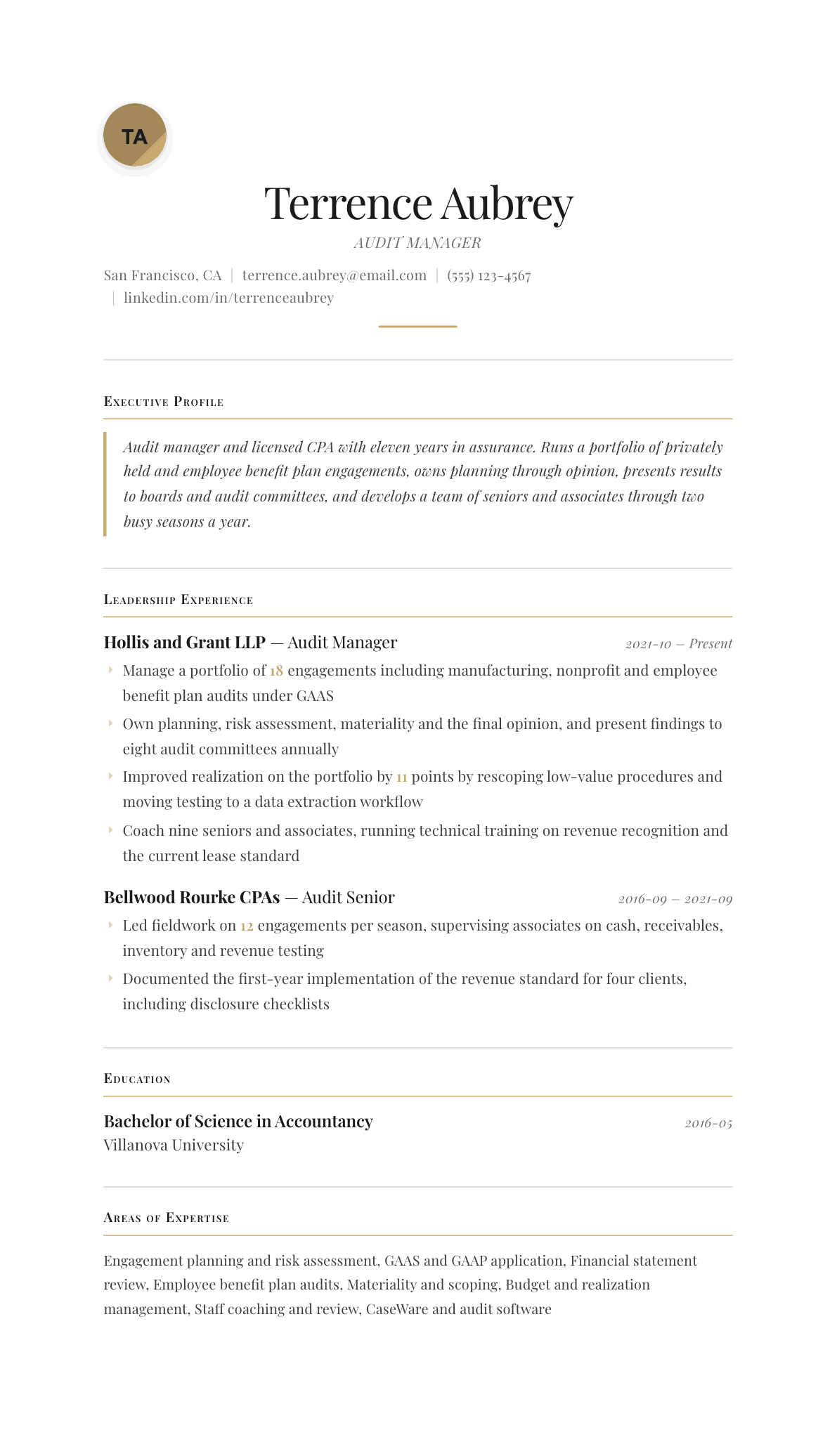
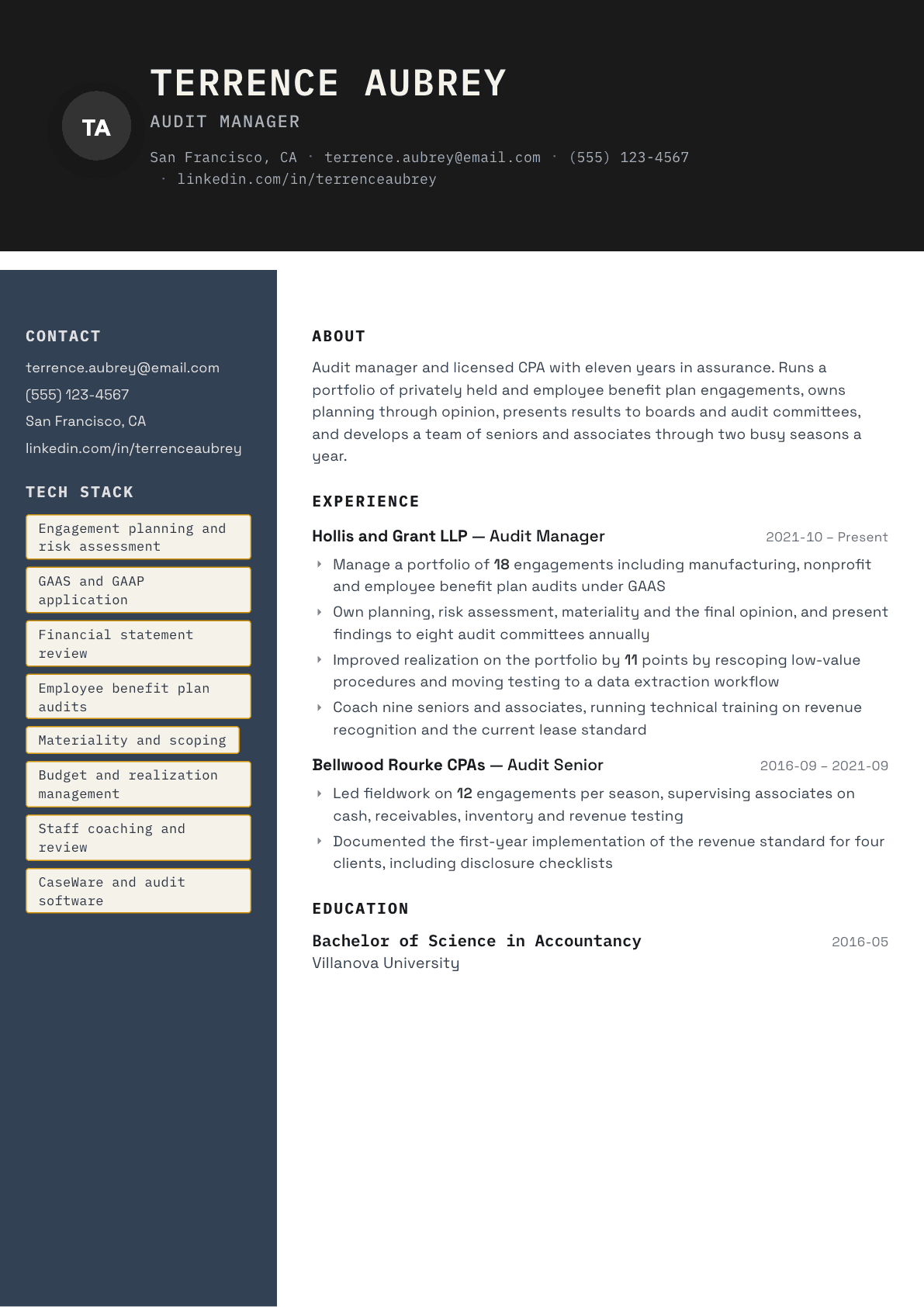
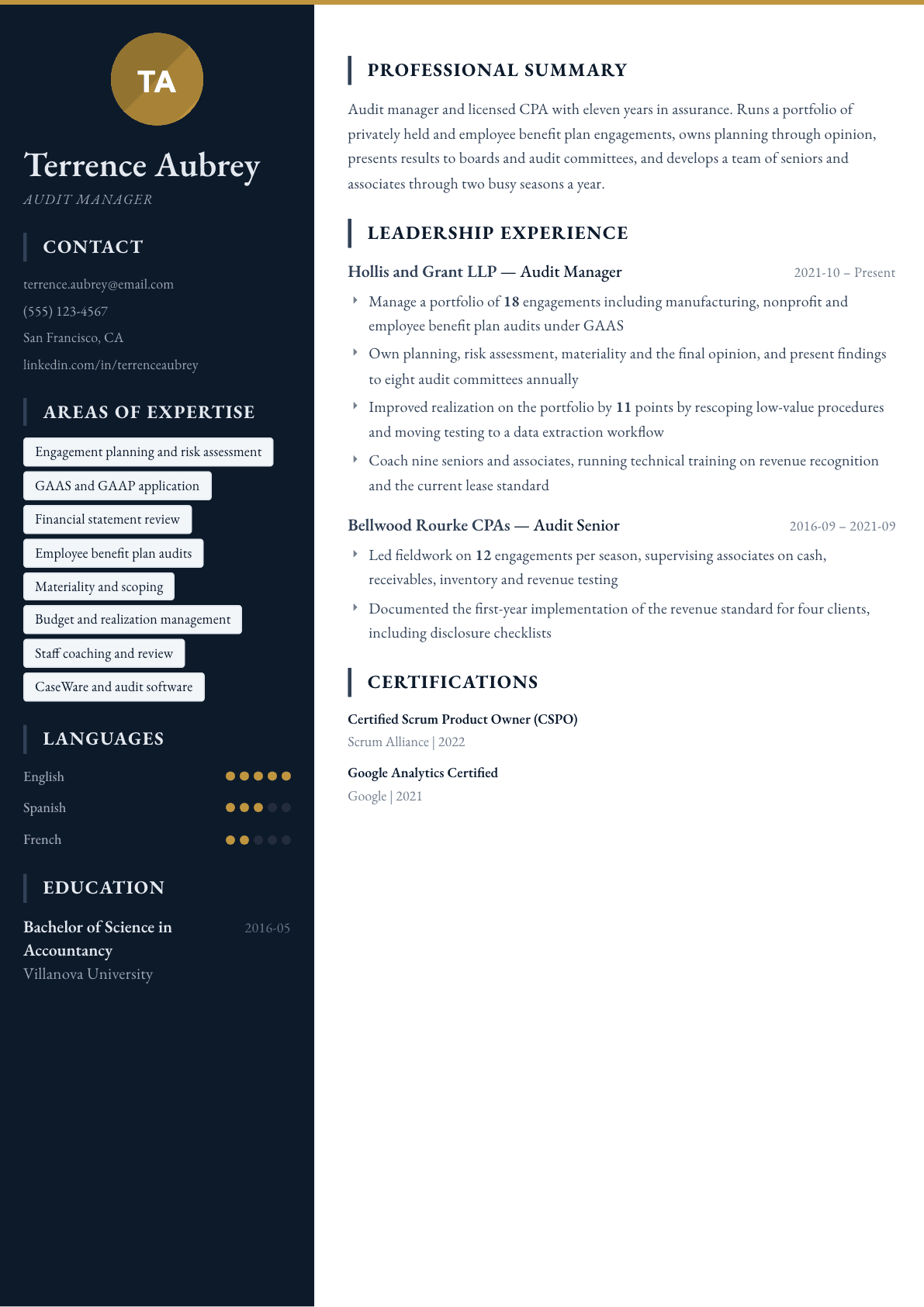
The same audit manager content laid out in three CVBooster templates, so you can see what the finished document looks like before you write a word.
Example Audit Manager summary
Audit manager and licensed CPA with eleven years in assurance, running a portfolio of eighteen private company, nonprofit and employee benefit plan engagements. Owns planning, materiality, risk assessment and the final opinion, and presents results to eight audit committees a year. Lifted portfolio realization by rescoping procedures and moving testing into a data extraction workflow, while coaching nine seniors and associates.
Skills to list on a Audit Manager resume
- Engagement planning and scoping
- Risk assessment and materiality
- GAAS and PCAOB standards
- GAAP financial reporting
- Revenue recognition standard
- Lease accounting standard
- Employee benefit plan audits
- Single audit and GAGAS
- Internal control evaluation
- Financial statement review
- Budget and realization management
- Audit committee presentation
- CaseWare and audit workflow tools
- Staff review and development
What actually gets this resume read
- Open with the engagement portfolio: how many clients, their industries, revenue range and whether they are private, public or plan audits.
- Show that you owned the engagement economics, including budget, hours, realization and the write-offs you prevented or absorbed.
- Name the standards you apply, GAAS, PCAOB standards, GAGAS for single audits, and the reporting frameworks such as GAAP or IFRS.
- Give the technical accounting you have handled first-hand, revenue recognition, leases, business combinations or fair value measurement.
- Describe your review capacity and staff development, since the step from senior to manager is measured by how many people you carry.
- Keep the CPA license, its state and status near the top, and add real credentials such as CFE or CIA with the issuing organization.
How to write a audit manager resume
At manager level in assurance, the technical work is assumed. What a partner reads for is whether you can carry engagements end to end: plan them, staff them, keep them on budget, resolve the accounting issues, sign off on the file and stand in front of an audit committee when the questions get pointed.
That means an audit manager resume has to show three things a senior resume does not. Portfolio scope, meaning how many engagements and in what industries. Economics, meaning budget, hours and realization. People, meaning how many seniors and associates you reviewed and developed across a season. Leave any of the three out and the page reads a grade below the role.
This guide covers the section order a firm expects, how to describe engagements and technical conclusions without naming clients, three summaries across levels, before and after bullets from real engagement files, and the questions auditors ask when they move between firms or into industry.
Format: two pages, portfolio before methodology
Two pages is normal at manager level. Single column, plain type, with the license line directly under your name because a state board credential is the first thing verified.
Lead each role with the portfolio rather than a duty list: number of engagements, industries, entity types, revenue range of the clients, and whether the work was private company, employee benefit plan, governmental or public company. That line frames every bullet that follows.
- Header: name, city and state, phone, email, CPA license and state.
- Order: summary, engagement portfolio, experience, technical accounting, systems, education, license.
- Say which standards applied: private company assurance, public company standards, or government auditing standards.
Summary: portfolio, ownership, and the committee
Four lines. Give years and firm type, the portfolio size and mix, what you own from planning through opinion, and how many people you develop. If you present to boards or audit committees, say so, because client-facing presence is the hardest thing for a firm to assess from a resume and the easiest to claim.
When you are moving into industry, use the summary to translate. Engagement management becomes project ownership, technical accounting becomes policy work, and audit committee reporting becomes executive communication. Say the target role explicitly so the reader is not left guessing.
Experience: engagements, economics, and technical conclusions
Group bullets around what a manager actually owns. Planning: risk assessment, materiality, scoping decisions and the staffing plan. Execution: supervision of fieldwork, resolution of review notes, coordination with specialists on valuation, tax or technology. Reporting: the opinion, the management letter, the governance communication. Economics: budget, hours, realization and write-offs avoided.
Realization is the number partners think in. If you improved it, say by how much and how: rescoping low-value procedures, moving testing to a data extraction workflow, negotiating a fee for scope creep, or resolving issues earlier in the field. Very few audit resumes address engagement economics at all, so the ones that do stand out immediately.
For technical accounting, name the standards you concluded on and the fact pattern type. First-year implementation of a new revenue or lease standard, a business combination purchase price allocation, going concern evaluation, or fair value measurement with a specialist are the ones that get probed in interviews.
People: review capacity is the promotion criterion
Give the number of seniors and associates you reviewed, the concurrent engagements they were spread across, and the training you delivered. A manager carrying nine staff across three simultaneous jobs has a different capacity from one supervising two on a single engagement, and the page should make that clear.
Add retention and development outcomes where you have them: staff you coached into promotion, a training session you built, or a review process change that reduced second-round comments. Firms lose money to turnover and read those signals carefully.
Systems and screening keywords
Name the audit workflow and documentation software you have used, along with any data extraction or analytics tools applied to client populations. Then mirror the posting language once each: engagement planning, risk assessment, materiality, internal control evaluation, substantive testing, financial statement review, opinion issuance, audit committee communication and staff development. Support each with a bullet rather than repeating the phrase.
Audit Manager resume summary examples
Audit senior stepping up
Audit senior with five busy seasons leading fieldwork on 12 engagements a year, supervising associates on cash, receivables, inventory and revenue testing. Documented first-year revenue standard implementation for four clients. Licensed CPA seeking a manager seat with portfolio and review ownership.
Audit manager
Audit manager and licensed CPA running 18 engagements across manufacturing, nonprofit and employee benefit plans. Owns planning, materiality and the final opinion, presents to eight audit committees a year, improved portfolio realization by 11 points, and coaches nine seniors and associates.
Senior manager
Senior audit manager with fifteen years in assurance, leading a portfolio of private company and employee benefit plan engagements plus two governmental single audits. Owns the technical consultation process for revenue and lease implementations, manages four managers and seniors, and mentors the firm campus hiring cohort.
Work experience bullets: before and after
Before: Managed multiple audit engagements at the same time.
After: Managed a portfolio of 18 engagements spanning manufacturing, nonprofit and employee benefit plan audits, running three to four concurrently through the January to April cycle.
Portfolio size, industry mix and concurrency give a partner the capacity picture a duty statement cannot.
Before: Was responsible for planning and completing audits.
After: Owned planning, risk assessment, materiality and the final opinion on every engagement in the portfolio, and presented results and control observations to eight audit committees annually.
The named phases plus committee presence prove end-to-end ownership at the level the role requires.
Before: Improved efficiency on my engagements.
After: Improved portfolio realization by 11 points by rescoping low-value substantive procedures, moving detail testing to a data extraction workflow and resolving technical issues before fieldwork close.
Engagement economics with three specific actions is the language partners use when evaluating a manager.
Before: Helped clients with new accounting standards.
After: Documented first-year implementation of the revenue standard for four clients, reviewing contract reviews, transition disclosures and the disclosure checklist for each.
A named standard and the deliverables reviewed show technical depth an interviewer can probe.
Before: Trained and reviewed the work of junior staff.
After: Coached nine seniors and associates across concurrent engagements, delivered technical training on revenue recognition and the lease standard, and reduced second-round review comments across two seasons.
Headcount, the training subject and a review outcome turn supervision into measurable development capacity.
Hard skills
- Engagement planning and scoping
- Risk assessment and materiality determination
- Generally accepted auditing standards
- Public company audit standards
- Government auditing standards and single audits
- Employee benefit plan audits
- Internal control evaluation
- Substantive analytical procedures
- Revenue recognition standard application
- Lease accounting standard application
- Financial statement and disclosure review
- Budget, hours and realization management
Soft skills
- Client relationship ownership
- Audit committee presentation
- Difficult conversations on adjustments
- Staff coaching and retention
- Scheduling across concurrent engagements
- Written technical memoranda
Certifications worth listing
- Certified Public Accountant (CPA) (State Board of Accountancy)
- Certified Internal Auditor (CIA) (Institute of Internal Auditors)
- Certified Fraud Examiner (CFE) (Association of Certified Fraud Examiners)
- Certified Information Systems Auditor (CISA) (ISACA)
- Chartered Global Management Accountant (CGMA) (American Institute of Certified Public Accountants)
Mistakes that cost audit manager candidates the interview
- Listing procedures a senior performs, which puts the resume a grade below the role being applied for.
- Leaving engagement economics off entirely, when budget and realization are how partners evaluate a manager.
- Naming clients rather than describing their industry, size and entity type, which raises a confidentiality concern.
- Omitting the standards applied, so a reader cannot tell private company work from public company or single audits.
- Giving no staff numbers, which hides the review capacity that defines the manager grade.
- Claiming technical standards you supported but never concluded on, which unravels in the first probing question.
Audit Manager resume questions
How do I describe engagements without naming clients?
Give the industry, the entity type and a size band. A privately held food manufacturer in the middle market or a defined contribution plan with several thousand participants tells the reader everything they need while respecting confidentiality obligations.
Should an audit manager resume include realization and budget figures?
Yes, when you can state them accurately. Realization, budget variance and write-offs are the metrics a partner uses to evaluate manager performance, and most competing resumes ignore them completely, so including them is a genuine differentiator.
How do I present employee benefit plan audits?
Separate them from the rest of the portfolio and give the count and plan types. Benefit plan work has its own reporting requirements and firm-level quality expectations, so a reader treats it as a distinct competency rather than general assurance.
What if I want to move from public accounting into industry?
Rewrite the bullets around the business outcome rather than the audit procedure. Emphasize technical accounting conclusions, control design observations, process improvement recommendations and executive communication, then name the industry target in the summary.
How many pages should an audit manager resume be?
Two. One page cannot hold the portfolio, the technical conclusions, the economics and the staff development a manager must evidence, and three signals an inability to prioritize, which is a poor look for someone who sets audit scope.
Related resume examples
- Auditor Resume example
- Controller Resume example
- Internal Auditor Resume example
- Accounting Manager Resume example
- CPA Resume example
- Budget Analyst Resume example