Internal Medicine Physician Resume Examples: free score
Write an Internal Medicine Physician Resume That Signals Complexity
By Mustafa Tarabya, founder of CVBooster · Published · Updated
An internal medicine physician resume guide with outpatient and inpatient examples, complexity and panel keywords, plus bullets that show diagnostic reasoning.
Sample resumes for a internal medicine physician
The same internal medicine physician content laid out in three CVBooster templates, so you can see what the finished document looks like before you write a word.
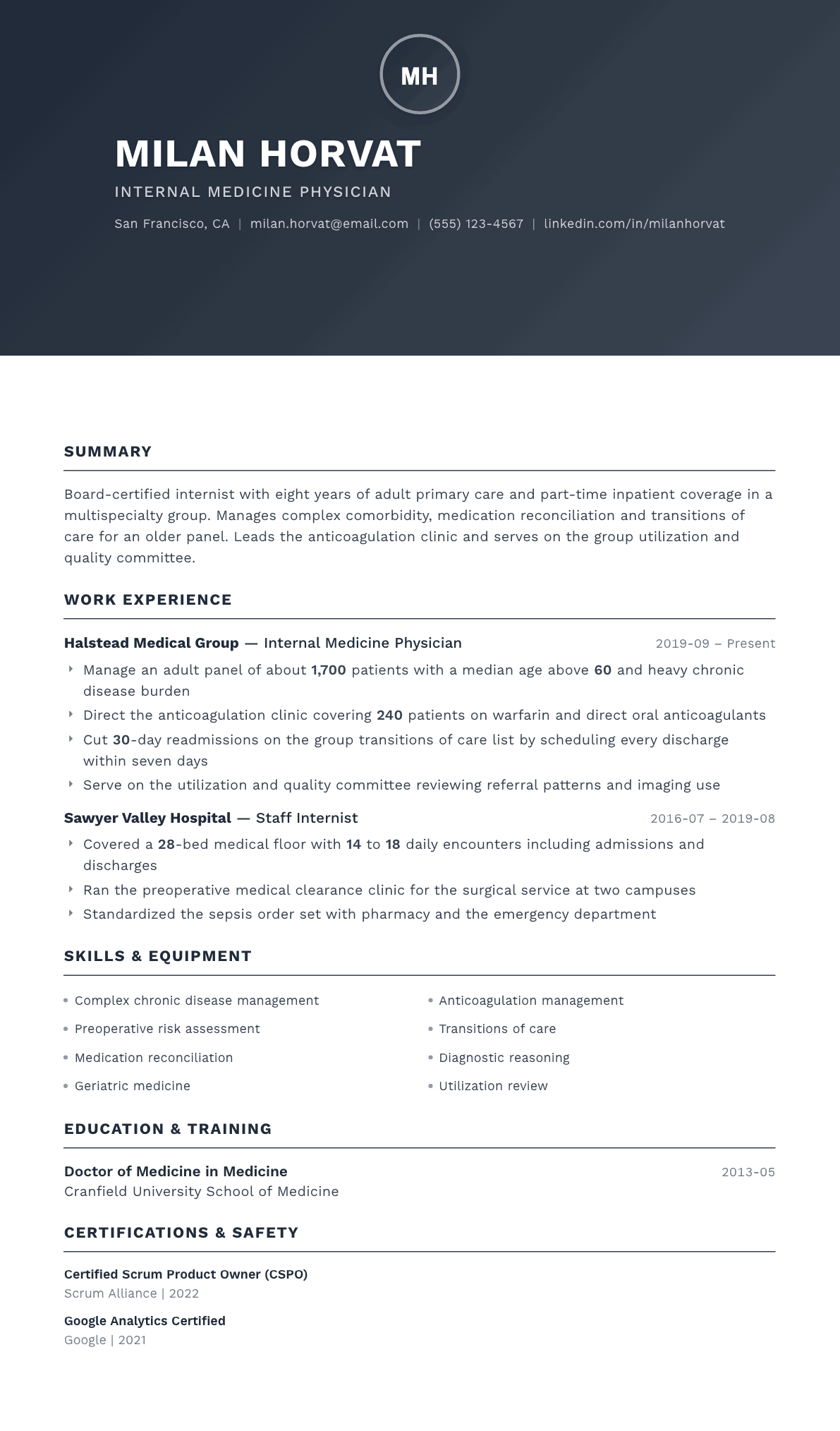
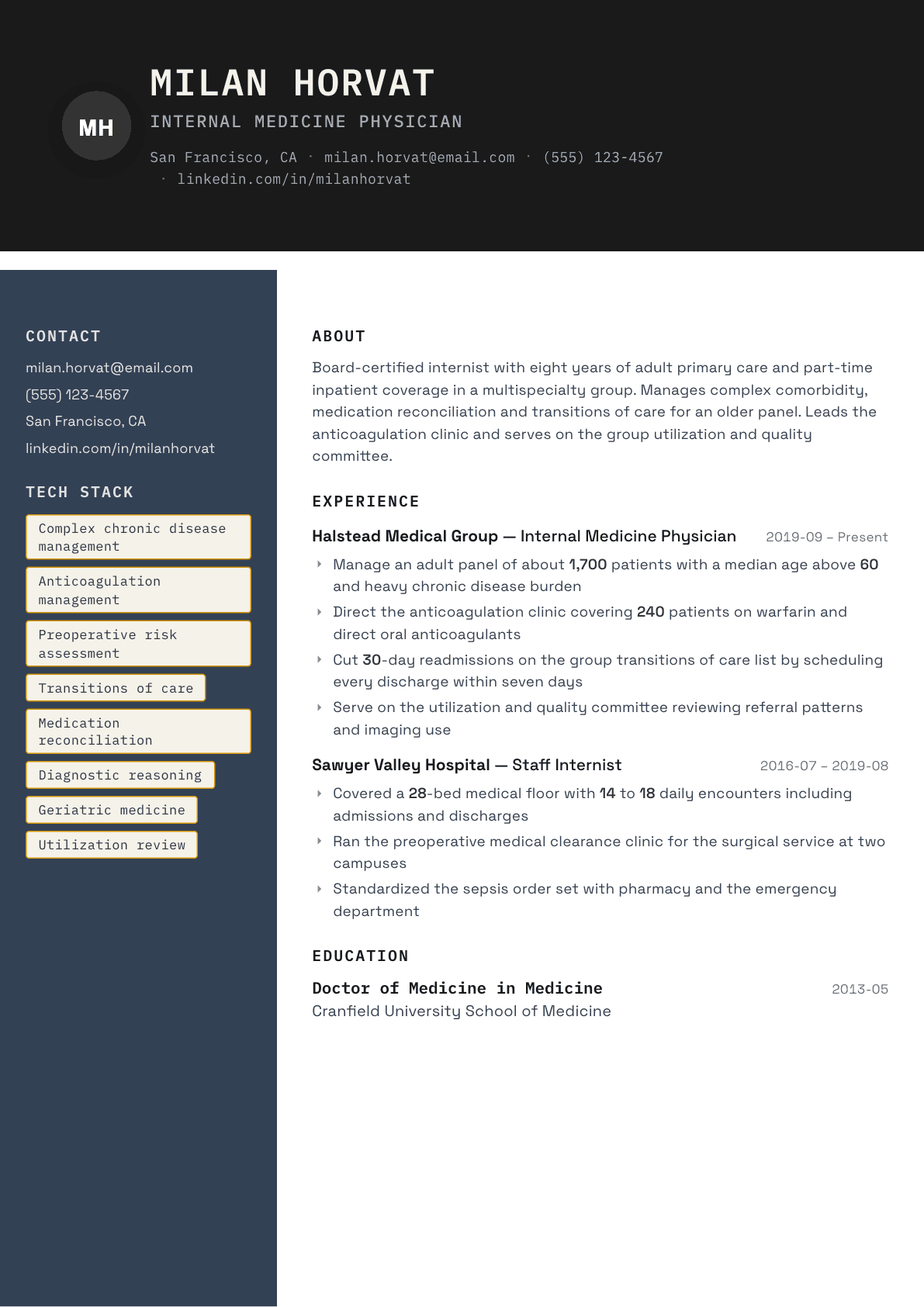
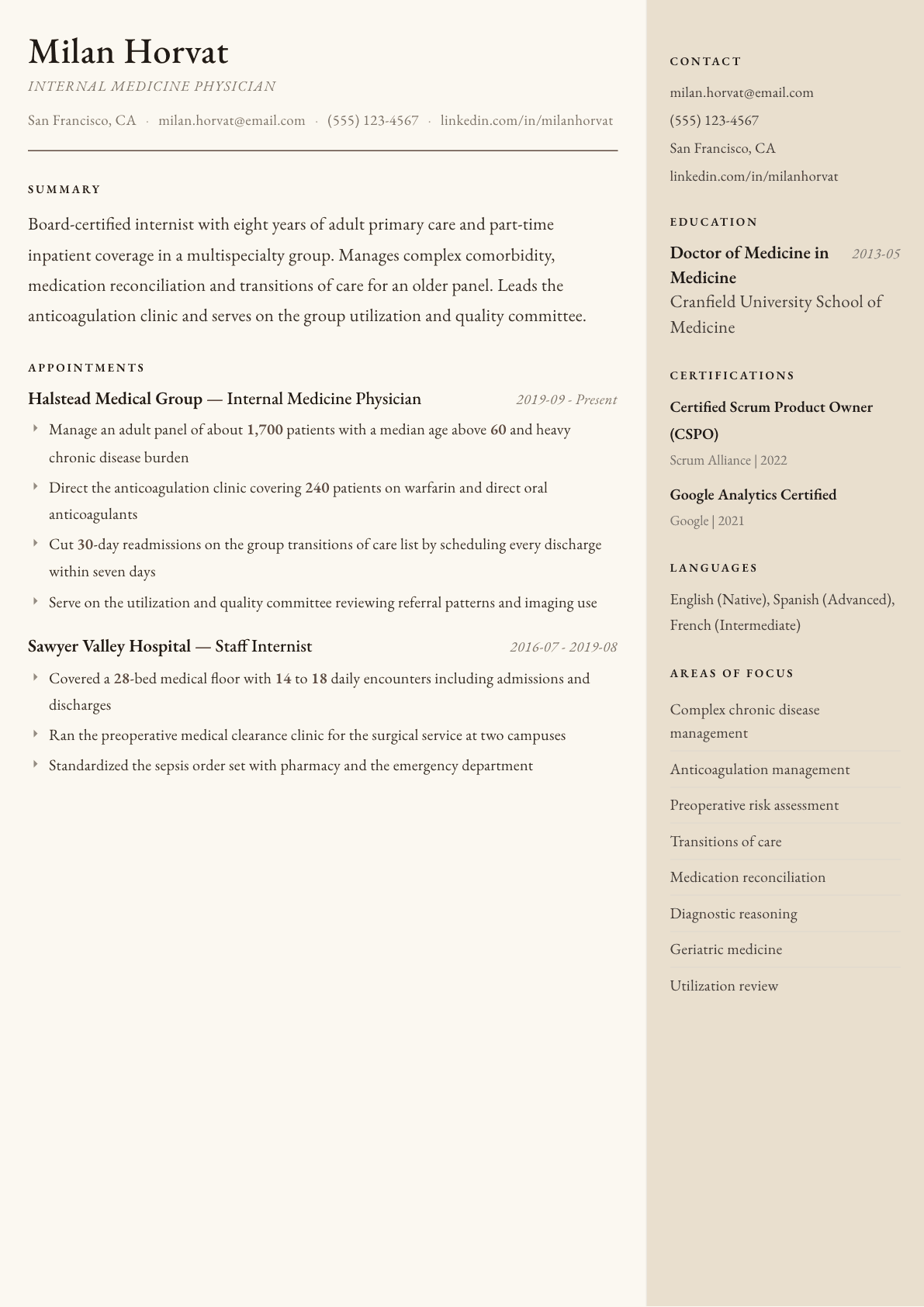
Example Internal Medicine Physician summary
Board-certified internist with eight years of adult primary care plus inpatient coverage, managing a panel of about 1,700 patients with a median age above 60 and heavy chronic disease burden. Directs an anticoagulation clinic of 240 patients, shortened post-discharge follow-up to within seven days, and sits on the group quality committee. Seeking an outpatient role with a strong care management team.
Skills to list on a Internal Medicine Physician resume
- Adult primary care
- Complex comorbidity management
- Diagnostic reasoning
- Anticoagulation management
- Diabetes and hypertension care
- Heart failure follow-up
- Preoperative medical clearance
- Transitions of care
- Medication reconciliation
- Geriatric medicine
- Inpatient medicine
- Preventive screening
- Utilization and quality review
- Electronic health records
What actually gets this resume read
- Say whether you want outpatient only, inpatient only or a mixed model, because these are separate hiring pipelines.
- Show panel complexity, not just size: median age, comorbidity burden, risk score or the share on multiple medications.
- Describe the specialty clinics you run, such as anticoagulation, heart failure follow-up or preoperative assessment.
- Give transitions of care results, since groups are measured on readmissions and post-discharge follow-up timing.
- Include committee work on utilization, formulary or quality, which signals readiness for a medical leadership track.
- Name any fellowship you completed or abandoned deliberately, so the reader understands your career direction.
How to write a internal medicine physician resume
Internal medicine resumes are read against a fork in the road. A group is hiring either for an outpatient adult primary care panel, a hospital-based service, or a mixed model that is now rare. Those are separate pipelines with separate schedules and separate pay structures, and a resume that hedges between them reads as a candidate who has not decided.
Once the lane is clear, the reader wants complexity and capacity. An internist is hired to manage patients other clinicians find difficult: multiple chronic conditions, long medication lists, competing specialists, and the transitions between hospital and home where things go wrong. Panel size alone does not show that. Panel complexity does.
This guide covers lane declaration, how to describe a complex adult panel, the specialty clinics an internist can run, transitions of care results, and the questions internists ask when moving between employed primary care, hospital medicine and a leadership track.
Format: state the model you want, then the credentials
Reverse chronological, two pages, no columns. Say in the first line of the summary whether you are seeking outpatient, inpatient or a mixed role. Recruiters route internal medicine applications by that single fact, and the wrong routing costs you two weeks.
Underneath the header, a credentials block: internal medicine board certification and status, any subspecialty certification, state licenses with expiration, controlled substance registration and current life support cards.
- Header: name and degree, city and state, phone, email.
- Credentials: board certification and status, licenses, registrations, life support cards.
- Then summary, practice history, residency and any fellowship, education, skills, committee and quality roles.
Summary: model, panel, complexity, and the clinic you run
Give the model, the years, the setting, the panel size, and one marker of complexity such as median panel age, comorbidity burden or the share of patients on five or more medications. Then name any specialty clinic you run, because that is what distinguishes one internist from another with an identical panel.
If you completed a fellowship and returned to general internal medicine, say so plainly. Readers notice a fellowship year on the timeline and will otherwise assume you plan to leave for subspecialty work within a year.
Experience: panel complexity, throughput, and what you own
Open each position with the group type and size, the population served, and the care team around you. An internist with a dedicated care manager, a clinical pharmacist and two medical assistants runs a different practice from one working alone with a shared front desk, and the care team explains your throughput.
Then the panel: size, median or typical age, chronic condition burden, and daily visit volume. Add the encounter mix if it matters, such as a high share of annual wellness visits, transitional care visits or complex care management enrollments.
Finally, what you own beyond your own list: an anticoagulation clinic, a preoperative medical clearance service, a heart failure or chronic kidney disease follow-up program, or the group formulary and utilization work. Ownership is the difference between an internist a group employs and one a group promotes.
- Group type, size, population and the care team supporting you.
- Panel size, typical age, comorbidity burden, daily visit volume.
- Specialty clinics or services you personally run.
- Committee, formulary and utilization work.
Transitions of care and readmissions
Every employed primary care group is measured on what happens in the week after a hospital discharge. If you built a post-discharge scheduling rule, ran transitional care management visits, reconciled medications against the discharge summary yourself, or worked with a care manager on high-risk follow-up, that belongs on the page with the effect it had.
Say what changed and over what period. Post-discharge follow-up within seven days, readmission on the group high-risk list, medication discrepancies caught at the first visit: these are numbers a medical director tracks, and a candidate who speaks in them is speaking the reader language.
Skills, subspecialty knowledge and keywords
Internal medicine postings reuse a predictable set of terms: adult primary care, chronic disease management, preventive screening, care coordination, transitions of care, medication reconciliation, risk adjustment documentation, patient centered medical home, value-based care. Mirror the exact posting language once in the skills list and once in a bullet.
Where you carry depth beyond the general, name it: anticoagulation, diabetes with insulin management, chronic kidney disease staging and referral timing, chronic obstructive pulmonary disease follow-up, or geriatric care including cognitive assessment and deprescribing. Depth in two areas reads better than a list of every organ system.
Internal Medicine Physician resume summary examples
New from residency
Internal medicine board eligible, completing residency with a continuity panel of about 300 adults, a year as senior resident on the inpatient teaching service and a quality project on post-discharge follow-up. Seeking an outpatient adult primary care position with care management support and a structured onboarding panel.
Eight years in practice
Board-certified internist managing an adult panel of about 1,700 patients with a median age above 60 and heavy chronic disease burden. Directs an anticoagulation clinic covering 240 patients, shortened post-discharge follow-up to within seven days, and covered inpatient service for three years earlier in practice.
Associate medical director
Internist and associate medical director with sixteen years of practice, responsible for quality performance, referral patterns and clinician onboarding across two adult primary care sites. Maintains a personal panel, built the preoperative clearance clinic, and chairs the utilization and formulary committee.
Work experience bullets: before and after
Before: Managed a panel of adult primary care patients.
After: Managed an adult panel of about 1,700 patients with a median age above 60, most carrying three or more chronic conditions and long medication lists.
Complexity markers show the difficulty of the panel, which panel size alone never conveys.
Before: Ran an anticoagulation clinic.
After: Directed an anticoagulation clinic of 240 patients on warfarin and direct oral anticoagulants, with pharmacist-supported dosing, a bleeding risk review at each visit and standing periprocedural bridging rules.
The patient count, the drug classes and the protocol detail describe a service rather than a title.
Before: Reduced hospital readmissions.
After: Cut readmissions on the group high-risk list by scheduling every medical discharge for a visit within seven days and reconciling medications against the discharge summary before the appointment.
Naming the exact mechanism makes the outcome credible and shows a process a new employer could adopt.
Before: Did preoperative evaluations for surgery patients.
After: Ran the preoperative medical clearance clinic for the surgical service at two campuses, evaluating cardiac and pulmonary risk and setting perioperative medication plans for anticoagulated patients.
The service scope and the specific risk work show a clinic you owned instead of a task you performed.
Before: Served on hospital committees.
After: Served on the utilization and quality committee, reviewing imaging use and specialty referral patterns across the group and rewriting the low-back pain imaging guidance with radiology.
A committee is only meaningful when the reader sees the decision you influenced and the artifact you produced.
Hard skills
- Adult primary care and panel management
- Complex comorbidity and polypharmacy management
- Diagnostic reasoning for undifferentiated presentations
- Diabetes management including insulin titration
- Hypertension and lipid management
- Anticoagulation management
- Chronic kidney disease and referral timing
- Heart failure follow-up
- Preoperative medical clearance
- Transitions of care and medication reconciliation
- Geriatric assessment and deprescribing
- Preventive screening and immunization
- Risk adjustment documentation
Soft skills
- Longitudinal relationships with complex patients
- Coordination across multiple specialists
- Goals of care conversations
- Concise consultative writing
- Care team supervision
- Working through diagnostic uncertainty
Certifications worth listing
- Internal Medicine Certification (American Board of Internal Medicine)
- Geriatric Medicine Subspecialty Certification (American Board of Internal Medicine)
- Focused Practice in Hospital Medicine (American Board of Internal Medicine)
- Advanced Cardiovascular Life Support (ACLS) (American Heart Association)
- Basic Life Support (BLS) (American Heart Association)
Mistakes that cost internal medicine physician candidates the interview
- Hedging between outpatient and hospital work, which sends the application into the wrong recruiting pipeline.
- Giving panel size with no complexity marker, so the reader cannot tell an easy list from a hard one.
- Leaving out the care team, which makes your visit volume impossible to interpret.
- Ignoring transitions of care, the metric employed primary care groups are judged on most directly.
- Listing every chronic condition you treat rather than the two areas where you carry real depth.
- Leaving an unexplained fellowship year on the timeline, which reads as an intention to leave general practice.
Internal Medicine Physician resume questions
Should an internal medicine resume target outpatient or inpatient roles?
Pick one per version of the document. Write an outpatient version leading with panel, complexity and quality results, and a hospital version leading with census, admissions and length of stay. Sending one hybrid resume to both weakens it in each direction.
How do I show panel complexity?
Use whatever your system measures: median panel age, average chronic conditions per patient, the share on five or more medications, or a risk score distribution. Any one of these turns a plain panel count into a picture of how hard the work actually is.
Does an internist need to list procedures?
List them only if you still perform them and want a role that includes them, such as paracentesis, lumbar puncture, joint injection or point-of-care ultrasound. In outpatient adult medicine, panel management and specialty clinics usually carry more weight than a procedure list.
How should I present a fellowship I did not complete or did not use?
Include the dates and the program with one honest line about why you returned to general internal medicine. An unexplained year invites the assumption that you are still looking for a subspecialty position and will leave the new job quickly.
What outcome numbers matter most for an internist?
Post-discharge follow-up timing, readmission on the high-risk list, blood pressure and diabetes control rates, cancer screening completion, and annual wellness visit rates. Choose the two you personally moved and describe the workflow change behind each of them.