Doctor Resume Examples: what a hiring manager reads first
Build a Doctor Resume That Opens Doors
By Mustafa Tarabya, founder of CVBooster · Published · Updated
Doctor resume examples with expert tips, ATS keywords, and professional templates. See exactly what a winning internal medicine physician resume looks like.
Sample resumes for a doctor
The same doctor content laid out in three CVBooster templates, so you can see what the finished document looks like before you write a word.
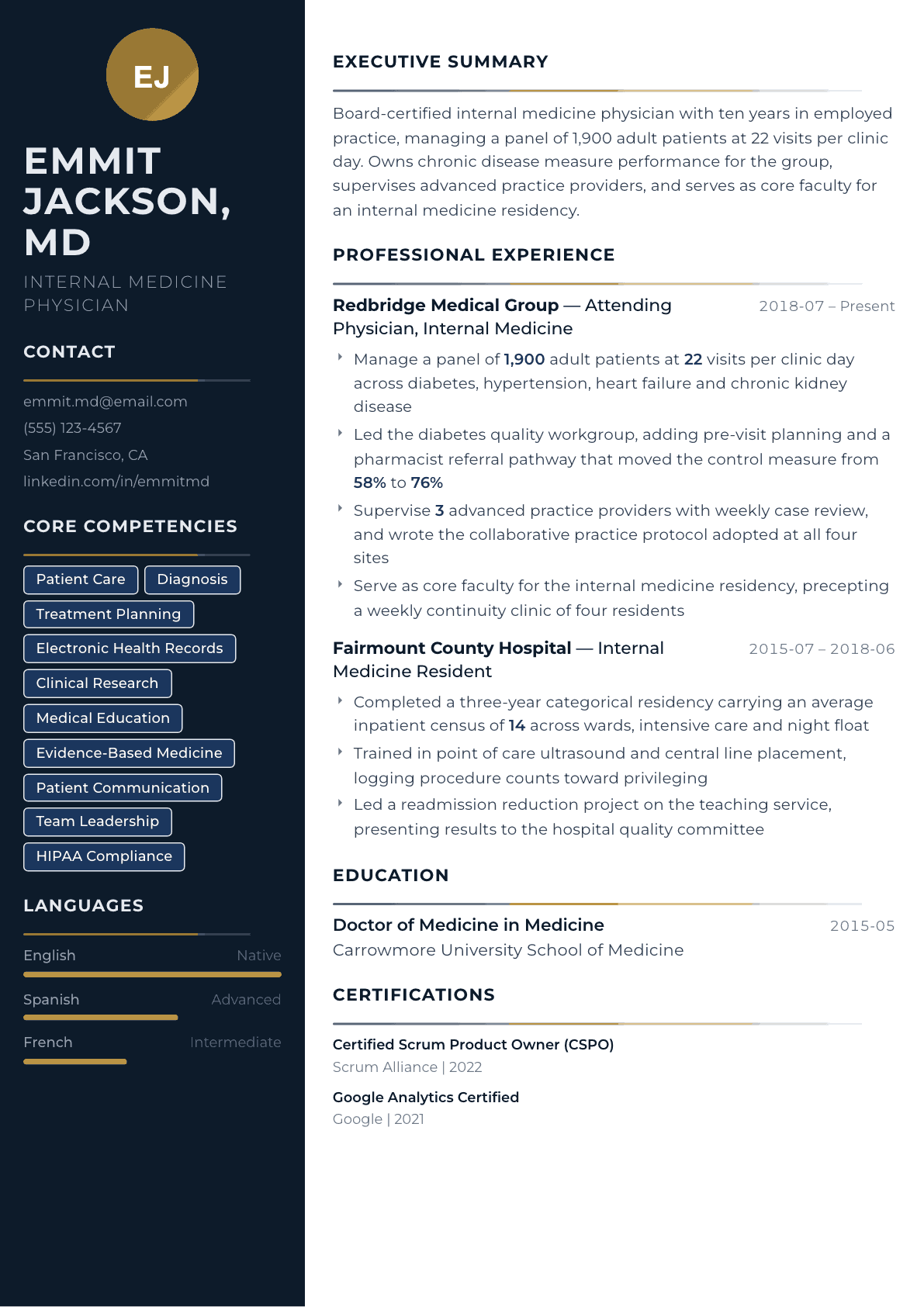
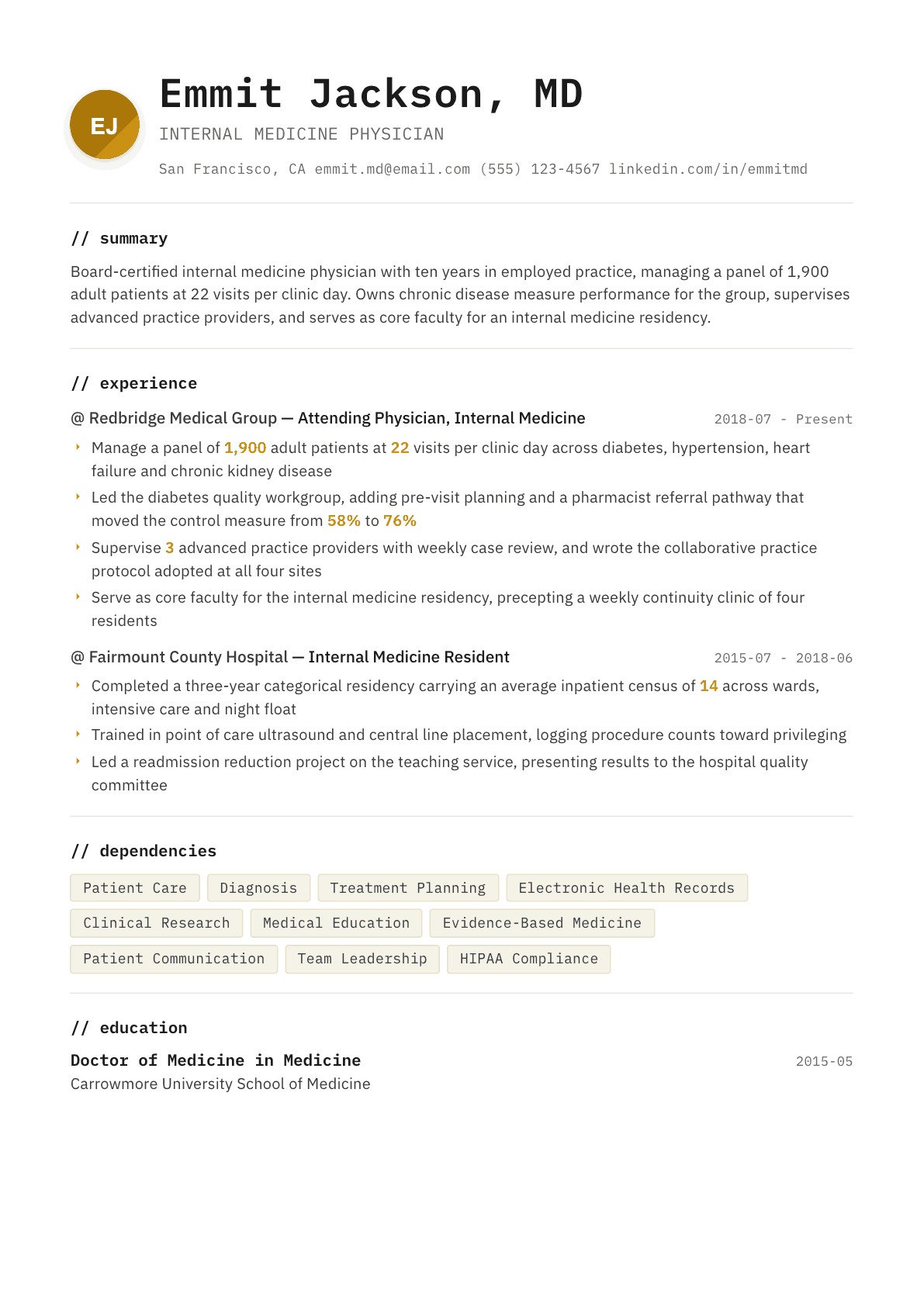
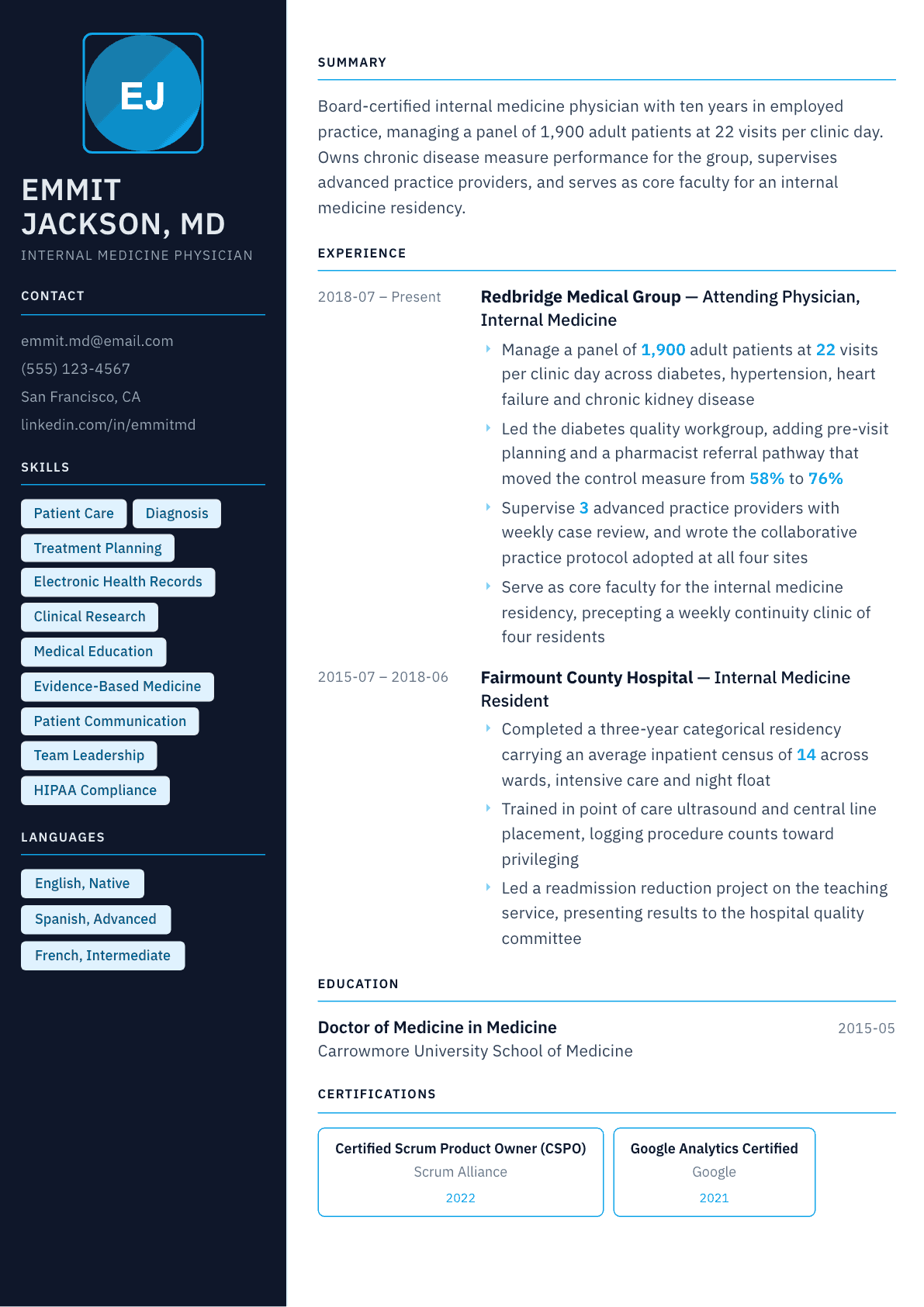
Example Doctor summary
Board-certified internal medicine physician with ten years in a 14-physician group, managing a panel of 1,900 adult patients at 22 visits per clinic day with unrestricted state licensure and current DEA registration. Raised diabetes control measure performance from 58% to 76%, supervises three advanced practice providers, and serves as core faculty for an internal medicine residency.
Skills to list on a Doctor resume
- Patient Care
- Diagnosis
- Treatment Planning
- Electronic Health Records
- Clinical Research
- Medical Education
- Evidence-Based Medicine
- Patient Communication
- Team Leadership
- HIPAA Compliance
What actually gets this resume read
- Put a credential block under the summary: specialty board and status, each state license marked unrestricted, DEA registration and life support cards.
- Write board certified, board eligible or continuous certification exactly, because a medical staff office verifies the distinction before an offer is issued.
- Give the practice profile in numbers: panel size, patients per clinic session, average inpatient census, admissions per shift and call frequency.
- Add a short procedures block with approximate annual counts, since a department chair reads procedure volume as a privileging calculation.
- Name the quality measure you moved, the intervention you led and the direction it went, rather than claiming quality improvement in general.
- Keep a clean month and year timeline with no unexplained gaps, because credentialing verifies every date and stalls on silence.
- Send a two or three page resume for employed practice and keep the full curriculum vitae for academic and fellowship applications.
How to write a doctor resume
Physician hiring is a credentialing exercise before it is a hiring exercise. Whoever opens your file, a medical staff recruiter, a group president or a department chair, is checking a fixed list: medical school and degree, residency and any fellowship, board certification and the certifying board, unrestricted state license, DEA registration, hospital privileges, and whether the timeline has any gap that will need explaining to a credentialing committee.
Only after that list clears does anyone read what kind of doctor you are. That is where most physician resumes stall, because they list rotations and duties that every trained physician performs. What differentiates you is the practice profile: panel size, patients per clinic session, inpatient versus outpatient split, procedures you perform, call structure you have carried, and the quality measures your name is attached to.
This guide walks through both halves, the credential block a screener verifies and the practice profile a chair evaluates, with summaries for a graduating resident, a physician several years into practice and a medical director, plus rewrites of the bullets that fill most physician applications.
Choose the document: resume for employment, curriculum vitae for academics
Employed practice positions with hospital systems, medical groups and community health centers want a two or three page resume built around your clinical profile. University appointments, research posts and fellowship applications want a full curriculum vitae with publications, presentations, funding, teaching and committee service in the conventional order.
Keep both current from the same source material. The curriculum vitae holds everything; the resume is the version where scholarship compresses to a line and clinical volume expands. Sending the wrong one is the most common self inflicted problem in physician job searches.
- Header: name with MD or DO, city and state, phone, email, and NPI if the posting asks for it.
- Order for employment: summary, board certification and licensure, clinical experience, procedures, training, education, quality and leadership, selected scholarship.
- Include a clean month and year timeline for every position, since credentialing verifies dates and gaps must be accounted for.
Credential block: certification, licensure, and privileges
Put this immediately under the summary. Name the specialty board and your status, each state license with an unrestricted designation, DEA registration, and current life support certifications. If you hold privileges at a hospital, name the facility and the category of privileges, because a group that shares that medical staff can move you faster.
State certification precisely. Board certified, board eligible with a scheduled examination, and recertification through a continuous certification program are three different situations, and a credentialing office will discover which one applies. Writing the accurate version prevents an offer from unraveling at verification.
Practice profile: the numbers that describe your clinical work
For each position give the setting and its scale: group size, hospital bed count, clinic panel, payer mix if it shaped the work, and whether the role was outpatient, inpatient, hospitalist or a blend. Then give the volume: patients per clinic session, average daily inpatient census, admissions per shift, or consults per week.
Add the coverage structure. Call frequency, night and weekend obligations, cross coverage of a service, supervision of advanced practice providers, and whether you staffed residents or students. Coverage is often the real reason a group is hiring, and a physician who has carried a demanding call schedule says so plainly.
Procedures belong in a short block of their own with rough annual counts, whether that means office based procedures, point of care ultrasound, joint injections, ventilator management, central lines and arterial lines, or endoscopy for a proceduralist. A chair reading procedures with counts is calculating privileges.
Quality, leadership and teaching
Employed physicians are measured on quality metrics, so name the ones you moved and how. Chronic disease control measures, screening and immunization completion, readmission rates, documentation and coding accuracy, patient experience scores, and antibiotic or opioid stewardship all belong here when you had an actual role in the work.
Leadership counts when it is specific: service line director, medical director of a clinic, chair of a committee, electronic health record physician champion, residency core faculty, or clinical guideline authorship. Give the scope, the number of physicians affected and the result rather than the title alone.
Training, scholarship and keywords
List medical school with degree and graduation, internship, residency and fellowship with institutions and dates, then licensing examination history only if a program asks for it. For international medical graduates, add certification by the Educational Commission for Foreign Medical Graduates and current visa status, because both affect how quickly a group can act.
Mirror the vocabulary that recurs across physician postings so both the screener and the parsing software find it: board certified, evidence based practice, quality improvement, care coordination, chronic disease management, clinical documentation, electronic health record, and the specific system such as Epic or Cerner that the group runs.
Doctor resume summary examples
Graduating resident
Internal medicine resident completing training in June and board eligible, with 2,600 continuity clinic visits and an average inpatient census of 12 on wards and intensive care rotations. Trained in point of care ultrasound and central line placement, seeking an outpatient internal medicine position with limited inpatient coverage.
Eight years in practice
Board certified internal medicine physician with eight years in a 14 physician group, managing a panel of 1,900 patients and seeing 22 patients per clinic day. Raised diabetes control measure performance from 58% to 76% and serves as the physician lead for the group transition to Epic.
Medical director
Board certified physician and medical director with seventeen years of practice, overseeing 26 physicians and 11 advanced practice providers across four primary care sites. Owns quality performance, provider onboarding and peer review, and has held continuous hospital privileges throughout.
Work experience bullets: before and after
Before: Provided care to a wide variety of patients in the clinic.
After: Managed a panel of 1,900 adult patients at 22 visits per clinic day, with chronic disease management for diabetes, hypertension, heart failure and chronic kidney disease.
Panel size, visit volume and named conditions describe a practice a group can staff around.
Before: Admitted and treated hospital patients.
After: Carried an average daily census of 16 on a hospitalist service with four to six admissions per shift, including intensive care step down patients and rapid response calls.
Census, admission volume and acuity are how a hospitalist group models coverage and compensation.
Before: Worked on improving quality of care.
After: Led the diabetes quality workgroup, added a pre visit planning step and pharmacist referral pathway, and moved the control measure from 58% to 76% across the practice within a year.
The named measure, the intervention and the movement make the improvement attributable rather than aspirational.
Before: Supervised nurse practitioners and physician assistants.
After: Supervised three advanced practice providers with weekly case review and co signature of complex visits, and wrote the collaborative practice protocol adopted at all four sites.
Supervision becomes credible when the review cadence and the artifact you produced are visible.
Before: Taught medical students and residents.
After: Served as core faculty for an internal medicine residency, precepting a weekly continuity clinic of four residents and leading the ambulatory diagnostic reasoning curriculum.
A named faculty role, a recurring clinic and an owned curriculum are verifiable teaching contributions.
Hard skills
- Chronic disease management
- Inpatient admission and management
- Diagnostic reasoning and workup
- Preventive care and screening
- Medication management and reconciliation
- Point of care ultrasound
- Central and arterial line placement
- Ventilator and critical care management
- Clinical documentation and coding
- Quality measure improvement
- Care transitions and discharge planning
- Epic and Cerner electronic health records
Soft skills
- Goals of care conversations
- Interdisciplinary team leadership
- Consultant communication
- Clinical decision making under uncertainty
- Mentoring trainees
- Patient adherence coaching
Certifications worth listing
- Board Certification in Internal Medicine (American Board of Internal Medicine)
- Board Certification in Family Medicine (American Board of Family Medicine)
- Osteopathic board certification (American Osteopathic Association Bureau of Osteopathic Specialists)
- Advanced Cardiovascular Life Support (ACLS) (American Heart Association)
- Basic Life Support (BLS) for Healthcare Providers (American Heart Association)
- DEA Registration (United States Drug Enforcement Administration)
- ECFMG Certification (Educational Commission for Foreign Medical Graduates)
Mistakes that cost doctor candidates the interview
- Sending a fifteen page academic curriculum vitae to a community group that asked for a resume, burying the clinical profile behind abstracts.
- Leaving unexplained gaps in the month and year timeline, which credentialing will flag and which slows an offer more than the gap itself would.
- Blurring board eligible and board certified, a distinction that payers and medical staff offices verify directly.
- Listing rotations completed during residency as though they were independent practice experience.
- Giving no panel size, clinic volume or inpatient census, so a group cannot estimate what you would produce.
- Claiming quality improvement without naming the measure, the intervention or the direction it moved.
- Omitting call and coverage history, when coverage is frequently the vacancy the group is trying to fill.
Doctor resume questions
How long should a physician resume be?
Two to three pages for an employed practice position. Use the space for the credential block, the practice profile with volumes, procedures, quality work and leadership. Keep the full publication and presentation record on your curriculum vitae and reference it in a single line.
What should a graduating resident put on a first physician resume?
Lead with residency and board eligibility, then give continuity clinic visit totals, average inpatient census, procedures performed with counts, intensive care and night float exposure, plus any quality project, teaching role or research from training that shows initiative beyond the required curriculum.
How do I explain a break in clinical practice?
Give the dates and the reason in one factual line, then show your return to readiness: continuing medical education, a supervised reentry period, locum assignments, or maintained certification and licensure. Credentialing committees accept explained gaps and stall on silent ones.
Should an international medical graduate list visa status?
Yes, in the credential block. State ECFMG certification and your current status or the sponsorship you require. Groups differ widely in what they can sponsor, and naming it early routes your file to employers who can actually proceed.
Do quality metrics really belong on a physician resume?
Yes, when you had a direct role. Employed physicians are evaluated on measure performance, so a named metric with a starting point, an intervention you led and a result is one of the strongest differentiators available on an otherwise similar clinical profile.