Hospitalist Resume Examples: free ATS score and gap list
Write a Hospitalist Resume That Shows Census, Throughput and Coverage
By Mustafa Tarabya, founder of CVBooster · Published · Updated
A hospitalist resume guide with census and length of stay examples, admission volume bullets, credentialing keywords and a section-by-section writing walkthrough.
Sample resumes for a hospitalist
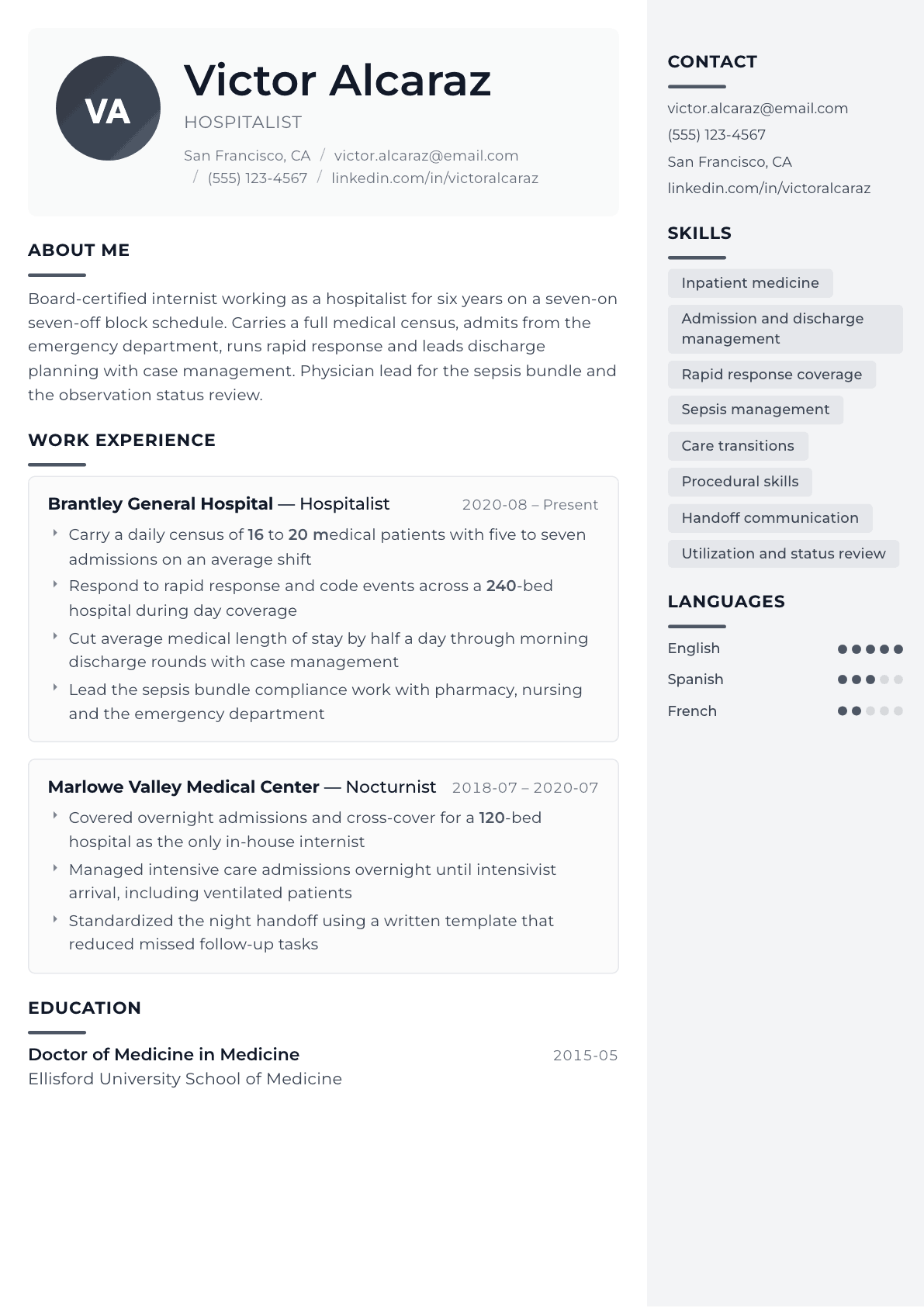
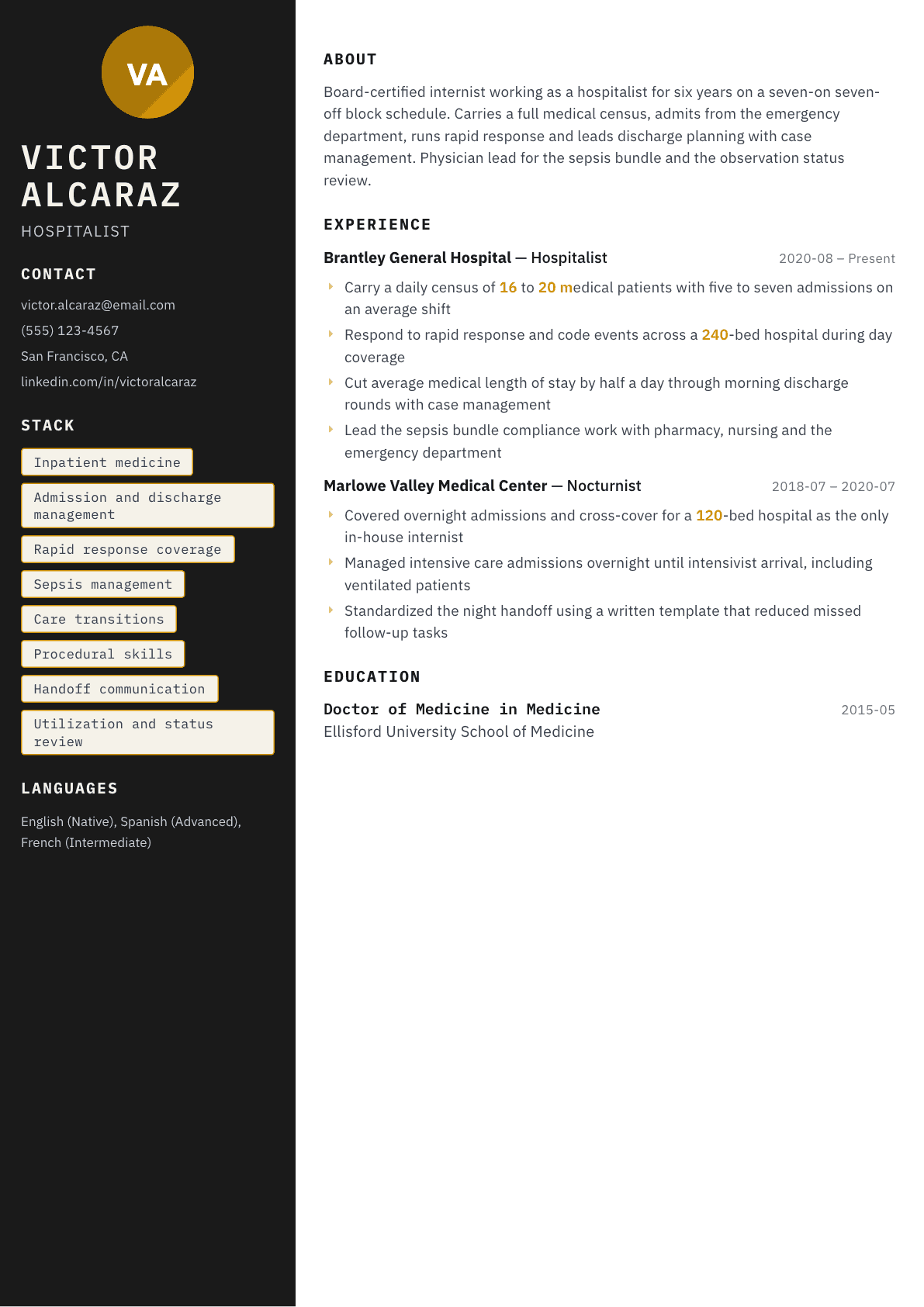
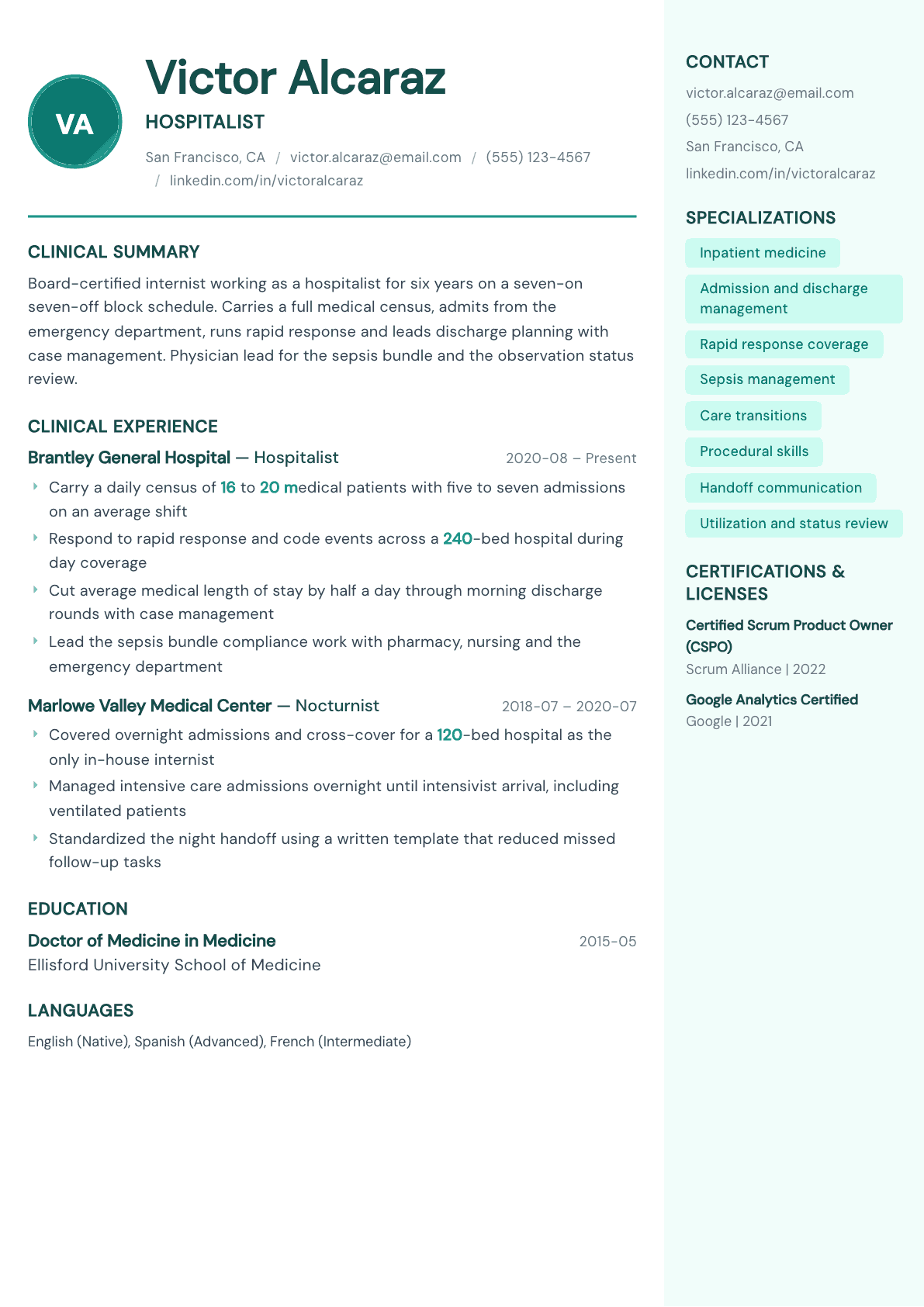
The same hospitalist content laid out in three CVBooster templates, so you can see what the finished document looks like before you write a word.
Example Hospitalist summary
Board-certified internist and hospitalist with six years on a seven-on seven-off schedule, carrying a daily census of 16 to 20 patients with five to seven admissions a shift at a 240-bed hospital. Cut average medical length of stay by half a day through structured morning discharge rounds and leads the sepsis bundle work. Two years of nocturnist coverage. Seeking a hospitalist role with a leadership track.
Skills to list on a Hospitalist resume
- Inpatient internal medicine
- Admission and triage decisions
- Sepsis and shock management
- Rapid response and code coverage
- Surgical comanagement
- Telemetry and step-down care
- Discharge planning
- Length of stay management
- Paracentesis and lumbar puncture
- Palliative and goals of care conversations
- Handoff communication
- Clinical documentation and severity capture
- Observation status review
- Interdisciplinary rounds
What actually gets this resume read
- Give daily census, admissions per shift and the hospital bed count so a group can size your workload immediately.
- State the schedule model you worked, whether seven-on seven-off, a rotating block or a nocturnist line.
- Show length of stay, readmission or discharge-before-noon numbers, since hospitalist groups are measured on all three.
- Say which services you cover: intensive care, telemetry, surgical comanagement, rapid response and code team duty.
- List procedures you still perform, such as paracentesis, lumbar puncture or central lines, and the volume you keep.
- Include documentation and coding work, because accurate severity capture is a common reason groups hire experienced hospitalists.
How to write a hospitalist resume
A hospitalist resume is evaluated by a group director who is short of bodies on a schedule and short of performance on a dashboard. The schedule question is whether you can carry a full census on their block model. The dashboard question is whether length of stay, readmissions, documentation accuracy and patient experience move in the right direction while you are on service.
Those two questions explain why the strongest hospitalist resumes read almost operationally. Census, admissions per shift, discharge timing, service lines covered, procedures maintained, and the schedule model you have worked. A resume built only from clinical adjectives leaves a director unable to compare you with anyone.
This guide covers census and admission reporting, the schedule models groups use, the throughput and documentation work that gets a hospitalist promoted, and the questions that come up when hospitalists move between community groups, academic services and nocturnist lines.
Format: credentials block, then a service picture
Two pages, reverse chronological, plain layout. Directly beneath the header, a credentials block: board certification and status, any focused practice recognition in hospital medicine, state licenses with expiration, controlled substance registration and current advanced life support cards.
Then move quickly into the service picture. A hospitalist reader is scanning for numbers, and paragraphs about compassionate care push those numbers onto page two where they are read last if at all.
- Header: name and degree, city and state, phone, email.
- Credentials: board certification, focused practice recognition, licenses, life support cards.
- Then summary, hospital service history, residency, education, procedures, quality and committee roles.
Summary: schedule model, census, admissions, hospital size
Name the schedule model you have worked, the hospital size, your typical daily census, admissions per shift, and any nocturnist experience. Directors staff by exactly those variables, and a summary that carries them lets the reader place you before reading a single bullet.
If you want a specific line, say so. Nocturnist, swing shift, admitter role, comanagement service or a leadership track are all distinct positions inside one group, and asking for one directly is far more effective than hoping to be offered it.
Experience: census, admissions, and the services you cover
Open each position with the hospital: bed count, whether it is a teaching site, the size of the hospitalist group, and whether intensivists, subspecialists and surgical services are in-house or on call. That last detail sets the ceiling on what you were expected to manage alone.
Then the workload: average daily census, admissions and discharges per shift, the schedule you worked, and the share of night coverage. Add the services you cover: general medical floors, telemetry and step-down, intensive care admissions until an intensivist arrives, surgical comanagement, observation units and rapid response or code team duty.
Procedures come next if you maintain them. Paracentesis, thoracentesis, lumbar puncture and central lines are increasingly rare among hospitalists, so keeping them is a genuine differentiator when a group has no procedure service.
- Hospital bed count, teaching status, group size, in-house specialty backup.
- Average daily census, admissions and discharges per shift, night share.
- Services covered: floors, telemetry, intensive care admissions, comanagement, observation.
- Rapid response and code team responsibility, and procedures you still perform.
Throughput, documentation and the metrics a director owns
Length of stay, readmission within thirty days, discharge order timing, observation conversion rates and patient experience scores are the numbers a hospitalist director reports upward every month. A candidate who has moved one of them and can explain how is the candidate who gets called first.
Documentation is the other half. Severity capture, query response rates and accurate present-on-admission coding determine how a hospital is measured on expected mortality and length of stay. Hospitalists who work well with clinical documentation specialists are valuable and rarely say so on a resume.
Write these with a mechanism. Morning discharge rounds with case management, a written multidisciplinary rounding script, a standing rule that discharge orders are placed before noon: name the practice, then the result.
Skills, handoffs and keywords
Hospital medicine postings reuse a stable set of terms: inpatient medicine, admissions, discharge planning, care transitions, length of stay, readmission reduction, sepsis bundle, rapid response, surgical comanagement, interdisciplinary rounds, clinical documentation improvement, observation status. Mirror the posting language once in the skills block and once inside a bullet.
Handoff quality deserves a line of its own. Hospital medicine runs on the transfer of a census between physicians twice a day and again at the end of a block, and a hospitalist who has built or standardized a handoff tool has solved a problem every group has.
Hospitalist resume summary examples
New from residency
Internal medicine board eligible, completing residency with senior resident experience running a 14-patient inpatient teaching team, night float admitting and a quality project on discharge timing. Maintains procedural skills in paracentesis and lumbar puncture. Seeking a community hospitalist position on a seven-on seven-off block schedule.
Six years on service
Board-certified internist and hospitalist working a seven-on seven-off schedule with a daily census of 16 to 20 patients and five to seven admissions a shift at a 240-bed hospital. Cut average medical length of stay by half a day through structured morning discharge rounds with case management.
Hospitalist group director
Hospitalist and group director with fifteen years on service, accountable for scheduling, recruitment, quality metrics and budget for 22 clinicians across two hospitals. Rebuilt the admitter model, reduced observation conversion disputes, and improved documentation query response while carrying a partial clinical load.
Work experience bullets: before and after
Before: Cared for hospitalized medical patients.
After: Carried a daily census of 16 to 20 medical patients with five to seven admissions a shift on a seven-on seven-off block at a 240-bed hospital.
Census, admissions, schedule model and hospital size are the four variables a director staffs from.
Before: Worked to reduce length of stay.
After: Cut average medical length of stay by half a day by moving multidisciplinary rounds to seven in the morning and placing discharge orders before noon on anticipated discharges.
The mechanism is specific enough that a hiring group could adopt it, which makes the result believable.
Before: Covered nights as a nocturnist.
After: Covered overnight admissions and cross-cover as the only in-house internist at a 120-bed hospital, managing intensive care admissions until the intensivist arrived at seven.
Sole in-house coverage and intensive care responsibility describe autonomy that the word nocturnist alone hides.
Before: Improved documentation quality.
After: Worked with clinical documentation specialists to raise query response within 24 hours across the group, improving severity capture on sepsis and heart failure admissions.
Naming the partner team, the response window and the diagnoses shows real documentation work rather than a slogan.
Before: Participated in sepsis quality work.
After: Led sepsis bundle compliance with pharmacy, nursing and the emergency department, rewriting the order set and adding a lactate recheck reminder at the four-hour mark.
The partners and the concrete change to the order set turn committee membership into an intervention.
Before: Improved patient handoffs between shifts.
After: Standardized the block-change handoff with a written template covering pending studies, code status and anticipated discharge date, cutting missed follow-up tasks across the group.
Naming the template contents shows exactly what problem was solved and how it could be reproduced.
Hard skills
- Inpatient internal medicine
- Admission triage and level of care decisions
- Sepsis and shock management
- Heart failure and chronic obstructive pulmonary disease exacerbation care
- Telemetry and step-down management
- Surgical comanagement
- Rapid response and code team coverage
- Discharge planning and care transitions
- Paracentesis, thoracentesis and lumbar puncture
- Observation status and utilization review
- Clinical documentation and severity capture
- Length of stay and throughput management
- Goals of care and palliative discussions
Soft skills
- Handoff discipline between blocks
- Interdisciplinary rounding leadership
- Family meetings under time pressure
- Negotiation with consulting services
- Case management partnership
- Sustained pace across a long block
Certifications worth listing
- Internal Medicine Certification (American Board of Internal Medicine)
- Focused Practice in Hospital Medicine (American Board of Internal Medicine)
- Advanced Cardiovascular Life Support (ACLS) (American Heart Association)
- Basic Life Support (BLS) (American Heart Association)
Mistakes that cost hospitalist candidates the interview
- Leaving out census and admissions per shift, the two numbers a hospitalist director uses to compare candidates.
- Not naming the schedule model, so a group cannot tell whether you have worked their block structure.
- Skipping the in-house specialty backup detail, which hides how much you were expected to manage alone.
- Writing throughput results with no mechanism, which reads as a claim rather than a practice you could repeat.
- Omitting documentation and severity capture work that hospital leadership values highly and few candidates mention.
- Dropping maintained procedures from the page when a group without a procedure service would pay for them.
Hospitalist resume questions
What census should I put on a hospitalist resume?
Give a typical daily range rather than a single figure, along with admissions and discharges per shift. Ranges are honest because census swings by season and by day, and a director reading a single precise number will assume it is the best day you ever had.
Does nocturnist experience help for a day position?
Yes. Night coverage demonstrates independent decision making without in-house backup, and groups always need cross-coverage flexibility. Say how long you worked nights and what services you managed alone, then state clearly which line you want next.
Should a hospitalist list procedures?
List the ones you currently perform and roughly how often, such as paracentesis, thoracentesis, lumbar puncture or central lines. Many groups have no procedure service, so a hospitalist who maintains these skills reduces referrals and delays for the whole hospital.
How do I show quality work as a hospitalist?
Pick metrics your group reports: length of stay, readmission, discharge before noon, observation conversion, sepsis bundle compliance or patient experience. Write the number before and after, then the specific rounding, ordering or communication change that produced the difference.
How is a hospitalist resume different from a general internal medicine one?
The hospitalist version leads with census, admissions, schedule model and throughput metrics. The outpatient version leads with panel size, complexity, quality measures and continuity. Keep two separate documents rather than one hybrid that answers neither reader properly.