Family Medicine Physician Resume Examples: free score
Build a Family Medicine Physician Resume Around Scope and Panel
By Mustafa Tarabya, founder of CVBooster · Published · Updated
A family medicine physician resume guide with full-scope practice examples, panel and quality metric bullets, licensure placement and the keywords clinics screen for.
Sample resumes for a family medicine physician
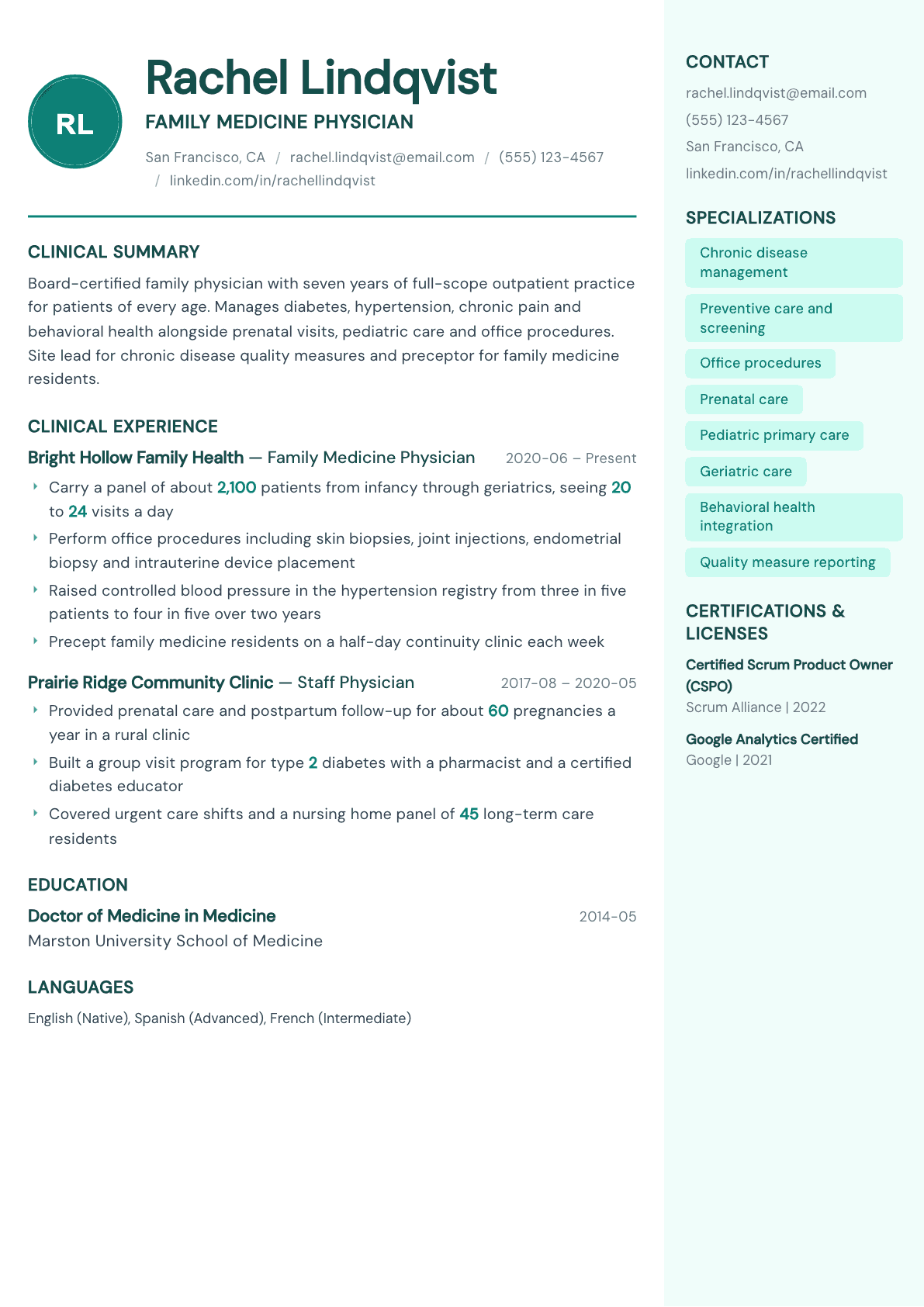
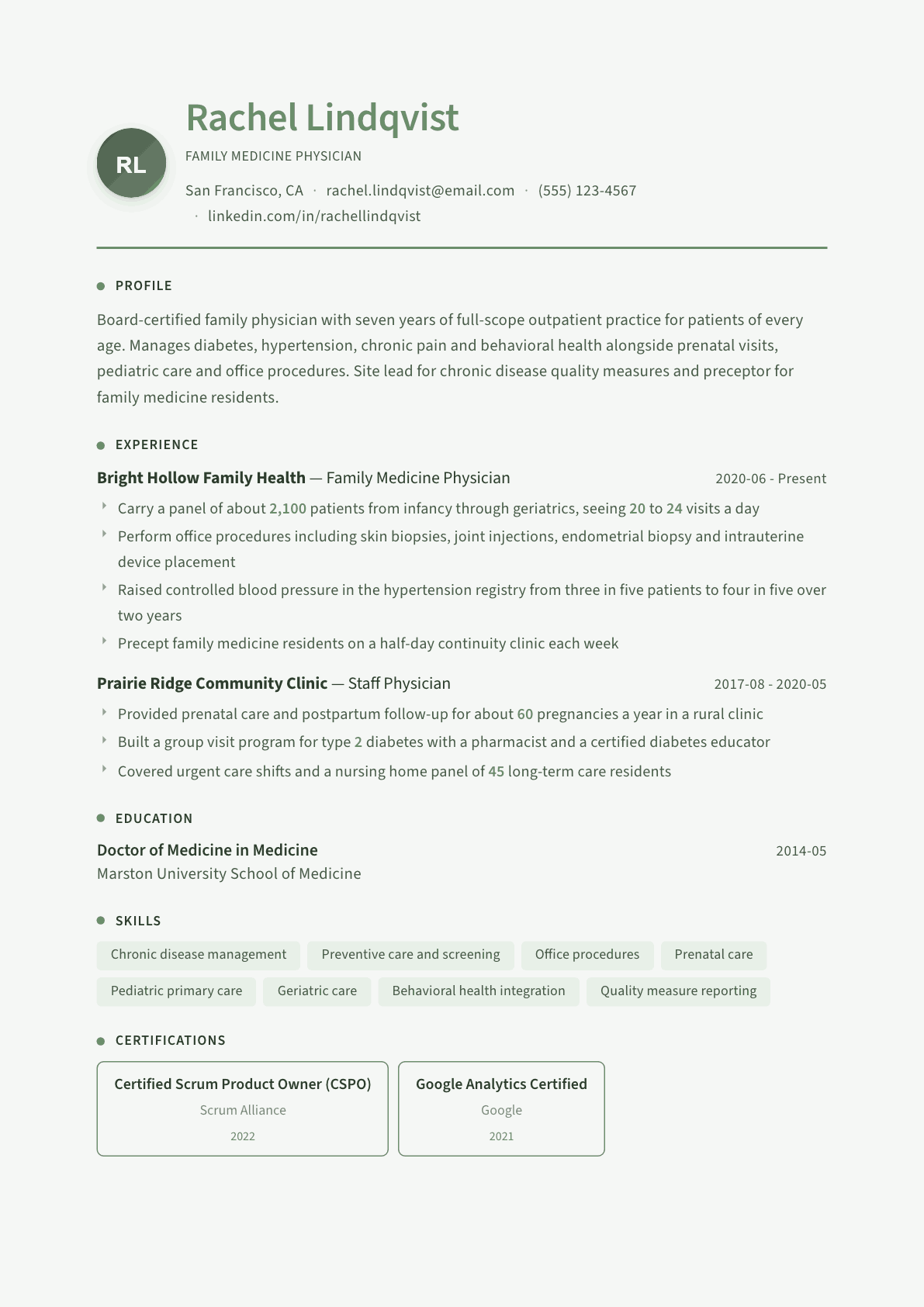
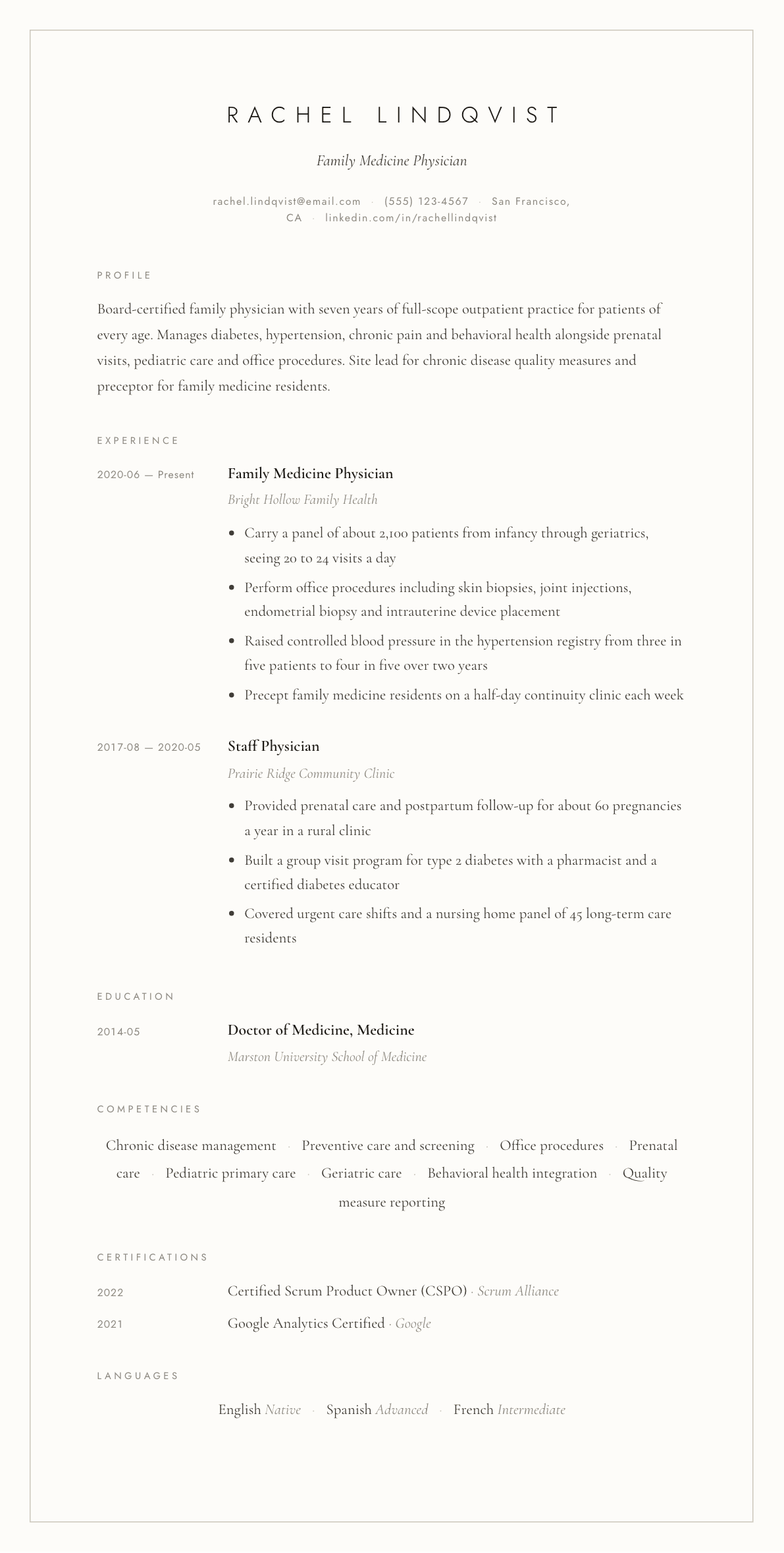
The same family medicine physician content laid out in three CVBooster templates, so you can see what the finished document looks like before you write a word.
Example Family Medicine Physician summary
Board-certified family physician with seven years of full-scope outpatient practice, carrying a panel of about 2,100 patients from infancy through geriatrics at 20 to 24 visits a day. Performs office procedures, provided prenatal care in a rural clinic, and raised hypertension control in the practice registry to four in five patients. Precepts residents weekly and is seeking a clinic with integrated behavioral health.
Skills to list on a Family Medicine Physician resume
- Full-scope family medicine
- Chronic disease management
- Diabetes and hypertension care
- Preventive screening
- Office-based procedures
- Prenatal and postpartum care
- Pediatric primary care
- Geriatric and nursing home care
- Behavioral health integration
- Urgent care coverage
- Population health measures
- Patient centered medical home
- Resident precepting
- Electronic health records
What actually gets this resume read
- Define your scope in the first two lines: obstetrics, nursing home, inpatient, procedures or purely outpatient adult and pediatric care.
- Give panel size and visits a day, because a clinic is deciding whether you can absorb an existing patient list.
- Name the office procedures you perform, since procedural scope is the fastest way to separate two similar resumes.
- Report quality measure results you personally moved, such as blood pressure control, diabetes screening or cancer screening rates.
- List the electronic record you have used and any experience with value-based care or patient centered medical home work.
- Add rural, underserved or loan repayment site experience when the posting comes from a similar community.
How to write a family medicine physician resume
Family medicine is the broadest specialty in the hiring market and the hardest to describe on one page. Two board-certified family physicians can have almost nothing in common: one delivers babies, staffs a nursing home and reduces fractures in a rural clinic, the other sees adults only in a suburban office with a referral for anything that needs a needle. A resume that does not settle which one you are wastes the reader entirely.
So the first job of a family medicine resume is defining scope. The second is showing panel and throughput, because a clinic is deciding whether you can absorb a list. The third is quality, since most primary care contracts pay against measures a physician can personally move.
This guide covers scope declaration, panel and visit reporting, procedural range, quality measure results, and the questions family physicians ask when moving between rural full-scope work, employed suburban practice and community health centers.
Format: scope statement, credentials block, two pages
Reverse chronological, two pages, no columns. Underneath the header, put a credentials block with board certification and status, state license and expiration, controlled substance registration, current life support cards, and any certificate of added qualification you hold.
Then a one-line scope statement before the summary if your practice is unusual. Something that says outpatient adult and pediatric care plus obstetrics, nursing home rounding and office procedures saves the reader from working it out across two pages.
- Header: name and degree, city and state, phone, email, languages spoken with patients.
- Credentials: board certification, license, registrations, life support cards, added qualifications.
- Then scope statement, summary, practice history, residency, education, procedures, quality work.
Summary: scope, panel, setting, and what you want next
Name the ages you treat, the settings you cover, the panel size and daily visit volume, and the parts of the job you want to keep. Family physicians often apply to roles narrower than their current work, and saying which parts of your scope you intend to continue prevents a mismatch that surfaces in month three.
If you are giving something up deliberately, such as obstetrics or inpatient work, say so plainly rather than leaving it off. A clinic that discovers you have delivery experience will ask about it, and a candidate who has already framed the decision looks settled rather than evasive.
Experience: panel, visits, and the scope each site allowed
Start each position with the clinic type, the number of clinicians, the population, and whether it was rural, suburban or a community health center. Scope is often set by the site rather than the physician, and naming the site explains why your procedure list looks the way it does.
Then give panel size and daily visit volume, along with the age spread. A panel of two thousand patients from infancy through geriatrics is a different job from two thousand adults, and both are worth stating exactly.
Follow with the coverage you carried outside the clinic day: nursing home rounds, hospital admissions, urgent care shifts, prenatal visits and deliveries, and any after-hours call. These are the parts a clinic cannot easily staff, so they are the parts worth spelling out.
- Clinic type, clinician count, community, and whether the site was rural or underserved.
- Panel size, daily visits, and the age range covered.
- Outside-clinic coverage: nursing home, hospital, obstetrics, urgent care, call.
- Teaching duties, since many family medicine sites host residents or students.
Procedures: the fastest way to separate two similar resumes
A procedure list is the single most useful block on a family medicine resume, and most candidates leave it out. Name what you perform and roughly how often: skin biopsy and excision, joint and trigger point injection, laceration repair, endometrial biopsy, intrauterine device insertion and removal, contraceptive implant placement, vasectomy, colposcopy, cryotherapy, toenail procedures, casting, and point-of-care ultrasound.
If a clinic can bill for a procedure you already do, you are worth more to them than an equivalent physician who refers it out. Say which ones you would want to continue in a new setting so the practice can plan the room and the supplies.
Quality, population health and keywords
Primary care employment is measured against a familiar set of quality measures: blood pressure control, diabetes management, cancer screening completion, immunization rates, depression screening and follow-up, and annual wellness visit completion. Pick the two you personally moved and write the change you made to move them.
Family medicine postings reuse a stable vocabulary: full-scope family medicine, panel management, preventive care, chronic disease management, patient centered medical home, value-based care, team-based care, care coordination. Mirror the exact posting phrases once in the skills block and once in a bullet where the work is visible.
Family Medicine Physician resume summary examples
New from residency
Family medicine board eligible, completing residency with a continuity panel of about 400 patients across all ages, obstetric training covering 40 deliveries, and a procedure log including skin biopsies, joint injections and intrauterine device placement. Seeking a full-scope outpatient position in an underserved community with obstetric coverage.
Seven years in practice
Board-certified family physician carrying a panel of about 2,100 patients from infancy through geriatrics at 20 to 24 visits a day. Performs office procedures, previously provided prenatal care in a rural clinic, and raised hypertension control in the practice registry from three in five patients to four in five.
Clinic medical director
Family physician and clinic medical director with sixteen years of practice, accountable for quality measures, provider scheduling and care team design across two sites and eleven clinicians. Maintains a personal panel, leads the diabetes group visit program, and precepts family medicine residents weekly.
Work experience bullets: before and after
Before: Provided primary care to patients of all ages.
After: Carried a panel of about 2,100 patients from infancy through geriatrics at 20 to 24 visits a day, covering acute care, chronic disease follow-up and preventive visits.
Panel size, daily volume and the age range replace a description every family physician could write.
Before: Performed in-office procedures.
After: Performed skin biopsies and excisions, joint and bursa injections, endometrial biopsy, intrauterine device placement and laceration repair, keeping these services in the clinic rather than referring them out.
The named procedure list is billable capability, and the last clause tells the practice what it gains.
Before: Improved blood pressure control in my patients.
After: Raised controlled blood pressure in the practice hypertension registry from three in five patients to four in five over two years using pharmacist-supported titration and repeat-visit protocols.
A registry denominator, a time frame and the mechanism make the quality result credible.
Before: Cared for pregnant patients.
After: Provided prenatal and postpartum care for about 60 pregnancies a year in a rural clinic, coordinating delivery coverage with the hospital obstetric team and managing gestational diabetes.
Annual volume, setting and the specific condition show the depth of obstetric scope you actually carried.
Before: Ran a diabetes program.
After: Built a shared medical appointment program for type 2 diabetes with a pharmacist and a diabetes educator, running monthly group visits for 70 patients with quarterly laboratory review.
The team, the cadence and the patient count turn a program mention into something the hiring clinic could copy.
Hard skills
- Full-scope family medicine across all ages
- Chronic disease management for diabetes and hypertension
- Preventive care and cancer screening
- Office-based procedures
- Point-of-care ultrasound
- Prenatal and postpartum care
- Pediatric primary care and immunization
- Geriatric and nursing home care
- Behavioral health integration
- Urgent care and minor emergency management
- Panel and population health management
- Patient centered medical home workflows
- Quality measure reporting
Soft skills
- Continuity relationships across families
- Shared decision making
- Care team coordination
- Motivational conversation on behavior change
- Teaching residents and students
- Efficient documentation between visits
Certifications worth listing
- Family Medicine Certification (American Board of Family Medicine)
- Certificate of Added Qualifications in Geriatric Medicine (American Board of Family Medicine)
- Advanced Life Support in Obstetrics (ALSO) (American Academy of Family Physicians)
- Pediatric Advanced Life Support (PALS) (American Heart Association)
- Basic Life Support (BLS) (American Heart Association)
Mistakes that cost family medicine physician candidates the interview
- Leaving scope undefined, so the reader cannot tell an obstetric rural physician from an adults-only office practice.
- Skipping the procedure list, which is the fastest way to stand out and the easiest section to write.
- Reporting panel size without the age range, which hides half of what makes family medicine hard.
- Claiming quality improvement with no denominator, time frame or mechanism behind it.
- Hiding a deliberate decision to stop obstetrics or inpatient work instead of stating it in one clean line.
- Omitting nursing home, urgent care and call coverage, the duties a clinic finds hardest to staff.
Family Medicine Physician resume questions
How do I define scope on a family medicine resume?
Write a single line before the summary naming the ages you treat, the settings you cover, and whether you provide obstetric, inpatient, nursing home or procedural care. That one sentence does more sorting work than the rest of the page combined.
Should I list office procedures individually?
Yes, as a compact block with rough frequency. A clinic can bill for procedures you already perform, so the list translates directly into value, and it is the clearest difference between two family physicians with similar training and panel sizes.
What if I want a narrower job than my current one?
Say so in the summary. State which parts of your scope you intend to continue and which you are leaving behind. A practice that understands your intent will not schedule you for coverage you never agreed to, which is a common early source of friction.
How do I show value-based care experience?
Name the measures your contract paid against, your results on two of them, and the workflow change that produced the improvement. Add any experience with risk adjustment documentation, care management referrals or annual wellness visit programs, since employed groups screen for these.
Does rural or underserved experience help?
It helps a great deal when the hiring site is similar. Describe the independence the setting demanded, the procedures you performed because no specialist was nearby, and any loan repayment or shortage area designation, which signals you can work in that environment.