Physician Assistant Resume Examples: what gets the call
Build a Physician Assistant Resume That Gets You Hired
By Mustafa Tarabya, founder of CVBooster · Published · Updated
Create a compelling physician assistant resume with ATS-optimized templates, clinical examples, and expert tips tailored to PA hiring managers.
Sample resumes for a physician assistant
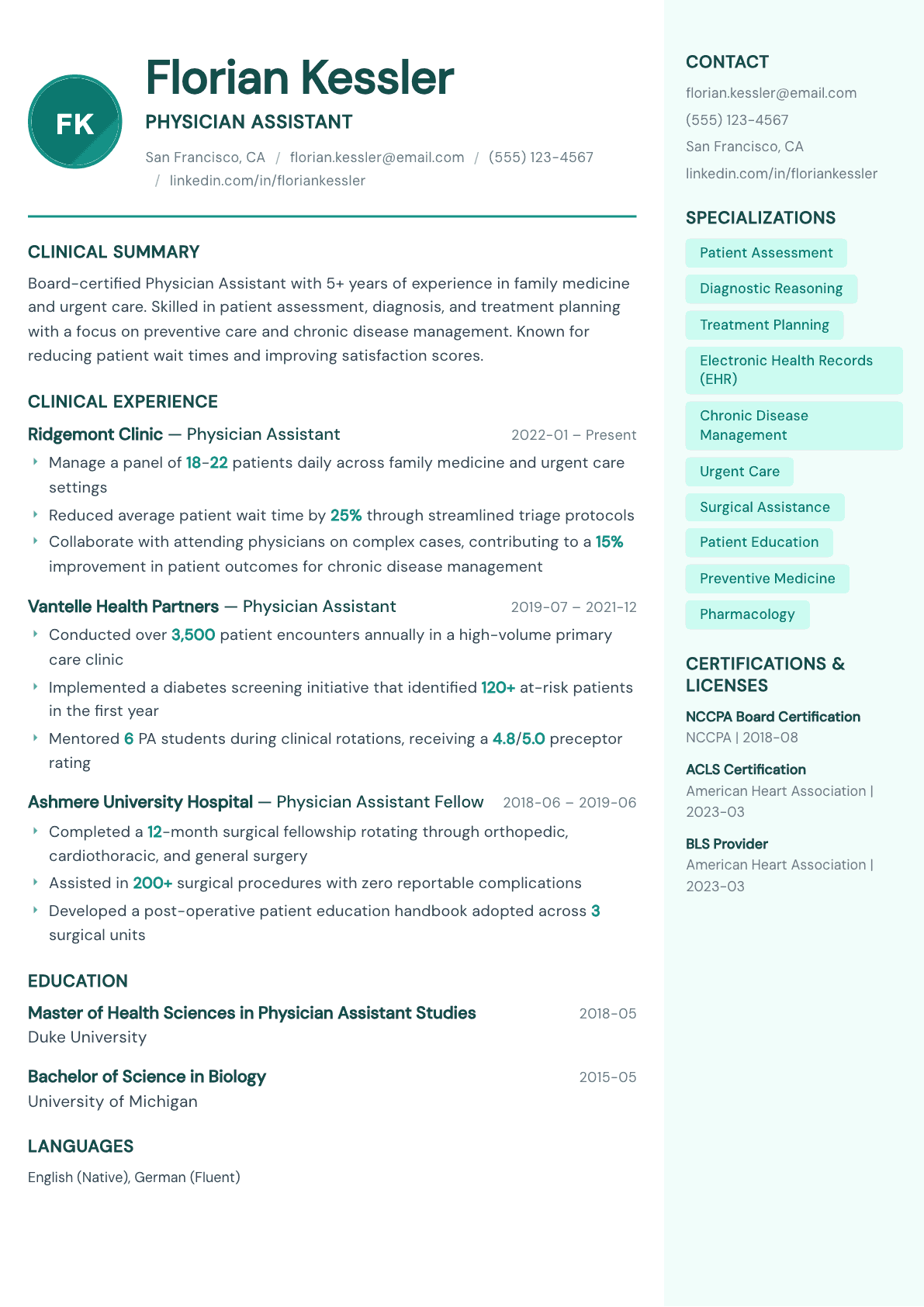
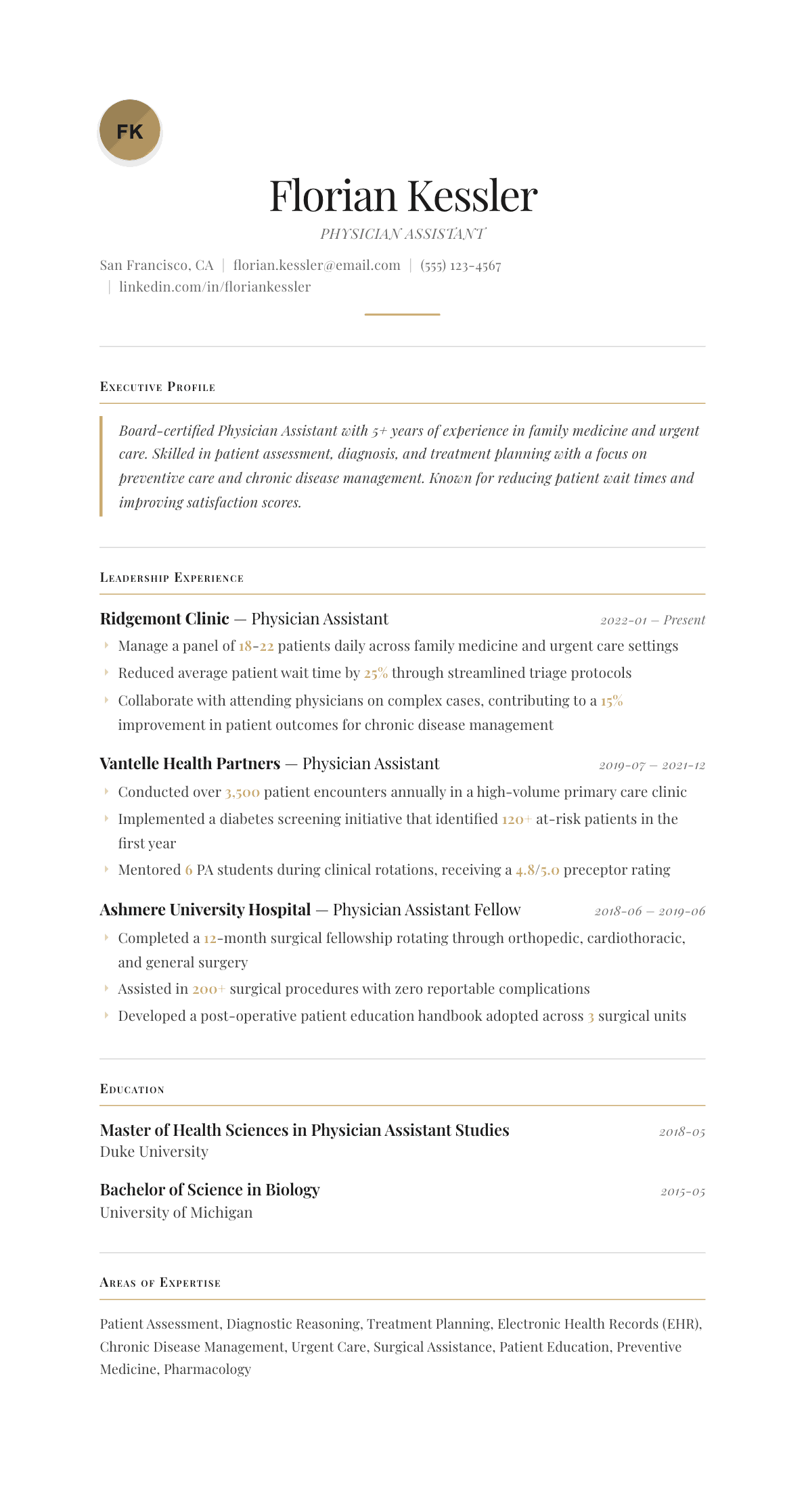
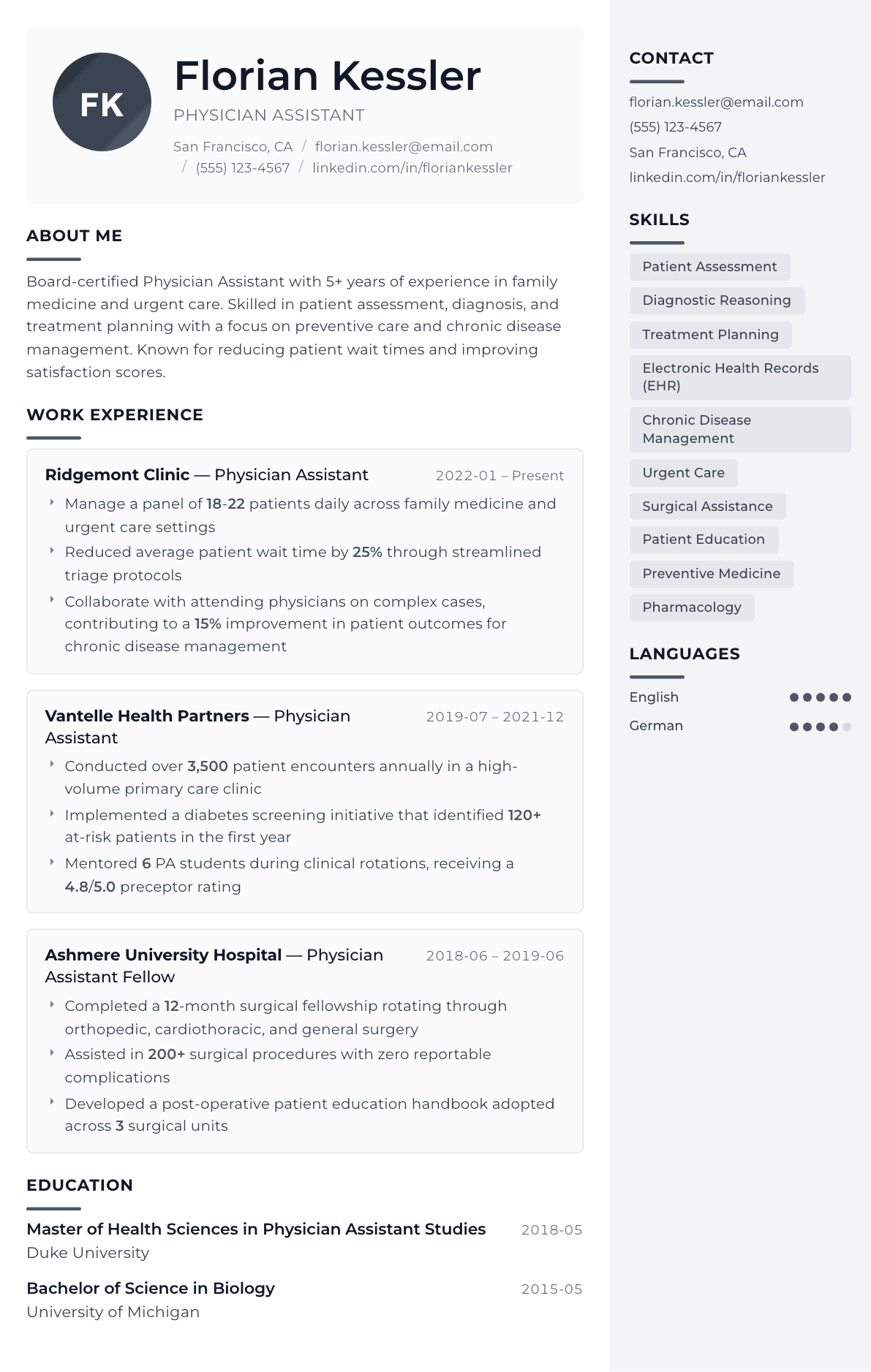
The same physician assistant content laid out in three CVBooster templates, so you can see what the finished document looks like before you write a word.
Example Physician Assistant summary
NCCPA board-certified Physician Assistant with 5 years in family medicine and urgent care, carrying a daily panel of 18-22 patients at a 96% satisfaction score. Strong in chronic disease management, preventive care and Epic documentation. Targeting an outpatient PA role with room to lead clinical workflow improvement.
Skills to list on a Physician Assistant resume
- Patient Assessment
- Clinical Diagnosis
- Treatment Planning
- Pharmacology
- Surgical Assistance
- EHR Documentation
- Chronic Disease Management
- Urgent Care
- Preventive Medicine
- Patient Education
- Lab Interpretation
- Procedural Skills
- Care Coordination
- Medical Decision-Making
What actually gets this resume read
- Highlight your NCCPA certification prominently at the top of your resume.
- Quantify patient volumes, outcomes, and efficiency improvements in each role.
- List clinical rotations and specialties to show breadth of experience.
- Include state licensure information and DEA registration if applicable.
- Tailor your summary to the specific specialty or practice setting you are targeting.
- Mention EHR systems you are proficient in, such as Epic, Cerner, or Allscripts.
How to write a physician assistant resume
A physician assistant resume is screened against a credential checklist before anyone judges the writing. The recruiter confirms NCCPA certification, an active state PA license, DEA registration where the role prescribes, and the specialty on the last two jobs. Only then does the supervising physician read it, and what she wants to know is narrow: how many patients you carry in a session, how independently you work, and whether you have seen the presentations her clinic sees every day.
Most PA resumes fail on the same thing. They describe the profession rather than the practice. Every PA takes histories, orders labs and writes notes. What separates one applicant from another is the setting, the volume, the acuity, the procedures owned, and the supervision model: solo coverage of a satellite clinic reads very differently from a hospitalist team with an attending on the same floor.
This guide covers the section order PA hiring uses, three summaries for a new graduate, a mid-career PA and a lead, before-and-after bullets from real charts, and the questions PAs ask when they move between specialties.
Format: credentials in the header, certification section high
Reverse chronological, one page for a new graduate and two once you have several rotations, procedures and a specialty behind you. Put your credentials after your name exactly as the board writes them: PA-C, plus your degree if you hold an MPAS, MMS or MHS. Then a certifications and licensure block directly under the summary rather than at the foot of the page, because that block is what a credentialing coordinator pulls first.
Avoid multi column layouts. Hospital systems and large group practices run resumes through parsers that read a sidebar out of order and drop the license dates, which is the one thing you cannot afford to lose.
- Header: name, PA-C, degree, city and state, phone, email, and the states where you hold an active license.
- Order: summary, licensure and certification, clinical experience, procedures, education and rotations, skills.
- New graduates move education and clinical rotations above experience and list preceptor sites by specialty.
Summary: specialty, setting, panel size, supervision model
Three sentences. Name the specialty, the practice setting, how long you have been in it, and one thing the posting asked for. A family medicine group hiring for a rural satellite wants to read that you have covered a clinic with the supervising physician offsite. A surgical service wants first assist volume and the procedures you close.
If you are switching specialties, name the pivot rather than hoping the reader finds it. An urgent care PA moving to orthopedics should say so and point at the fracture reductions, splinting and joint injections already on the resume.
Experience: volume, autonomy, and what you managed alone
Head each job with the employer, the specialty, the setting and the scale: number of providers, clinic sessions per week, patients per session, or beds covered. A line such as staff PA, eight provider family medicine clinic, eighteen to twenty two patients daily, does more work than a paragraph of adjectives.
Then bullets that show clinical decisions. Chronic disease panels you titrate, the presentations you work up independently, the referrals you make and the ones you avoid, the procedures you perform without an attending scrubbed in. Add first assist cases, hospital rounding, admission and discharge authority, and call coverage when you have them.
Leave out anything true of every PA in the country. Documented in the electronic health record and provided patient education are floor requirements, not achievements, and they crowd out the bullets a supervising physician actually reads.
Procedures: a short list beats a long paragraph
Give procedures their own block and attach volume or independence where you have it. Laceration repair, incision and drainage, joint and trigger point injections, arthrocentesis, casting and splinting, skin biopsy and excision, endotracheal intubation, central and arterial lines, lumbar puncture, chest tube placement, and first assist by case type. A director scanning for someone to run a procedure clinic is scanning for exactly this list.
Licensure and certification: state, number, expiry, prescriptive authority
List NCCPA certification with the current cycle status, each state license with its status, DEA registration and any state controlled substance registration, plus BLS and ACLS or PALS as the setting requires. Certificates of Added Qualifications in a specialty belong here too and carry real weight, because few PAs hold one.
Say whether your prescriptive authority is active and unrestricted. Practices in states with delegated prescribing agreements will ask on the first call, so answering it on the page shortens the process.
Skills and keywords the applicant tracking system scans
Postings recycle the same terms: patient assessment, differential diagnosis, treatment planning, chronic disease management, preventive care, point of care testing, interdisciplinary collaboration, plus the specialty name and the charting system. Name the record you have used, whether Epic, Cerner or Athenahealth, and the specific modules if you have built order sets or SmartPhrases. Mirror the posting language once in the summary and once inside a bullet where it is demonstrated.
Physician Assistant resume summary examples
New graduate PA
PA-C and recent MPAS graduate with rotations across family medicine, emergency medicine, general surgery, psychiatry and a 6-week elective in orthopedics. Comfortable with laceration repair, splinting and joint injections, Epic trained, and seeking a primary care position with structured onboarding.
Five years in
Family medicine PA with 5 years in an 8-provider group, carrying a panel of 18 to 22 patients daily and covering a satellite clinic 2 days a week with the supervising physician offsite. Strong in diabetes and hypertension management, in-office procedures and same-day acute care.
Lead PA
Lead physician assistant with 11 years in surgical specialty practice: 900 first assist cases, independent preoperative and postoperative clinic, and inpatient rounding on a 24-bed service. Built the advanced practice onboarding pathway and precepts 4 PA students each year.
Work experience bullets: before and after
Before: Saw patients in a busy family medicine clinic.
After: Carried a daily panel of 18 to 22 patients across wellness, chronic disease and same-day acute visits, covering the satellite clinic solo 2 days a week.
Volume, visit mix and solo coverage tell a supervising physician exactly how much autonomy you already hold.
Before: Ordered and interpreted diagnostic tests.
After: Worked up undifferentiated chest and abdominal pain independently, ordering and interpreting ECG, troponin, CT and point of care ultrasound before escalating to the attending.
Naming the presentations and the studies shows diagnostic reasoning instead of a task every PA performs.
Before: Performed minor procedures.
After: Performed roughly 200 in-office procedures a year including laceration repair, incision and drainage, joint and trigger point injections, skin biopsy and toenail removal.
A named procedure list with a volume is what a practice hiring for procedural coverage is scanning for.
Before: Helped improve diabetes care at the clinic.
After: Ran a nurse-supported diabetes recall program that brought 120 overdue patients back for A1C testing and cut the clinic's uncontrolled A1C group by a quarter over 12 months.
The mechanism and the outcome turn a claim into a project a medical director can evaluate.
Before: Taught PA students during rotations.
After: Precepted 6 PA students through 8-week clinical rotations, wrote the orthopedic rotation objectives, and served as the site coordinator for two university programs.
Numbers plus the coordinator role show teaching responsibility rather than incidental student contact.
Hard skills
- Patient assessment and history taking
- Differential diagnosis
- Chronic disease management
- Suturing and laceration repair
- Joint injection and arthrocentesis
- Casting and splinting
- First assist in surgery
- ECG interpretation
- Point of care ultrasound
- Prescribing and medication reconciliation
- Epic and Cerner charting
- Evaluation and management coding
Soft skills
- Working under a supervising physician
- Escalation judgment
- Patient counseling
- Handoff and consult communication
- Precepting students
- Time management across a full clinic session
Certifications worth listing
- PA-C (Physician Assistant Certified) (National Commission on Certification of Physician Assistants)
- Certificate of Added Qualifications (CAQ) (National Commission on Certification of Physician Assistants)
- Basic Life Support (BLS) (American Heart Association)
- Advanced Cardiovascular Life Support (ACLS) (American Heart Association)
- Pediatric Advanced Life Support (PALS) (American Heart Association)
- Advanced Trauma Life Support (ATLS) (American College of Surgeons)
Mistakes that cost physician assistant candidates the interview
- Leaving NCCPA certification status and the state license off the page, which stalls the file at the credentialing step before an interview is offered.
- Describing the profession instead of the practice, so nothing distinguishes you from every other certified physician assistant in the stack.
- Hiding procedures inside prose paragraphs where a director scanning for procedural coverage will never find them.
- Omitting the supervision model, so the reader cannot tell whether you have ever run a session without an attending in the building.
- Sending one resume to an emergency medicine posting and a dermatology posting without changing the summary and reordering the bullets.
- Listing every rotation years after graduation, when the paid clinical work should have replaced them.
- Skipping DEA and prescriptive authority details for a role that clearly prescribes controlled substances.
Physician Assistant resume questions
How long should a physician assistant resume be?
One page as a new graduate, two pages once you have several years, a procedure list and multiple settings. Two is normal and expected in clinical hiring, so do not compress a real procedure log to fit a single sheet.
Should a new PA graduate list clinical rotations?
Yes. List each rotation with the site, the specialty, the length and one line on the presentations and procedures you handled. Rotations are your only clinical evidence until you have a year of paid practice, then drop them.
Do I need to include a procedure list?
Include one whenever the role is procedural, which covers surgery, emergency medicine, orthopedics, dermatology and most urgent care. Give the procedure names and an annual volume or a total, because directors hire for the gaps in their current coverage.
How do I show autonomy on a PA resume?
Describe the supervision model in the job header and the decisions you owned in the bullets: solo clinic coverage, independent workups before escalation, admission and discharge authority, call, and which presentations you close without an attending reviewing them.
How do I write a PA resume when changing specialties?
Say the move in the first sentence of the summary, then reorder every job so the transferable procedures and presentations lead. An urgent care PA moving to orthopedics leads with fracture care, splinting, joint injections and musculoskeletal exam rather than general acute visits.