Judicial Clerk Resume Examples: the lines they read
Write a Judicial Clerk Resume for Chambers Hiring
By Mustafa Tarabya, founder of CVBooster · Published · Updated
Judicial clerk resume example with bench memo, opinion drafting and chambers keywords, plus a guide to applying to judges and to firms afterward.
Sample resumes for a judicial clerk
The same judicial clerk content laid out in three CVBooster templates, so you can see what the finished document looks like before you write a word.
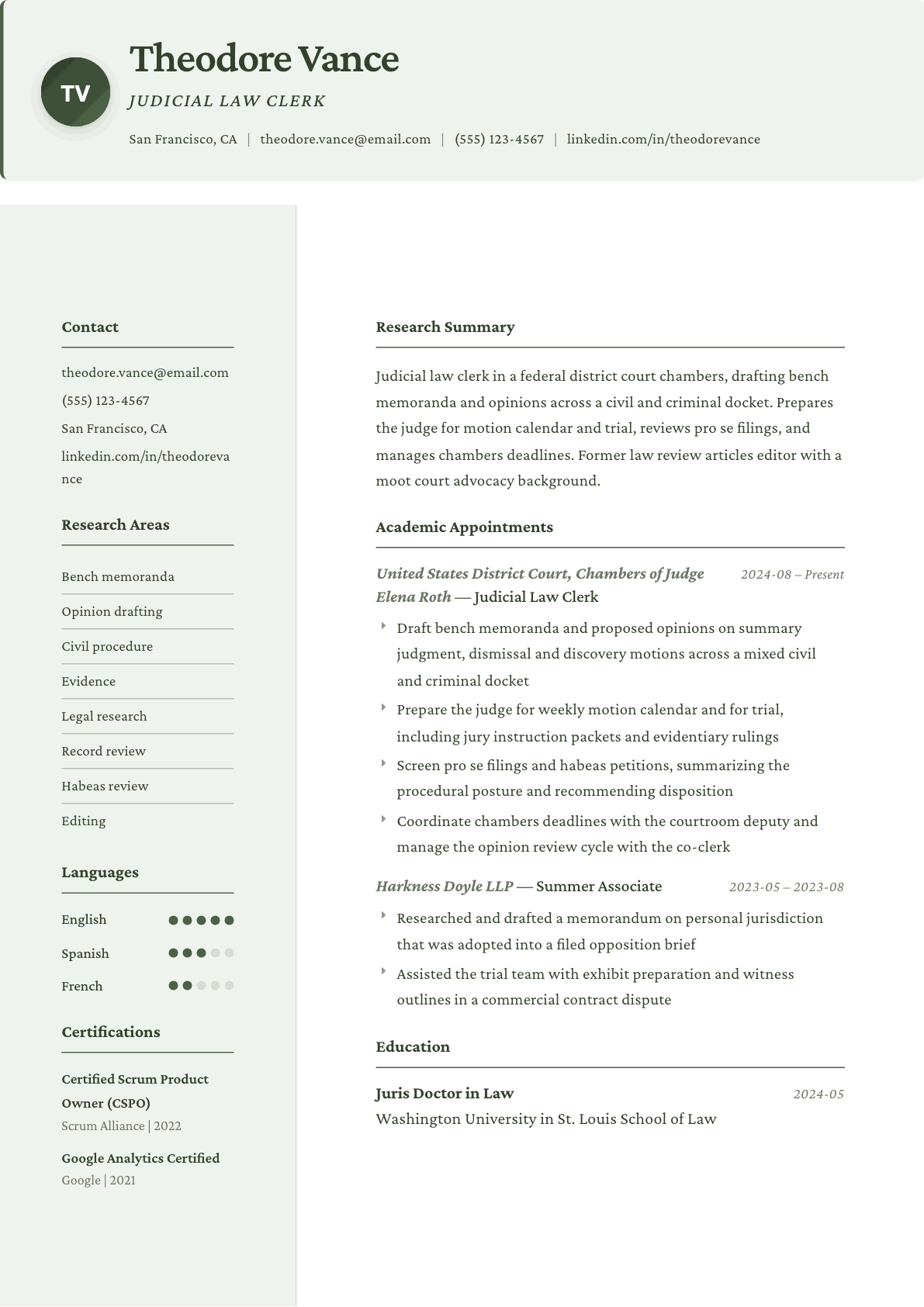
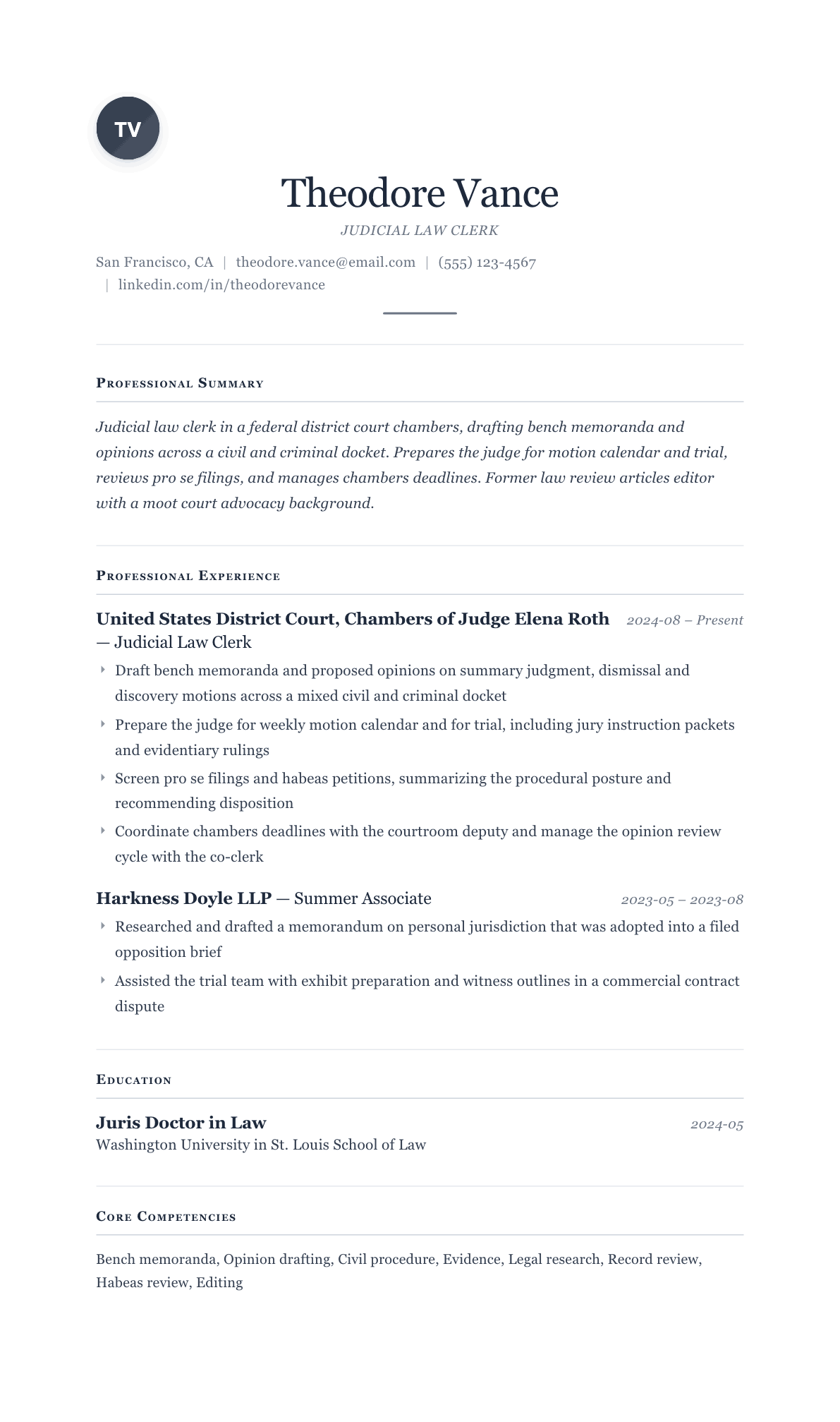
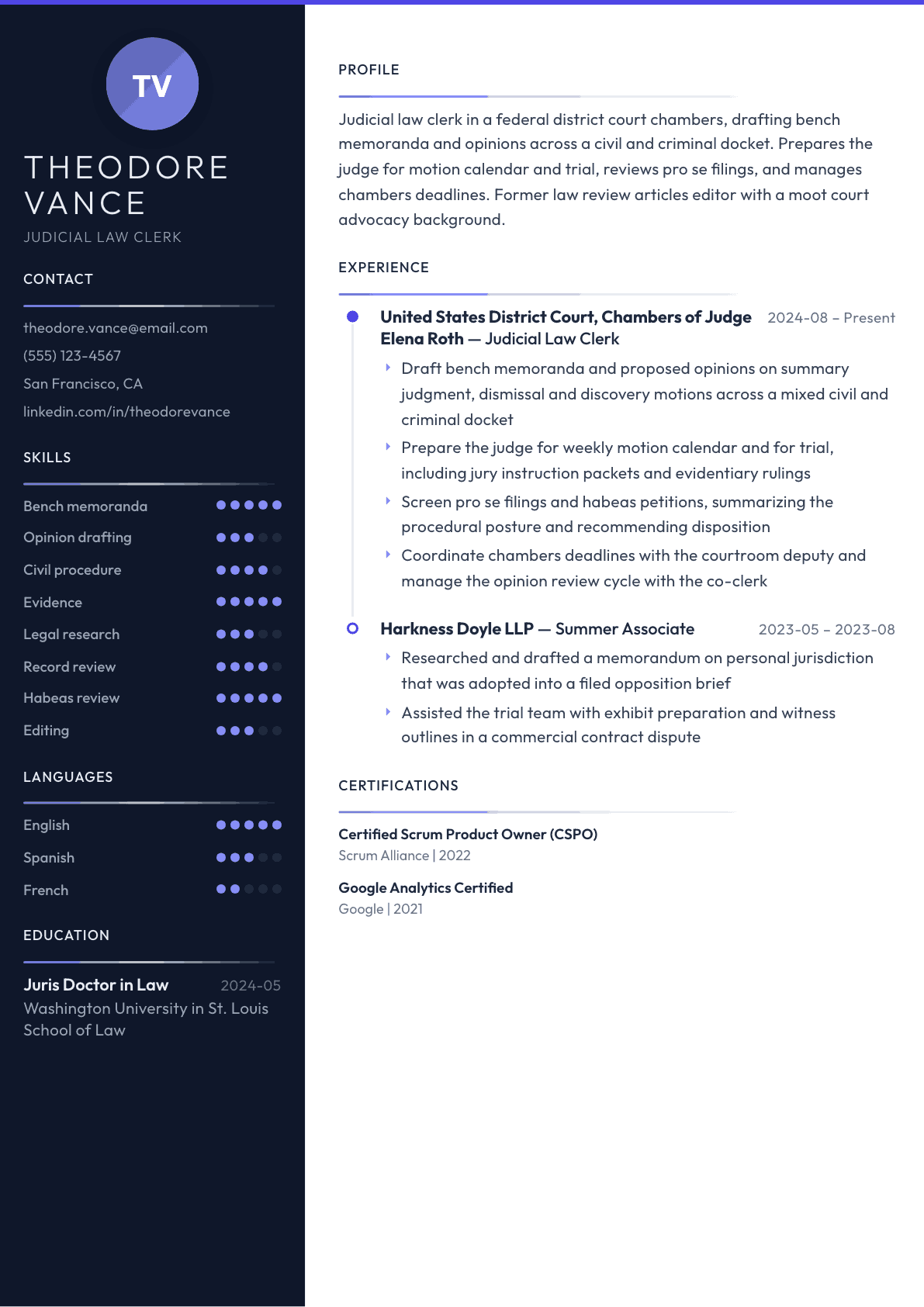
Example Judicial Clerk summary
Judicial law clerk in federal district court chambers, drafting bench memoranda and proposed opinions on summary judgment, dismissal and discovery motions. Prepares the judge for motion calendar and trial, screens pro se and habeas filings, and manages the chambers opinion cycle. Former law review articles editor. Seeking a litigation associate role where clerkship writing and procedure carry over.
Skills to list on a Judicial Clerk resume
- Bench memoranda drafting
- Judicial opinion drafting
- Civil procedure
- Federal rules of evidence
- Summary judgment analysis
- Discovery dispute analysis
- Habeas and post-conviction review
- Pro se filing review
- Legal research
- Record and transcript review
- Jury instruction preparation
- Case management and scheduling
- Editing and cite verification
What actually gets this resume read
- Name the court level and the docket mix, because appellate chambers and trial chambers read as different jobs to the next employer.
- Describe the writing you produced: bench memoranda, proposed opinions, orders, and the motion types behind them.
- Keep law review, moot court and grade-based honors on the resume, since chambers hiring weighs the academic record heavily.
- Say who you clerked for by court rather than only by judge name, and give the exact term dates for the clerkship.
- When applying to firms after the clerkship, translate chambers work into practice terms: motion practice, evidence and trial procedure.
- Note any second clerkship, externship or judicial internship, and give the chambers the same level of detail.
How to write a judicial clerk resume
A judicial clerk resume has two audiences and they read in opposite directions. Chambers hiring, where a judge or a career clerk screens applicants, weighs the academic record, the writing sample and the recommendation letters, and treats the resume as a summary of the file. Firm hiring afterward reads the same page for practice-ready skill and wants to know what you drafted and which procedural questions you handled.
Most candidates write only for the first audience and then never rewrite. The clerkship year is the most concentrated litigation training available, and a resume that lists it as one line under employment throws that away. A judge sees your work product every week for a year, and the resume should show what that work product was.
This guide covers the format chambers expects, how to describe bench memoranda and opinion drafting without breaching confidentiality, summaries for an applicant to chambers, a sitting clerk and a former clerk moving to a firm, and the questions that come up around second clerkships and post-clerkship hiring.
Format: one page for chambers applications
Chambers applications run on one page with education first, and they stay conservative in appearance. A clean single column, a standard serif face, full dates and no graphics. Chambers staff compare dozens of nearly identical files, and anything decorative reads as noise rather than personality.
Education carries more weight here than in almost any other legal hire. Give the law school, graduation date, class standing if published, journal position, moot court results, and the professors you worked with as a research assistant, because those names connect to the recommendation letters in the same envelope.
- Header: name, city and state, phone, email, and bar admission if you already have one.
- Order for chambers: education and honors, journal and competitions, experience, publications, interests.
- Order after the clerkship: experience with the clerkship first, then education, honors and publications.
Describing chambers work without breaching confidentiality
Chambers work is confidential in its particulars and describable in its shape. Write the categories: bench memoranda on dispositive motions, proposed opinions, orders on discovery disputes, review of pro se filings, preparation for motion calendar and trial. Never name parties, never describe unpublished deliberations, and never claim authorship of a signed opinion.
The safe and accurate formulation is that you drafted memoranda and proposed opinions for the judge in specified categories of motion. That sentence tells a firm exactly what you can do and keeps the confidentiality line where it belongs.
Volume helps when it is honest. Motion calendars a week, the mix of civil and criminal on the docket, the number of trials you supported and whether you worked with a co-clerk are all sizing information a hiring partner uses without needing any case detail.
Court level and docket mix: the two facts firms read first
A trial court clerkship and an appellate clerkship produce different lawyers. Trial chambers means motion practice, evidentiary rulings, scheduling, settlement conferences and jury mechanics. Appellate chambers means record review, standards of review, brief analysis and longer opinion drafting. State that difference explicitly.
Name the docket mix as well. A district court clerkship heavy in employment and contract disputes speaks to a commercial litigation group, while one heavy in criminal and habeas matters speaks to a defense or government hiring committee. The docket is the closest thing a clerkship has to a practice area.
Academic record, journal and publications
Journal work belongs on the page with the role and the substance: your note topic, whether it was published, the editing volume you carried and whether you supervised other editors. A judge is hiring a writer and an editor, and journal responsibility is the closest available proxy.
Publications, research assistance and teaching assistance all fit here. Give the title of any published piece and the journal. Keep the list short and accurate, since chambers staff have been known to read the pieces.
Translating the clerkship for firm hiring
When the clerkship ends, rewrite the entry in practice language. A firm wants to hear about summary judgment analysis, evidentiary standards, discovery dispute resolution, class certification if it appeared, sentencing procedure, and the drafting speed that a chambers calendar forces on you.
Add what the year taught you about how judges actually read briefs. Applicants who can articulate that in an interview stand out, and the resume should point to it with a bullet on the volume and type of briefing you reviewed rather than only on what you wrote.
Judicial Clerk resume summary examples
Applying to chambers
Third-year law student and journal articles editor with two research assistant positions in civil procedure, a moot court semifinal finish and a summer at a litigation firm where a jurisdiction memorandum was adopted into a filed opposition brief. Applying for a district court clerkship beginning after graduation.
Sitting clerk
Judicial law clerk in federal district court chambers drafting bench memoranda and proposed opinions on summary judgment, dismissal and discovery motions across a mixed civil and criminal docket. Prepares the judge for weekly motion calendar and trial, screens pro se and habeas filings, and manages the chambers opinion cycle with a co-clerk.
After the clerkship
Former district court clerk with a year of motion practice from the bench side, moving into commercial litigation. Analyzed summary judgment and dismissal briefing on an employment and contract heavy docket, drafted evidentiary orders, and prepared jury instruction packets for four civil trials. Admitted and seeking a litigation associate position.
Work experience bullets: before and after
Before: Assisted the judge with research and writing.
After: Drafted bench memoranda and proposed opinions on summary judgment, dismissal and discovery motions across a docket split between civil and criminal matters.
Naming the document types and the motions makes the work legible to a firm without touching confidential case detail.
Before: Prepared the judge for hearings.
After: Prepared the judge for a weekly civil motion calendar of six to ten matters, producing a short recommendation memorandum and a question list for each argument.
A calendar volume and the artifacts you produced show the pace of chambers work rather than a general assisting role.
Before: Reviewed filings from unrepresented parties.
After: Screened pro se filings and habeas petitions, summarizing procedural posture, identifying timeliness and exhaustion issues, and recommending disposition to the judge.
The specific procedural issues you handled demonstrate doctrinal command that a generic review sentence hides.
Before: Helped with trials in the courtroom.
After: Supported four civil jury trials, researching evidentiary objections during proceedings, drafting the jury instruction packet and preparing rulings on motions in limine.
Trial support becomes valuable to a firm when the reader sees the live research and the instruction drafting behind it.
Before: Edited articles for the law journal.
After: Served as articles editor, selecting pieces from a submission pool with two other editors and running substantive edits and source verification on six articles across the volume.
Editorial responsibility and workload prove judgment and stamina, which is why chambers read the journal line closely.
Hard skills
- Bench memoranda drafting
- Judicial opinion and order drafting
- Civil procedure
- Federal rules of evidence
- Summary judgment and dismissal analysis
- Discovery dispute resolution
- Habeas and post-conviction review
- Pro se filing review
- Record and transcript review
- Jury instruction preparation
- Legal research platforms
- Citation verification and editing
Soft skills
- Precise writing under a calendar
- Impartial analysis
- Confidentiality
- Working closely with one supervisor
- Editing another writer's draft
- Handling volume without dropping detail
Mistakes that cost judicial clerk candidates the interview
- Reducing an entire clerkship year to a single line under employment when it is the strongest training on the page.
- Describing case facts or internal deliberations, which breaches chambers confidentiality and ends the application.
- Failing to state the court level, leaving a firm unable to tell trial experience from appellate experience.
- Sending a decorated or two-column layout to chambers, where a plain conservative page is the expectation.
- Listing a journal position without the note topic, the editing volume or whether the piece was published.
- Keeping the chambers wording unchanged when applying to firms instead of translating it into practice terms.
Judicial Clerk resume questions
How do I apply for a judicial clerkship?
Chambers hire on a file rather than a resume: a one page resume, a transcript, a writing sample and two or three recommendation letters, usually submitted together. Follow each judge's stated preferences exactly, because a deviation is read as inattention before anyone opens the writing sample.
What can I say about my clerkship work on a resume?
Describe categories, not cases. Bench memoranda, proposed opinions, motion types, docket mix and calendar volume are all appropriate. Keep party names, internal discussions and any indication of how the judge decided a particular matter off the page entirely.
Is a state trial court clerkship worth doing?
Yes, particularly for litigators. State trial chambers give more courtroom exposure, more hearings and often more direct contact with practicing attorneys. Describe the docket and the volume, because those are what a hiring partner uses to compare it with a federal placement.
How do I list a second clerkship on my resume?
Give each clerkship its own dated entry with the court, chambers and term, then describe them separately because the work differs. An appellate year after a trial year is a strong combination, so make the contrast in document types and analysis visible rather than repeating the same bullets.
What writing sample should a clerkship applicant use?
A piece you wrote alone, edited yourself and can discuss in detail: a journal note excerpt, a moot court brief or a memo from a summer position with permission and redactions. Ten pages is a common ceiling, and a short cover note explaining the context helps a reader place it.