Litigation Attorney Resume Examples: what gets the call
Write a Litigation Attorney Resume Built on Case Results
By Mustafa Tarabya, founder of CVBooster · Published · Updated
Litigation attorney resume examples with trial and discovery keywords, and a guide to writing motions, depositions and verdicts clearly.
Sample resumes for a litigation attorney
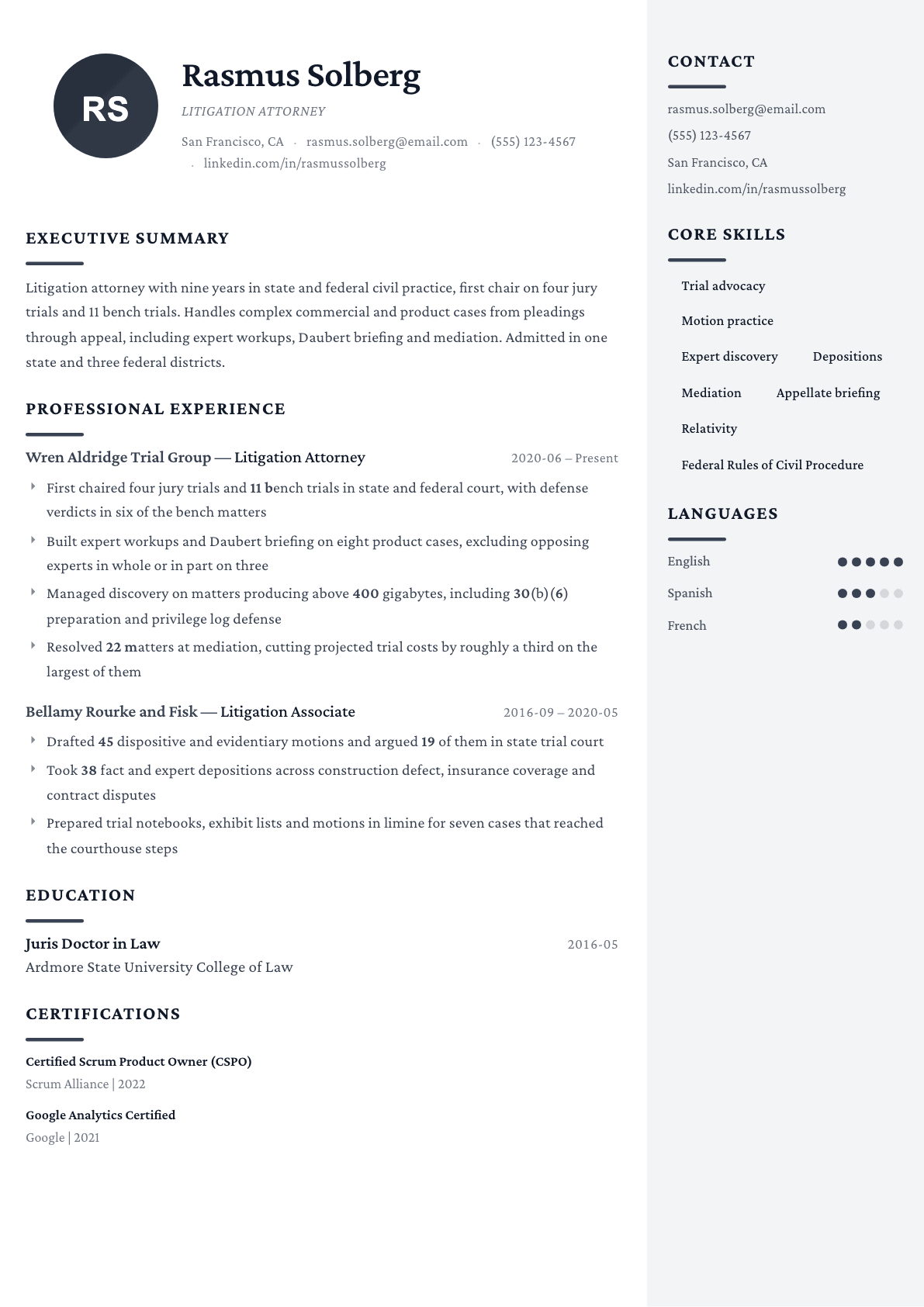
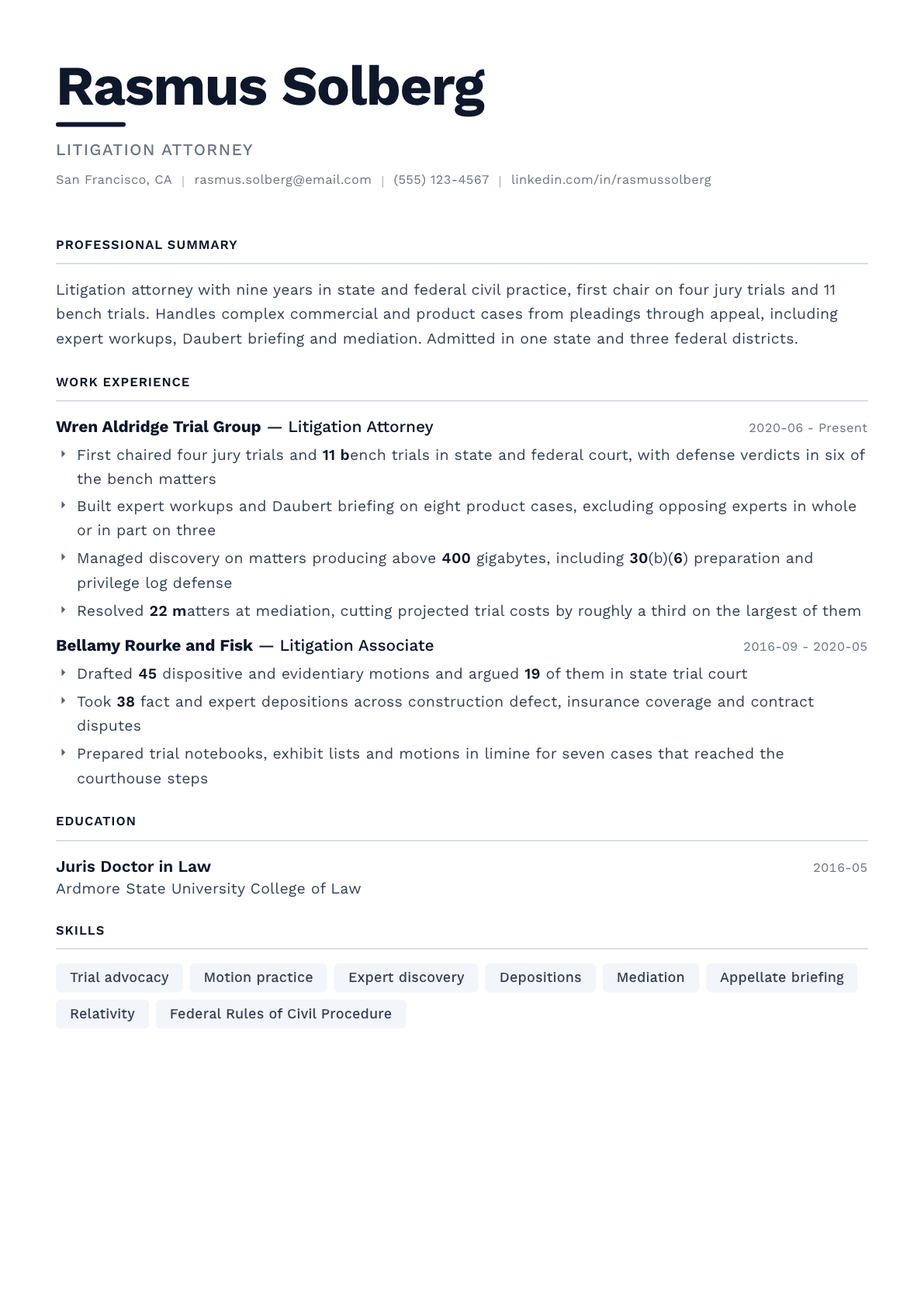
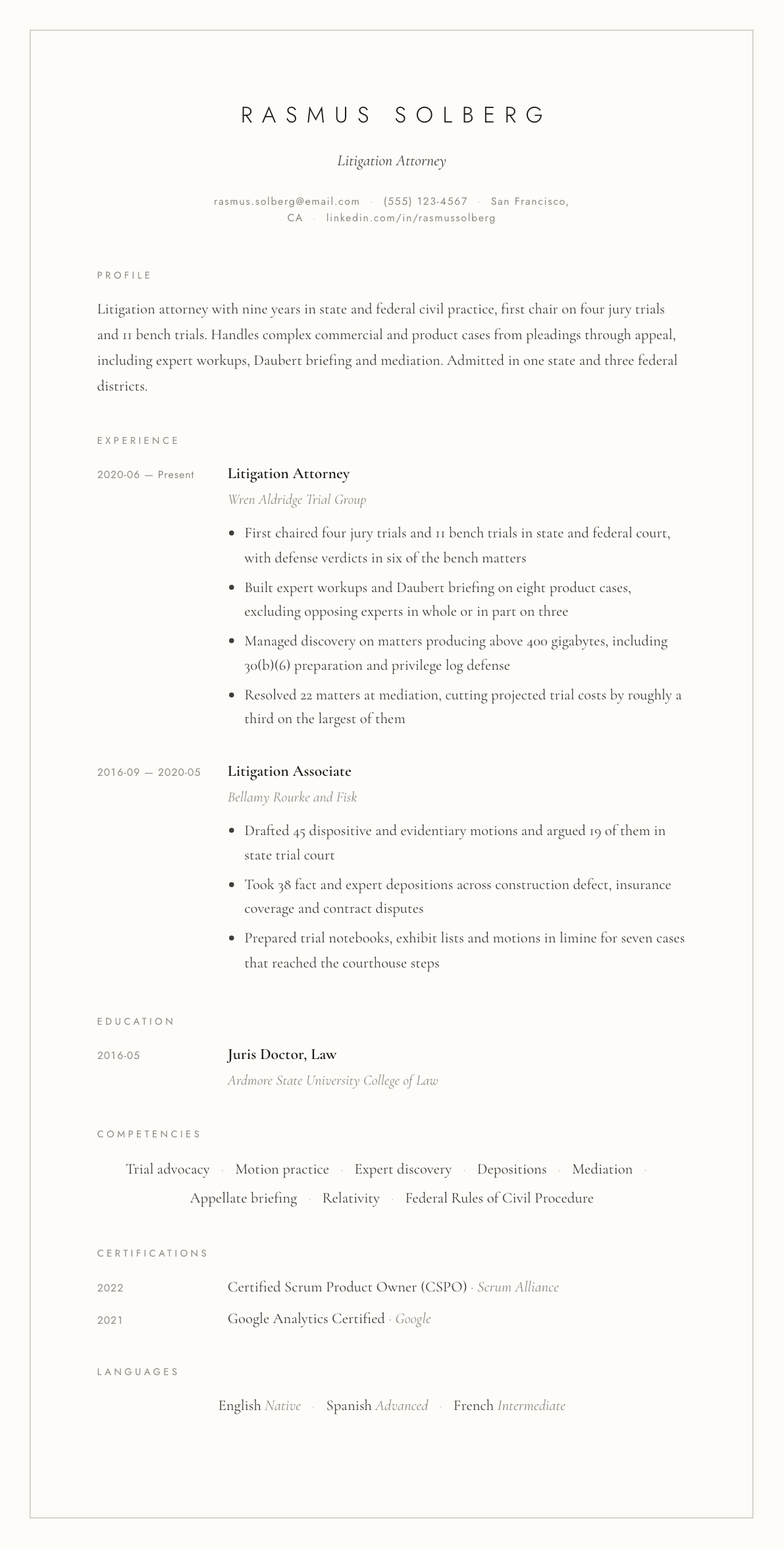
The same litigation attorney content laid out in three CVBooster templates, so you can see what the finished document looks like before you write a word.
Example Litigation Attorney summary
Litigation attorney with nine years in state and federal civil practice, first chair on four jury trials and 11 bench trials. Runs cases from pleadings through appeal, including expert workups, Daubert briefing, large document productions and mediation. Has taken and defended more than 60 depositions across commercial, product and coverage disputes. Admitted in one state and three federal districts.
Skills to list on a Litigation Attorney resume
- Trial advocacy
- Jury selection
- Direct and cross examination
- Dispositive motion practice
- Motions in limine
- Expert witness workups
- Daubert challenges
- Deposition practice
- Discovery disputes
- Privilege review
- Mediation advocacy
- Appellate briefing
- Trial presentation software
- Federal Rules of Civil Procedure
What actually gets this resume read
- Open with trial counts split by first chair, second chair, jury and bench, since that is the first thing a litigator reads.
- Name the forums where you are admitted, including the specific federal districts and any appellate courts.
- Quantify depositions taken and defended, motions argued, and cases resolved at mediation rather than describing process.
- Describe case types by subject matter and posture: coverage, construction defect, product, class certification, appeal.
- Include the review platform and trial presentation software you use, because staffing decisions turn on tool fluency.
- Report outcomes carefully and avoid client names when a protective order or engagement terms restrict what you can say.
How to write a litigation attorney resume
A litigation attorney resume is read by trial lawyers, and trial lawyers keep score. They want the trial count broken out by chair and by fact finder, the number of depositions you have taken as opposed to sat through, the motions you argued yourself, and the forums where you are admitted. Those figures form a profile that a partner can compare against her own bench in about ten seconds.
The second thing they read for is stage coverage. Some litigators are excellent through discovery and disappear at trial. Others are trial ready but have never managed a large production. A resume that shows the whole arc, from pleadings through discovery, dispositive motions, expert work, trial and appeal, is worth far more than one that shows depth in a single phase.
This guide covers the trial and deposition block, how to write case descriptions that survive confidentiality, how to talk about outcomes without overclaiming, and how to present the document heavy side of modern practice that many litigators still leave off the page.
Lead with a litigation profile block
Under your admissions, build a short block that answers the questions a trial partner will ask anyway. Jury trials first chair and second chair, bench trials, arbitrations, evidentiary hearings, depositions taken and defended, and appellate arguments. Four or five lines, plain numbers, no narrative.
Include the forums in that block: the state courts, the federal districts and any appellate courts where you are admitted, plus administrative tribunals you appear before. Litigation hiring is jurisdiction specific and this saves a screening email.
- Trials: jury and bench, split by first and second chair.
- Arbitrations and evidentiary hearings, with the administering body where relevant.
- Depositions taken and defended, including expert depositions.
- Courts of admission and any appellate arguments.
Write cases by subject matter, posture and role
A useful case line has three parts: what the dispute was about, where it sat procedurally, and what you personally did. A construction defect action in state court through a two week jury trial, where you handled the expert witnesses, is a complete picture. Represented clients in complex litigation is not.
Group your case types so a reader can see the pattern. Insurance coverage, product liability, construction defect, employment, professional negligence, commercial contract, class and collective actions. If you are targeting a specific practice, order the groups so the matching one appears first.
For confidential matters, name the client by industry and the dispute by type. A publicly reported case can be named, and naming one or two that a reader may recognize gives the rest of the list credibility.
Expert work and dispositive motions
Expert practice is where mid level litigators separate from senior ones. Say which experts you have worked up and which you have deposed: economists, engineers, treating physicians, accident reconstructionists, forensic accountants, industry standard of care witnesses. Add any challenges you briefed and how they came out.
For motions, count what you drafted and what you argued, and name the types: dismissal, summary judgment, class certification, discovery sanctions, in limine, judgment as a matter of law. A litigator who has argued in limine motions the week before trial has been in a different position from one who has only briefed dispositive papers.
Discovery at scale, which is most of the job
Modern civil practice is a document management problem wearing a trial costume, and resumes that ignore it read as dated. Describe the productions you have managed by volume, the search term and preservation negotiations you have handled, the privilege logs you have defended, and the corporate designee depositions you have prepared or taken.
Name the review platform and any analytics workflows you have run. A partner staffing a large matter is deciding whether you can supervise a review team or whether she will need a second lawyer to do it.
Outcomes, stated the way a lawyer would state them
Write results you can defend. Defense verdict, dismissal on the pleadings, exclusion of an opposing expert, class certification denied, resolution at mediation on terms the client approved. Avoid adjectives like successful and favorable, which a careful reader treats as an absence of a result rather than the presence of one.
When a matter resolved confidentially, say resolved at mediation and stop there. A litigator reading your resume understands exactly what that means and will respect the restraint more than an inflated claim.
Litigation Attorney resume summary examples
Junior litigator
Litigation attorney in the second year of practice with 12 fact depositions taken, six discovery motions argued in state trial court, and second chair experience at two evidentiary hearings. Runs document review and privilege logs on three active commercial matters. Admitted in one state and the federal district court.
Nine years in
Litigation attorney with nine years in state and federal civil practice, first chair on four jury trials and 11 bench trials. Has taken and defended more than 60 depositions across commercial, product and coverage disputes, and briefed expert challenges on eight product matters. Admitted in three federal districts.
Trial group partner
Trial lawyer with twenty years first chairing jury and bench trials in commercial, product and professional negligence cases. Leads case teams from pleadings through verdict and appeal, argues dispositive and in limine motions personally, and trains younger litigators on cross examination and exhibit strategy.
Work experience bullets: before and after
Before: Represented clients in complex litigation.
After: First chaired four jury trials and 11 bench trials in state and federal court across commercial contract, product and construction defect disputes.
Chair position, fact finder and case type are the three facts a trial partner counts first.
Before: Worked with expert witnesses on cases.
After: Built expert workups and challenge briefing on eight product matters, deposing engineering and biomechanical experts and excluding opposing opinions in whole or in part on three.
Naming the disciplines and the results shows expert practice rather than expert coordination.
Before: Handled discovery in large cases.
After: Managed discovery on matters producing above 400 gigabytes, negotiating search terms, defending the privilege log and preparing corporate designees for testimony.
Volume plus the specific tasks proves you can supervise a review team rather than only participate in one.
Before: Got good results at mediation.
After: Resolved 22 matters at mediation on terms the client approved, cutting projected trial cost by roughly a third on the largest of them.
A defensible framing replaces an adjective a careful reader would discount anyway.
Before: Argued motions in court.
After: Drafted 45 dispositive and evidentiary motions and personally argued 19, including summary judgment, sanctions and motions in limine on the eve of trial.
Separating drafted from argued, and naming motion types, shows the courtroom half of the practice.
Hard skills
- Jury trial practice
- Bench trial and evidentiary hearings
- Direct and cross examination
- Jury selection
- Dispositive motion practice
- Motions in limine
- Expert witness development
- Expert challenge briefing
- Deposition practice
- Corporate designee preparation
- Discovery dispute resolution
- Privilege review and log defense
- E-discovery platform supervision
- Appellate briefing and argument
Soft skills
- Case theory development
- Courtroom presence
- Witness preparation
- Client expectation management
- Team leadership under deadline
- Negotiation posture
Certifications worth listing
- State Bar Admission (State Bar Association)
- Admission to the United States District Court (United States District Court)
- Admission to the United States Court of Appeals (United States Court of Appeals)
- Board Certification in Civil Trial Law (National Board of Trial Advocacy)
- Relativity Certified Administrator (Relativity)
Mistakes that cost litigation attorney candidates the interview
- Giving a trial count without splitting first chair from second chair, which a trial partner will discount entirely.
- Counting depositions attended alongside depositions taken, so the number cannot be trusted.
- Leaving out large scale document work, which makes an otherwise strong profile read as dated practice.
- Using favorable and successful in place of the actual disposition of the matter.
- Listing case names without the posture, so a reader cannot tell whether the case reached discovery or verdict.
- Omitting federal district admissions, which are a threshold requirement in many postings.
Litigation Attorney resume questions
How should I count trials on a litigation resume?
Separate jury from bench and first chair from second chair, and count only trials that reached a verdict or a judgment. Arbitration merits hearings can be listed alongside them if you label them clearly rather than folding them into the trial number.
What if my matters all settled before trial?
Show the depth you built instead. Depositions taken, dispositive motions argued, experts developed, mediations attended as lead, and the point in the case where each resolved. Most civil matters resolve, and a partner knows that better than anyone.
Should I name cases on my resume?
Name publicly reported matters where the docket is available, since verifiable examples lend credibility to the rest of your list. Everything else should be described by client industry, dispute type and procedural posture without identifying the client.
How do I show e-discovery experience without sounding like a review attorney?
Frame it as management rather than execution: negotiating protocols and search terms, supervising review teams, defending privilege logs, and preparing corporate designees on collection. That is a supervisory record, and it reads that way to a hiring partner.
Does an appellate argument belong on a trial lawyer resume?
Yes. Appellate work signals writing quality and issue preservation discipline, both of which trial partners value. List the court, whether you briefed, argued or both, and keep it in the same profile block as your trial numbers.