In-House Counsel Resume Examples: the lines they read
Build an In-House Counsel Resume the Legal Department Trusts
By Mustafa Tarabya, founder of CVBooster · Published · Updated
In-house counsel resume example, commercial contract keywords, and a writing guide for lawyers moving from a firm into a company legal team.
Sample resumes for a in-house counsel
The same in-house counsel content laid out in three CVBooster templates, so you can see what the finished document looks like before you write a word.
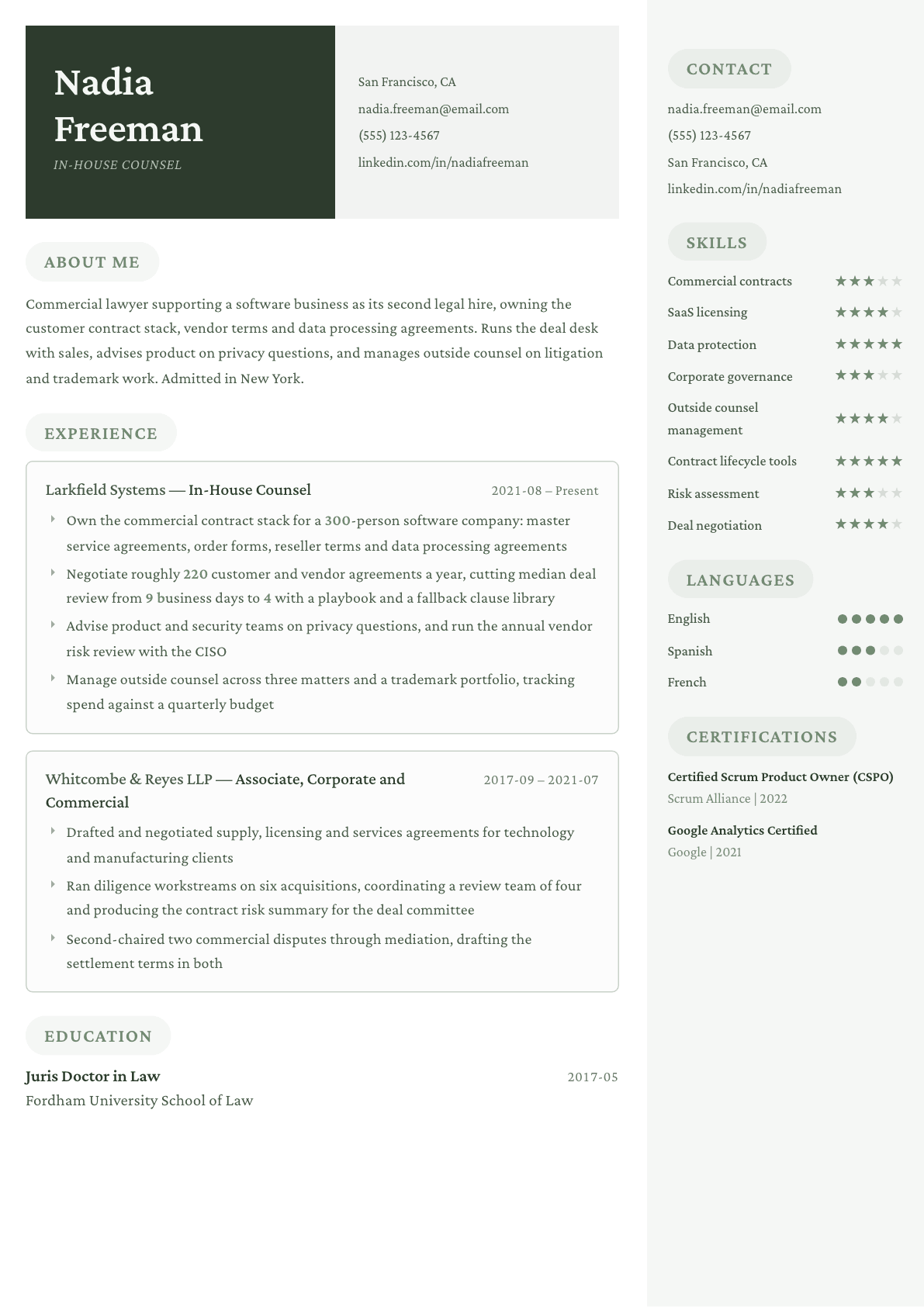
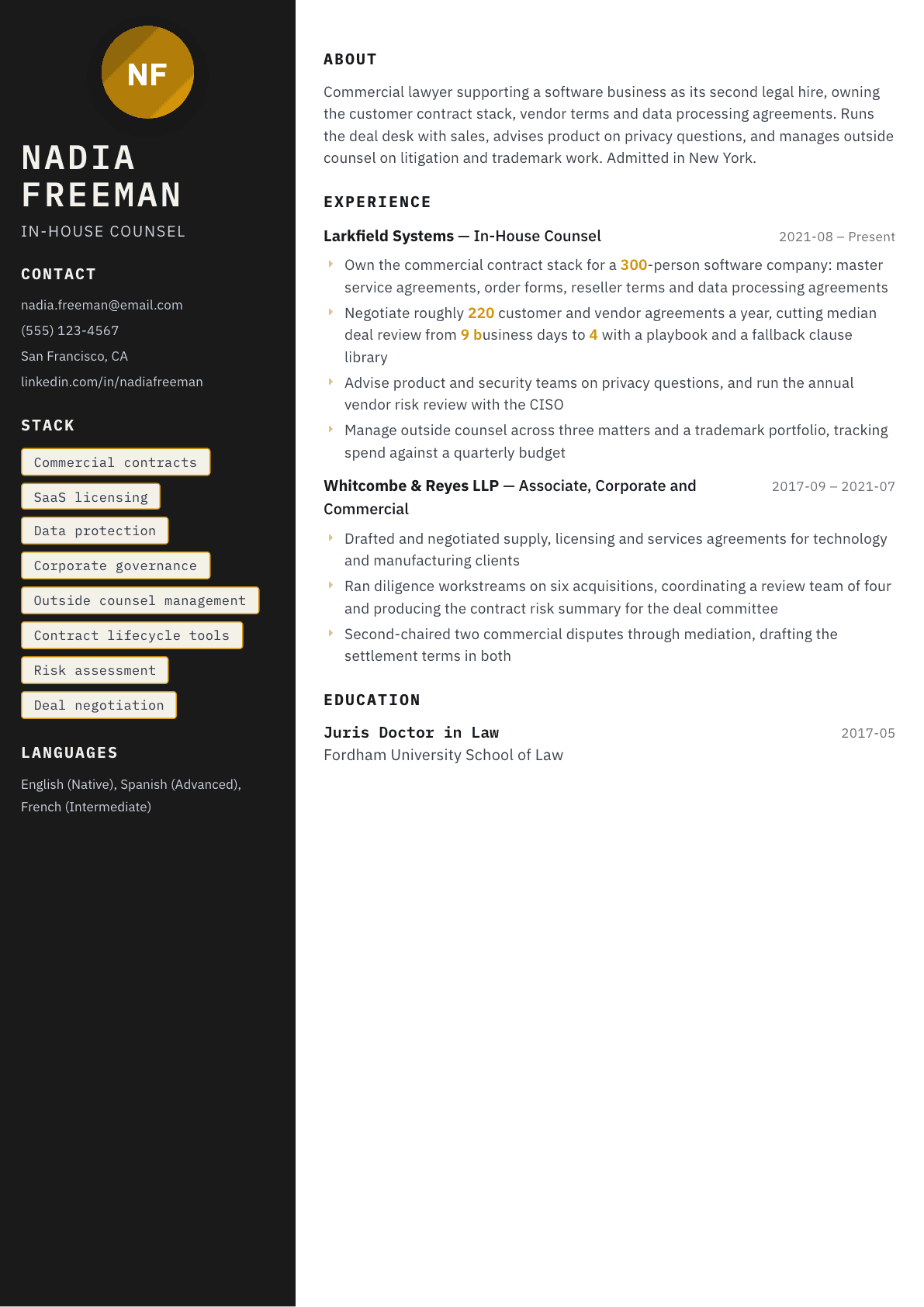
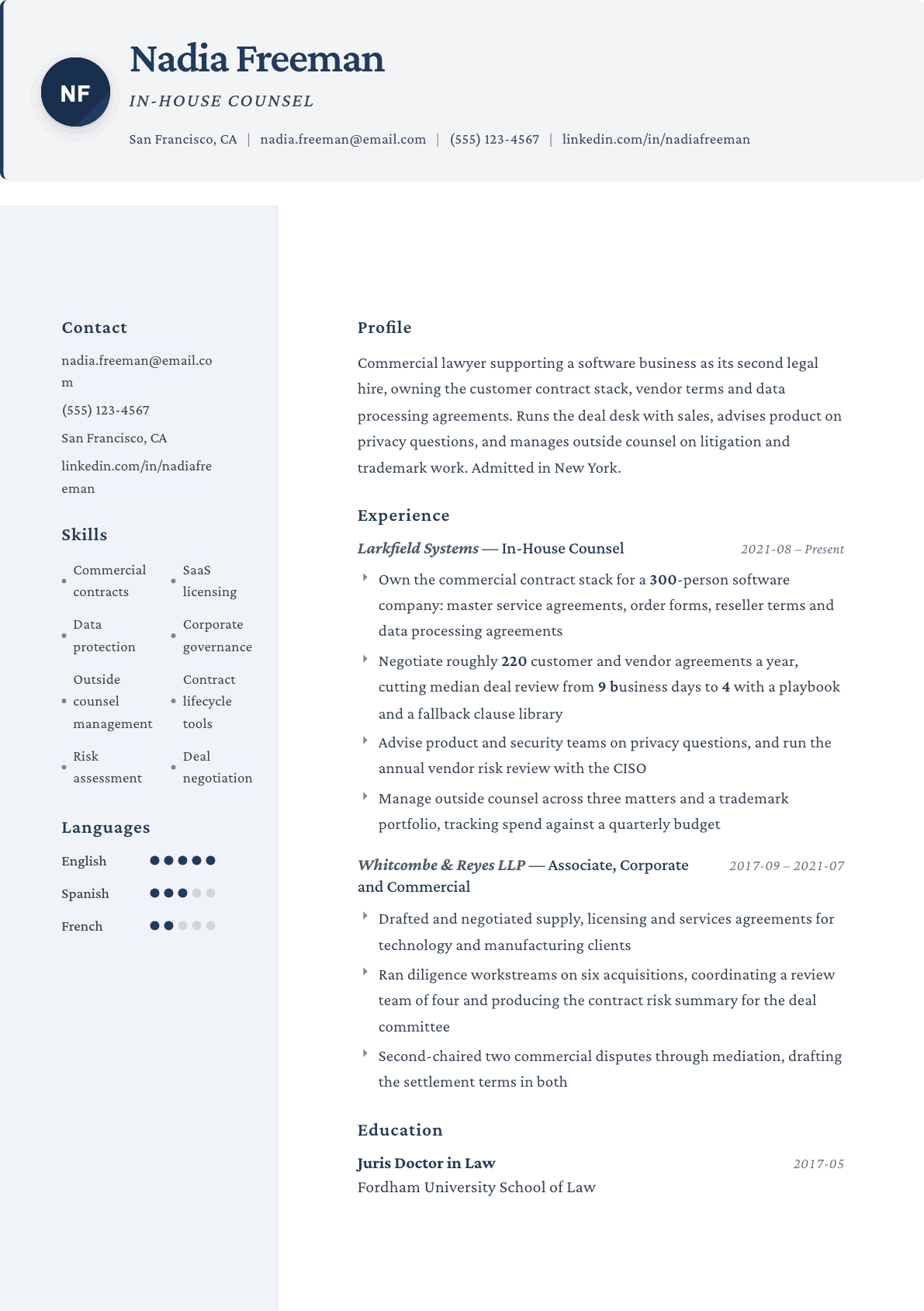
Example In-House Counsel summary
In-house counsel with six years across a commercial law firm and a growing software company, now the owner of a contract stack covering customers, vendors and resellers. Built the sales playbook that halved deal review time, advises product on privacy questions, and manages outside counsel on disputes and trademarks. Admitted in New York and looking for a broader commercial remit.
Skills to list on a In-House Counsel resume
- Commercial contract drafting
- Master service agreements
- SaaS and software licensing
- Data processing agreements
- Vendor and procurement contracts
- Corporate governance
- Board minutes and resolutions
- Employment law advice
- Intellectual property portfolio management
- Outside counsel management
- Legal budget tracking
- Contract lifecycle management systems
- Regulatory compliance
- Risk assessment
- Deal negotiation
- Policy drafting
What actually gets this resume read
- Lead with the contract types you own end to end, because a legal department hires for the specific paper it signs every week.
- Give the business context in every job: company size, industry, revenue model and how many internal clients you support.
- Show volume and cycle time on contract work, since those are the two numbers a general counsel checks first.
- Name your bar admissions and the states in the header, and add any registration you hold in another jurisdiction.
- Separate the legal advice you gave from the process you built, because in-house hiring rewards both and firms only test one.
- Keep litigation on the resume but frame it as management of outside counsel, budget and business exposure rather than motion practice.
How to write a in-house counsel resume
An in-house counsel resume fails for one of two reasons. Either it reads like a law firm biography, listing matters and clients that mean nothing to a company, or it reads like an administrator's resume, listing contract types with no sign of the judgment behind them. The general counsel doing the hiring wants a third thing: proof that you can sit in a room with sales, engineering or procurement and give an answer the business can act on that afternoon.
The screening path is short. A recruiter or the legal operations manager checks bar admission, years of practice and whether the contract types on your page match the paper the company signs. Then the general counsel reads the experience section looking for scope, autonomy and how much supervision you needed. If your page never says who you advised or what you decided alone, the read stops there.
This guide covers the section order a legal department expects, three summaries written for a first in-house move, a settled commercial lawyer and a senior counsel, before-and-after bullets drawn from contract and advisory work, and the questions firm lawyers ask when they write their first in-house resume.
Format: two pages, business context before legal detail
Reverse chronological, no columns, and a header that carries your name, city, phone, email and bar admissions with the states spelled out. Admissions belong in the header because that is the first hard filter, and a legal operations coordinator should not have to hunt for them on page two.
Each employer gets a one line description before the bullets: what the company does, its size, its revenue model and the region it sells into. A lawyer who supported a hardware manufacturer selling through distributors did a different job from one who supported a subscription software business, and the bullets alone will not carry that difference.
- Header: name, admissions with states, city, phone, email, and a note if you hold registered in-house counsel status elsewhere.
- Order: summary, experience, education, admissions detail, certifications, languages.
- One line of company context under every employer name, before the first bullet.
Summary: the contract stack, the internal clients, the reporting line
Four lines at most. Say what you own, who you advise and who you report to. Ownership is the word that matters: a lawyer who owns the customer paper for a business unit is described differently from one who reviews it when asked.
If you are making the move from private practice, spend one clause on the translation. Name the practice group, then say what part of it maps to the role: commercial drafting, licensing, disputes management, regulatory advice. Do not leave the reader to guess whether your capital markets background helps a company that mostly signs vendor agreements.
Experience: what you own, what you decided, what you built
Split each role into three kinds of bullet. The first kind is ownership: the agreements, the entities, the jurisdictions and the internal teams you carry. The second is advice: a hard question you answered and the call you made, such as an indemnity position held against a large customer or a data transfer question resolved with the security team. The third is process: templates, playbooks, approval matrices, self-service tools and the training that made the business follow them.
Volume and cycle time carry weight because they are the only operational numbers a legal department reliably tracks. Contracts reviewed a year, median turnaround, the share of deals closed on standard terms, the size of the panel you manage. These are checkable, unlike a claim that you are commercially minded.
Litigation stays on the page but changes shape. In-house, litigation is budget, exposure, discovery obligations, witness preparation with employees and the settlement recommendation you took to management. Motion practice you supervised rather than wrote should be described as supervision.
Skills and systems: name the tools the department runs on
The skills block is where the applicant tracking system finds its match, so it should mirror the posting: master service agreements, data processing agreements, statements of work, reseller and channel terms, nondisclosure agreements, employment advice, corporate governance. Add the systems you have worked inside, because contract lifecycle software, e-billing and matter management appear in postings by name.
Keep the block factual. A general counsel reading "trusted business partner" learns nothing, while reading that you administered a contract lifecycle system and built its clause library tells her what your first month will look like.
Certifications, languages and the second specialty
Privacy and compliance credentials are worth listing because companies buy them deliberately, and they show you handle the regulatory work a legal department cannot outsource cheaply. Languages matter when the company sells across borders, so give the language and the level rather than a flag of convenience.
A second specialty is the strongest differentiator on an in-house resume. Employment, privacy, export controls, intellectual property or healthcare regulation each turn a general commercial lawyer into the obvious hire for a specific company. Name it, then support it with two bullets in the experience section rather than leaving it as a claim in the skills list.
In-House Counsel resume summary examples
First move in-house
Commercial associate with four years drafting and negotiating supply, licensing and services agreements for technology clients, moving in-house to own a company's customer and vendor paper. Handled diligence on six acquisitions and second-chaired two commercial disputes through mediation. Admitted in New York.
Sole or second legal hire
In-house counsel for a 300-person software business, owning master service agreements, order forms, reseller terms and data processing agreements. Negotiates around 220 agreements a year and cut median review time from 9 business days to 4 with a playbook and fallback clause library. Advises product on privacy and manages three outside firms.
Senior counsel
Senior counsel supporting two business units of a medical technology company, covering commercial contracting, distributor arrangements and product regulatory questions across the Americas and Europe. Supervises two counsel and a contract manager, chairs the deal review committee, and holds the escalation line on indemnity and data terms.
Work experience bullets: before and after
Before: Reviewed and negotiated a wide variety of commercial contracts.
After: Owned the customer contract stack for a subscription software business: master service agreements, order forms, data processing agreements and reseller terms, negotiating about 220 a year with sales.
Naming the agreement types and the annual volume shows the reader exactly what paper you can pick up on day one.
Before: Improved the contract process for the company.
After: Wrote a negotiation playbook with tiered fallback positions for eleven clauses, trained the sales team on it, and lifted the share of deals closing on standard terms from 40% to 68%.
A process claim becomes credible once the reader sees the artifact, the audience trained and the measured change.
Before: Managed outside counsel on litigation matters.
After: Managed three employment disputes and one supplier claim with two outside firms on agreed rate cards and matter budgets, running quarterly reviews and taking the settlement recommendation to the executive team.
Budgets, cadence and the decision you carried upward describe management, while the weak version only describes contact.
Before: Advised the business on data protection issues.
After: Advised product and security on vendor data transfers, ran the annual processor review across 60 suppliers, and rewrote the data processing addendum used with every enterprise customer.
The advice lands because there is a scope, a recurring process and a document that exists because of you.
Before: Handled corporate governance matters for the company.
After: Kept the corporate record for four subsidiaries: board and shareholder resolutions, entity filings in three states, the signature authority matrix and the annual conflicts questionnaire.
Listing the entities, filings and instruments proves you have done the unglamorous governance work rather than watched someone else do it.
Hard skills
- Commercial contract drafting
- Master service agreements and order forms
- Software and technology licensing
- Data processing agreements
- Vendor and procurement contracting
- Corporate governance and entity management
- Employment law advice
- Trademark portfolio management
- Outside counsel and budget management
- Contract lifecycle management systems
- Regulatory compliance advice
- Dispute and settlement management
- Policy and playbook drafting
Soft skills
- Commercial judgment
- Plain language advice
- Negotiation under deadline
- Stakeholder influence
- Prioritizing a mixed queue
- Escalation discipline
Certifications worth listing
- Certified Information Privacy Professional (CIPP/US) (International Association of Privacy Professionals)
- Certified Information Privacy Professional (CIPP/E) (International Association of Privacy Professionals)
- Certified Compliance and Ethics Professional (CCEP) (Compliance Certification Board)
- Certified Commercial Contracts Manager (CCCM) (National Contract Management Association)
Mistakes that cost in-house counsel candidates the interview
- Listing firm clients and matter names instead of describing the legal work a company would need done.
- Hiding bar admission on the second page, which stalls the file with the recruiter before a lawyer ever reads it.
- Writing every bullet as review work, so nothing on the page shows a position you took and defended.
- Skipping company context, leaving the reader unable to tell a two-person startup legal function from a business unit of a listed group.
- Claiming to be commercial without a single cycle time, volume or standard-terms figure to support it.
- Padding the skills list with soft phrases that could describe any lawyer in any department.
In-House Counsel resume questions
How do I move from a law firm to an in-house counsel role?
Rewrite your practice as capabilities rather than matters. Group your work into the agreement types you can draft alone, the advice areas you can cover, and the disputes you can supervise. Then name the industry you already know from client work, because companies hire lawyers who understand their product.
Should an in-house counsel resume be one page or two?
Two pages is standard once you have more than three years of practice, because admissions, company context and a mixed advisory record do not compress well. Keep the first half page carrying scope, industry and reporting line, and let detail fall below that.
Do I need to list every contract type I have negotiated?
List the ones the posting names and the ones you could negotiate unsupervised tomorrow. A long undifferentiated list reads as padding. Six precise agreement types with a volume figure beats twenty types with no indication of depth or frequency.
How do I show business impact when legal work is not revenue generating?
Use the operational numbers your department already tracks: contracts closed, median turnaround, share of deals on standard terms, panel size, spend against budget, and audit or inspection outcomes. Attach each to a change you made rather than to the department in general.
Where do compliance and privacy credentials belong on the page?
Give them a short certifications section under education, and support them with experience bullets. A privacy credential with no privacy work behind it invites a question in the interview you would rather not answer, so pair the credential with the review, policy or filing you actually handled.