Massage Therapist Resume Examples: the lines they read
Build a Massage Therapist Resume That Relieves Hiring Stress
By Mustafa Tarabya, founder of CVBooster · Published · Updated
Create a professional massage therapist resume with templates that highlight your therapeutic expertise and certifications.
Sample resumes for a massage therapist
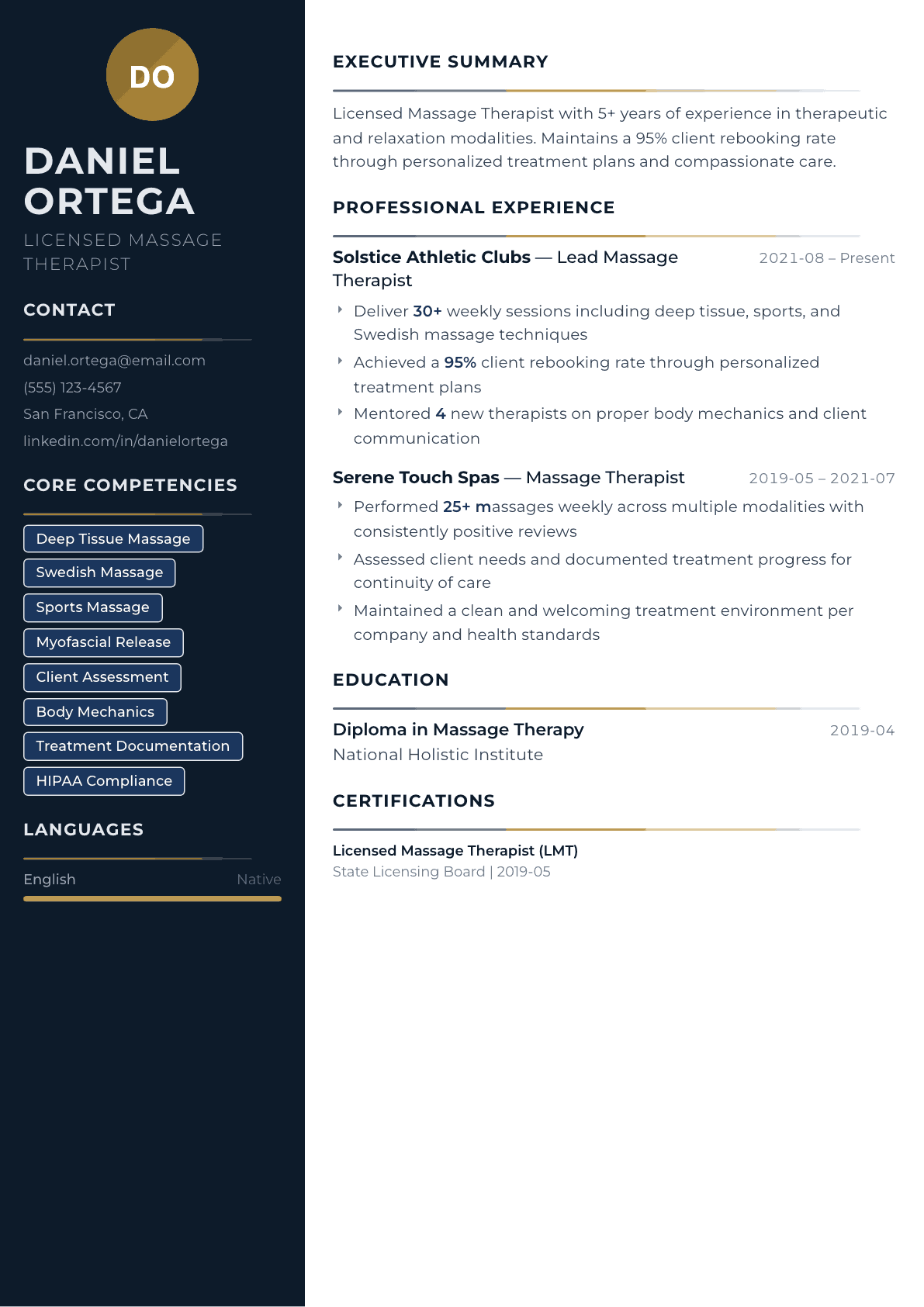
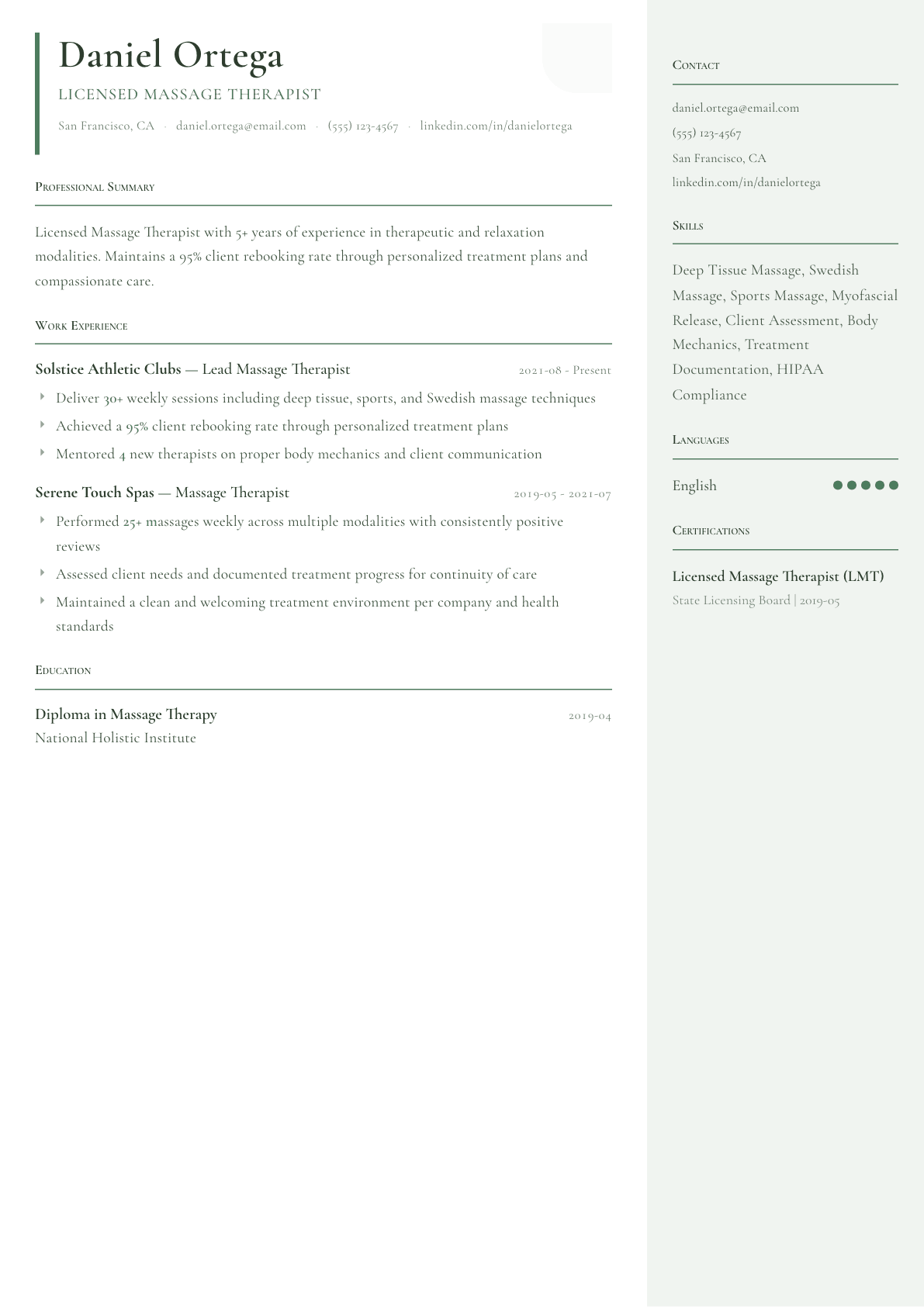
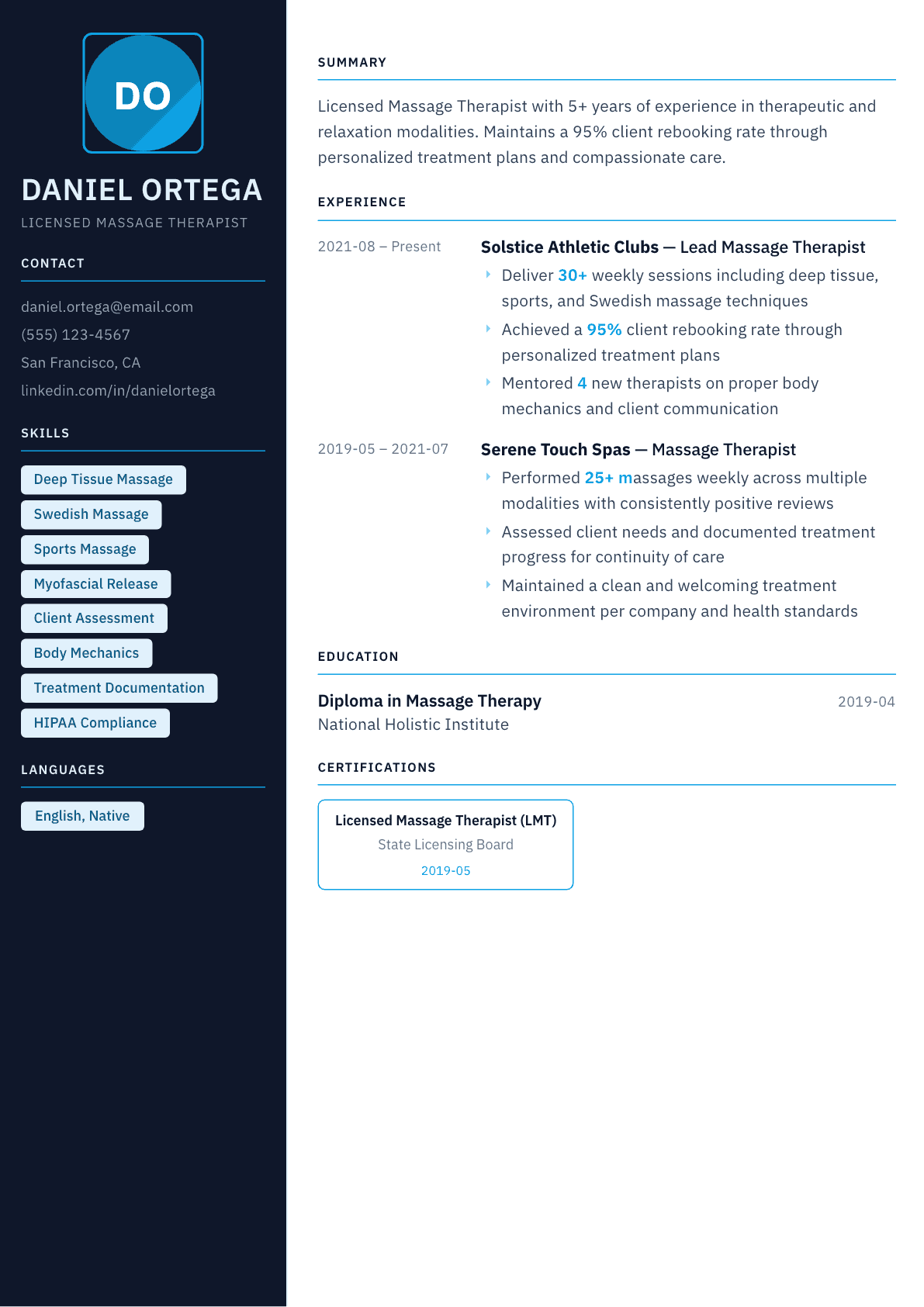
The same massage therapist content laid out in three CVBooster templates, so you can see what the finished document looks like before you write a word.
Example Massage Therapist summary
Compassionate Licensed Massage Therapist with 5 years of hands-on experience in therapeutic and relaxation modalities. Achieves a 95% rebooking rate by delivering personalized, results-oriented sessions.
Skills to list on a Massage Therapist resume
- Deep Tissue Massage
- Swedish Massage
- Sports Massage
- Myofascial Release
- Trigger Point Therapy
- Prenatal Massage
- Client Assessment
- Treatment Planning
- Body Mechanics
- SOAP Documentation
What actually gets this resume read
- List all massage modalities you are trained in to broaden ATS matches.
- Highlight client retention and rebooking rates as key metrics.
- Include your state license and any advanced certifications prominently.
- Mention body mechanics knowledge and injury prevention training.
How to write a massage therapist resume
The person hiring a massage therapist is solving a scheduling problem and a liability problem at the same time. They need to know your license is current in their state, that your malpractice insurance is active, which modalities you can put on the menu, and how many table hours a week your body can sustain without you calling out on a Saturday.
Those four answers should be findable in the top third of the page. After that, the reader is deciding what kind of therapist you are, because the work is genuinely different across settings. A franchise clinic runs high volume on a fixed protocol. A chiropractic or physical therapy office wants treatment notes and referral communication. A resort spa wants guest experience and upgrade attachment. A sports program wants event work and pre-event and post-event protocols.
This guide walks the sections in the order a spa director or clinic owner reads them, with two complete sample resumes for massage therapy (one spa, one clinical), example summaries at three stages, before-and-after bullets built on numbers the booking software actually reports, and the questions therapists ask when they change settings or come back from an injury.
Format: one page, license and insurance in the header block
One page unless you have more than a decade across several settings. Put your name and the credential after it, then city, phone, email, license type with the state, and a line saying your liability insurance is current. Nobody wants to chase that in an email thread after they have already decided to hire you.
Use reverse chronological order and give each employer a type: franchise clinic, day spa, resort spa, chiropractic office, medical practice, sports program or private practice. The setting changes what the bullets mean, so the reader needs it before the bullets start.
- Header: name and credential, city, phone, email, license and state, liability insurance status.
- Sections: summary, license and certifications, experience, modalities and skills, continuing education.
- Private practice belongs in the experience list under your business name with the dates.
Summary: hours on the table, modalities, and the population you treat
Three lines. Give the years, the weekly session load you carry comfortably, your two or three strongest modalities, and the population you are used to: desk workers with neck and shoulder patterns, post-surgical clients under a referral, prenatal, athletes in season, or older adults with limited mobility.
That last item matters more than therapists expect. A clinic treating referred pain patients is not looking for the same person as a hotel spa selling a relaxation menu, and a summary that names the population sorts you correctly in the first ten seconds.
Experience: session load, rebooking and what you documented
Lead each job with volume and mix. Sessions per week, the split between 60 and 90 minute appointments, and the share that were deep tissue or clinical rather than relaxation. A spa director reads that as whether you can hold a full book without burning out by month four.
Then the outcomes the software tracks: rebooking rate, membership conversion if the clinic sells memberships, enhancement or upgrade attachment, and guest rating. Add the clinical side if you have it: intake and assessment, treatment planning across a series, SOAP notes, contraindication screening, and communication back to a referring chiropractor or physician.
Do not fill space with the parts every therapist does. Setting up a room, changing linens and greeting a client are assumed. Space is better spent on the modality you were the only one on the floor trained in.
- Weekly session count and the length mix, plus how many weeks a year you carried it.
- Rebooking rate, membership conversion and enhancement attachment.
- Assessment and documentation practice, including SOAP notes and referral communication.
- Specialty work: prenatal, oncology-trained, lymphatic, sports event coverage, cupping, hot stone.
License, examination and continuing education
Give the license its own block: the credential, the state, and whether you hold licenses in more than one state. If you passed the national examination used for licensure, list it, because it travels across state lines better than a school name does. Board certification is a separate and higher credential than licensure, so if you hold it, do not bury it in a list with a weekend workshop.
Continuing education is where a hiring manager reads your trajectory. List the hours and the subjects, not just the total. A therapist adding lymphatic drainage, oncology massage or prenatal training is telling a clinic which menu items they can add without hiring anyone new.
Modalities and skills: the treatment menu, in the menu language
Write the skills block as a menu the employer could paste into their own price list: Swedish, deep tissue, trigger point, myofascial release, sports, prenatal, hot stone, cupping, craniosacral, reflexology, chair and event massage. Add the practical items around the table: intake and consultation, draping standards, body mechanics, room turnover time and the booking system you have used.
Body mechanics deserves its own line. Turnover in this trade is driven by injury, and an owner reading that you protect your hands, wrists and shoulders is reading that you will still be on the schedule next year.
Sample resume for massage therapy: spa and clinical, start to finish
A resume for massage therapy is easiest to write from a complete sample, so here are two pages in outline. The people and businesses are invented; the order is the part to copy. Both put the license number, state and insurance in the header, because that is the line every owner checks before reading further, and both say how many sessions a week the therapist carries.
Sample one, resort spa: Jasmine Reyes, Licensed Massage Therapist, state license number, professional liability insurance current, member of a national massage association. Sample two, clinical: Daniel Brooks, Licensed Massage Therapist, state license number, insurance current, working in a chiropractic and physical therapy office.
- Spa sample, summary: licensed massage therapist with four years at a resort spa, carrying 25 sessions a week across Swedish, deep tissue, hot stone and prenatal massage, with a strong rebooking and add-on record.
- Spa sample, experience: deliver 50 and 80 minute treatments to the spa menu, adjusting pressure and focus after a short intake with each guest.
- Spa sample: recommend add-ons such as aromatherapy and scalp treatment where they fit the guest, and keep the treatment room to the spa standard between sessions.
- Clinical sample, summary: licensed massage therapist with three years in a chiropractic office, treating patients referred for neck, back and shoulder pain, writing SOAP notes after every session.
- Clinical sample, experience: carry about 22 patient sessions a week on a treatment plan set with the chiropractor, using trigger point, myofascial release and stretching.
- Clinical sample: write SOAP notes the same day and flag changes in symptoms to the treating provider, supporting insurance billing documentation.
- Both samples close with the license and examination line, continuing education by modality, and a skills block written in the menu or treatment language of the setting.
Massage Therapist resume summary examples
Newly licensed
Newly licensed massage therapist with 750 program hours and 120 supervised student clinic sessions in Swedish, deep tissue and trigger point work. Trained in intake, contraindication screening and SOAP documentation. Seeking a clinic position with a mentor and a build to 20 sessions a week.
Four years on the table
Massage therapist with 4 years in a high volume clinic, holding 24 sessions a week at a 78% rebooking rate. Strongest in deep tissue and myofascial release for desk-related neck and shoulder patterns, with prenatal certification added last year and a full standing prenatal book.
Lead therapist
Lead massage therapist with 12 years across chiropractic and resort settings, board certified, and trained in oncology and lymphatic work. Manages the treatment menu and continuing education for a 9-therapist team, and treats referred pain clients under written plans with the practice chiropractor.
Work experience bullets: before and after
Before: Performed massages for clients using various techniques.
After: Delivered 24 sessions a week split between 60 and 90 minutes, with roughly two thirds deep tissue and trigger point work for chronic neck and shoulder complaints.
Load, session length and the clinical mix tell an owner exactly what your day looks like on their floor.
Before: Had good client retention.
After: Held a 78% rebooking rate and converted 3 to 4 new clients a month onto the clinic membership by mapping out a treatment series at the first visit.
Two numbers plus the method behind them turn retention into something the clinic can expect to repeat.
Before: Kept notes on client sessions.
After: Documented every session in SOAP format, screened for contraindications at intake, and sent progress summaries to referring chiropractors after each series of 6 visits.
Documentation and referral communication are what separate a clinical therapist from a spa therapist on paper.
Before: Trained in prenatal massage.
After: Completed 24 hours of prenatal training and built a standing prenatal book of 15 clients, adding a menu item the clinic had previously turned away.
A credential attached to demand and revenue shows the employer the return on that training.
Before: Helped new therapists get settled.
After: Mentored 4 new therapists on body mechanics, pressure calibration and room turnover, cutting their average turnover time between clients to under 10 minutes.
A specific coaching subject and a measured result make mentoring credible instead of polite.
Hard skills
- Swedish massage
- Deep tissue massage
- Trigger point therapy
- Myofascial release
- Sports and event massage
- Prenatal massage
- Lymphatic drainage
- Hot stone therapy
- Cupping
- Client intake and assessment
- Contraindication screening
- SOAP documentation
- Body mechanics and injury prevention
- Spa booking systems
Soft skills
- Setting pressure expectations
- Boundary and draping communication
- Referral coordination
- Client privacy and discretion
- Pacing a full book
- Rebooking conversation
Certifications worth listing
- Licensed Massage Therapist (LMT) (State Massage Therapy Board)
- Massage and Bodywork Licensing Examination (MBLEx) (Federation of State Massage Therapy Boards)
- Board Certification in Therapeutic Massage and Bodywork (National Certification Board for Therapeutic Massage and Bodywork)
- Basic Life Support (BLS) (American Heart Association)
Mistakes that cost massage therapist candidates the interview
- Leaving the license state and status off the page, when that is the first thing a clinic has to verify before it can put you on the schedule.
- Listing fifteen modalities from weekend workshops, which reads as a certificate collection rather than a menu you can deliver well.
- Writing about relaxation and healing energy on an application to a clinical practice that measures outcomes and writes notes.
- Omitting session volume, so an owner cannot tell whether you have carried a full book or worked six appointments a week.
- Saying nothing about body mechanics, when injury is the main reason therapists leave the trade and owners know it.
- Using the same resume for a franchise clinic and a resort spa, when one is buying throughput and the other is buying the guest experience.
Massage Therapist resume questions
How many sessions a week should I claim on a massage therapist resume?
Claim the number you can hold for a full year without injury, not your busiest week. Owners schedule to the figure on your resume. Give the count and the session length mix, and note if part of the load was chair or event work rather than table hours.
What does a good sample resume for massage therapy look like?
It opens with the license number, state and active insurance, names the setting and weekly session load in a two line summary, and lists modalities in the language the employer uses. Experience bullets show rebooking, notes and client types. The spa and clinical samples on this page follow that order.
How do I move from a spa to a clinical or chiropractic setting?
Rewrite the summary around assessment and treatment planning, then pull every bullet that shows intake, contraindication screening, SOAP notes and communication with a referring provider. Add any continuing education in orthopedic, medical or lymphatic work, since that is the vocabulary a clinic hires on.
Should I mention my liability insurance?
Yes, one line in the header or the credentials block. Many employers require proof of current coverage before your first shift, and independent contractors are almost always asked for it. Naming your professional association membership alongside it saves the reader a question.
What do I write if I took time off for an injury?
Name the break in one line and say what you did about it: rehabilitation, a change in technique, continuing education, or a shift toward modalities that are easier on your hands. Employers understand injury in this trade. What worries them is a silent gap and no evidence anything changed.
Related resume examples
- Esthetician Resume example
- Spa Manager Resume example
- Nail Technician Resume example
- Sports Massage Therapist Resume example
- Spa Therapist Resume example
- Aesthetician Resume example