Spa Therapist Resume Examples: free ATS score and gap list
Write a Spa Therapist Resume That Wins the Treatment Room
By Mustafa Tarabya, founder of CVBooster · Published · Updated
Spa therapist resume example with treatment menus, body and facial keywords, and a guide to writing bookings, retail and guest scores.
Sample resumes for a spa therapist
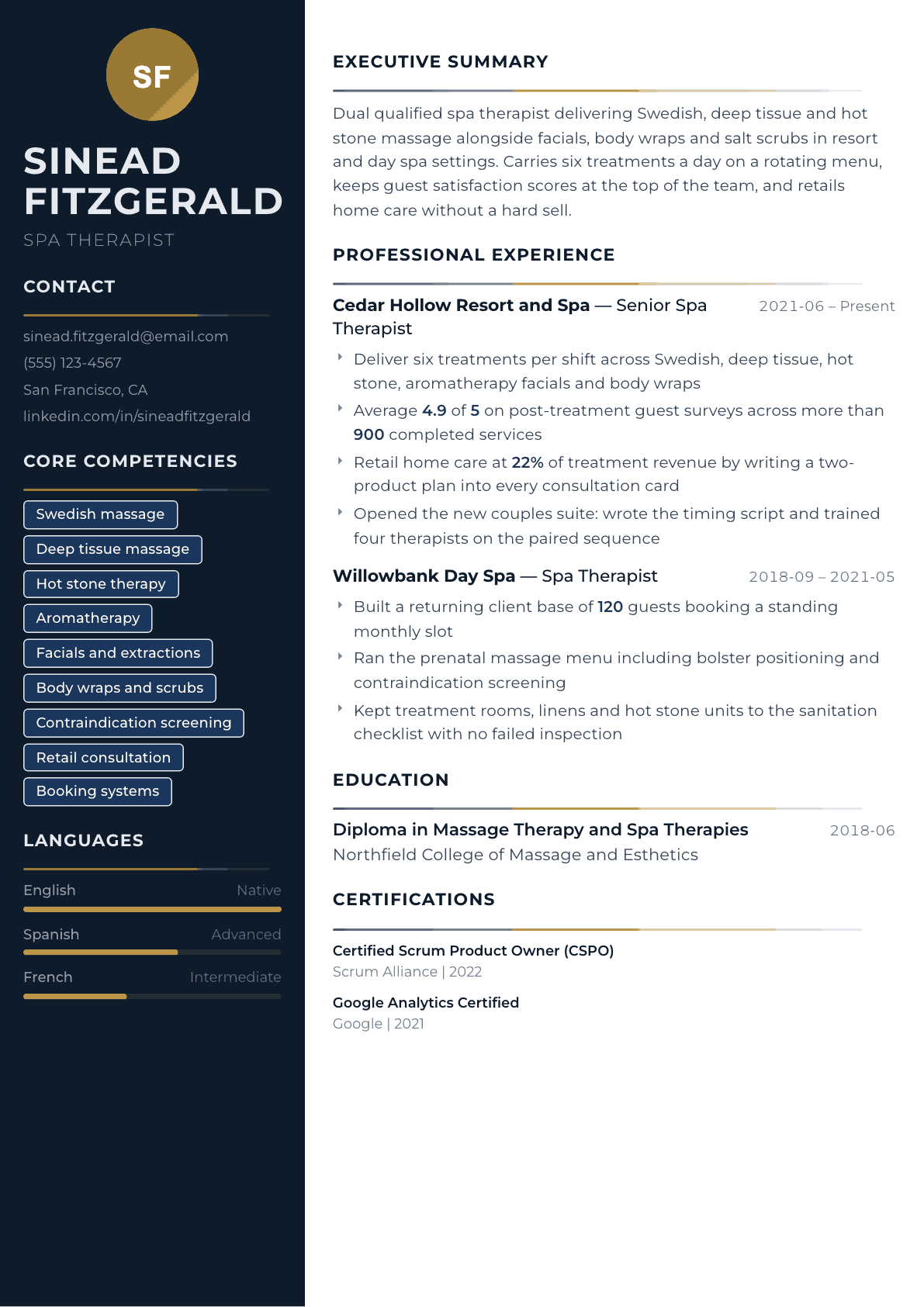
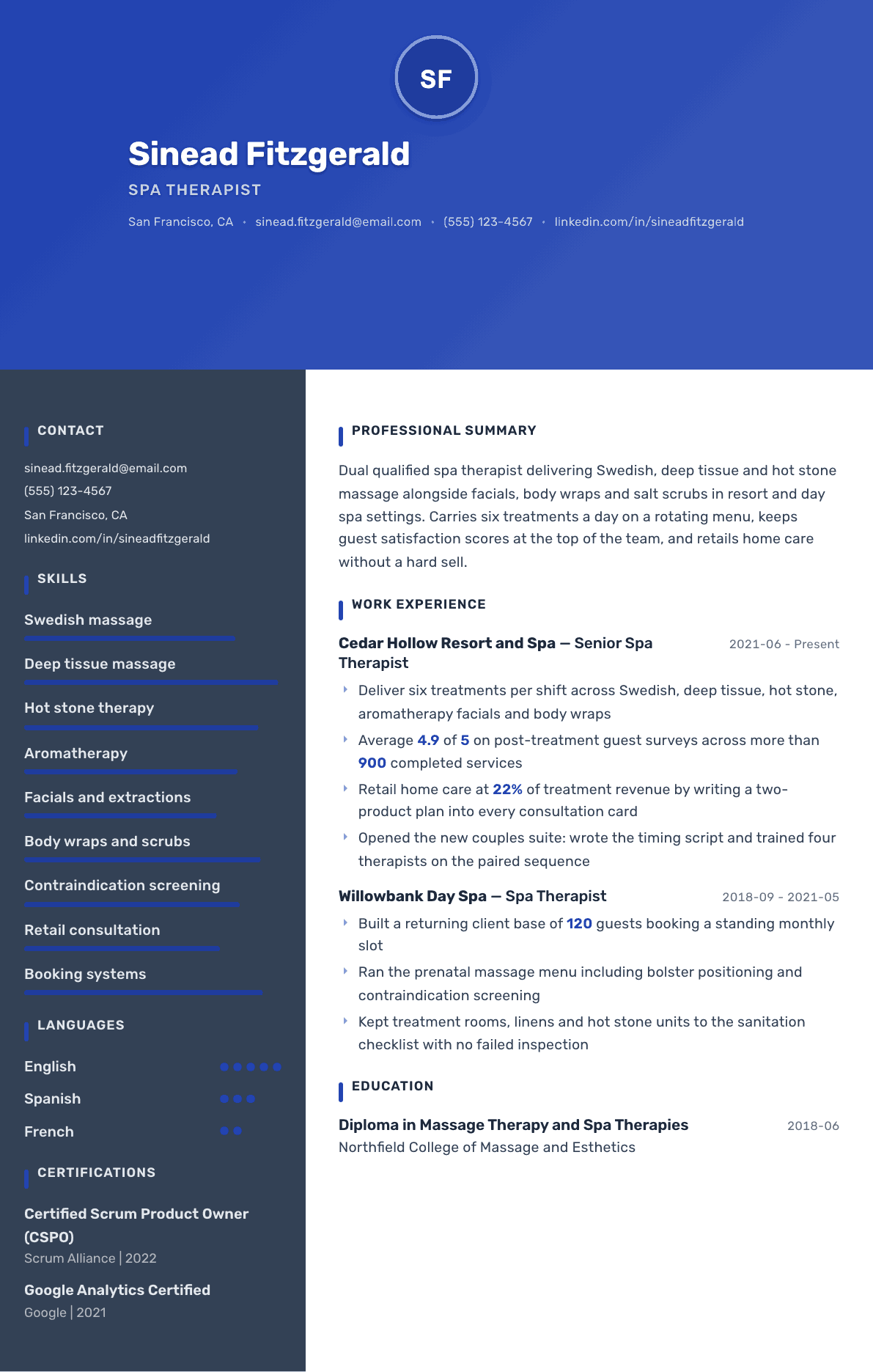
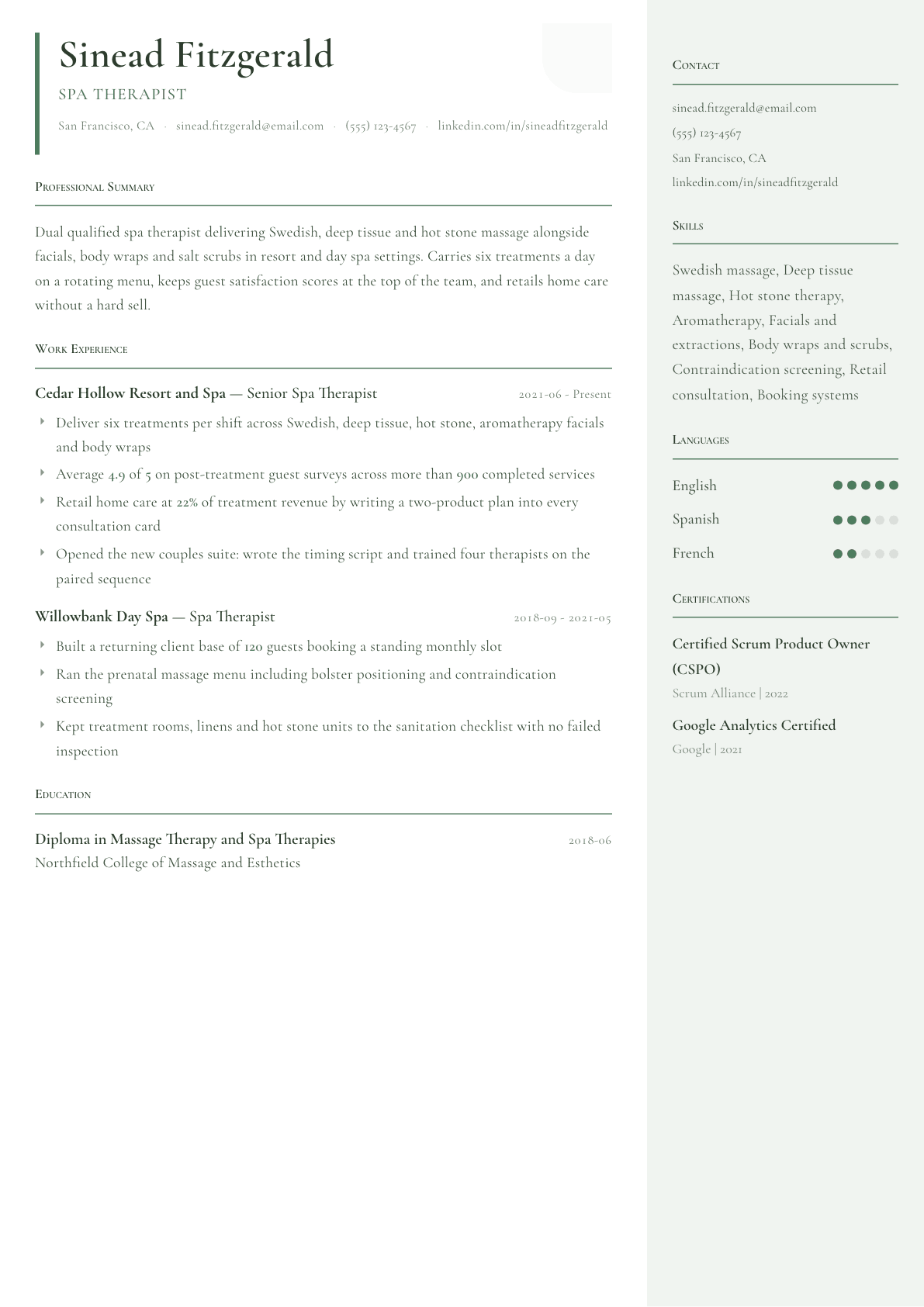
The same spa therapist content laid out in three CVBooster templates, so you can see what the finished document looks like before you write a word.
Example Spa Therapist summary
Spa therapist with six years across resort and day spa floors, dual qualified in massage and esthetics. Delivers Swedish, deep tissue, hot stone and aromatherapy work alongside facials, wraps and scrubs, carrying six treatments a shift without losing pressure or timing. Holds top guest satisfaction scores on the team and retails home care at roughly a fifth of treatment revenue. Seeking a senior room in a resort spa.
Skills to list on a Spa Therapist resume
- Swedish massage
- Deep tissue massage
- Hot stone therapy
- Aromatherapy blending
- Prenatal massage
- European facials
- Body wraps and scrubs
- Dry brushing and exfoliation
- Contraindication screening
- Consultation and intake forms
- Home care retail
- Room turnover and sanitation
- Spa booking software
- Guest experience recovery
What actually gets this resume read
- List the treatment menu you can walk into on day one, modality by modality, not as a single word.
- Name the spa setting: resort, medical, day spa or hotel, because the pace and the guest differ in each.
- Give your treatments per shift and your turnaround time so a manager can slot you into a schedule.
- Report guest satisfaction scores and retail attachment together, since spas measure therapists on both.
- Say which license or diploma you hold, the state, and any modality certificates with the issuing school.
- Mention linen, sanitation and equipment routines, which is what an inspection actually turns on.
How to write a spa therapist resume
A spa director hiring a therapist is filling a room, not a job title. She has a treatment menu with fixed times on it, a rota that has to cover six days, and a revenue target per room that only works if the therapist inside it can run the full menu and sell a little home care afterwards. Your resume either answers that or it does not.
The resumes that stall are the ones that say "delivered a range of relaxing treatments to guests". A spa menu is specific: Swedish at sixty minutes, deep tissue at ninety, hot stone with a set stone rotation, an aromatherapy facial, a wrap that needs a shower fitted into the turnaround. A director wants to see those names on the page in the order she has to schedule them.
This guide walks through the sections a spa reads, in order, with summaries for a fresh graduate, a therapist with a settled book and a senior room lead, before and after bullets, and the questions therapists ask when they rewrite the page for a resort role.
Format: one page, menu first, license and modality certificates together
Reverse chronological, one page unless you have more than a decade across several properties. Spa hiring is credential driven and schedule driven, so the two blocks a director looks for early are the treatment menu you can run and the license and modality certificates that let you run it.
Group your license with every modality certificate in one section rather than scattering them. A director cross-checks that block against her menu, and a therapist who holds hot stone, prenatal and a facial qualification in one place looks immediately more schedulable than one who mentions them in passing inside job bullets.
- Menu block near the top: massage modalities with their standard durations, then facials, wraps, scrubs and any signature rituals.
- License section: massage or esthetics license with the issuing state, plus each modality certificate and the school that awarded it.
- Every job names the property type first: resort spa, hotel spa, day spa, medical spa or wellness club, and the room count.
- New graduates put clinic hours, the modalities covered and the supervised client count above paid work.
Summary: setting, modalities, treatments per shift, retail
Three lines. Name the setting you have worked, the modalities you deliver at full pressure, how many treatments you carry in a shift, and your home care attachment if you track it. Those four facts let a director slot you straight into a rota and a revenue model.
If you are dual qualified in massage and esthetics, put it in the first line. Dual therapists are the ones a spa can move between a body room and a facial room when the day changes, and that flexibility is worth more to a director than any adjective you could use instead.
Experience: what you carried, at what pressure, in what turnaround
Each job needs the property, the number of treatment rooms, the shift length and the treatments per shift. A therapist who has carried six deep tissue hours in a day is a different hire from one who has carried three light Swedish sessions, and the page should not leave that to guesswork.
Then three to five bullets covering the technical work: pressure range and how you adjust it mid-treatment, hot stone rotation and temperature handling, prenatal positioning and bolstering, contraindication screening on intake, and any signature or couples ritual you have delivered or built. Add one bullet on the numbers a spa tracks: guest scores, rebooking, retail attachment, or room turnaround time.
Cut the lines about creating a relaxing atmosphere and providing excellent customer service. Every therapist writes them, and none of them tell a director whether your ninety-minute deep tissue leaves a guest able to walk out satisfied.
Retail, scores and the numbers a spa is measured on
Spas measure therapists on three things beyond technique: guest satisfaction, rebooking and home care sales. If you have a survey score, put it with the number of services it was measured across. If you retail, give attachment as a share of treatment revenue and say how you do it, because directors are wary of therapists who sell hard in the room and generate complaints.
The honest version wins here. A therapist who says home care is written into the consultation card during the treatment, then handed over at the desk, sounds like someone who has solved the tension between service and sales rather than someone reciting a target.
Skills and keywords a spa filters on
Property postings recycle a small vocabulary: Swedish, deep tissue, hot stone, aromatherapy, prenatal, body wrap, salt scrub, dry brushing, facial, contraindications, guest experience, retail attachment. Use the exact words from the posting once in your menu block and once inside a bullet where the work is shown. Name the booking platform too, since a resort with a large book will not want to retrain a therapist on it.
Sanitation belongs on the page, briefly and concretely: linen handling, stone unit cleaning, room turnover time between guests. A director who has been through a health inspection reads that line closely even though nobody puts it in the job advert.
Spa Therapist resume summary examples
New graduate
Massage and esthetics graduate with 620 program hours and 150 supervised treatments across Swedish, deep tissue, hot stone and hydrating facials. Trained in prenatal positioning and contraindication screening. Seeking a first treatment room in a day spa with a rotating menu.
Five years in
Spa therapist with five years across a day spa and a resort property, carrying six treatments a shift on Swedish, deep tissue, hot stone, aromatherapy facials and body wraps. Guest survey average of 4.9 across more than 900 services, with home care at 22% of treatment revenue.
Senior therapist and room lead
Senior therapist with nine years in resort spas, leading a five-room floor and the training rota. Built the couples suite timing script, holds prenatal and hot stone certificates, and covers both body and facial rooms when the day shifts. Rebooking sits above the property average.
Work experience bullets: before and after
Before: Provided massage treatments to spa guests.
After: Delivered six treatments per shift across Swedish, deep tissue, hot stone, aromatherapy facials and body wraps in a nine-room resort spa on a rotating six-day rota.
The volume, the menu and the property size let a director slot you into a real schedule.
Before: Received good feedback from guests.
After: Averaged 4.9 out of 5 on post-treatment guest surveys across more than 900 completed services, with pressure accuracy the most cited comment.
A score attached to a service count and a reason is verifiable where "good feedback" is not.
Before: Recommended products to clients after treatments.
After: Retailed home care at 22% of treatment revenue by writing a two-product plan onto the consultation card during the treatment and handing it to the desk at checkout.
The method explains the number and shows you sell without turning the room into a pitch.
Before: Helped launch a new treatment.
After: Opened the couples suite: wrote the paired timing script so both therapists finish within 90 seconds of each other, then trained four therapists on the sequence.
A concrete build with a tolerance and a training count reads as ownership, not participation.
Before: Kept the treatment room clean and stocked.
After: Turned rooms in under eight minutes including linen change, stone unit sanitation and amenity restock, and closed three inspection cycles with no findings.
Turnaround time and inspection outcomes matter to a director in a way that "kept clean" never does.
Hard skills
- Swedish massage
- Deep tissue massage
- Hot stone therapy
- Aromatherapy blending
- Prenatal massage and bolstering
- European facials and extractions
- Body wraps and salt scrubs
- Dry brushing and exfoliation
- Contraindication screening
- Consultation and intake documentation
- Home care retail
- Room turnover and sanitation
- Spa booking software
Soft skills
- Reading pressure feedback without interrupting the treatment
- Timing discipline across a full rota
- Guest recovery after a service issue
- Discretion with medical and personal history
- Working a shared floor with other therapists
Certifications worth listing
- Board Certification in Therapeutic Massage and Bodywork (BCTMB) (National Certification Board for Therapeutic Massage and Bodywork)
- CIDESCO Diploma (CIDESCO International)
- Adult CPR and AED (American Red Cross)
Mistakes that cost spa therapist candidates the interview
- Writing "various spa treatments" instead of naming each modality with the duration the menu runs it at.
- Leaving out treatments per shift, which is the number a director uses to work out whether you can hold a full rota.
- Hiding modality certificates inside job bullets instead of grouping them where they can be checked against the menu.
- Claiming excellent guest service with no survey score, rebooking figure or single concrete recovery story behind it.
- Skipping contraindication screening, prenatal positioning and stone temperature, the details that separate trained hands from willing ones.
- Using the same resume for a medical spa and a resort spa when the two want opposite halves of your history.
Spa Therapist resume questions
How long should a spa therapist resume be?
One page for anyone under about ten years. Two pages only when you have worked several properties with different menus and hold a long list of modality certificates. A director scans for the menu and the license, so a third page never gets read.
Should I list every modality I have ever trained in?
List the ones you can deliver at full standard today, and separate them from training you have completed but not yet run on paying guests. A director who books you for a modality you last practiced in school will find out inside the first week.
How do I move from a day spa to a resort spa?
Lead with volume, stamina and menu breadth, because resort work means longer shifts and back to back bookings. Mention any experience with couples treatments, signature rituals and guests who do not speak your first language, since resorts run all three constantly.
Does retail belong on a spa therapist resume?
Yes, and it is often the deciding factor between two therapists with similar technique. Give the attachment figure, name the product categories you sell, and describe the moment in the service where the recommendation is made rather than claiming a talent for selling.
What should a new graduate put in the experience section?
Your clinic hours, broken down by modality, with the supervised client count and the setting. Add any student spa work, event chair massage or community clinics. A director will accept training hours as experience if you present them with the same specifics a paid job would carry.
Related resume examples
- Massage Therapist Resume example
- Spa Manager Resume example
- Spa Receptionist Resume example
- Aesthetician Resume example
- Esthetician Resume example
- Sports Massage Therapist Resume example