Sports Massage Therapist Resume Examples: free ATS score
Write a Sports Massage Therapist Resume Coaches Trust
By Mustafa Tarabya, founder of CVBooster · Published · Updated
Sports massage therapist resume example, keyword list and guide covering event work, athlete caseloads, assessment and return to play.
Sample resumes for a sports massage therapist
The same sports massage therapist content laid out in three CVBooster templates, so you can see what the finished document looks like before you write a word.
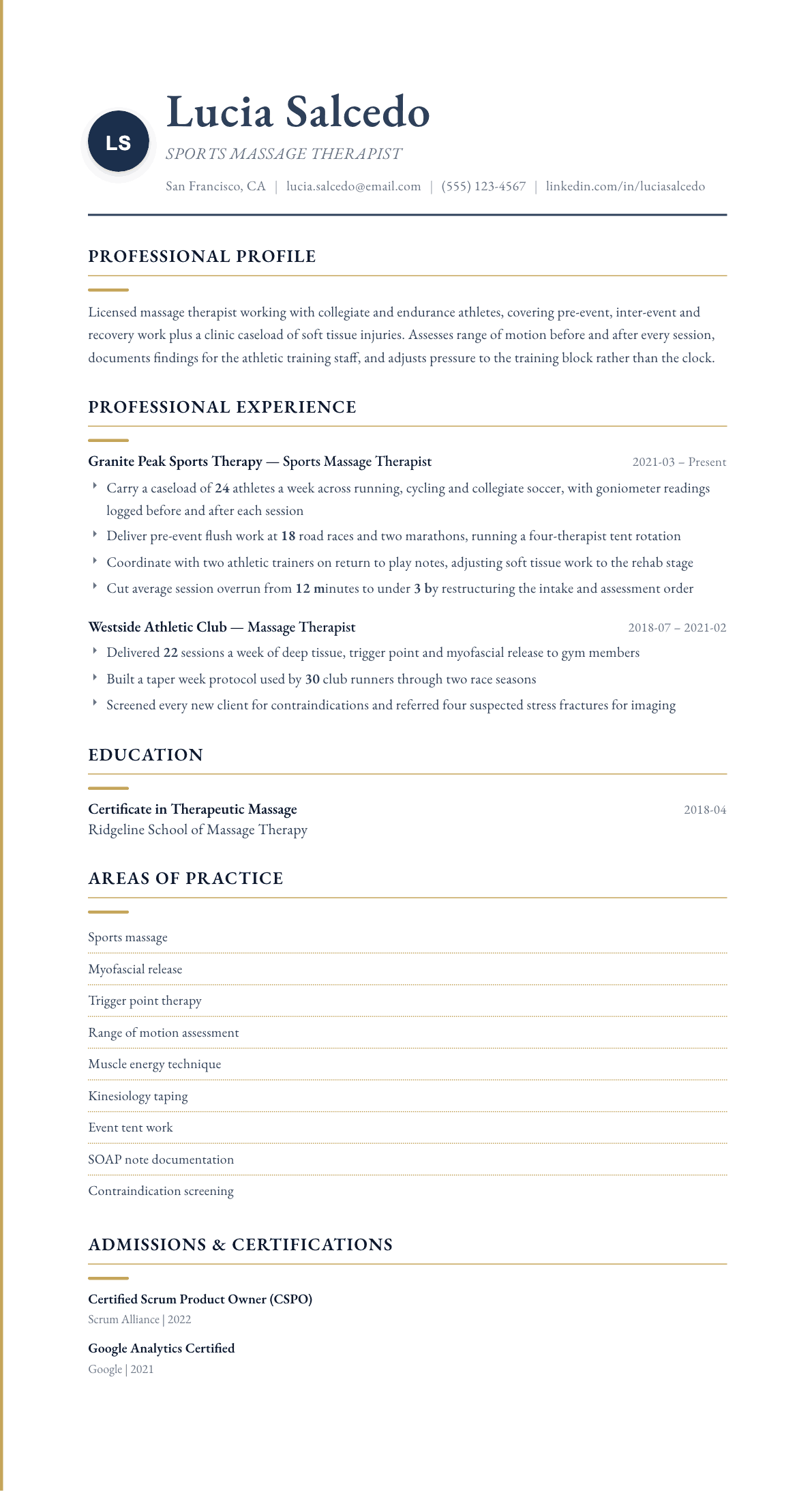
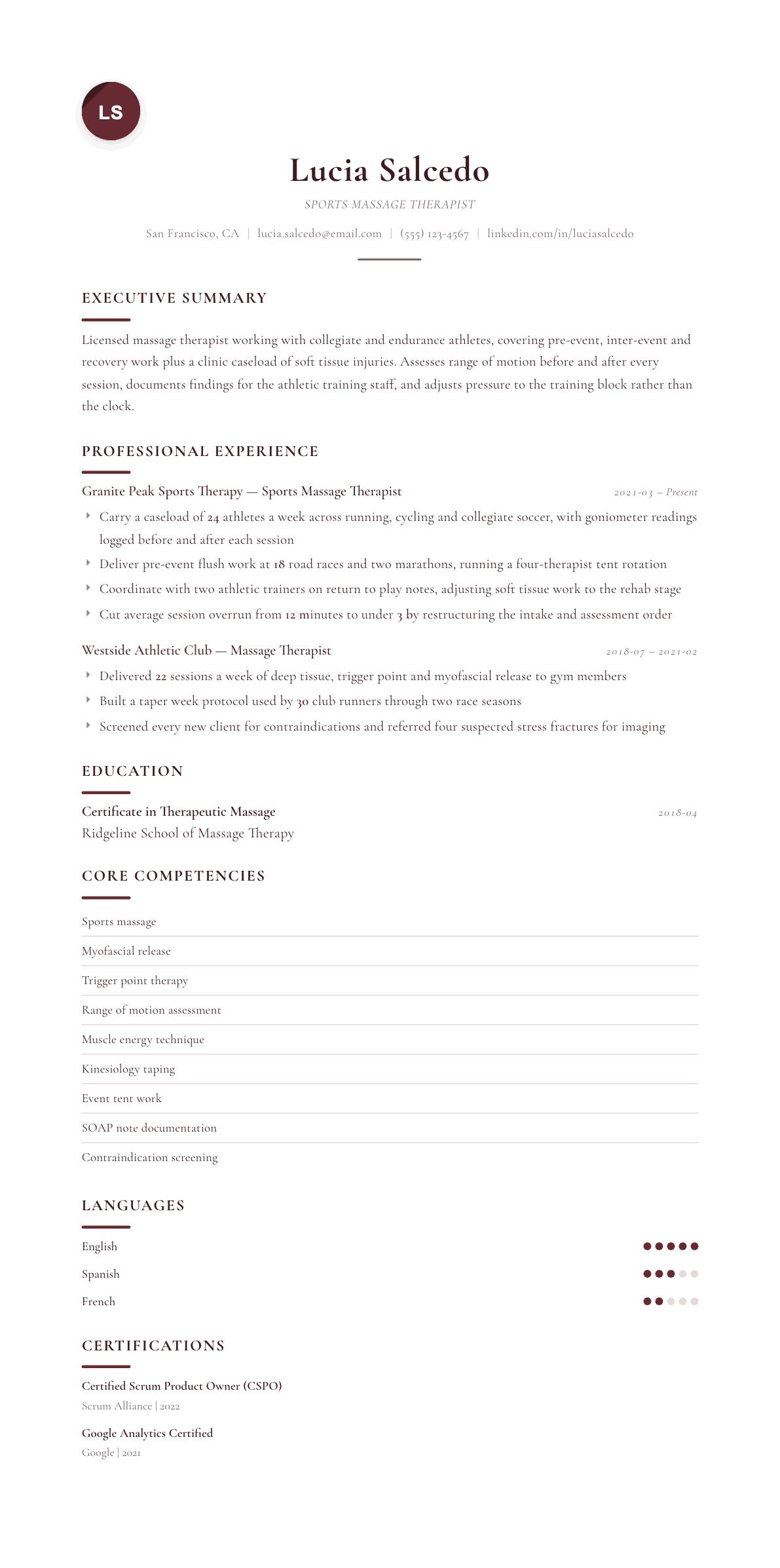
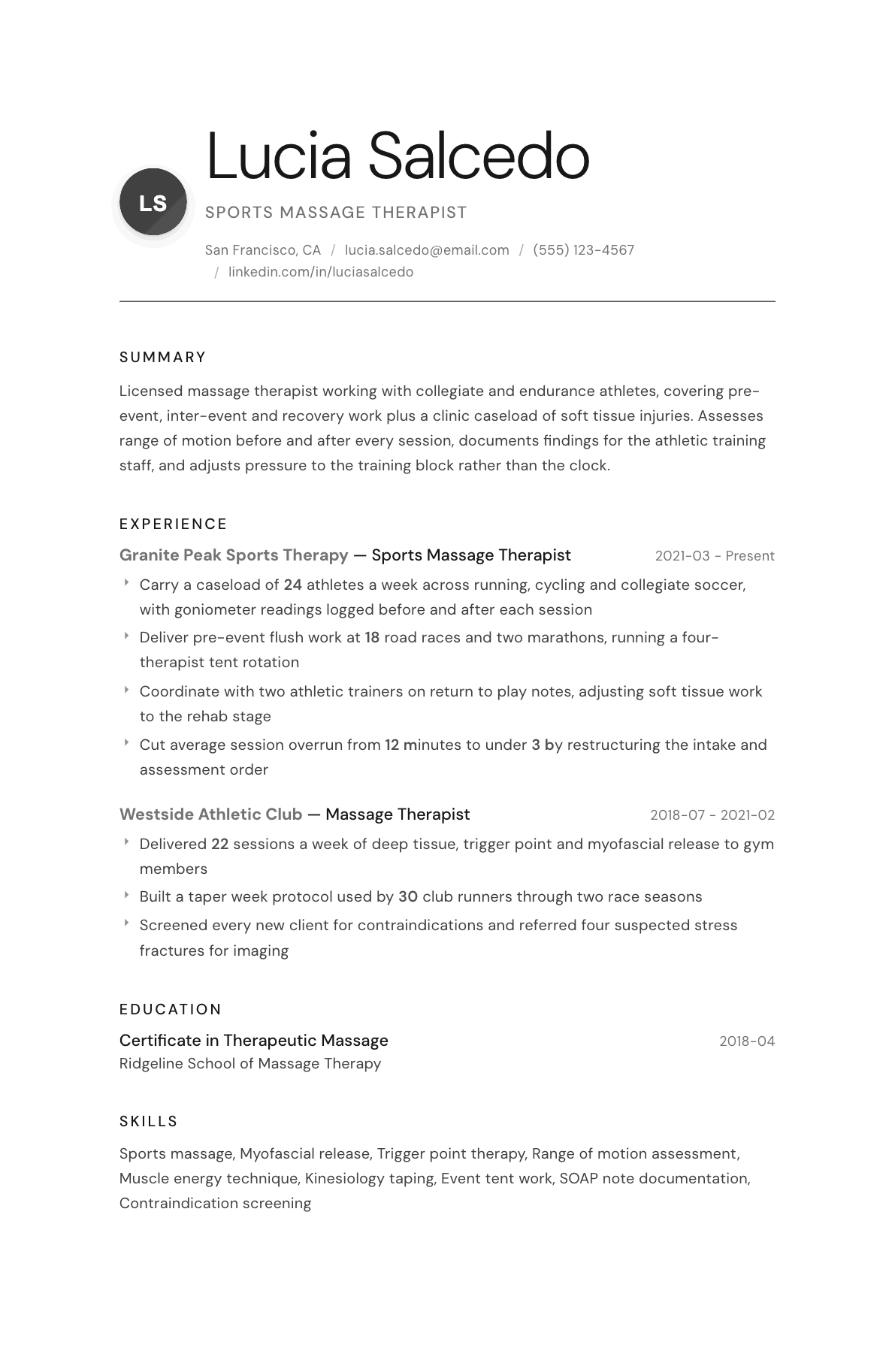
Example Sports Massage Therapist summary
Licensed massage therapist specializing in athletes, with clinic, team and race tent experience across running, cycling and collegiate soccer. Runs range of motion assessment before and after every session, documents findings for athletic training staff, and matches pressure and technique to the training block rather than a fixed routine. Carries a two dozen athlete weekly caseload and has covered eighteen road races. Seeking a team-side therapy role.
Skills to list on a Sports Massage Therapist resume
- Pre-event and post-event massage
- Deep tissue technique
- Myofascial release
- Trigger point therapy
- Muscle energy technique
- Positional release
- Range of motion testing
- Postural and gait observation
- Kinesiology taping
- Cupping
- Event tent rotation
- SOAP note documentation
- Contraindication and red flag screening
- Athlete education on recovery
What actually gets this resume read
- Separate pre-event, inter-event, post-event and maintenance work, because coaches book each one differently.
- Name the sports and the training phases you have worked, from base miles through taper and race week.
- Give the caseload: athletes per week, session length, and whether you work clinic, team or event tents.
- Show your assessment routine and the tool you use for it, not just the modalities you apply afterward.
- State your massage license, the state board that issued it, and any national board certification you hold.
- Describe how you document and hand off to athletic trainers or physical therapists on a shared athlete.
How to write a sports massage therapist resume
Sports massage sits between a spa menu and a clinic chart, and the person hiring you sits on the clinic side. A team lead, clinic owner or head athletic trainer wants to know whether you can assess before you touch, whether your notes are good enough to hand back, and whether you understand that the same athlete needs different work in base training than in race week.
That is why a resume written like a relaxation massage resume gets passed over. Listing modalities is not enough. The reader is looking for the assessment step, the documentation, the referral judgment, and the training context around the athlete you were treating.
What follows is the structure a sports therapy hire is read in, with summaries for a newly licensed therapist, a therapist with a settled athlete caseload and a senior clinician, five before and after bullets, and the questions that come up when a spa or clinic therapist moves toward team work.
Format: one page, license and assessment tools visible early
Reverse chronological, one page under about eight years. The reader wants three things quickly: your state license, the settings you have worked in, and the fact that you assess rather than simply apply pressure. Put an assessment line into your skills block so it is not hidden inside a bullet halfway down.
Do not lead with a modality list alone. Modalities are a commodity in this field, and a therapist who names a goniometer, a straight leg raise, an active range test and a note format immediately reads as clinical rather than decorative.
- License line: massage license with the issuing state board, plus any national board certification and current CPR status.
- Setting line per job: clinic caseload, team room, athletic department, endurance event tent or gym floor, and the sports involved.
- Assessment block: range of motion testing, postural and gait observation, palpation findings, and the note format you write in.
- Event history as its own short list: race distances covered, therapist count in the tent and the rotation you ran.
Summary: sports, setting, caseload, assessment habit
Three lines, no adjectives. Name the sports you have hands-on hours with, the settings, the athletes per week, and the fact that you measure before and after. A clinic owner reading that knows what your week looks like and what your notes will be worth to the rest of the team.
If you are moving in from general or spa massage, say it and name the bridge. Trigger point work, myofascial release and deep tissue technique all carry over. What does not carry over is training phase awareness and return to play coordination, so present those as things you have studied and are seeking hours in.
Experience: the athlete, the phase, the finding, the handoff
Write bullets that follow an athlete through a session rather than listing techniques. The reader wants to see that you took a history, found something on assessment, chose the work because of the finding, and told someone about it afterwards. A bullet that names a hamstring restriction, a technique choice and a note to the athletic trainer does all four in one line.
Distinguish pre-event, inter-event, post-event and maintenance work, because they are booked differently and paid differently. Pre-event is short, brisk and never introduces anything new. Post-event is flushing. Maintenance is where the actual soft tissue change happens. A therapist who blurs them on the page tends to blur them in the tent as well.
Give the caseload numbers: athletes per week, session lengths, and whether you carried a clinic book, a team room or both. Then add one bullet on the operational side, such as restructuring an intake so sessions stopped running over, or building a taper week protocol a coach adopted.
Documentation, scope and referral
Sports therapy resumes live or die on the notes section. Say what you write, where it goes and who reads it. A therapist whose findings reach the athletic trainer in a usable format becomes part of the care team. A therapist who writes nothing is a pair of hands the team books when there is budget left.
Then show scope judgment. Screening for red flags and referring on is not a limitation, it is the thing a clinical employer checks hardest. Naming the suspected stress fractures or nerve symptoms you sent for imaging tells the reader you know exactly where soft tissue work stops.
Keywords a clinic or athletic department screens for
Postings in this field reuse a specific vocabulary: soft tissue mobilization, myofascial release, trigger point, muscle energy technique, positional release, range of motion, kinesiology taping, cupping, pre-event, post-event, recovery, return to play, SOAP notes, contraindications. Mirror the ones you genuinely deliver, once in the skills block and once inside a bullet that shows the work.
Add the sports themselves. A running clinic, a collegiate soccer program and a cycling team all search on their own sport before they search on technique, and a therapist with real hours in that sport gets read first.
Sports Massage Therapist resume summary examples
Newly licensed
Newly licensed massage therapist with 750 program hours, a sports emphasis and 60 supervised athlete sessions across a collegiate training room rotation. Trained in range of motion testing, muscle energy technique and kinesiology taping. Has covered four road races as tent support and seeks a clinic caseload.
Athlete caseload
Sports massage therapist carrying 24 athletes a week across running, cycling and collegiate soccer, with goniometer readings logged before and after each session. Covers pre-event and recovery work at road races, writes notes the athletic training staff use, and adjusts pressure to the training block.
Lead therapist
Lead sports therapist with ten years across clinic and team settings, running a four-therapist race tent rotation and co-managing return to play with two athletic trainers. Built the intake and assessment order that cut session overruns, and mentors newly licensed therapists on documentation.
Work experience bullets: before and after
Before: Gave sports massages to athletes at a clinic.
After: Carried a caseload of 24 athletes a week across running, cycling and collegiate soccer, with goniometer readings recorded before and after every session.
The sports, the caseload and the measurement turn a service description into a clinical practice.
Before: Worked at running events providing massage.
After: Delivered pre-event flush work at 18 road races and two marathons, running a four-therapist tent rotation that cleared a finisher queue in under six minutes per athlete.
Event count, therapist count and throughput show you can run a tent, not just staff one.
Before: Used deep tissue and stretching techniques.
After: Applied muscle energy technique and positional release to a restricted hip flexor found on a Thomas test, then rechecked range at the end of the session and logged the change.
Tying technique to a finding and a recheck is the difference between treating and rubbing.
Before: Communicated with the athletic trainers.
After: Sent a written finding to the athletic training staff after every session on a shared athlete, and adjusted soft tissue work to the stage of the rehab plan they were running.
A named handoff and an adjustment prove you work inside a care team rather than beside it.
Before: Referred clients to doctors when needed.
After: Screened every intake for red flag symptoms and referred four athletes with suspected stress fractures for imaging, documenting the reason and the outcome in the client file.
Specific referrals with documentation show scope judgment, which is what a clinical employer checks first.
Hard skills
- Pre-event and post-event massage
- Deep tissue technique
- Myofascial release
- Trigger point therapy
- Muscle energy technique
- Positional release
- Range of motion testing
- Postural and gait observation
- Kinesiology taping
- Cupping
- SOAP note documentation
- Red flag screening and referral
- Recovery and taper protocols
Soft skills
- Explaining findings without alarming an athlete
- Working alongside coaches and trainers
- Pacing a tent queue
- Holding boundaries on scope
- Reading an athlete who understates pain
Certifications worth listing
- Board Certification in Therapeutic Massage and Bodywork (BCTMB) (National Certification Board for Therapeutic Massage and Bodywork)
- Massage and Bodywork Licensing Examination (MBLEx) (Federation of State Massage Therapy Boards)
- Basic Life Support (BLS) (American Heart Association)
- Certified Strength and Conditioning Specialist (CSCS) (National Strength and Conditioning Association)
Mistakes that cost sports massage therapist candidates the interview
- Listing modalities with no assessment step, which reads as relaxation work with athletic vocabulary bolted on.
- Treating pre-event, post-event and maintenance work as one category when clinics book and price them separately.
- Omitting the note format and who receives it, so the reader cannot tell whether your findings ever leave the room.
- Skipping the sports themselves, when a cycling clinic and a soccer program search for their own athlete first.
- Claiming rehabilitation outcomes that belong to a physical therapist, which makes a clinical reader distrust the whole page.
- Leaving off the license state and current CPR status, both of which are hiring gates rather than extras.
Sports Massage Therapist resume questions
Do I need a massage license to work in sports massage?
In nearly every state, yes, and sports massage is a specialization on top of that license rather than a separate credential. Put the license, the issuing state board and any national board certification near the top, then treat sports training as continuing education.
How do I get event work onto my resume with no team experience?
Volunteer tent shifts at road races and community triathlons count, and you should list them with the event, the distance, the therapist rotation and the number of athletes seen. Event work is how most therapists build the first year of a sports caseload.
What numbers matter most for a sports massage therapist?
Athletes per week, session length, retention across a training season, and anything you measured before and after such as range of motion. Avoid claiming injury reduction, because that outcome depends on coaching and load management you do not control.
How is this different from a spa massage resume?
A spa resume sells menu breadth, guest scores and retail. A sports resume sells assessment, documentation and referral judgment. Same hands, different reader, so the two versions should reorder the bullets and swap the summary rather than share one page.
Should I mention working with a physical therapist or athletic trainer?
Yes, and be precise about the split. Say which athletes were co-managed, what you sent back after each session, and how you adapted to the rehab stage. Employers in this field hire therapists who fit into an existing care team without overstepping it.
Related resume examples
- Massage Therapist Resume example
- Physical Therapist Resume example
- Sports Nutritionist Resume example
- Spa Therapist Resume example
- Medical Esthetician Resume example
- Skincare Specialist Resume example