MBA Graduate Resume Examples: free ATS score and gap list
MBA Graduate Resume With a Complete MBA Resume Sample
By Mustafa Tarabya, founder of CVBooster · Published · Updated
MBA graduate resume example with a complete MBA resume sample, pre-MBA results, the internship entry, application resume advice and recruiting keywords.
Sample resumes for a mba graduate
The same mba graduate content laid out in three CVBooster templates, so you can see what the finished document looks like before you write a word.
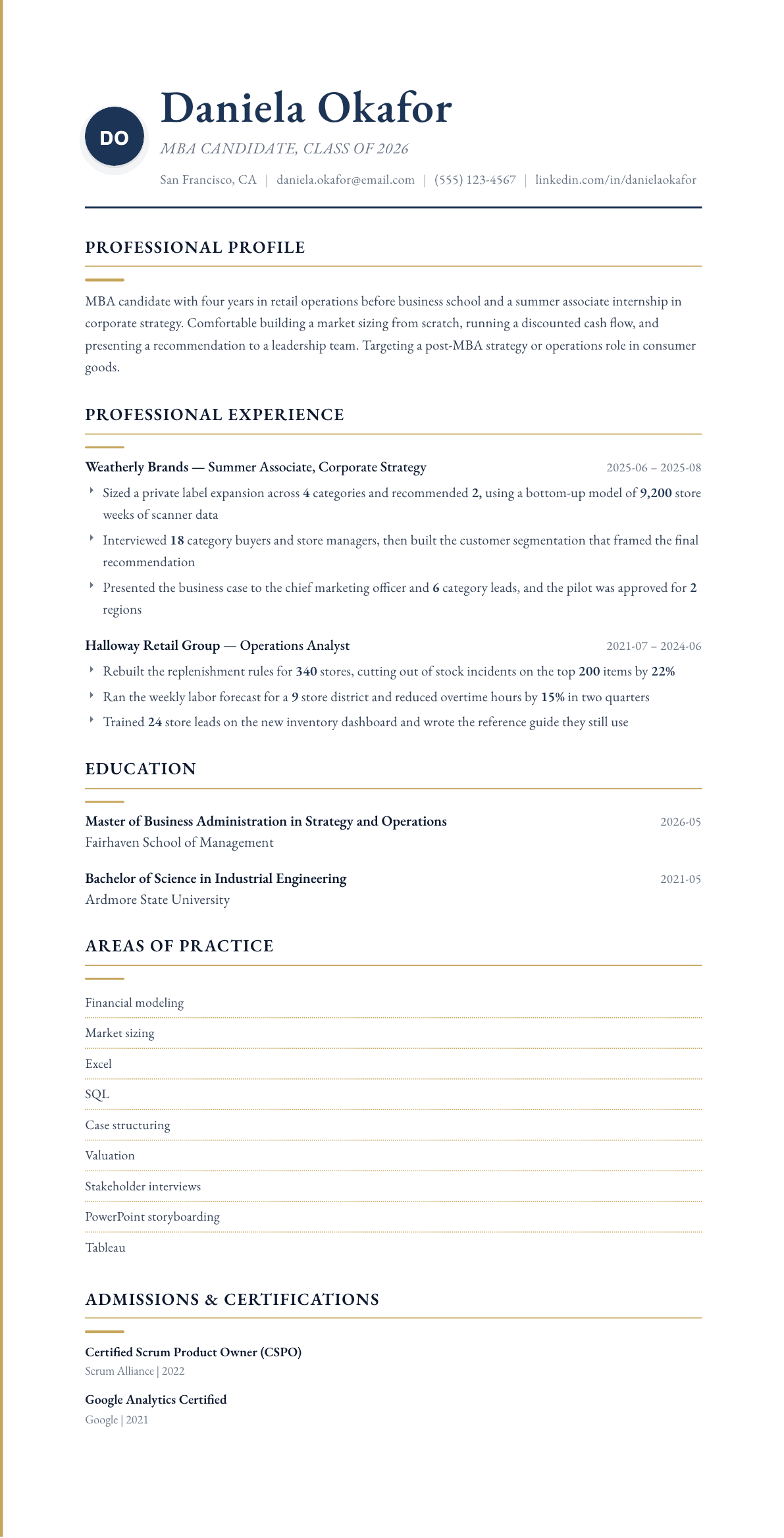
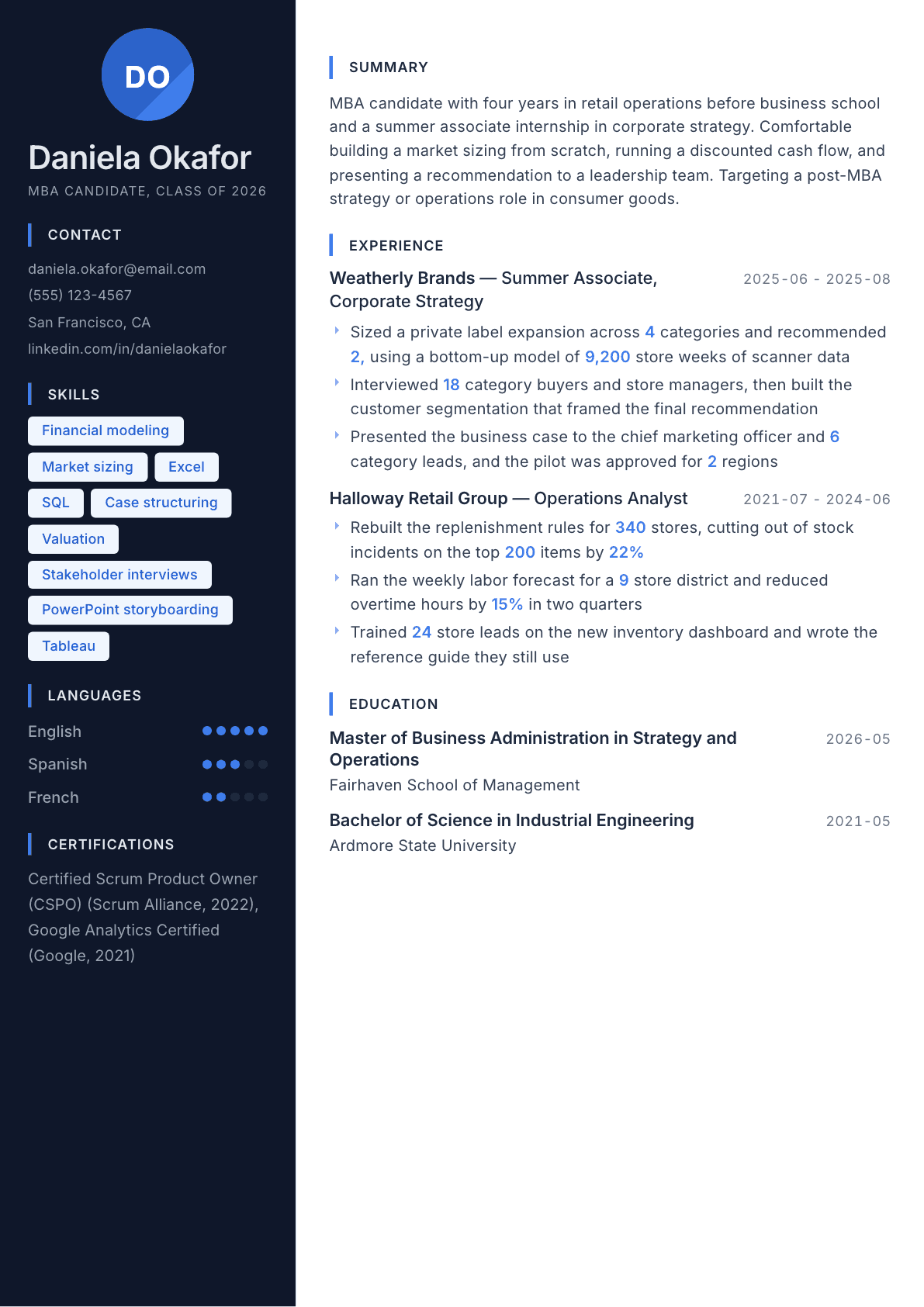
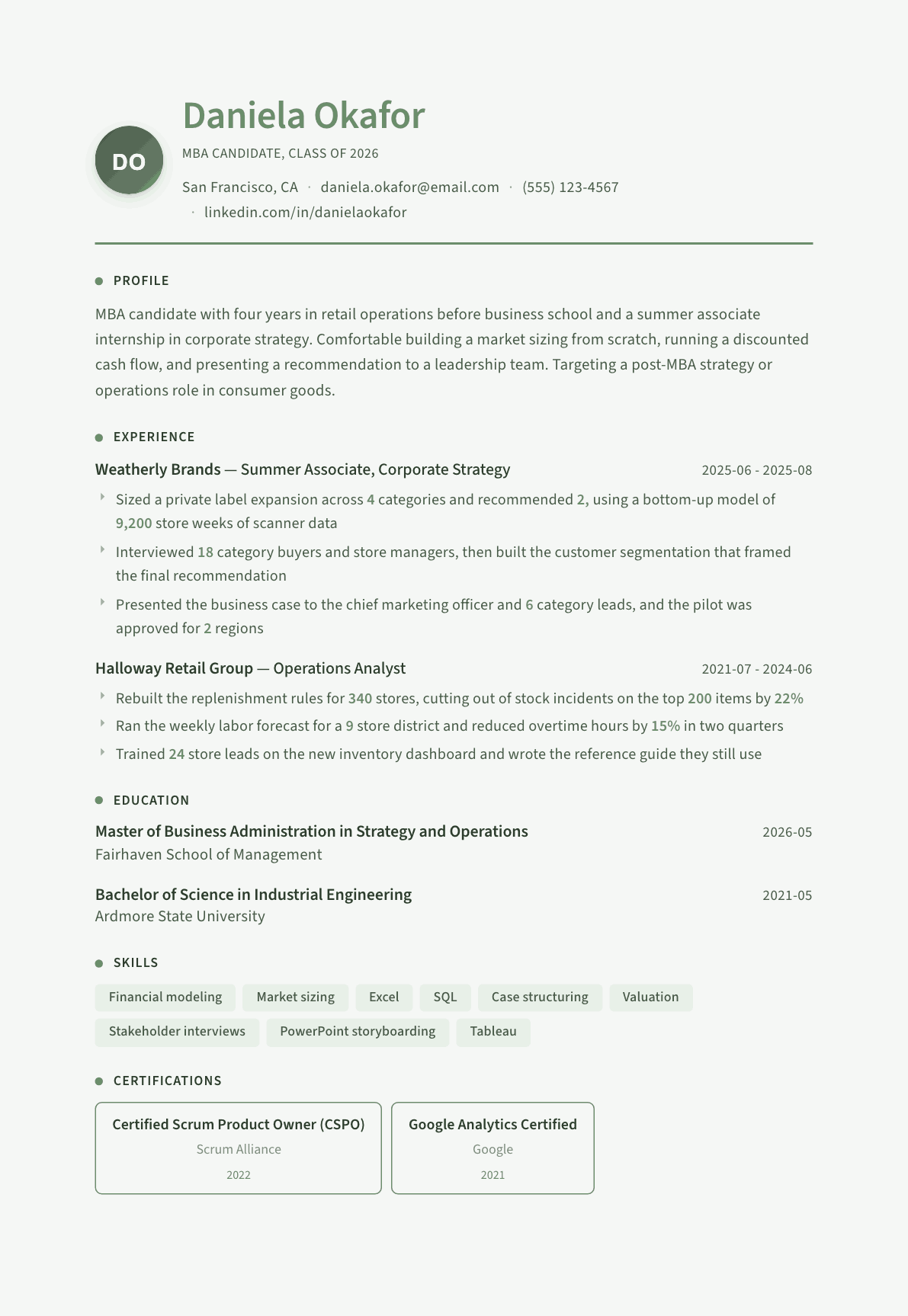
Example MBA Graduate summary
MBA candidate concentrating in strategy and operations, with four years of retail operations experience before business school and a corporate strategy internship where a two category recommendation was approved for pilot. Builds market sizings and cash flow models, interviews frontline operators for the facts a spreadsheet misses, and turns both into a recommendation a leadership team can act on.
Skills to list on a MBA Graduate resume
- Financial modeling
- Market sizing
- Valuation
- Case structuring
- Excel
- SQL
- Data analysis
- Business strategy
- Operations analysis
- Stakeholder management
- Executive presentation
- Competitive analysis
- Cross-functional leadership
- Tableau
- Project scoping
What actually gets this resume read
- Put the MBA at the top with the concentration and graduation date, then move education below experience once you have a post-MBA job.
- Lead every pre-MBA job with results, not duties, because recruiters read that block to judge what you did before school.
- Give the summer internship its own entry with the same depth as a full-time role, including the recommendation and who heard it.
- Name the recruiting track you want in the summary, since strategy, finance and product pipelines screen for different signals.
- List the clubs and case competitions that show leadership, and drop the ones that only show attendance at meetings.
- Keep it to one page and use the space on numbers, scope and decisions rather than coursework titles.
How to write a mba graduate resume
An MBA graduate resume is judged against a strange standard: the degree is assumed, so it earns you almost nothing on the page. Every candidate in the pile has the same two letters. What separates the resumes that convert into interviews is the pre-MBA record, the summer internship, and whether the reader can tell in ten seconds which recruiting track you belong to.
Business school recruiting also runs on a format most schools enforce through a career center template: one page, education first while you are still a student, consistent date formatting, and a bottom section for interests. Deviating from it signals that you did not read the instructions, which is the wrong first impression for a candidate selling judgment.
This guide covers the section order for a current student and for a recent graduate, how to write the pre-MBA block so it carries real weight, a complete MBA resume sample, three example summaries at different stages, before and after bullets from the mistakes MBA candidates make most, and the questions that come up in every resume review appointment.
Format: one page, education on top while you are still enrolled
One page is not a suggestion in MBA recruiting. Consulting and banking screeners read hundreds of resumes in a sitting and a second page reads as an inability to prioritize. Use a single column, no photo, no skill bars, and no icons, because the same document goes through an applicant tracking system at most corporate employers.
While you are enrolled, education sits at the top with the school, the degree, the concentration and the expected graduation date. Add the undergraduate degree directly underneath. Once you have started a post-MBA job, education moves below experience and the pre-MBA block gets compressed.
- Header: name, city, phone, email, and a link line if your school template allows one.
- Order while enrolled: education, experience, leadership and activities, additional information.
- Order after graduating into a role: experience, education, leadership, additional information.
- Dates right aligned and formatted the same way in every entry, including the internship.
The pre-MBA block is the real resume
Recruiters read the years before business school to understand what you can actually do. That block needs to show scope and results, not the tasks of a junior analyst. Give each role the employer, the title, the dates and three or four bullets, and make the first bullet the one with the largest number attached to it.
Career switchers often bury the pre-MBA work because it feels irrelevant to the target industry. That is a mistake. A supply chain analyst moving into product management should keep the analytical scope and translate the language: cross-functional coordination, root cause work, forecasting under uncertainty. The facts stay the same, the vocabulary changes to match the posting.
If your pre-MBA experience was in a field with unfamiliar titles, add a short parenthetical after the title that explains the level in plain terms, so a reader outside your former industry can place you without guessing.
The internship: treat it like a full role
The summer internship is the most recent evidence of what you do in a professional setting, so give it the same depth as a full-time job. Name the workstream, the analysis you owned, the people you interviewed or worked with, and the recommendation you delivered. State who heard the recommendation and what happened to it.
If the internship did not convert to an offer, do not explain that on the resume. Explain it in the interview. What the page needs to show is that the work was real and that a senior person acted on it.
- Bullet one: the question you were asked to answer and the scope of it.
- Bullet two: the method, including the data source, the model or the interviews.
- Bullet three: the recommendation, the audience for it, and the decision that followed.
Leadership and activities: signal, not a list
Club membership is not leadership. A vice president role in a professional club, a case competition placement, an admissions committee seat, or leading a student consulting engagement for a real client all count because they involve responsibility for an outcome. Two or three entries is enough, each with one line describing what you were accountable for.
Pre-MBA community work belongs here too when it shows the same qualities: running a program, managing volunteers, raising a budget. Keep the line count tight so this section never crowds the experience block.
Keywords and the additional information line
For corporate roles the resume passes through screening software before a person sees it, so mirror the language of the posting. Financial modeling, market sizing, valuation, product roadmap, go to market, demand planning: use the exact phrasing the employer uses, once in a bullet where it is demonstrated rather than in a list of adjectives.
The last line of the page carries languages, technical tools, certifications in progress and two or three genuine interests. Interviewers use that line to open a conversation, so make the interests specific and true. A named marathon, a competitive sport, a craft you actually practice: those start a conversation, while the word travel does not.
MBA resume sample: one complete page
This MBA resume sample is for a second year student recruiting for a corporate strategy role. The person is invented. The order is what most business school career centers teach: education, experience, then a short additional section, all on one page with every bullet starting with a verb and ending with a result.
If you are applying to business school rather than graduating from it, the application resume uses the same one page and the same kind of bullets, but experience goes first, the degree you hold sits at the bottom, and the leadership and community lines matter more because the admissions committee reads them for fit with the program.
- Education: MBA candidate with expected graduation month and year, concentration in strategy and finance, the school named, and leadership roles such as vice president of the consulting club. Undergraduate degree below it with the university and major.
- Summer internship: Corporate Strategy MBA Intern, a consumer goods company. Built the market model for a new product category, presented a go or no go recommendation to the division president, and received a full time offer.
- Pre-MBA experience: Senior Analyst, a regional bank, four years. Led the pricing review for the small business lending portfolio, built the dashboard the credit committee used every month, and trained three new analysts.
- Earlier experience: Analyst, the same bank, with one line on the rotation programs completed.
- Additional information: languages with an honest level, tools such as Excel, SQL and Tableau, a certification in progress, and two interests specific enough to talk about.
MBA Graduate resume summary examples
First year MBA, career switcher
First year MBA candidate concentrating in strategy after four years in supply chain analytics, where I ran demand forecasting for 340 stores. Recruiting for summer consulting internships and comfortable structuring an ambiguous problem, sizing a market from the bottom up, and presenting the answer to an operating team.
Second year MBA with a summer offer
Second year MBA candidate with a returning offer from a corporate strategy group, where I sized a private label expansion across 4 categories and saw the recommendation approved for pilot in 2 regions. Six years of pre-MBA retail operations experience and a focus on consumer goods strategy roles.
Recent MBA, first post-degree role
Consumer goods strategy associate and recent MBA graduate with seven years of combined operations and strategy experience. Delivered a category expansion case that reached pilot, rebuilt replenishment rules across a 340 store chain, and now leads market and competitor analysis for two brand teams.
Work experience bullets: before and after
Before: Worked on a strategy project for a consumer goods client.
After: Sized a private label expansion across 4 categories using a bottom-up model of scanner data, and recommended the 2 categories the leadership team approved for pilot.
The scope, the method and the decision that followed replace a description that could belong to any student on any project.
Before: Improved inventory processes at a retail company.
After: Rebuilt replenishment rules for 340 stores and cut out of stock incidents on the top 200 items by 22% within two quarters.
A number for the population, a number for the result and a time frame turn a claim into evidence a recruiter can test.
Before: President of the consulting club.
After: Led a 12 person consulting club board, ran a case practice program that 90 classmates completed, and secured 4 new company sponsors for the annual conference.
Leadership becomes measurable when the reader sees the team size, the reach of the program and something you brought in.
Before: Built financial models in Excel.
After: Built a discounted cash flow and sensitivity model for a 3 site acquisition, testing 5 demand scenarios that framed the go or no go discussion.
Naming the model type, the asset and the scenarios shows the analysis had consequences rather than existing as an exercise.
Before: Managed a team and improved performance.
After: Ran the weekly labor forecast for a 9 store district, coached 24 store leads on the new dashboard, and reduced overtime hours by 15%.
Three specifics, the scope, the coaching and the outcome, do the work that the words managed and improved cannot.
Hard skills
- Financial modeling
- Market sizing
- Discounted cash flow valuation
- Case structuring
- Competitive analysis
- Advanced Excel
- SQL
- Tableau
- Business case development
- Operations analysis
- Customer segmentation
- PowerPoint storyboarding
Soft skills
- Structured problem solving
- Executive communication
- Stakeholder interviewing
- Working under ambiguity
- Team leadership
- Influence without authority
Certifications worth listing
- Chartered Financial Analyst (CFA) Level I (CFA Institute)
- Project Management Professional (PMP) (Project Management Institute)
- Certified Associate in Project Management (CAPM) (Project Management Institute)
- Certified Six Sigma Green Belt (CSSGB) (American Society for Quality)
Mistakes that cost mba graduate candidates the interview
- Leading with the MBA as though the degree is the achievement, when every competing candidate holds one.
- Compressing six years of pre-MBA work into three lines because it feels unrelated to the target industry.
- Listing course names and group projects in place of the internship and the jobs that came before school.
- Running to two pages, which reads as an inability to select what matters in a recruiting process built on selection.
- Writing the internship as observation, using verbs like assisted, supported and shadowed instead of owning the analysis.
- Filling the activities section with membership in eight clubs and no role that carried accountability.
- Using one generic version for consulting, product and finance applications when each track screens for different evidence.
MBA Graduate resume questions
Should an MBA resume be one page?
Yes. Almost every business school career center requires one page and recruiters expect it, including for candidates with a decade of prior experience. Two pages signals that you could not decide what mattered, which is the wrong message for a candidate selling judgment.
What should an MBA resume sample include?
One page with education at the top while you are enrolled, showing the MBA with concentration and expected graduation date and the undergraduate degree below it. Then the summer internship and pre-MBA roles with results in every bullet, and a short additional section for languages, tools and interests. After graduation, education moves below experience.
How do I handle a career switch on an MBA resume?
Keep every pre-MBA role but rewrite the bullets in the vocabulary of the target function, leading with analysis, scope and results that transfer. State the target track in your summary so the reader is not left to guess which pipeline you belong in.
Do I include my GMAT or GRE score?
Include it if it is strong and if consulting or banking employers you are targeting still ask for it, placed on the education line. Leave it off for corporate roles, where it takes space from the experience block and is rarely used to screen.
What should go in the additional information section?
Languages with an honest proficiency level, technical tools, certifications completed or in progress, and two or three genuine interests. Interviewers open with that line, so make it specific enough to support a real conversation rather than listing travel and reading.
Related resume examples
- Management Consultant Resume example
- Business Analyst Resume example
- Business Consultant Resume example
- Management Trainee Resume example
- Consultant Resume example
- Strategy Consultant Resume example