Strategy Consultant Resume Examples: what gets the call
Build a Strategy Consultant Resume That Opens Doors at Top Firms
By Mustafa Tarabya, founder of CVBooster · Published · Updated
Create a compelling strategy consultant resume with case-driven metrics, structured problem-solving highlights, and ATS-optimized formatting for MBB and Big Four firms.
Sample resumes for a strategy consultant
The same strategy consultant content laid out in three CVBooster templates, so you can see what the finished document looks like before you write a word.
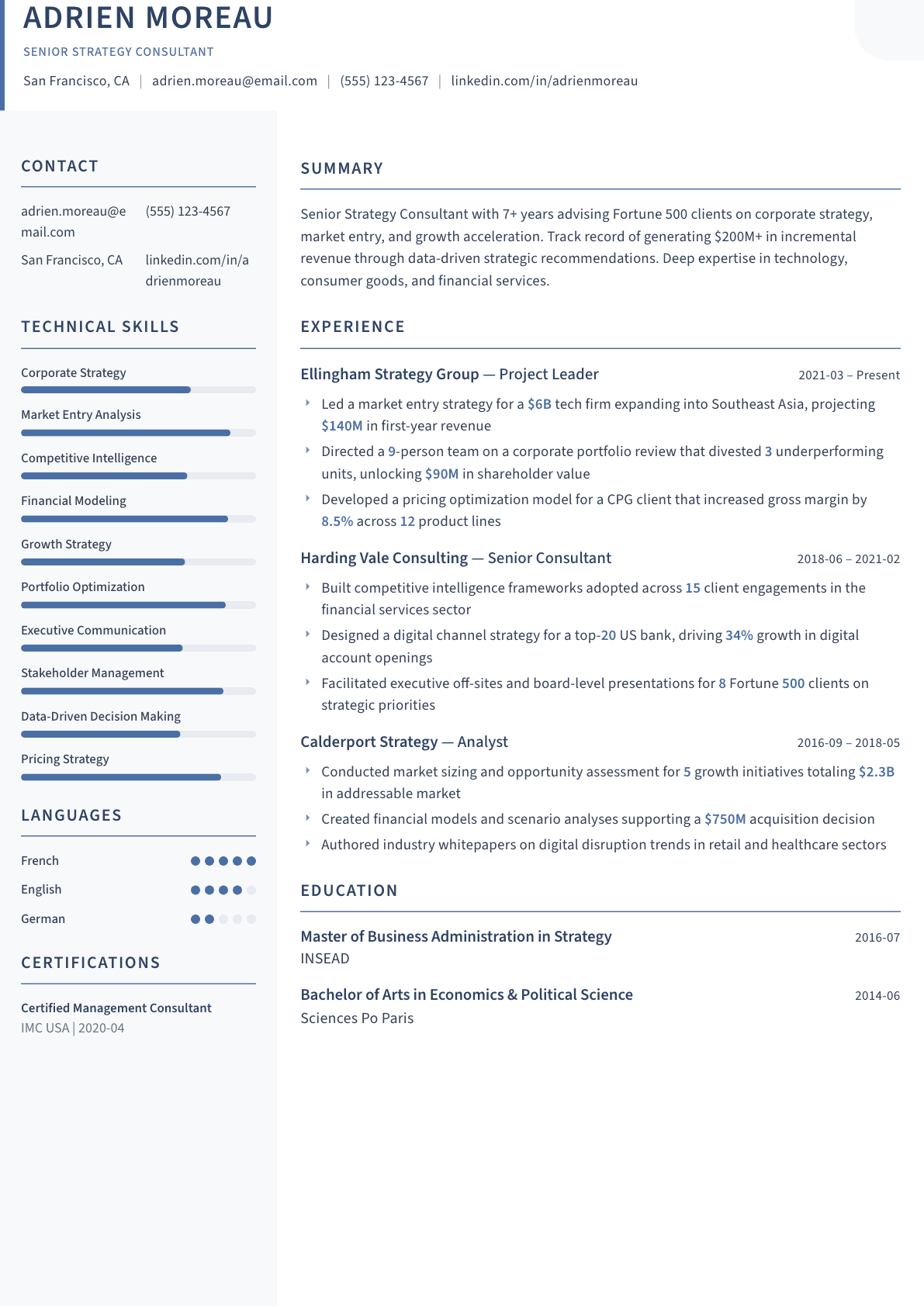
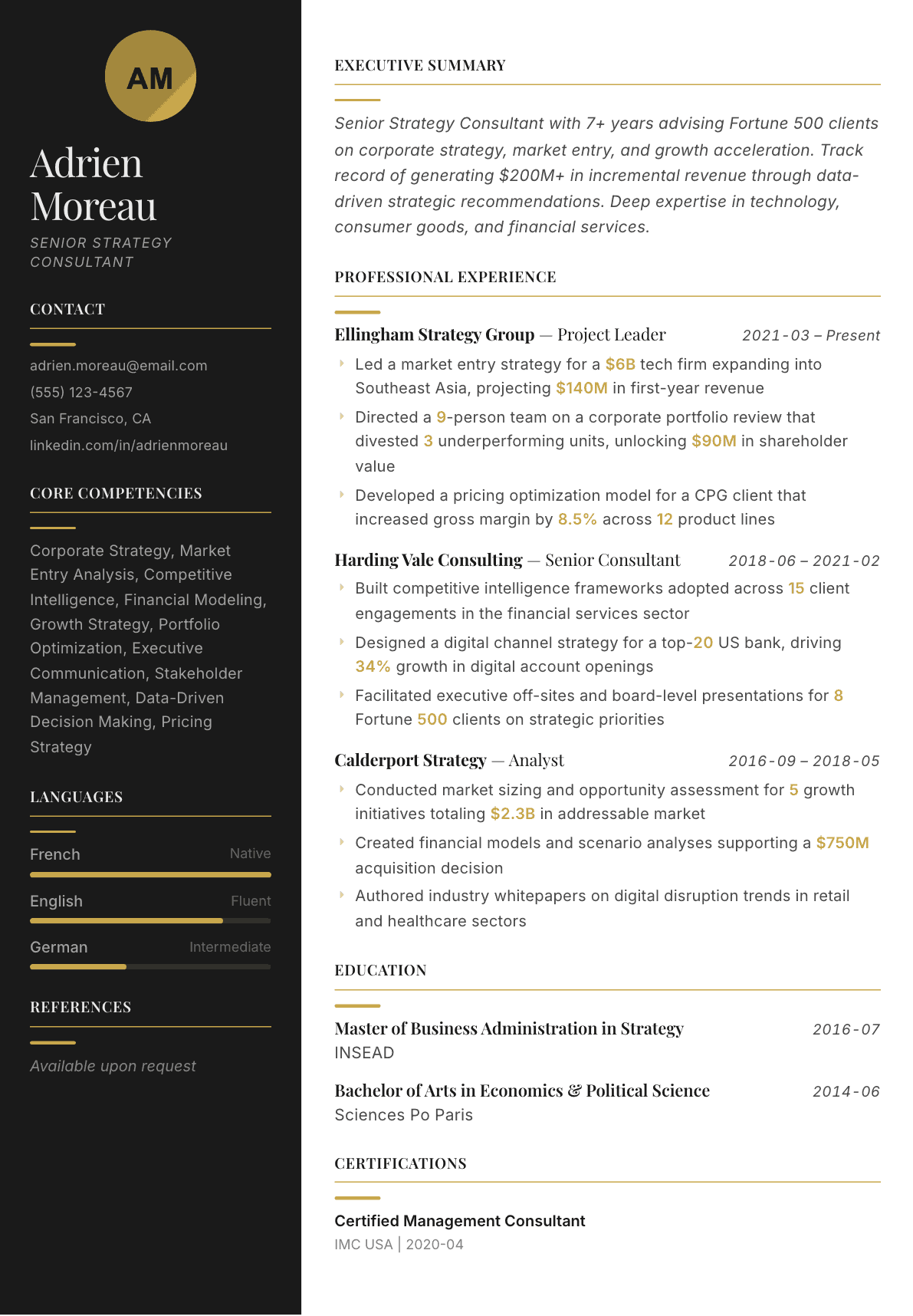
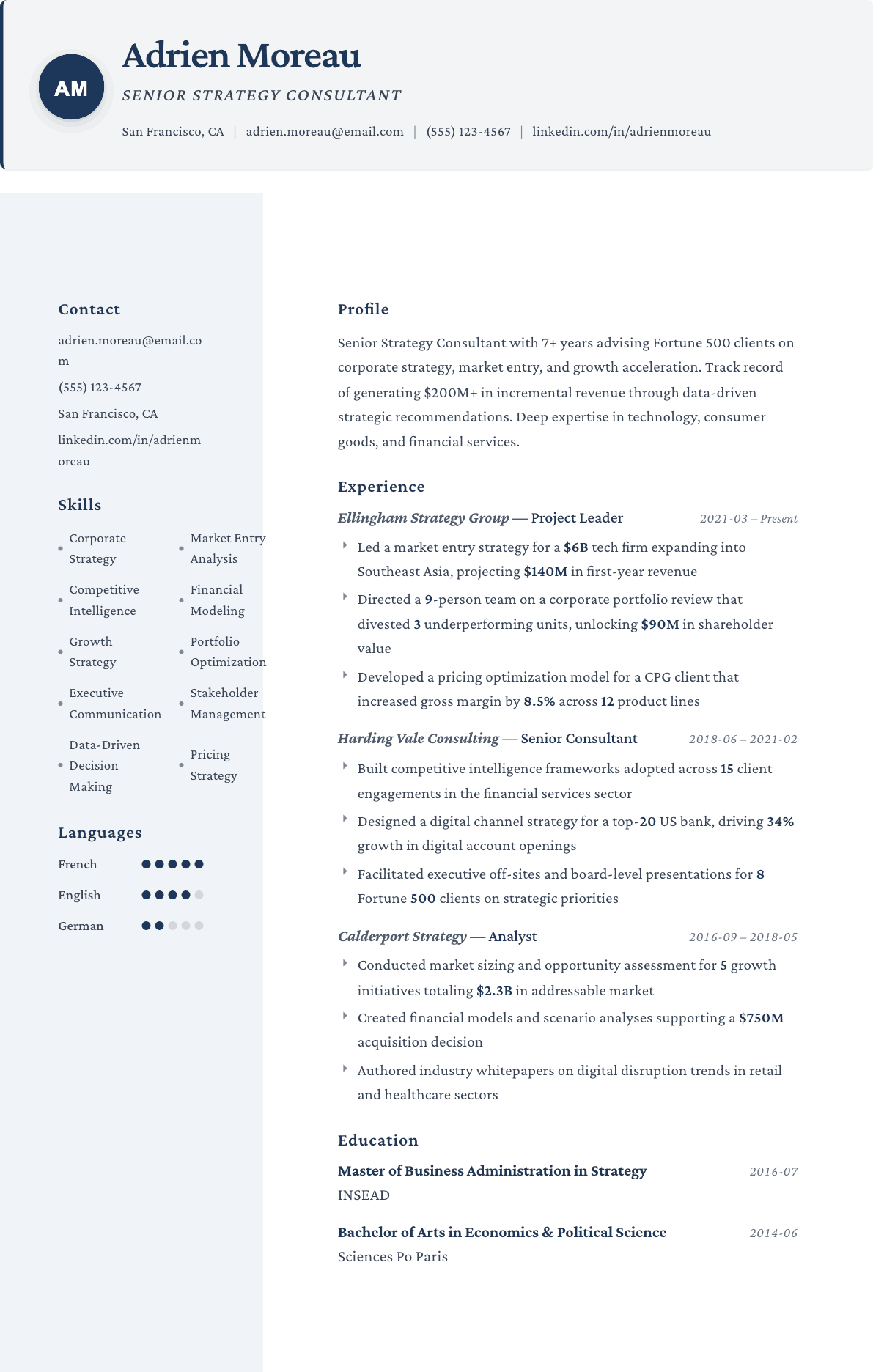
Example Strategy Consultant summary
Strategy consultant, 7 years, currently a project leader running teams of up to nine on market entry, portfolio and pricing work. Recent cases include a Southeast Asia entry plan for a technology client and a portfolio review that divested three units, and the pricing model built for a consumer goods client added 8.5 points of gross margin across 12 lines.
Skills to list on a Strategy Consultant resume
- Corporate Strategy
- Market Entry
- Growth Strategy
- Competitive Analysis
- Financial Modeling
- Portfolio Optimization
- Pricing Strategy
- M&A Advisory
- Due Diligence
- Stakeholder Management
- Executive Presentations
- Data Analytics
What actually gets this resume read
- Write each engagement as a case line: the client question, the analysis you owned, the recommendation, and whether the client acted on it.
- Separate what you modeled from what the client realized, since a screener will discount a number you cannot defend in a case interview.
- Give the engagement shape: weeks on the ground, team size, whether you were on the workplan or writing it, and how much of the client contact was yours.
- Group the page by sector so a staffing partner can see where you are billable on day one, and name the practice area you want to be staffed in.
- Name the analytical tools you actually built with, whether market sizing models, conjoint studies, price elasticity work or diligence data rooms.
- One page for pre-MBA roles, two at the most for experienced hires, with the education block at the top while the school is still your strongest signal.
How to write a strategy consultant resume
Strategy consulting resumes are read for a single quality that is hard to fake on paper: the ability to reach a defensible answer on a question nobody has settled. Recruiters and staffing partners see thousands of files that describe analysis. The ones that get interviews describe a recommendation, the evidence behind it, and what the client decided as a result.
Structure carries most of that signal. A strategy file is dense with numbers per line, ruthless about ordering, and free of the padding that fills a general business resume. When a screener reads three bullets and can reconstruct the question, the approach and the answer, they have their evidence for structured thinking before you ever sit a case.
This guide covers the layout firms and in house strategy teams expect, how to write about market work, growth and diligence without breaching client confidence, summaries for an analyst, a consultant and a project leader, and the questions people ask when moving into strategy from industry or out of consulting into a corporate strategy team.
Format: one page, education visible, no design flourishes
One page is the norm through project leader level. Keep education prominent for the first several years, including degree classification, standardized test results where they are strong, and scholarships or academic prizes, because strategy recruiting still screens on academic signal. Add a leadership block for anything you founded, led or captained, since firms read it as evidence of drive rather than as filler.
Keep the design plain. Files circulate as attachments through recruiting teams and are read on screens of different sizes, and anything with a sidebar, a photograph or a skills bar chart reads as a mismatch with the profession. Consistent dates, consistent tense and consistent number formatting do more for you than any layout choice.
- Education: institution, degree, dates, classification, awards, relevant coursework only when very early.
- Experience: firm, office, title, dates, then a scope line and three or four dense bullets.
- Leadership: societies led, ventures started, teams captained, volunteering with responsibility.
- Additional: languages, analytical tools, and one line of genuine interests.
Write the question, the approach and the answer
The most effective bullet structure in strategy is compressed: the client question, what you did to answer it, and the recommendation with its consequence. Sizing a new market, testing a pricing change, deciding whether to enter a country, choosing which units to divest, or judging whether a target could deliver its plan are all questions that read instantly. Attach your analysis to the question rather than describing it in isolation.
Show the evidence base. Strategy work is judged on the quality of the inputs: the customer survey you designed and its sample, the expert interviews you ran, the transaction data you obtained, the plant tours you took, the competitor teardown you assembled. A recommendation with a described evidence base is credible. One without reads as an opinion with slides.
Confidentiality without vagueness
Do not name clients. Describe them by industry, size class and geography instead, and give enough of the situation for the reader to see the difficulty: a family owned building products manufacturer facing import competition, a subscription media business losing customers after a price rise, a payments provider deciding between two acquisition targets.
Handle numbers the same way. Percentage movements against a baseline you describe, counts of products, stores, markets or customers, and orders of magnitude in words all convey scale without disclosing client financials. Screeners in this profession write these bullets themselves and will read the convention correctly.
The analytical toolkit, stated at the level you actually use it
Name the tools with which you personally do the work. Building a driver based model in a spreadsheet, running a conjoint or pricing survey, querying a client transaction table, cleaning data in a preparation tool, and building the visual layer for a client dashboard are separate capabilities, and being clear about which you own is more persuasive than a long list.
Add sector depth if you have it. Strategy teams staff by industry as much as by capability, and a candidate who has done three engagements in industrial distribution is more valuable to a firm building that practice than a broader generalist. Group your experience by sector when the pattern is there, and say plainly what the sector taught you.
Keywords, and the difference between firm and in house roles
Recurring language includes corporate strategy, growth strategy, market entry, market sizing, competitive benchmarking, pricing strategy, portfolio review, commercial due diligence, business case development and executive communication. Use each once, attached to work you did.
Then adjust for the destination. A consulting firm reads for engagement variety, client handling and pace. An in house corporate strategy team reads for the ability to live with a recommendation: annual planning cycles, business partnering with unit leaders, tracking a strategy through implementation, and board paper writing. A file optimized for one reads thin to the other, so decide which you are applying to and lead accordingly.
Strategy Consultant resume summary examples
Strategy analyst
Strategy analyst with two years at a mid sized firm serving consumer and industrial clients. Sized an addressable market across four European countries using trade data and 26 expert interviews, and built the pricing sensitivity model that shaped a client decision to hold list price during an input cost rise.
Consultant, five years in
Strategy consultant with five years across growth and portfolio work in subscription media and payments. Led the customer research workstream on a churn diagnostic covering 3,200 survey responses, and recommended a segment specific retention offer the client rolled out to two markets.
Project leader
Project leader with nine years in strategy, running teams of four to six on growth and commercial due diligence engagements. Delivered market entry recommendations in three countries for an industrial distributor, two of which were executed, and built the firm sector view on aftermarket parts distribution.
Work experience bullets: before and after
Before: Conducted market research for a client entering a new market.
After: Sized the addressable market for a specialty coatings producer across four European countries using customs trade data and 26 distributor interviews, and recommended entering two of the four on channel access rather than market size.
The evidence sources and a recommendation that contradicts the obvious criterion demonstrate judgment, not just research.
Before: Analyzed customer churn for a subscription business.
After: Diagnosed churn for a subscription media client using 3,200 survey responses and eighteen months of behavioral data, isolated a single price tier as the driver, and designed a retention offer targeted at that cohort alone.
Naming the data volumes and the narrow cause shows a diagnosis that ended somewhere specific.
Before: Built financial models to support strategic recommendations.
After: Built a driver based model for a portfolio review covering nine business units, testing divestment and reinvestment cases across three scenarios, and presented the two units the analysis favored keeping against management expectation.
Scope, scenario count and an uncomfortable conclusion make the model consequential rather than decorative.
Before: Presented recommendations to senior client stakeholders.
After: Presented the pricing recommendation to the client executive committee, defended the elasticity assumption against the commercial director, and secured approval to pilot in two regions before a full rollout.
Naming the challenge you faced and the outcome shows a recommendation surviving contact with the client.
Before: Supported commercial due diligence for an investor.
After: Ran the customer workstream on a commercial due diligence for a mid market software target, completing 22 customer references in three weeks and identifying a renewal concentration the sponsor reflected in its offer.
The reference count, the timeline and the effect on the deal show diligence work that changed a decision.
Hard skills
- Market sizing and segmentation
- Growth strategy development
- Competitive benchmarking
- Pricing and elasticity analysis
- Portfolio and divestment review
- Commercial due diligence
- Customer research and survey design
- Expert and executive interviewing
- Driver based financial modeling
- Business case development
- Scenario planning
- Executive storyline construction
- SQL and data preparation tools
Soft skills
- Structured reasoning under time pressure
- Defending a recommendation
- Synthesis from messy inputs
- Interviewing senior executives
- Collaborating with client teams that resist the answer
Certifications worth listing
- Chartered Financial Analyst (CFA) (CFA Institute)
- Certified Management Consultant (CMC) (Institute of Management Consultants USA)
Mistakes that cost strategy consultant candidates the interview
- Describing analysis with no recommendation attached, which leaves a screener unable to judge your thinking.
- Padding the page with responsibilities when this profession reads density of evidence as a proxy for rigor.
- Naming the client, which signals to a partner that you would do the same with their accounts.
- Dropping education, classification and awards too early in a career where they are still screened on.
- Using a designed template with sidebars or charts that marks the file as outside the profession.
- Sending a firm oriented file to an in house strategy team that hires for planning cycles and implementation follow through.
Strategy Consultant resume questions
How is a strategy consultant resume different from a general business resume?
It is denser and more decisive. Every bullet carries a question, an approach and an answer, numbers appear on most lines, and responsibilities are cut entirely. A general business resume describes a role, while a strategy file has to demonstrate reasoning within the space of a single page.
Do I need an MBA to work in strategy consulting?
It is one common entry route, particularly for post degree associate intakes, but it is not the only one. Firms hire experienced professionals for sector expertise and analysts directly from undergraduate programs. If you lack the degree, make the sector depth and the recommendation quality unmissable.
How do I move from strategy consulting into a corporate strategy team?
Emphasize continuity rather than variety. Show engagements where you stayed through implementation, worked with the same client across phases, or built something the organization kept using. In house teams worry that consultants leave once the recommendation lands, so answer that concern directly.
What should I put on a strategy resume if I have no consulting experience?
Find the decisions in your current work. A pricing change you analyzed, a market you assessed, a supplier or product choice you argued for with evidence, a business case you wrote. Then present them in the same question, approach and answer form so the reasoning pattern is visible.
Should I include a case study or project section?
A short selected engagements block works well for candidates from industry or from a firm whose employer name means little abroad. Give three engagements, each two lines, with the client described generically, the question, and the outcome. Keep it above earlier roles so it is read first.
Related resume examples
- Management Consultant Resume example
- Business Analyst Resume example
- Strategy Director Resume example
- Consultant Resume example
- MBA Graduate Resume example
- Business Consultant Resume example