Business Analyst Resume Examples: the lines they read
Build a Business Analyst Resume That Bridges Strategy and Execution
By Mustafa Tarabya, founder of CVBooster · Published · Updated
Create a sharp business analyst resume with requirements gathering skills, process improvements, and data analysis expertise.
Sample resumes for a business analyst
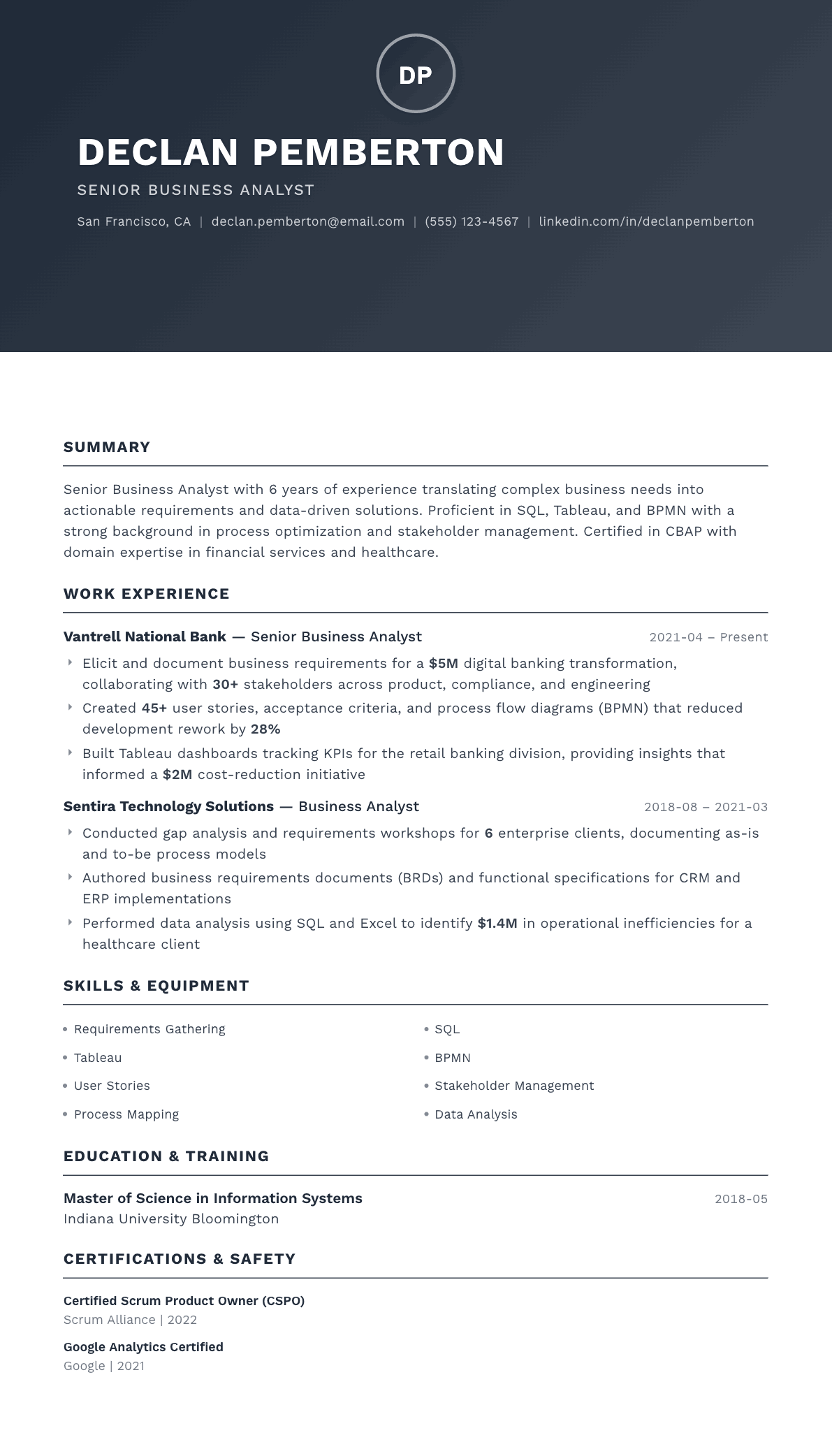
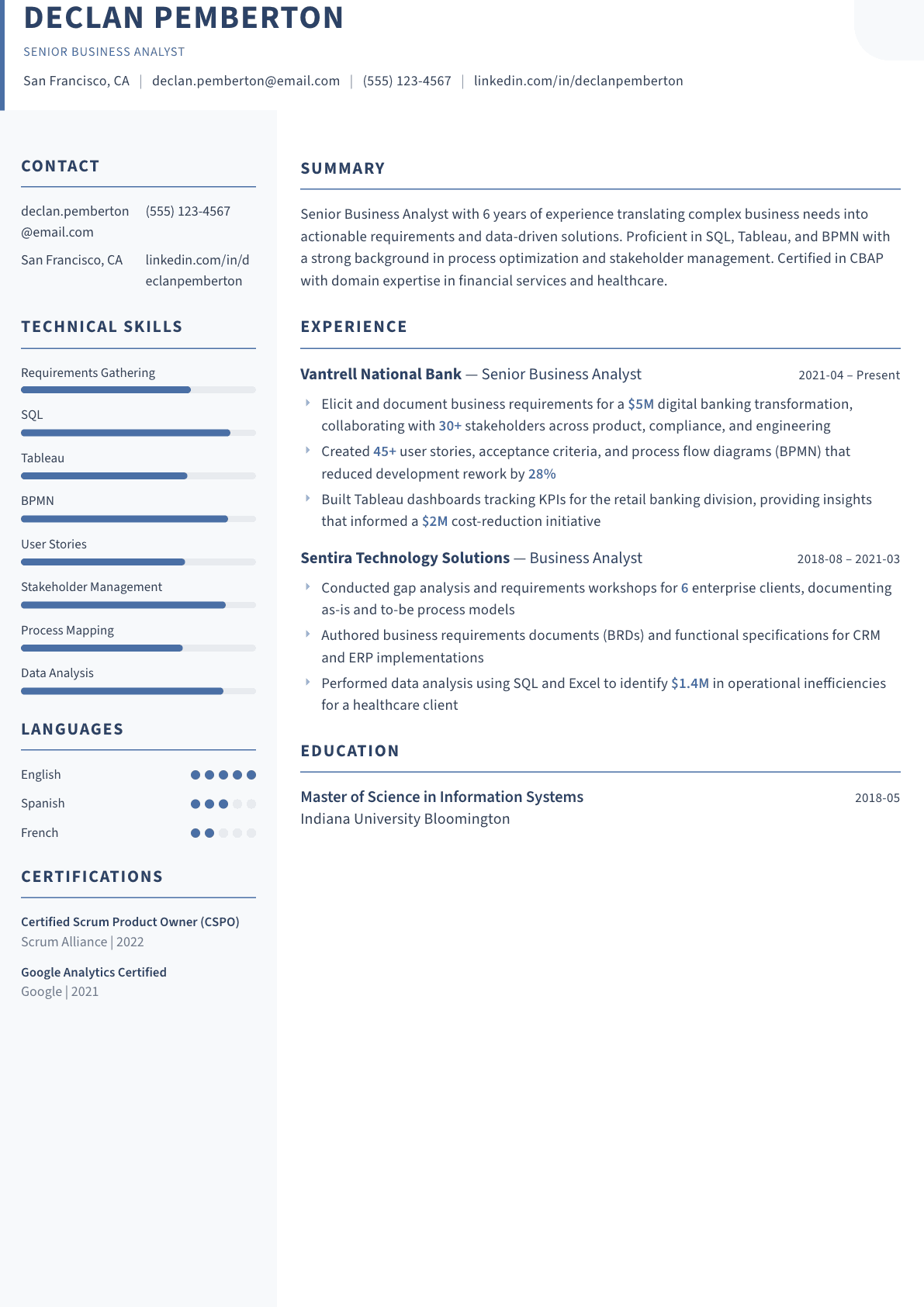
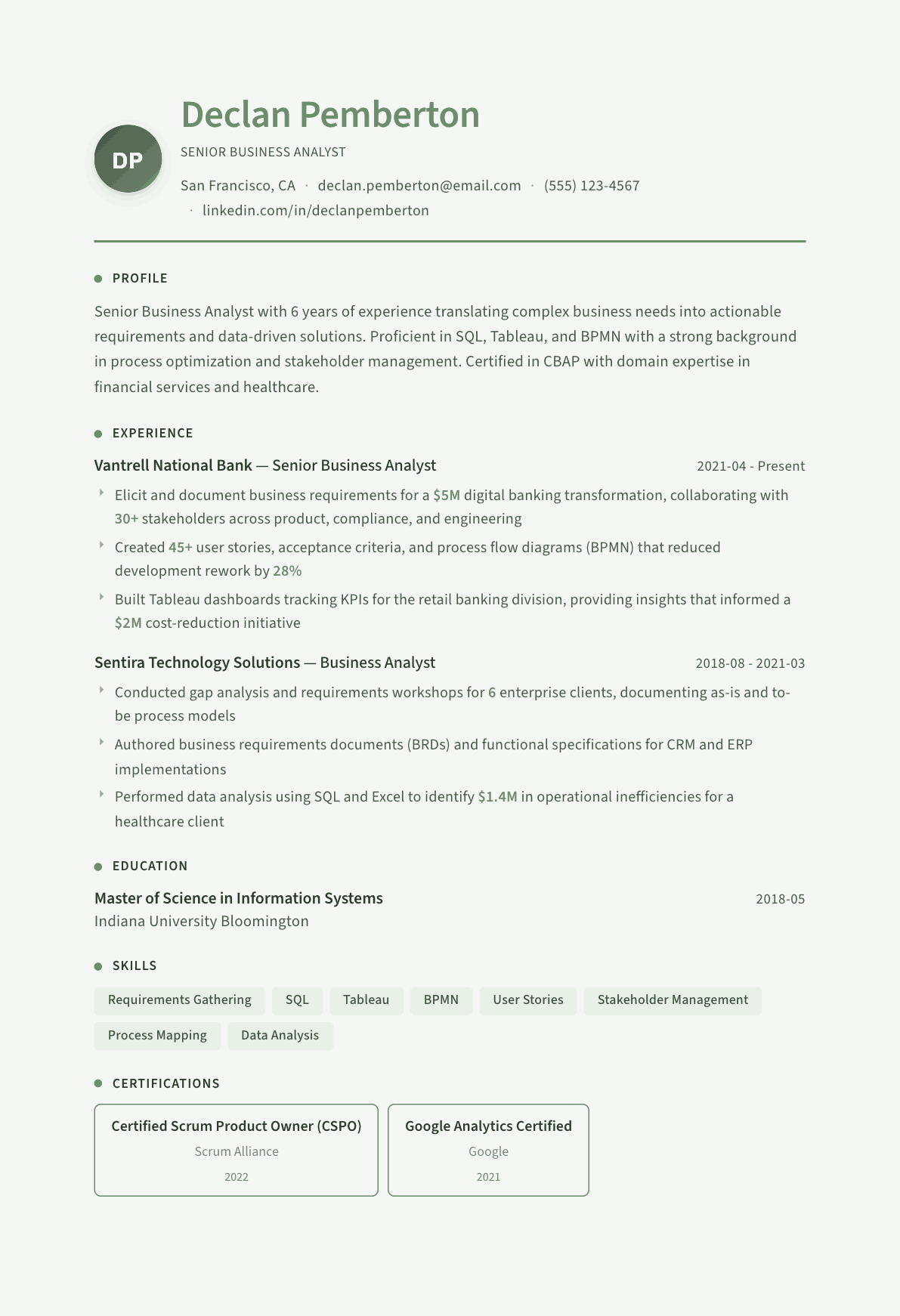
The same business analyst content laid out in three CVBooster templates, so you can see what the finished document looks like before you write a word.
Example Business Analyst summary
CBAP certified business analyst, 6 years in financial services and healthcare, currently on a $5M digital banking program with 30 stakeholders across product, compliance and engineering. Writes the user stories, acceptance criteria and BPMN flows that cut development rework 28%, and builds the Tableau reporting that framed a $2M cost reduction.
Skills to list on a Business Analyst resume
- Requirements Gathering
- SQL
- Tableau
- Power BI
- BPMN
- User Stories
- Use Cases
- Stakeholder Management
- Process Mapping
- Data Analysis
- Gap Analysis
- UAT Coordination
- Agile / Scrum
- JIRA / Confluence
- Business Requirements Documents
What actually gets this resume read
- Highlight the types of documents you produce: BRDs, FRDs, user stories, use cases, data flow diagrams, and wireframes.
- Quantify process improvements: time saved, cost reduced, error rates decreased, or cycle times shortened.
- Name the methodologies you work in: Agile, Scrum, Waterfall, or SAFe.
- Showcase data analysis skills with specific tools: SQL, Excel (pivot tables, VLOOKUP), Tableau, Power BI.
- Mention certifications prominently: CBAP, CCBA, PMI-PBA, or Six Sigma.
- Demonstrate domain expertise by calling out industries you have worked in (finance, healthcare, retail, manufacturing).
How to write a business analyst resume
Business analyst is one of the most inconsistently defined titles on the market. At one company it means requirements elicitation and documentation on a large system implementation. At another it means writing SQL and building dashboards. At a third it sits inside a product team writing user stories and running acceptance. The screener knows which version they are hiring for, and your resume has to answer that question inside the first three lines.
The second thing a hiring manager checks is artifacts. Analysts are judged by what they produce: requirements documents, process models, user stories with acceptance criteria, traceability matrices, data models, test plans, dashboards. Naming the artifacts you have personally authored is faster and more convincing than any description of collaboration.
This guide covers how to declare which kind of analyst you are, how to write about elicitation and process work so it survives a technical interview, which tools and certifications actually get filtered on, and the questions analysts ask when they move between domains or into product ownership.
Format: one page under five years, two after, artifacts visible
Reverse chronological, one clean column, standard section names. Requirements roles in banking, insurance and health care are almost always filtered by software first, so avoid tables and text boxes that break parsing and put your tools in a plain list.
Give every engagement a context line: the industry, the system or program, the methodology and where you sat. Analyst on a core banking migration, working inside a Scrum team of 9, is a completely different job from analyst supporting a finance transformation with a waterfall stage gate, and the reader needs to know which one before they read a bullet.
- Header: name, city, phone, email, professional profile link.
- Sections: summary, skills and tools, experience, certifications, education.
- Put the tools block above experience when you are applying to data-heavy analyst roles.
Summary: which kind of analyst, which domain, which stack
Three lines. State the flavor of analysis you do, the domain you know, the delivery method you work in, and the two or three tools you are strongest in. Domain knowledge is the single most valuable thing on a business analyst resume, because a payments analyst who understands settlement, chargebacks and reconciliation is worth more than a generalist who learns it in month four.
Do not write that you bridge the gap between business and technology. Every analyst resume says it, it names nothing, and it costs you the most valuable line on the page.
Experience: elicitation, artifacts, decisions and what changed
Start with the elicitation work and be concrete about method: stakeholder interviews, requirements workshops, job shadowing, document analysis, and how many people or functions were in scope. A reader who can picture the room believes the rest.
Then the artifacts, by name and by count: business requirements documents, functional specifications, process models in a standard notation, user stories with acceptance criteria, data mappings, traceability matrices, and test scripts for user acceptance testing. Numbers here are honest and easy to remember, and they hold up when the interviewer asks you to walk through one.
Finish each job with the outcome the analysis produced: a process cycle time that fell, rework that dropped because acceptance criteria were sharper, a manual reconciliation that disappeared, a report that replaced a spreadsheet nobody trusted. Analysts often skip this because the developer built the thing, but the decision to build the right thing is your contribution and it is measurable.
- Program context: system, industry, budget scale, team shape and methodology.
- Elicitation: workshops run, stakeholders interviewed, functions and geographies in scope.
- Artifacts authored, with counts and the standard you used.
- Data work: queries written, models built, reports and dashboards delivered.
- Outcome: cycle time, defect or rework reduction, manual effort removed, adoption of the new process.
Tools and techniques: name them the way a posting does
Split the list so a reader can scan it. Analysis and modeling techniques on one line, such as process mapping, gap analysis, root cause analysis, use cases, user stories, decision tables and data flow diagrams. Then the platforms: the backlog and documentation tools, the query language and database, the reporting tool, the diagramming tool and any test management system.
Be honest about depth on the data side, because it is the easiest claim to test. If you write intermediate joins, aggregation and window functions, expect to write one in the interview. If your querying is limited to reading someone else's views, say you work from curated data sets and lead with your requirements strength instead.
Certifications and education: what the filter looks for
The business analysis credentials come from two bodies and they are tiered by experience, so put the level you actually hold rather than the family name. Agile roles often ask for a Scrum credential as well, and analysts working on process improvement frequently carry a Lean Six Sigma belt. Any of these can be a hard filter in large organizations, so list them near the top if you have them.
Degrees are secondary here. A computer science, information systems, finance or engineering background helps, but domain experience and a portfolio of artifacts outweigh the subject you studied. If you moved into analysis from the business side, say what you did before, because an analyst who used the process before documenting it is a genuine advantage.
Business Analyst resume summary examples
Junior business analyst
Business analyst with 2 years supporting a claims processing platform, authoring user stories and acceptance criteria for a Scrum team of 8. Runs requirements workshops with claims handlers, writes SQL for reconciliation checks, and maintains the process models for 4 core workflows.
Five years in
Business analyst with 5 years in payments, working across core banking and card processing. Authored 30 business requirements documents and mapped 60 as-is and to-be processes for a settlement platform migration, and cut post-release defects by 24% by tightening acceptance criteria with QA.
Lead business analyst
Lead business analyst on enterprise programs, running the analysis workstream across 3 delivery teams and mentoring 6 analysts. Owns requirements governance and the traceability matrix, chairs the change control board, and works directly with product and vendor teams through user acceptance testing.
Work experience bullets: before and after
Before: Gathered requirements from stakeholders for various projects.
After: Ran 18 requirements workshops with claims, underwriting and finance across 3 regions, producing a signed-off requirements set for a policy administration replacement.
Workshop count, the functions in the room and the signed artifact turn a generic duty into verifiable delivery.
Before: Wrote documentation for the development team.
After: Authored 30 business requirements documents and 140 user stories with acceptance criteria, maintaining a traceability matrix from requirement through test case to release.
Naming the artifacts and the traceability chain proves rigor rather than volume of writing.
Before: Analyzed data to support business decisions.
After: Wrote SQL against the transaction warehouse to quantify a manual reconciliation backlog, and built a Power BI view that replaced a weekly spreadsheet used by 4 operations teams.
The query, the question it answered and the artifact it replaced show analysis with a consequence.
Before: Improved business processes.
After: Mapped the order to cash process end to end, removed 2 approval steps that added no control, and cut average cycle time from 9 days to 5.
A named process, the specific change and a before and after number make the improvement checkable.
Before: Supported user acceptance testing.
After: Wrote 90 acceptance test scripts, coordinated 22 business testers through 3 test cycles, and triaged defects daily with the vendor to clear the go-live criteria.
Scripts, testers and cycles describe the coordination work that user acceptance testing actually is.
Hard skills
- Requirements elicitation
- Business requirements documents
- User stories and acceptance criteria
- Process modeling in BPMN
- Gap and as-is to-be analysis
- Requirements traceability
- SQL
- Data mapping and data dictionaries
- Power BI and Tableau reporting
- User acceptance test planning
- Jira and Confluence
- Use cases and decision tables
- Change control and impact assessment
Soft skills
- Workshop facilitation
- Questioning to find the real requirement
- Written precision
- Negotiating scope with stakeholders
- Working between business and engineering
- Handling conflicting priorities
Certifications worth listing
- Entry Certificate in Business Analysis (ECBA) (International Institute of Business Analysis)
- Certification of Capability in Business Analysis (CCBA) (International Institute of Business Analysis)
- Certified Business Analysis Professional (CBAP) (International Institute of Business Analysis)
- PMI Professional in Business Analysis (PMI-PBA) (Project Management Institute)
- Certified ScrumMaster (CSM) (Scrum Alliance)
Mistakes that cost business analyst candidates the interview
- Writing that you bridge business and technology, a sentence that appears on nearly every analyst resume and identifies nothing about you.
- Never naming the artifacts you authored, which leaves the reader unable to tell a documentation analyst from a data analyst.
- Claiming advanced SQL when your querying stops at simple selects, since this is the one skill an interviewer will test in the room.
- Leaving out the domain, when domain knowledge is the strongest differentiator on this particular resume.
- Describing the project outcome as if you built it, rather than the analysis decision that made the build correct.
- Listing every methodology you have heard of instead of the one you delivered in, which reads as unfamiliarity with all of them.
- Burying the business analysis certification at the bottom when large employers filter on it directly.
Business Analyst resume questions
What is the difference between a business analyst and a data analyst resume?
A business analyst resume leads with elicitation, requirements artifacts and process change, with data as supporting evidence. A data analyst resume leads with data modeling, querying, statistics and visualization. If you genuinely do both, write two versions and send whichever matches the posting.
Do I need a business analysis certification to get hired?
Not usually, but it helps you pass automated screening at large employers, and some public sector and banking postings treat it as a requirement. The tiers are matched to experience, so pick the level you qualify for rather than aiming at the senior credential too early.
How do I show business analyst experience if my title was something else?
Many analysts start as operations, support or subject matter experts. Use the title you held, then write bullets around the analyst work you did: documenting the process, defining requirements for a system change, testing it and training the users. Domain depth from that period is a selling point.
Should I list the projects I worked on separately?
Only if your work is contract or consulting based and the projects vary widely. In that case a short project block with the client type, the system, your role and the artifacts you produced reads better than trying to compress six engagements into a single employer entry.
How do I move from business analyst to product owner?
Shift the emphasis from documenting requirements to owning outcomes: backlog prioritization, release decisions, working with users on value rather than specification, and any metric you moved after launch. Keep the elicitation depth, because it is what makes analysts strong product owners in the first place.
Related resume examples
- Product Manager Resume example
- Data Scientist Resume example
- Project Manager Resume example
- Operations Analyst Resume example
- Business Consultant Resume example
- Management Consultant Resume example