Consultant Resume Examples: free ATS score and gap list
Consultant Resume: Examples and How to List Consulting Work
By Mustafa Tarabya, founder of CVBooster · Published · Updated
Consultant resume examples, with how to put consultant work on a resume as an independent, agency placed or side consultant, plus ATS keywords.
Sample resumes for a consultant
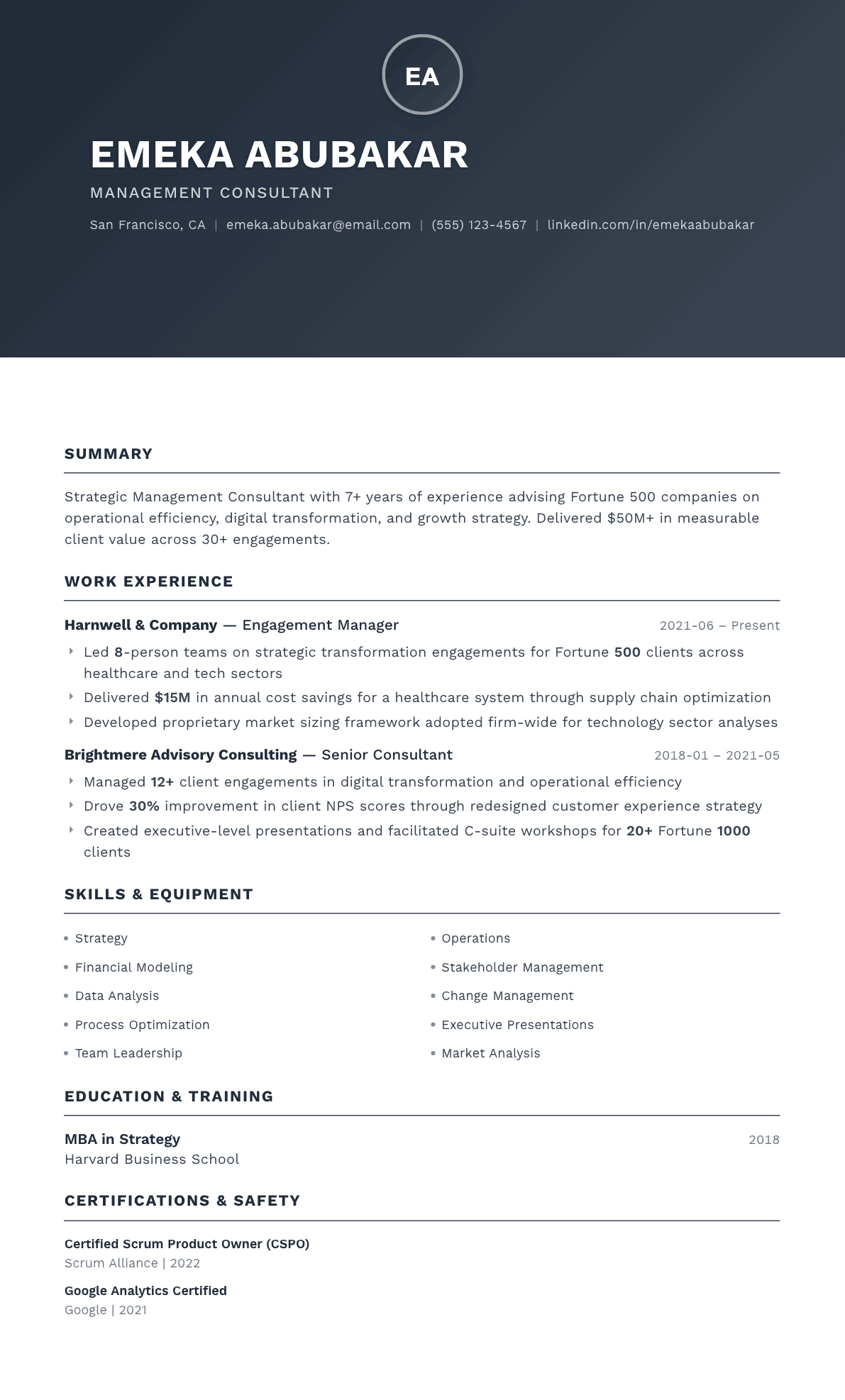
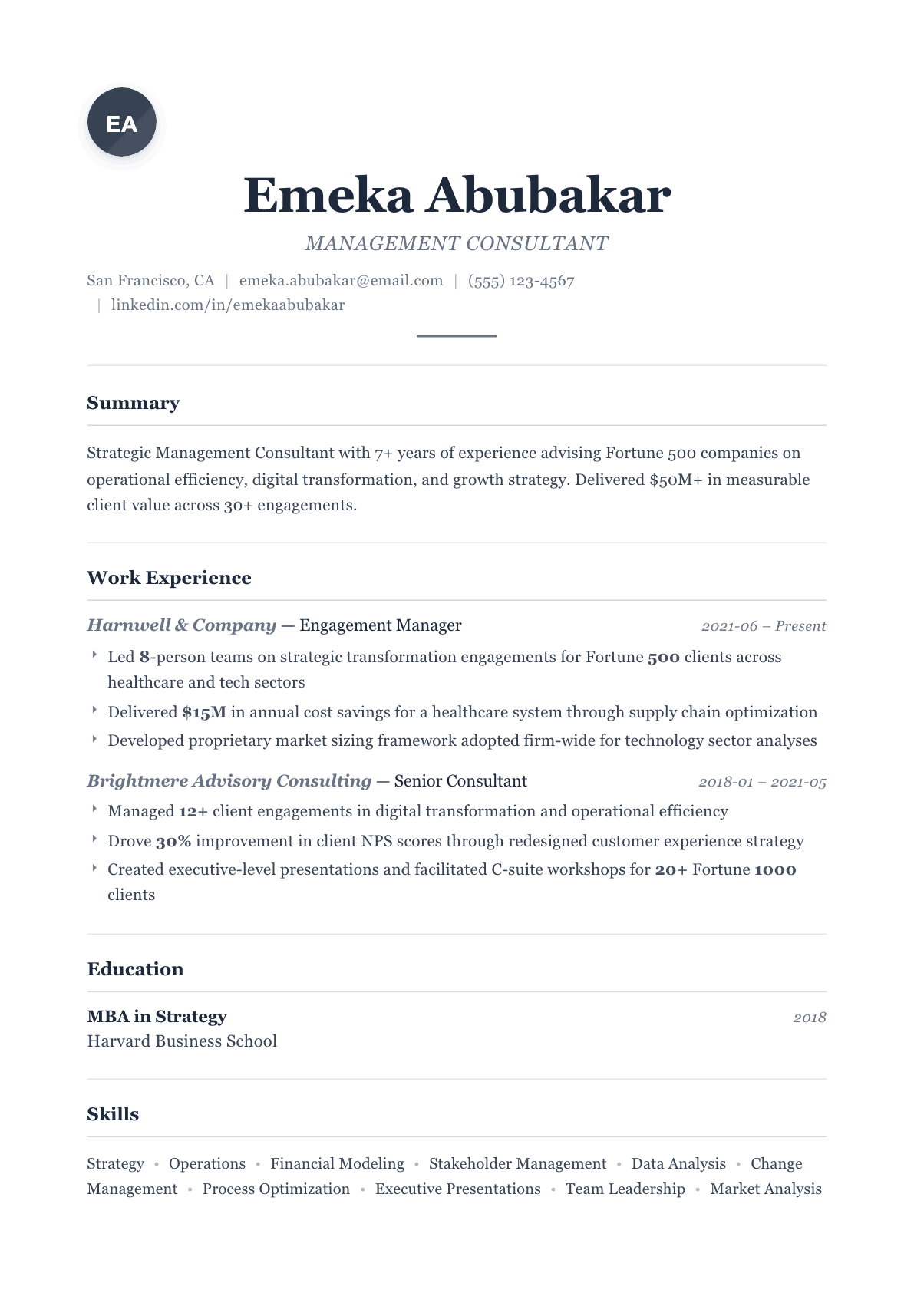
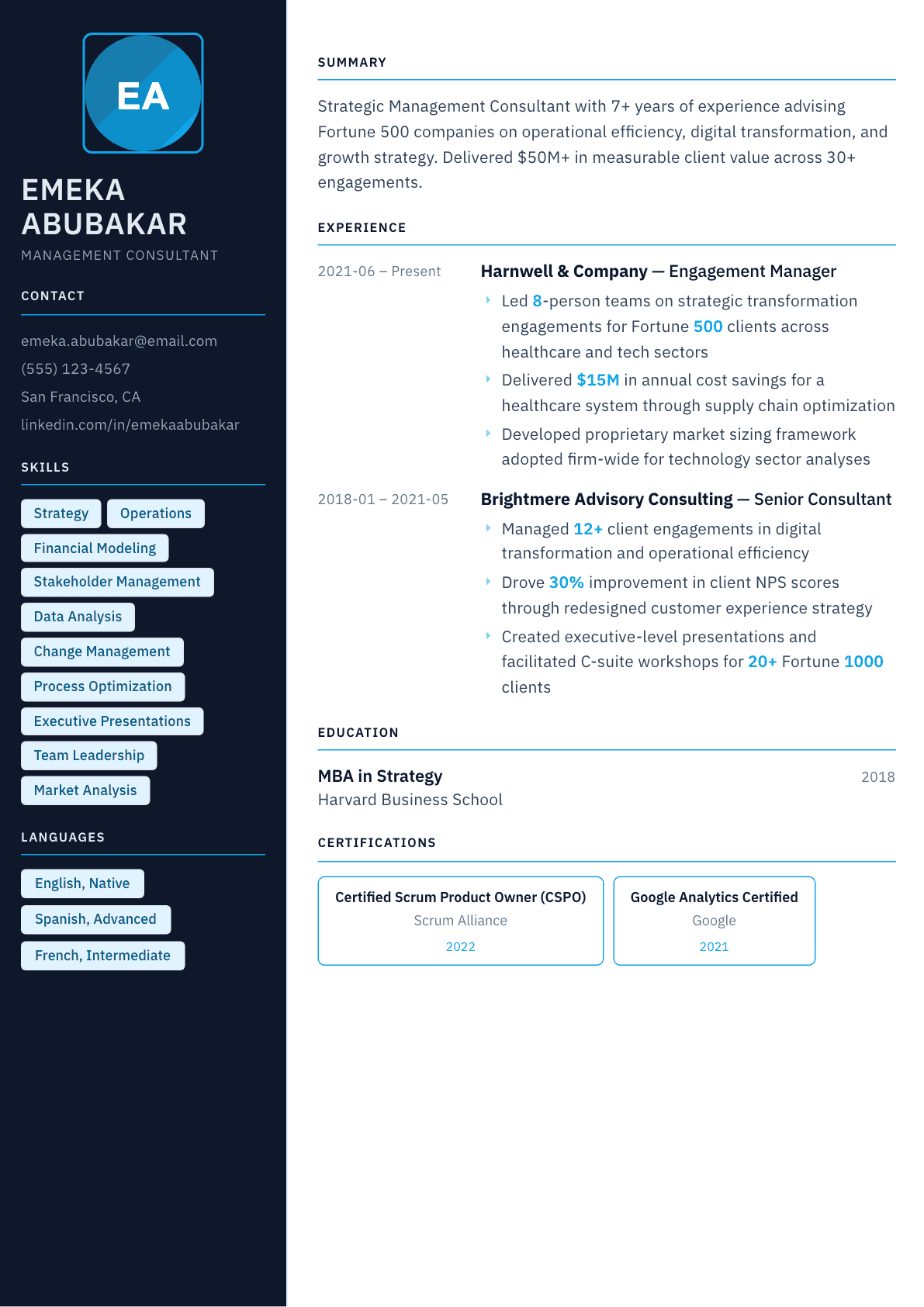
The same consultant content laid out in three CVBooster templates, so you can see what the finished document looks like before you write a word.
Example Consultant summary
Management consultant, 7 years, now an engagement manager running teams of eight on transformation work in healthcare and technology. Delivered $15M of annual savings through a supply chain redesign, built the market sizing framework the firm reuses, and runs C-suite workshops as part of every engagement.
Skills to list on a Consultant resume
- Strategy
- Operations
- Financial Modeling
- Stakeholder Management
- Data Analysis
- Change Management
- Process Optimization
- Executive Presentations
- Team Leadership
- Market Analysis
What actually gets this resume read
- Lead with client impact: revenue growth, cost savings, efficiency gains.
- Name prestigious clients or industries if NDA allows.
- Show progression from analyst to manager to demonstrate leadership growth.
- Include frameworks and methodologies you're experienced with.
- Highlight cross-functional team leadership and stakeholder management.
How to write a consultant resume
Management consulting recruiters screen faster than almost anyone else, partly because they receive so many applications and partly because the profession has a shared format they expect to see. A consulting resume is read for four signals in a fixed order: the caliber of the environments you have worked in, the analytical evidence, the leadership trajectory, and whether the writing itself is structured. That last point is not vanity. If you cannot organize one page, the reader doubts you can organize a client's problem.
The other thing a partner is assessing is whether you have carried a workstream to a decision. Consultants who describe frameworks applied and analyses run without ever naming the recommendation and what the client did with it look like researchers. The value of the job is the decision at the end, and the resume should keep arriving there.
This guide covers the structure the profession expects, how to describe engagements when clients cannot be named, how to show the shift from analysis to team leadership to selling work, and the questions consultants ask when moving between firms or leaving for industry.
Format: the structure consulting recruiters expect
One page until you are a manager, two after that. Reverse chronological with the firm as the employer and a short engagement list beneath it. Consulting recruiters are used to reading the page as firm, then role, then selected engagements, and deviating from that costs you attention rather than earning it.
Every engagement bullet should follow the same internal logic: the client described by sector and scale, the problem, what you did, and what changed. Keep the same order across every bullet so the reader can move quickly. Consistency of structure is itself part of the audition.
- Header: name, city, phone, email, professional profile link.
- Sections: summary, experience with selected engagements, education, certifications, skills and languages.
- Keep education prominent for the first few years, including any distinction or scholarship.
Summary: practice area, industries, engagement type and level
Three lines. The practice area you sit in, the industries you know, the type of engagement you run, the typical team size and duration you have led, and your level. Strategy, operations, technology, organization and transaction work are distinct hiring pools, and a summary that avoids naming one leaves you competing in all of them.
Industry depth is currency in this profession. A consultant who has done four engagements in industrial manufacturing is worth more to an industrial practice than a generalist with twelve varied ones, so lead with the concentration if you have it.
Experience: the engagement, the analysis, the decision, the result
Describe each significant engagement in a single dense bullet or a short block: the client by sector and scale, the question they were paying to answer, your role and the team shape, the core analysis you personally ran, and the decision or result that followed. Cost transformation, growth strategy, due diligence, operating model design and post-merger integration each have their own accepted evidence, so use the right currency for the work.
Name the analysis honestly and specifically. A market sizing built from three data sources, a cost baseline rebuilt from the general ledger, a customer segmentation from survey and transaction data, an operating model with a role and decision rights map, a diligence model tested against downside cases. These are what a partner interviews on.
Then show the arc of the career. Early roles are about analysis and workstream ownership. Manager roles are about running a team, the client relationship at the working level and the quality of the answer. Principal and partner roles are about selling work, practice building and client ownership. Make the transition visible, because promotion pace is one of the things this profession reads most closely.
- Client described by sector, size and geography where naming is restricted.
- Your role, team size, workstreams owned and engagement duration.
- The specific analysis you ran and the data behind it.
- The recommendation and what the client decided or implemented.
- Firm contribution: recruiting, training, internal assets, proposals and sold work.
Impact claims: how to size them without overstating
Consulting results are almost always joint work and often forecast rather than realized, so state which one you mean. Identified savings, agreed savings and implemented savings are three different claims, and a partner will ask which yours was. Saying it yourself first is a strong signal.
Where absolute figures are confidential, use proportions, ranges and operational measures instead: a share of the cost base addressed, a lead time reduced, a number of sites brought onto a standard process, a decision made by a board. Those travel well and cannot embarrass you or your former client.
Education, credentials and the firm contribution nobody writes down
Academic record carries unusual weight in this profession, particularly for the first several years. Include the degree, the institution and any distinction, and keep it near the top until you have run engagements of your own. Language ability is worth listing where the firm staffs across borders, since it decides which projects you can be placed on.
Then include the contributions that make someone a firm citizen: campus recruiting and interviewing, training you designed or delivered, internal tools or assets you built that other teams reused, and proposals you helped write or win. Partners read this closely, because a consultant who only bills is a smaller asset than one who also builds the practice.
Consultant on a resume: how to list consulting work
Putting consultant on a resume works three ways, and each has its own format. If you consult independently, list your own business or Independent Consultant as the employer, with the dates and the city, and group the clients underneath as one entry rather than a list of short jobs. If an agency or staffing firm placed you, name the agency and the client in the same line. If you consult on the side of a full time job, keep it as a separate entry so the dates stay clear.
The three examples below show how each version reads on the page.
- Example one, independent consultant: Independent Consultant, Operations and Supply Chain, self employed. Six engagements with manufacturers and distributors, each scoped as a fixed project of six to twelve weeks. Clients include a regional food distributor and a contract packaging firm, named with permission.
- Example one, bullet: Redesigned the warehouse slotting for a food distributor after a pick path study, cutting average pick time per order and freeing two aisles for new product lines.
- Example two, placed by an agency: Consultant, Brightline Staffing, placed at a national insurer. Twelve month contract in the claims transformation office, leading the requirements workstream for a new claims intake system.
- Example two, bullet: Ran the requirements workshops with claims, compliance and IT, and wrote the user stories the vendor built the first release from.
- Example three, consulting next to a full time role: Freelance Consultant, evenings and weekends, marketing analytics for small ecommerce brands. Separate entry below the full time Marketing Manager role, with its own dates.
- Example three, bullet: Built a monthly sales and ad spend dashboard for three online retailers and trained each owner to read it.
Consultant resume summary examples
Analyst
Consulting analyst with 2 years on operations and growth engagements in industrial and consumer sectors. Owned the data workstream on 5 projects, building cost baselines and customer segmentations, and presented findings directly to client directors in weekly steering sessions.
Engagement manager
Engagement manager with 6 years in operations consulting, running teams of 4 to 6 on cost transformation and supply chain engagements for industrial clients. Led a program that addressed 18% of a client cost base, and manages the working relationship with client vice presidents day to day.
Principal
Principal in a strategy practice covering industrials and energy, leading multi-workstream engagements with teams of 12 and owning 3 long-standing client relationships. Sold and delivered 9 engagements last year, and built the practice diagnostic now used across the sector team.
Work experience bullets: before and after
Before: Led a cost reduction project for a Fortune 500 client.
After: Led a cost transformation for a national industrial distributor, rebuilding the cost baseline from the general ledger and identifying savings across 4 spend categories, of which the board approved 3 for implementation.
The client type, the analytical method and the board decision show the work and its consequence rather than a label.
Before: Performed market analysis for a client entering a new market.
After: Sized 3 adjacent markets for a specialty chemicals producer using trade data, customer interviews and a bottom-up demand model, and recommended a single entry route the client launched the following quarter.
Naming the data sources and the recommendation adopted turns analysis into a decision the client acted on.
Before: Managed a team of consultants on client engagements.
After: Ran teams of 5 across 3 engagements simultaneously, owning workplans, the weekly steering committee and the quality review, and coached 2 analysts to promotion within the cycle.
Team size, concurrency, the governance you owned and a development outcome describe a manager rather than a senior doer.
Before: Created presentations for senior client stakeholders.
After: Authored the final recommendation document for an operating model redesign and presented it to an executive committee, converting a contested proposal into an approved implementation plan.
The audience and the outcome show persuasion at the level that matters, not slide production.
Before: Contributed to business development activities.
After: Wrote 6 proposals and converted 3 into engagements, and built a diagnostic tool the sector team reused on 8 subsequent pitches.
Proposal count, conversion and a reusable asset are the concrete evidence of commercial contribution.
Hard skills
- Hypothesis-driven problem structuring
- Financial and operating modeling
- Market sizing and demand modeling
- Cost baseline and spend analysis
- Operating model and organization design
- Commercial and operational due diligence
- Process improvement and lean methods
- Benefit case development and tracking
- Executive-level document writing
- Workplan and engagement management
- Client interview and workshop facilitation
- Data analysis and visualization
Soft skills
- Structured thinking under time pressure
- Client relationship building
- Persuading skeptical executives
- Coaching junior consultants
- Working across cultures and time zones
- Delivering an unwelcome answer well
Certifications worth listing
- Certified Management Consultant (CMC) (Institute of Management Consultants USA)
- Project Management Professional (PMP) (Project Management Institute)
- Certified Six Sigma Black Belt (CSSBB) (American Society for Quality)
- Chartered Financial Analyst (CFA) (CFA Institute)
Mistakes that cost consultant candidates the interview
- Describing frameworks applied and analyses performed without ever naming the recommendation or what the client decided.
- Claiming an engagement result as a personal one, when a partner knows the size of the team and will ask what you owned.
- Blurring identified savings with implemented savings, which is the first thing an experienced interviewer probes.
- Naming clients that your engagement terms do not allow, instead of describing them by sector, size and geography.
- Listing every engagement rather than selecting the ones that build a coherent industry or capability story.
- Hiding the promotion history, when pace of progression is one of the strongest signals this profession reads.
- Leaving out firm contribution such as recruiting, training and proposals, which partners treat as evidence of a future leader.
Consultant resume questions
How do I name clients on a consultant resume?
Only where your engagement terms permit it. Otherwise describe the client by sector, size and geography, such as a regional grocery chain with 200 stores. That gives the reader everything they need to judge the complexity of the work without breaching a confidentiality obligation.
Should a consulting resume be one page or two?
One page through the analyst and consultant grades, which is what most firms expect at application. Move to two pages once you are running teams and owning client relationships, and use the extra space for engagements and leadership rather than more detail on early analysis.
How do I show impact when the client never implemented the recommendation?
Describe what was decided rather than what was realized. A board approving a plan, a business case accepted, a pilot authorized or a market entry chosen are all legitimate outcomes. Say plainly that the figure is identified rather than delivered, and the honesty reads as professional maturity.
How do I move from consulting into an industry role?
Translate the language. Replace engagement with project, workstream with team, and client with business unit, then emphasize the implementation you stayed for rather than the analysis you produced. Industry hiring managers worry that consultants leave before the hard part, so answer that worry directly.
How do I list independent consultant work on my resume?
Give it one entry: Independent Consultant or your business name, the dates and the city. Under it, write a one line summary of the practice area and the number of engagements, then bullets for the two or three projects closest to the job. Name clients only with permission; otherwise describe them by industry and size.
Related resume examples
- Business Analyst Resume example
- Project Manager Resume example
- Operations Manager Resume example
- Strategy Consultant Resume example
- Management Consultant Resume example
- Environmental Consultant Resume example