Midwife Resume Examples: free score, then the gap list
Write a Midwife Resume That Proves Your Birth Volume
By Mustafa Tarabya, founder of CVBooster · Published · Updated
Midwife resume examples with birth numbers, licensure wording, prenatal and postpartum keywords, and a full writing guide for hospital and birth center roles.
Sample resumes for a midwife
The same midwife content laid out in three CVBooster templates, so you can see what the finished document looks like before you write a word.
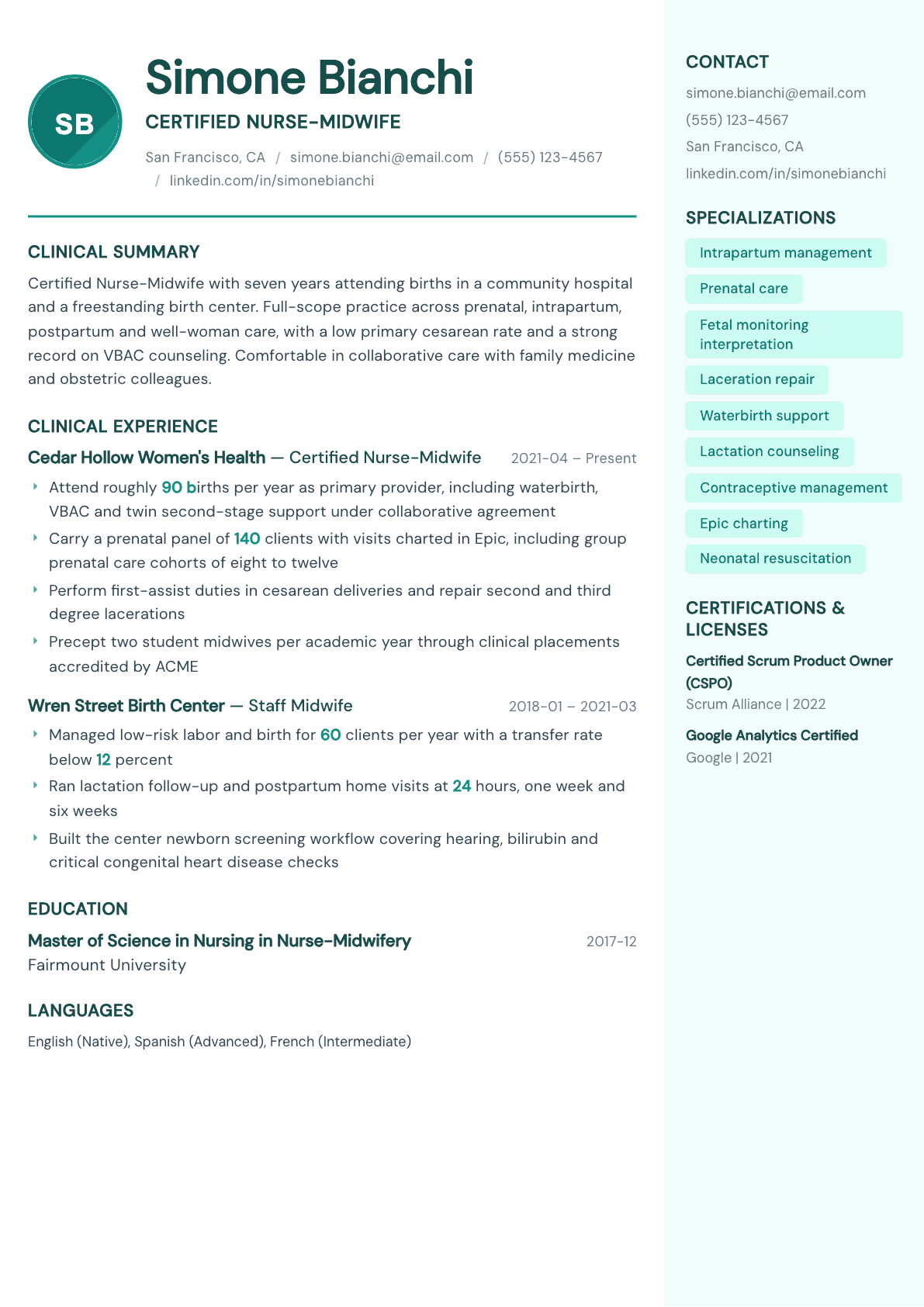
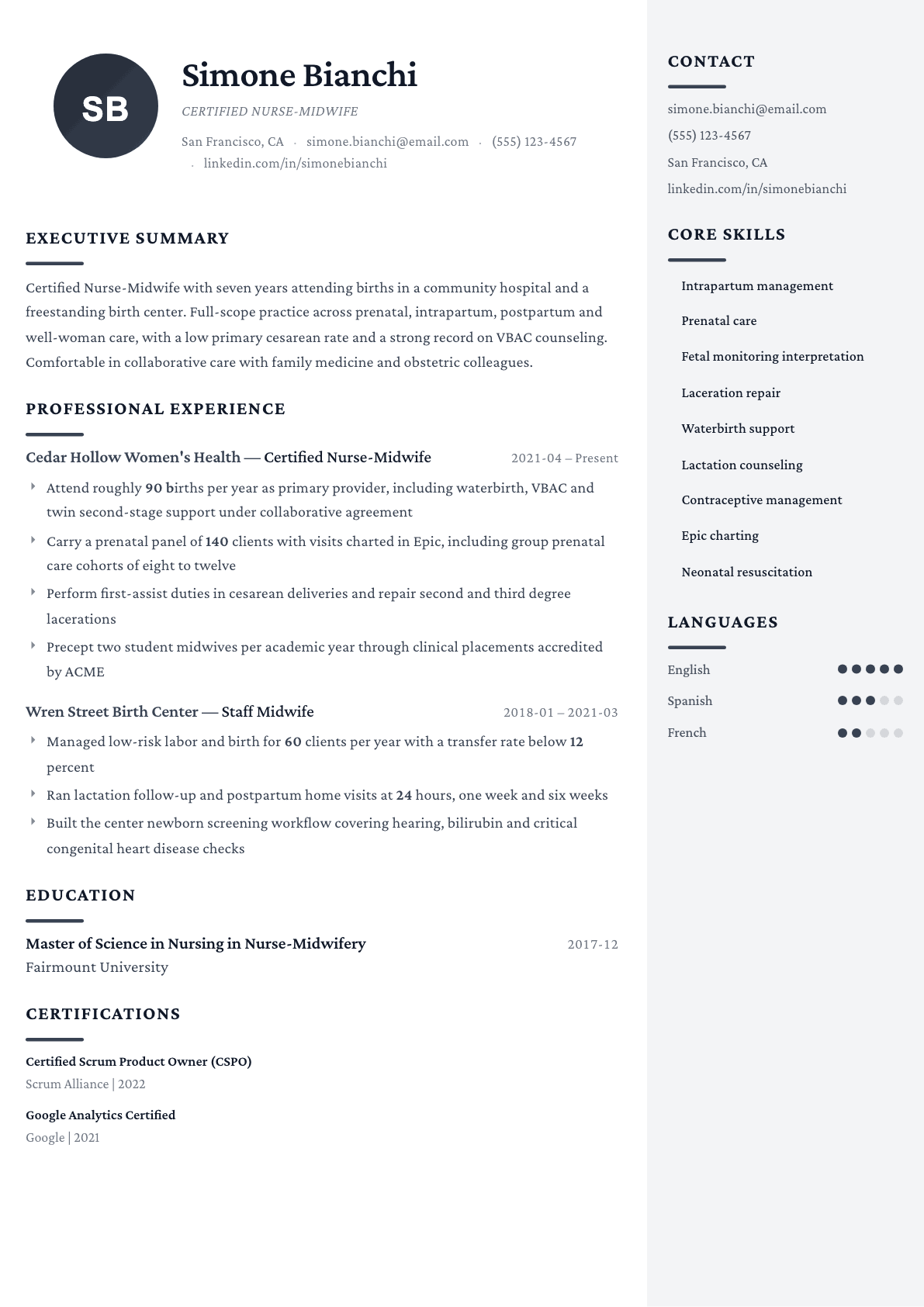
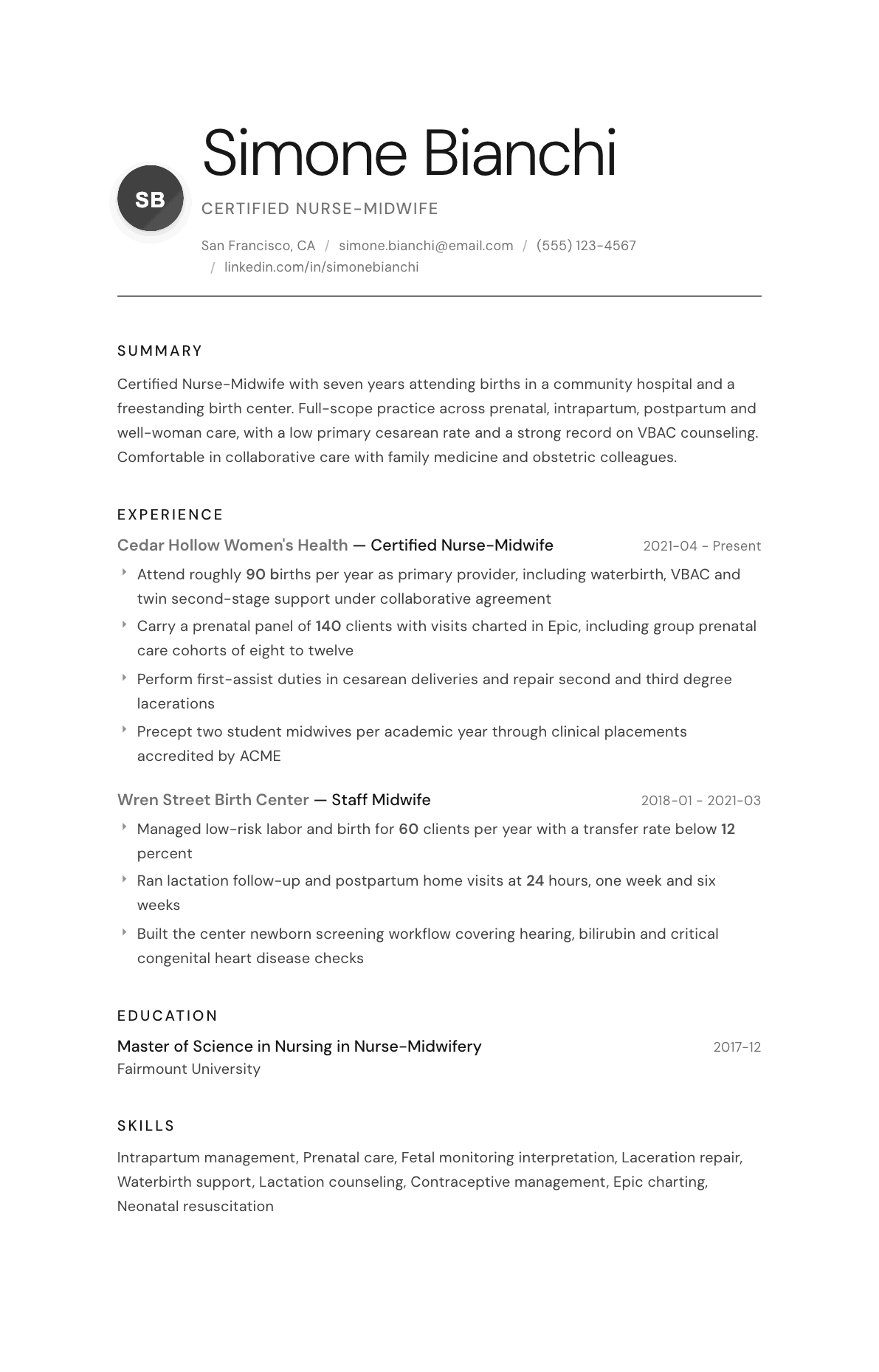
Example Midwife summary
Certified Nurse-Midwife with seven years of full-scope practice and more than 600 births attended as the primary provider across hospital and birth center settings. Skilled in labor support without routine intervention, laceration repair, and postpartum hemorrhage response. Known for a high VBAC success rate and for teaching student midwives through their intrapartum placements.
Skills to list on a Midwife resume
- Full-scope midwifery care
- Labor management
- Fetal heart rate interpretation
- Perineal repair
- Prenatal risk assessment
- Postpartum hemorrhage response
- Newborn assessment
- Lactation support
- Well-woman gynecology
- Contraceptive counseling
- Group prenatal care
- VBAC counseling
- Cesarean first assist
- Epic
- Neonatal resuscitation
- Clinical preceptorship
What actually gets this resume read
- State your annual birth volume and your role at each birth, because a hiring practice sizes you by caught births first.
- Name your certification body and license states in a credentials block near the top so the screener stops looking.
- Describe the practice model at every job: hospital call, birth center, home birth, or a collaborative group with physicians.
- Include the full scope you carry beyond birth, such as annual exams, contraception, colposcopy or newborn care.
- List the electronic record you charted in and the fetal monitoring system, since onboarding cost is a real hiring factor.
- Add teaching and preceptorship work, because most practices want a midwife who can carry students and new hires.
How to write a midwife resume
Whoever screens a midwife application is trying to answer one question before any other: can this person be added to the call schedule without changing how the service runs. That answer lives in three numbers and two documents. The numbers are your annual birth volume, the size of the prenatal panel you carried, and your years in full-scope practice. The documents are your certification and your state license.
Most midwife resumes bury all five under a paragraph about philosophy of care. Philosophy matters in the interview, where it belongs. On paper it displaces the facts a clinical director needs in order to move you forward, and it makes two candidates with very different experience look identical.
This guide sets out the section order that hospital groups, birth centers and home birth practices expect, with example summaries for a new graduate, a midwife at mid-career and a practice lead, before and after bullets drawn from real intrapartum work, and answers to the questions midwives ask when they sit down to update the file.
Format: credentials header, then a clinical volume block
Reverse chronological, one page under five years of practice and two after that. The header carries your name with credentials in the standard order, the states you are licensed in, and your certification number status if the posting asks for it. Do not spread that information across the document.
Directly under the header, add a short clinical volume block. Three lines: total births attended as primary, births per year in your current role, and the settings. A clinical director can then read the rest of the resume knowing what she is looking at, which is exactly what you want.
- Header: name with credentials, city and state, phone, email, license states.
- Section order: summary, licensure and certification, clinical volume, practice experience, education, skills, teaching.
- New graduates replace the volume block with clinical placement totals from their accredited program.
Summary: scope, setting, volume, and the thing you are known for
Four lines at most. Name the credential, the years of full-scope practice, the settings you have caught babies in, and one clinical strength that the posting names. A practice hiring for a hospital service with a high induction rate wants a midwife comfortable with augmentation and continuous monitoring. A birth center wants intermittent auscultation and low intervention labor support. Say which you are.
If you are moving between models, name the move directly. A birth center midwife applying to a hospital service should say so and point at the hospital privileges, the collaborative agreements and the first-assist experience that make the move workable.
Experience: the model of care, the collaboration, the scope you carried
Each job needs the practice type, the number of midwives and physicians in the group, the call structure, and the annual birth volume of the service. A reader who knows the field can size your workload from that alone, and everything after it becomes easier to believe.
Then three to five bullets on what you actually did. Lead with intrapartum work: waterbirth, VBAC, twin support under agreement, augmentation, breech assessment, shoulder dystocia and hemorrhage management. Follow with the scope beyond birth, because full-scope practice is what makes a midwife hireable in an outpatient heavy group: annual exams, contraception including implants and intrauterine devices, colposcopy, early pregnancy loss management and newborn care.
Leave out bullets that describe midwifery itself. Every applicant provides prenatal care and supports labor. What separates you is the population, the acuity, the intervention rate and the situations you have managed without a physician in the room.
Licensure, certification and the collaborative agreement
Give the certification with its issuing board, the license type for each state, and the prescriptive authority you hold. Add current neonatal resuscitation and life support cards with their issuing bodies. If you practice under a written collaborative agreement or under independent authority, say which, because that single line decides whether your experience transfers to the posting state.
Hospital privileges are worth their own line. Naming the facilities where you held admitting and delivery privileges tells a credentialing office that your file has already survived a privileging committee once.
Skills and keywords the tracking system is scanning
Job descriptions for midwives reuse a small vocabulary: full-scope care, antepartum, intrapartum, postpartum, well-woman, fetal heart rate interpretation, lactation support, and the record system. Mirror the wording once in the skills list and once inside a bullet where it is demonstrated. Name the charting platform and the fetal monitoring system, since onboarding cost shows up in hiring decisions more often than candidates expect.
- Clinical: laceration repair through third degree, hemorrhage protocol, cesarean first assist, manual placenta removal.
- Outpatient: contraceptive procedures, colposcopy, endometrial biopsy, prenatal genetic screening counseling.
- Systems: the electronic record, the fetal monitoring archive, the state birth registration process.
Midwife resume summary examples
New graduate midwife
Newly certified nurse-midwife with 65 births as primary under supervision and 220 antepartum visits completed during an accredited clinical year. Trained in intermittent auscultation, second degree repair and neonatal resuscitation. Seeking a hospital based service with structured mentorship through the first year of independent practice.
Six years in practice
Certified nurse-midwife with six years of full-scope practice and about 500 births attended, split between a community hospital service and a freestanding birth center. Comfortable with VBAC counseling, waterbirth, hemorrhage management and cesarean first assist. Carries a prenatal panel of 130 and runs group prenatal cohorts.
Practice lead
Lead midwife with fourteen years in hospital and community practice, more than 1,100 births attended, and five years directing a four midwife service. Owns the call schedule, clinical protocols, quality review and student placements. Holds hospital privileges and prescriptive authority in two states.
Work experience bullets: before and after
Before: Provided care to laboring women.
After: Attended about 90 births a year as primary provider on a service with a 24 hour in-house call model, including waterbirth, VBAC and second stage support for twins under collaborative agreement.
Volume, call model and the specific birth types tell a director exactly what shift you can cover.
Before: Did prenatal visits.
After: Carried a prenatal panel of 140 clients with routine screening, gestational diabetes management and genetic counseling referrals, and ran two group prenatal cohorts of ten per cycle.
Panel size and named clinical content turn a routine duty into a measure of outpatient capacity.
Before: Handled emergencies during birth.
After: Managed postpartum hemorrhage under standing protocol with uterotonics, bimanual compression and a balloon tamponade device, and led shoulder dystocia maneuvers with the response team twice in the last year.
Named interventions prove you can act before a physician arrives, which is the whole question in an emergency.
Before: Worked with doctors on complicated cases.
After: Co-managed preeclampsia, growth restriction and preterm labor with the maternal fetal medicine group, and first-assisted in roughly 30 cesarean deliveries a year.
Co-management and first-assist volume show how you function inside a collaborative service rather than beside it.
Before: Taught students.
After: Precepted two student midwives per academic year through their integration terms, signing off intrapartum competencies and giving structured feedback after each birth.
Specifying the placement stage and the sign-off role shows real teaching responsibility, not shadowing.
Hard skills
- Full-scope midwifery care
- Intrapartum labor management
- Fetal heart rate interpretation
- Perineal laceration repair
- Postpartum hemorrhage protocol
- Waterbirth and hydrotherapy support
- VBAC assessment and counseling
- Cesarean first assist
- Contraceptive procedures
- Newborn examination
- Lactation support
- Prenatal genetic screening counseling
Soft skills
- Informed consent conversations
- Calm decision making under pressure
- Collaborative handoff with physicians
- Student teaching and feedback
- Advocacy for client preferences
- Boundary setting on call
Certifications worth listing
- Certified Nurse-Midwife (CNM) (American Midwifery Certification Board)
- Certified Midwife (CM) (American Midwifery Certification Board)
- Certified Professional Midwife (CPM) (North American Registry of Midwives)
- Neonatal Resuscitation Program (NRP) (American Academy of Pediatrics)
- Advanced Life Support in Obstetrics (ALSO) (American Academy of Family Physicians)
- Basic Life Support (BLS) (American Heart Association)
Mistakes that cost midwife candidates the interview
- Writing a paragraph on birth philosophy before the reader knows your certification, license states and birth volume.
- Leaving out annual birth numbers, which forces a clinical director to guess whether you can carry a full call rotation.
- Describing the practice model vaguely, so a reader cannot tell a home birth practice from a hospital laborist service.
- Listing only intrapartum work when the posting is for a group whose midwives spend most of the week in clinic.
- Forgetting hospital privileges and the collaborative agreement, both of which decide how fast credentialing can move.
- Naming clients or identifying details from births, which reads as a confidentiality problem before it reads as experience.
- Using a two column template with icons, since hospital parsers frequently drop the dates out of the second column.
Midwife resume questions
How many births should I list on a midwife resume?
Give a cumulative figure for births attended as primary provider and an annual figure for your current role. Both matter: the cumulative number shows depth, and the annual number shows whether you are currently at volume or have stepped away from intrapartum work.
Do I need to list clinical placements as a new graduate?
Yes. For the first two years, list your accredited program placements with the site, the setting and the numbers you logged for births, antepartum visits, newborn exams and gynecology visits. Drop them once you have a full year of independent practice behind you.
How should a home birth midwife apply to a hospital service?
Name the transition in the summary, then make the hospital relevant parts obvious: transfer volume and how transfers went, continuous monitoring familiarity, hemorrhage and resuscitation experience, and any privileges or collaborative agreement you already hold with a facility.
Where do certifications and licenses go on the page?
Credentials go after your name in the header, then a separate block near the top listing certification with the issuing board, license type and state for each state, prescriptive authority, and current resuscitation cards with expiry dates. Do not scatter them through the experience section.
Should I include the cesarean rate of my practice?
Include your own primary cesarean rate only if you track it reliably and it supports your application. Never quote a whole practice figure as though it were yours. If you do include a rate, be ready to explain the population and the case mix behind it in the interview.