Lactation Consultant Resume Examples: what gets the call
Write a Lactation Consultant Resume That Wins Clinical Interviews
By Mustafa Tarabya, founder of CVBooster · Published · Updated
Lactation consultant resume example with clinical hours, IBCLC pathway details, hospital and outpatient settings, recruiter keywords and a full guide.
Sample resumes for a lactation consultant
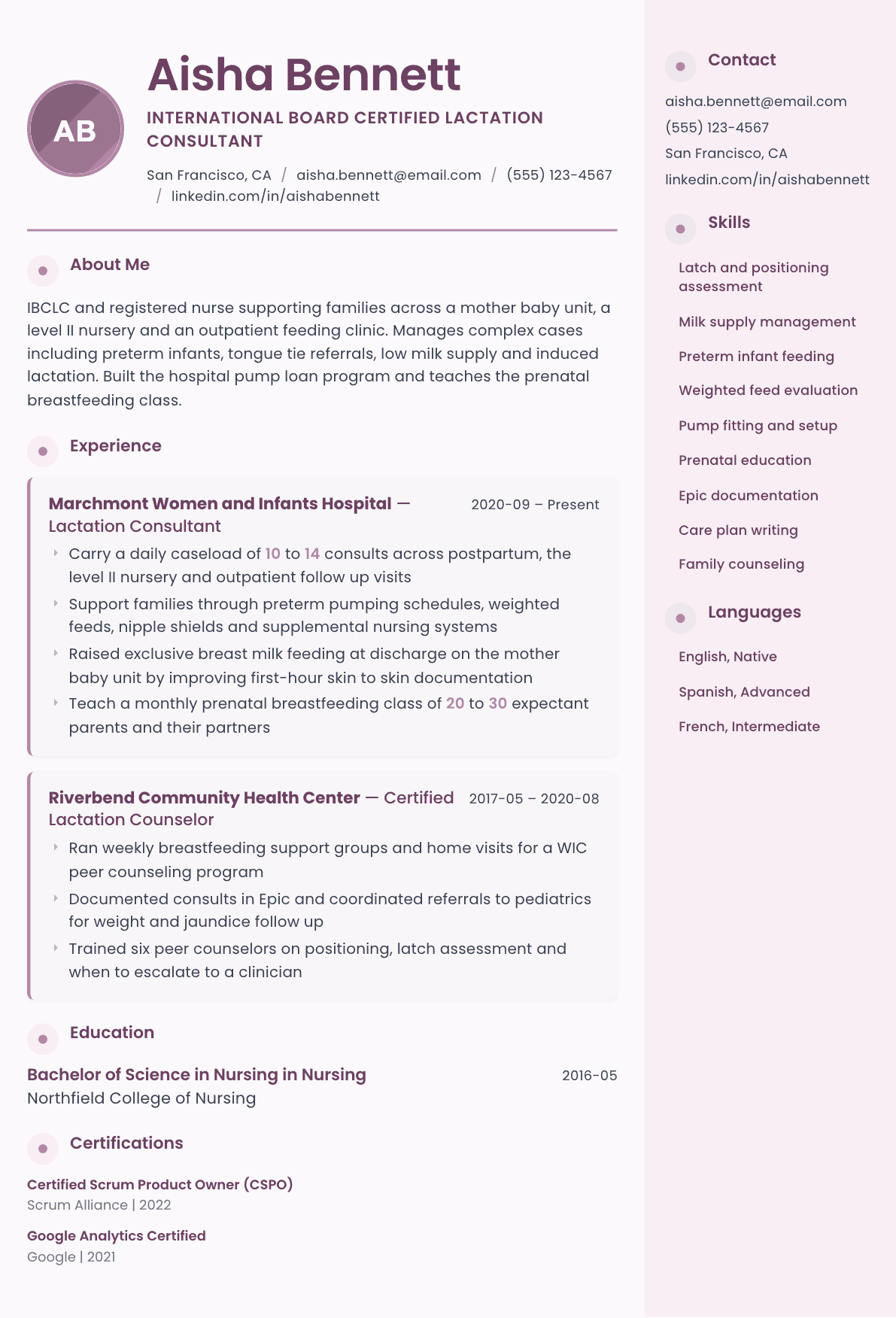
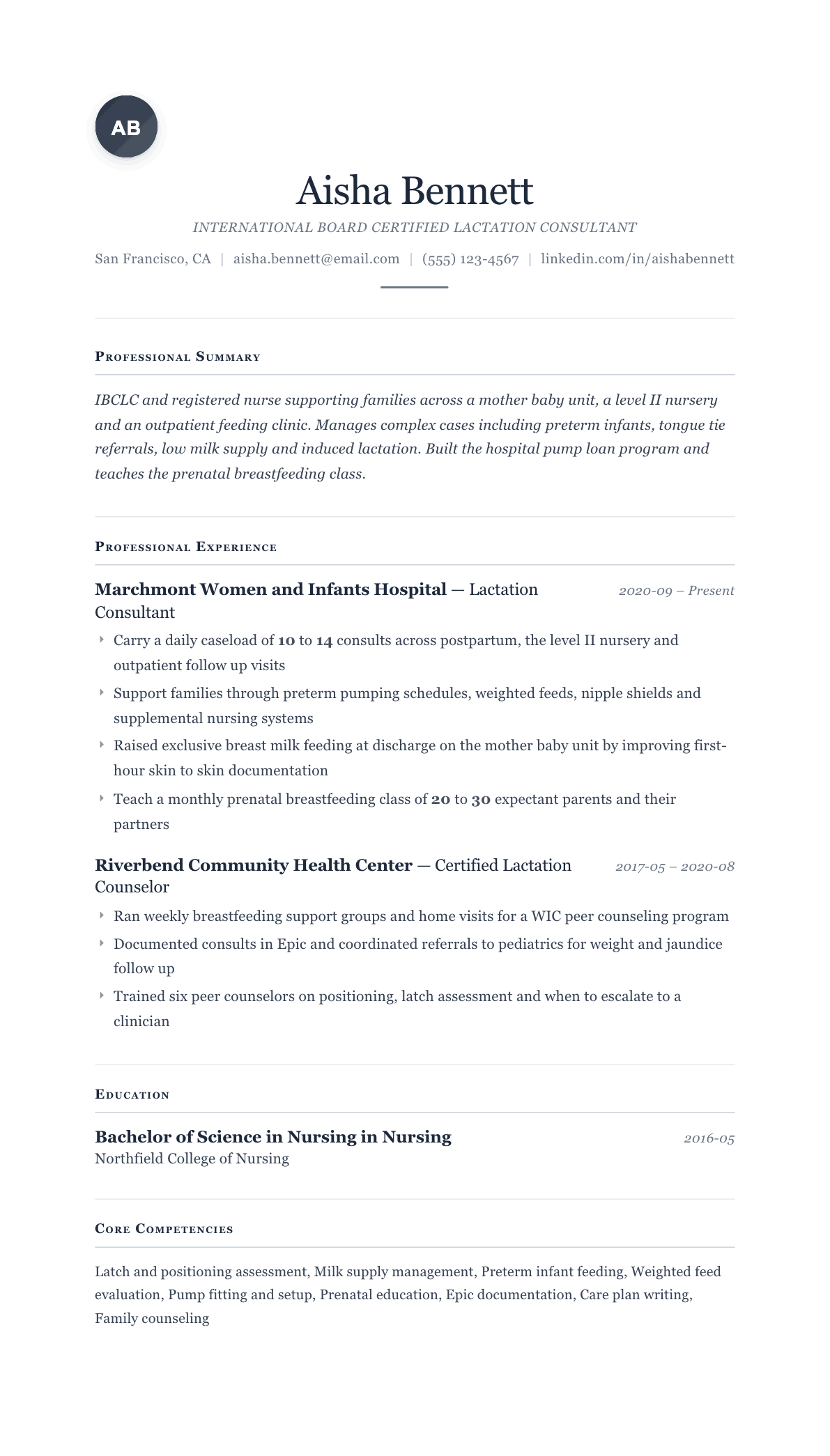
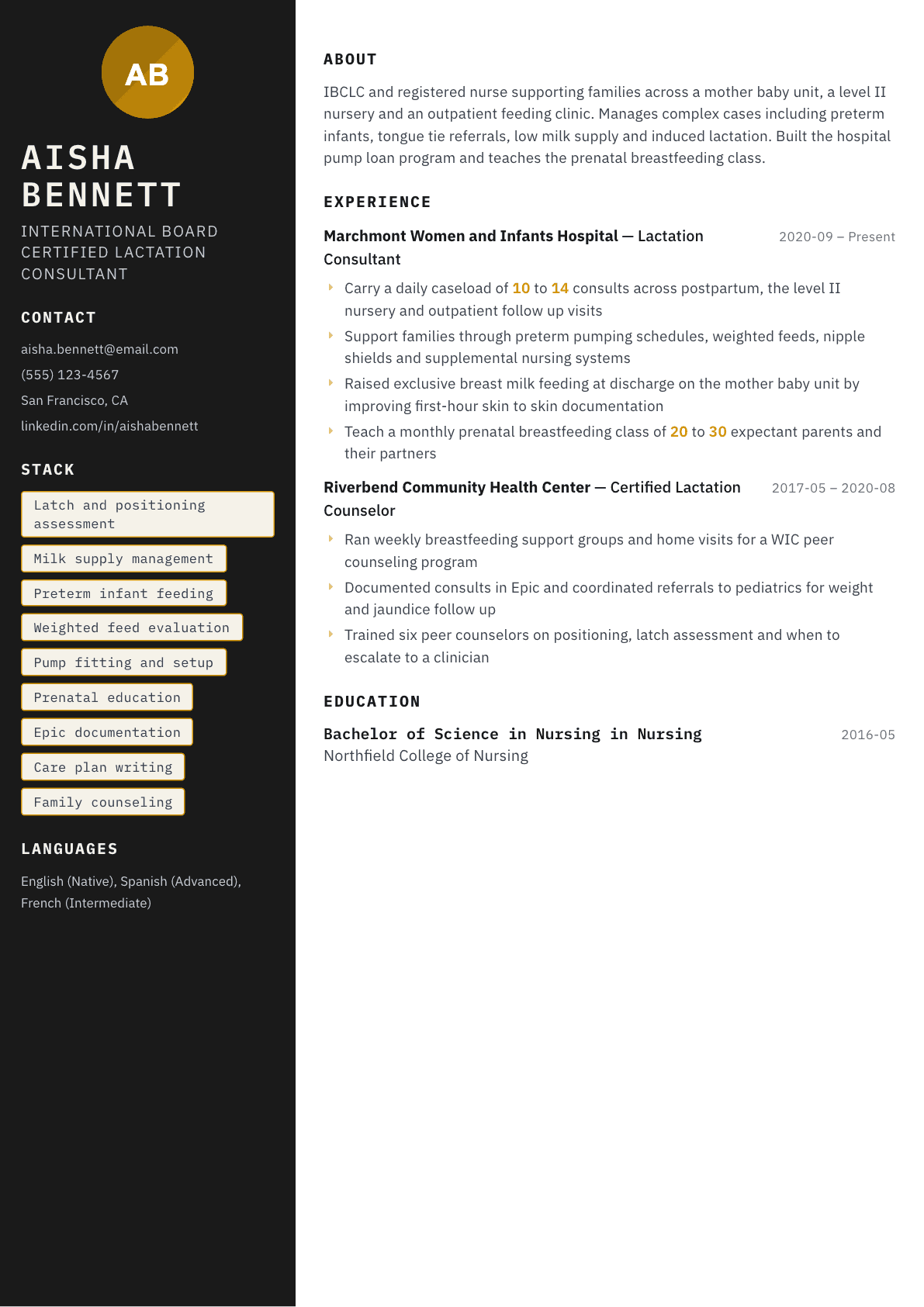
The same lactation consultant content laid out in three CVBooster templates, so you can see what the finished document looks like before you write a word.
Example Lactation Consultant summary
IBCLC and registered nurse with six years supporting families on a mother baby unit, in a level II nursery and in an outpatient feeding clinic. Carries a daily caseload of ten to fourteen consults covering preterm pumping, low supply workups and tongue tie referrals. Built a hospital pump loan program and teaches the monthly prenatal breastfeeding class for expectant parents.
Skills to list on a Lactation Consultant resume
- Latch assessment
- Positioning techniques
- Milk supply evaluation
- Preterm feeding support
- Pump selection and fitting
- Weighted feeds
- Tongue tie referral
- Supplemental nursing systems
- Prenatal breastfeeding education
- Care plan documentation
- Newborn weight monitoring
- Skin to skin support
- Staff education
- Community outreach
What actually gets this resume read
- Put IBCLC after your name and list your certifying board, because hiring managers verify that credential before scheduling an interview.
- Describe the setting precisely: hospital postpartum, level II or level III nursery, outpatient clinic, WIC or private practice each read differently.
- Give a daily consult caseload number so a manager can judge whether you can carry the volume on the unit.
- Name the complex situations you handle, such as preterm pumping, tongue tie referral, relactation and low supply workups.
- If you are on the pathway to certification, state the pathway, the clinical hours completed and your planned exam window.
- Include teaching and program work, because most job descriptions want someone who can run classes and staff education too.
How to write a lactation consultant resume
The person hiring a lactation consultant is usually a nurse manager on a mother baby unit, a nursery director or a clinic lead, and the first thing they check is the credential. The board certification is the gate. After that they want to know the setting you have worked in, how many consults you can carry in a day, and whether you can handle the complicated cases rather than only routine positioning.
The complicated cases are the whole job. Preterm infants on pumping schedules, mothers with low supply or oversupply, tongue tie referrals, weighted feeds, relactation, induced lactation, infants losing weight after discharge. A resume that lists education classes and support groups but never names a clinical problem reads as peer counselor experience, which is a different role with a different pay band.
This guide covers the credential presentation hospitals expect, how to describe each practice setting, three summary examples from a counselor working toward certification through a program lead, bullet rewrites that show clinical reasoning, and the questions consultants ask when they update their file.
Format: credential first, setting second, one to two pages
One page if you have under seven years, two once you have several settings and a teaching or program record. Single column, no icons. Hospitals parse resumes through large systems, and clinics often read them on a phone.
Your header carries name, then credentials in the standard order: nursing or dietetics degree if you hold one, license, then the lactation certification. A reader who sees a nursing credential alongside the lactation credential immediately understands the scope you can cover on a unit.
- Header: name with credentials, city and state, phone, email.
- Credentials block: certification, certifying board, license, life support cards.
- Sections: summary, credentials, clinical experience, teaching and program work, education.
Summary: setting, caseload, complexity
Name the settings in order of weight: hospital postpartum, level II or level III nursery, outpatient feeding clinic, home visits, private practice or a community nutrition program. Then give the daily consult caseload. Then name two or three complex situations you routinely manage. Three lines is enough and the manager has the whole picture.
If you are on a pathway to board certification, put that in the summary with the pathway number, the clinical hours completed and the exam window you are aiming for. Employers hire pathway candidates all the time, but only when the plan is legible.
Experience: caseload, population, interventions
Lead each job with the unit and the population. A mother baby unit with a level II nursery, an outpatient clinic seeing infants from birth through six months, a home visiting program covering a county. Then the caseload number: consults per day, visits per week, or families carried at once.
The bullets should show intervention, not attendance. Pumping plans for preterm infants, weighted feed assessment, nipple shield trials with a weaning plan, supplemental nursing systems, milk supply protocols, referral for frenotomy and follow up after it, and coordination with pediatrics on weight and bilirubin. Name the tools you use, including scales, pumps, hand expression teaching and flange sizing.
Add outcomes where the unit tracks them. Exclusive breast milk feeding at discharge, first-hour skin to skin rates, readmission for feeding related weight loss and clinic follow up attendance are metrics a nurse manager already reports upward, and a candidate who moved one of them is easy to justify hiring.
Teaching, programs and documentation
Most postings want more than one to one consults. They want prenatal classes taught, staff competency training delivered, a pump loan program run, policy written and outpatient follow up organized. Give this its own section if you have real depth, with class sizes, audiences and how often you teach.
Documentation matters too. Name the electronic record you chart in, whether you write care plans that follow the family home, and how you communicate with pediatrics. Charting quality is what keeps a lactation service billable and defensible.
- Prenatal and postpartum classes: audience, size, frequency.
- Staff education: nursing competencies, resident teaching, peer counselor training.
- Program work: pump loan, outpatient clinic setup, policy or protocol authorship.
- Documentation: electronic record, care plan format, referral communication.
Keywords that hospital and clinic postings reuse
Expect latch assessment, positioning, milk supply, breast pump instruction, weighted feeds, supplementation, skin to skin, prenatal education, care plan documentation, interdisciplinary collaboration and family centered care. Use the exact wording once near the top and again in a bullet where the work is visible.
Lactation Consultant resume summary examples
Certified counselor on the pathway
Certified lactation counselor with two years of community and clinic support, currently accumulating supervised clinical hours toward board certification with an exam window set for next year. Runs weekly support groups, completes latch and positioning assessments, and refers weight and jaundice concerns to pediatrics the same day.
Six years in
Board certified lactation consultant and registered nurse carrying ten to fourteen consults daily across postpartum, a level II nursery and outpatient follow up. Manages preterm pumping plans, low supply workups, weighted feeds and post frenotomy follow up, and teaches the monthly prenatal breastfeeding class for expectant parents.
Lactation program lead
Lactation program lead for a birth center delivering about 2,400 infants a year, supervising four consultants and a peer counselor team. Wrote the donor milk and supplementation protocols, rebuilt staff competency training, and raised exclusive breast milk feeding at discharge through structured first-hour skin to skin auditing.
Work experience bullets: before and after
Before: Helped new mothers with breastfeeding.
After: Carried a daily caseload of 10 to 14 consults across postpartum, a level II nursery and outpatient follow up, covering first latch through the six-week visit.
Caseload and settings tell a nurse manager whether you can hold the unit, which general helping language never does.
Before: Worked with mothers of premature babies.
After: Built pumping plans for mothers of preterm infants, coaching hand expression within the first hour, setting an eight-session daily schedule and tracking volumes against day of life targets.
Naming the timing, the schedule and the tracking shows the protocol knowledge that separates this work from general support.
Before: Taught breastfeeding classes.
After: Taught a monthly prenatal breastfeeding class of 20 to 30 expectant parents and partners, covering positioning, feeding cues, supply establishment and when to call for help.
Class size, frequency and curriculum turn a line item into a teaching record a manager can rely on.
Before: Improved breastfeeding rates on the unit.
After: Raised exclusive breast milk feeding at discharge by auditing first-hour skin to skin documentation, coaching night shift on early hand expression and adding a feeding plan to the discharge packet.
The outcome is tied to three specific changes, so the reader sees a method rather than a claim.
Before: Used pumps and other equipment with patients.
After: Fitted flanges by measurement rather than default size, set up hospital grade pumps and supplemental nursing systems, and wrote weaning plans for every nipple shield trial.
Specific equipment practice and the weaning plan detail demonstrate clinical judgment about when a tool ends.
Hard skills
- Latch and positioning assessment
- Oral and suck evaluation
- Milk supply assessment and protocols
- Preterm infant feeding support
- Weighted feed measurement
- Breast pump instruction and flange fitting
- Supplemental nursing systems
- Nipple shield use and weaning
- Care plan documentation
- Prenatal breastfeeding education
- Newborn weight and jaundice monitoring
- Staff competency training
Soft skills
- Nonjudgmental counseling
- Cultural humility
- Teaching under exhaustion
- Clear family communication
- Collaboration with pediatrics
- Emotional support during grief
Certifications worth listing
- International Board Certified Lactation Consultant (IBCLC) (International Board of Lactation Consultant Examiners)
- Certified Lactation Counselor (CLC) (Academy of Lactation Policy and Practice)
- Certified Breastfeeding Specialist (CBS) (Lactation Education Resources)
- Neonatal Resuscitation Program (NRP) (American Academy of Pediatrics)
- Basic Life Support (BLS) (American Heart Association)
Mistakes that cost lactation consultant candidates the interview
- Listing the certification only in the education section when it is the credential the manager verifies before reading anything else.
- Describing support and encouragement without a single clinical problem you solved, which reads as a peer counselor file.
- Leaving out the setting, so a reader cannot tell a level III nursery consultant from a community class instructor.
- Omitting caseload numbers, which are the only way a manager can judge whether you can hold the volume on the unit.
- Forgetting documentation and referral work, since a lactation service is only defensible when the charting supports it.
- Using titles inconsistently across jobs, which makes it unclear when you moved from counselor to board certified consultant.
Lactation Consultant resume questions
What is the difference between a lactation counselor and an IBCLC on a resume?
They are different credentials with different scopes, so never blur them. Use the exact title you hold for each job you held it in, and if you moved from counselor to board certified consultant, show the date so the reader can follow the progression accurately.
How do I write a lactation resume while still on the certification pathway?
Name the pathway you are following, the supervised clinical hours completed so far, the accredited education you have finished and your target exam window. Employers regularly hire pathway candidates, but they need to see a plan with dates rather than an intention.
Should nursing experience go on a lactation consultant resume?
Yes, and prominently if it is in maternal newborn care. Postpartum, nursery and labor experience explain why you can manage a full assignment and read a chart. Frame the bullets around infant feeding, weight monitoring and family teaching rather than general nursing tasks.
What metrics belong on a lactation consultant resume?
Daily consult caseload, exclusive breast milk feeding at discharge, first-hour skin to skin rates, class attendance and outpatient follow up completion. Choose the ones your unit actually tracked and pair each with the specific change you made to move it.
Do private practice consults count as clinical experience?
They do, and they show independence. Give visit volume, the age range you see, the referral relationships you maintain with pediatric offices, and how you document and communicate findings back to the primary provider. That structure is what makes private work read as clinical rather than casual.