Labor and Delivery Nurse Resume Examples: free ATS score
Write a Labor and Delivery Nurse Resume With Real Detail
By Mustafa Tarabya, founder of CVBooster · Published · Updated
Labor and delivery nurse resume example and sample for L&D RNs: unit line, fetal monitoring, cesarean circulating, RNC-OB and how to write each section.
Sample resumes for a labor and delivery nurse
The same labor and delivery nurse content laid out in three CVBooster templates, so you can see what the finished document looks like before you write a word.
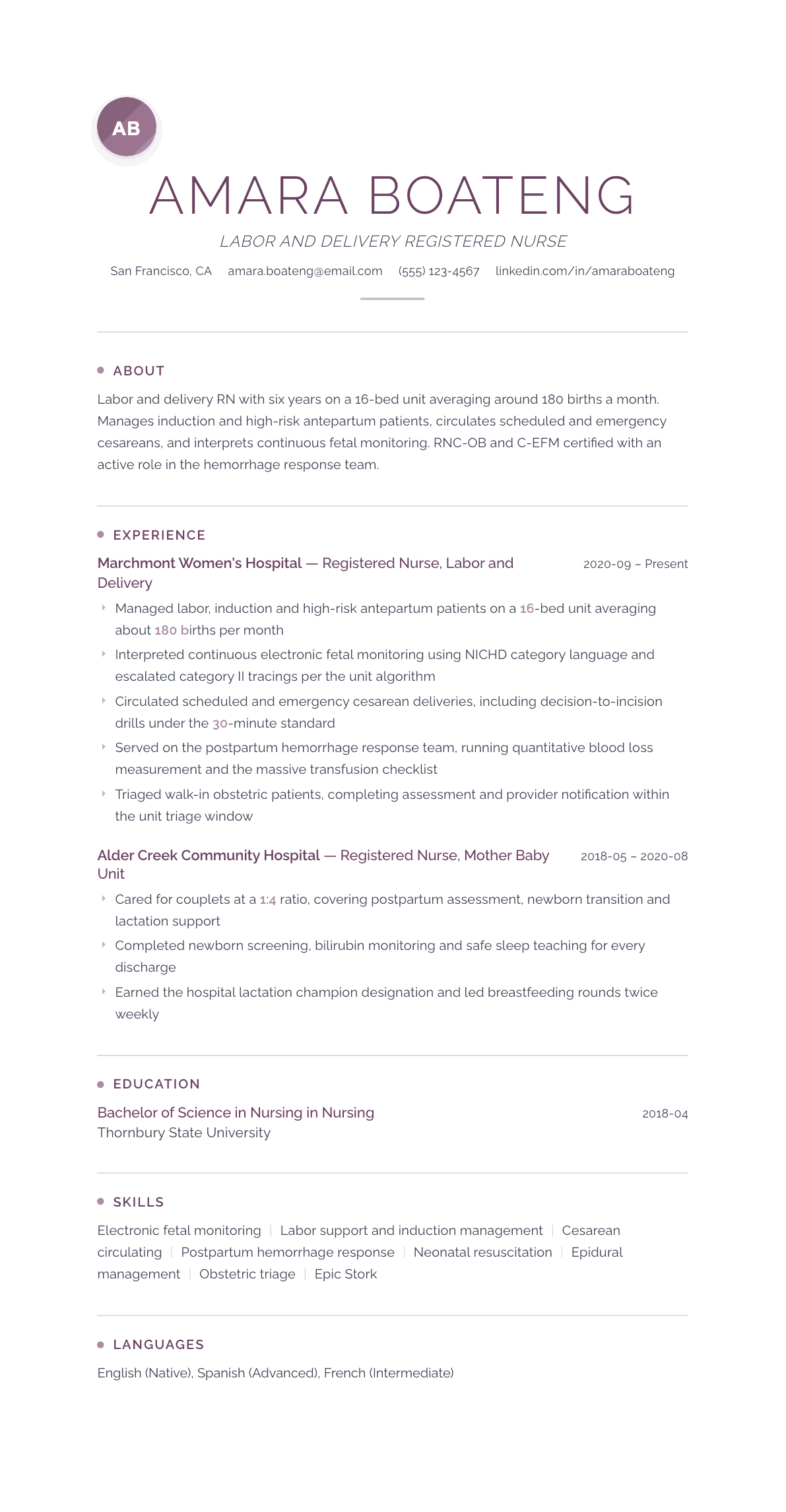
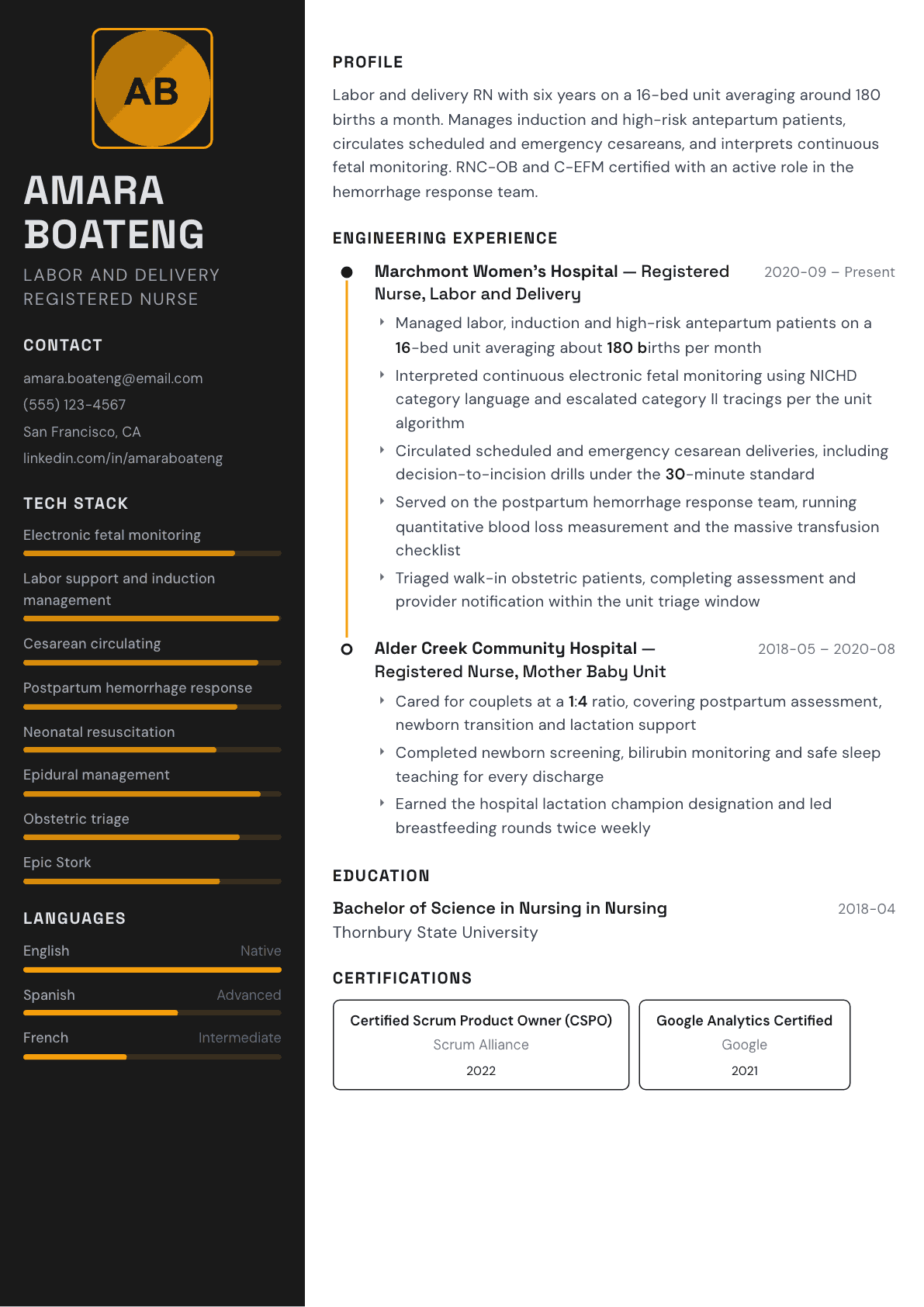
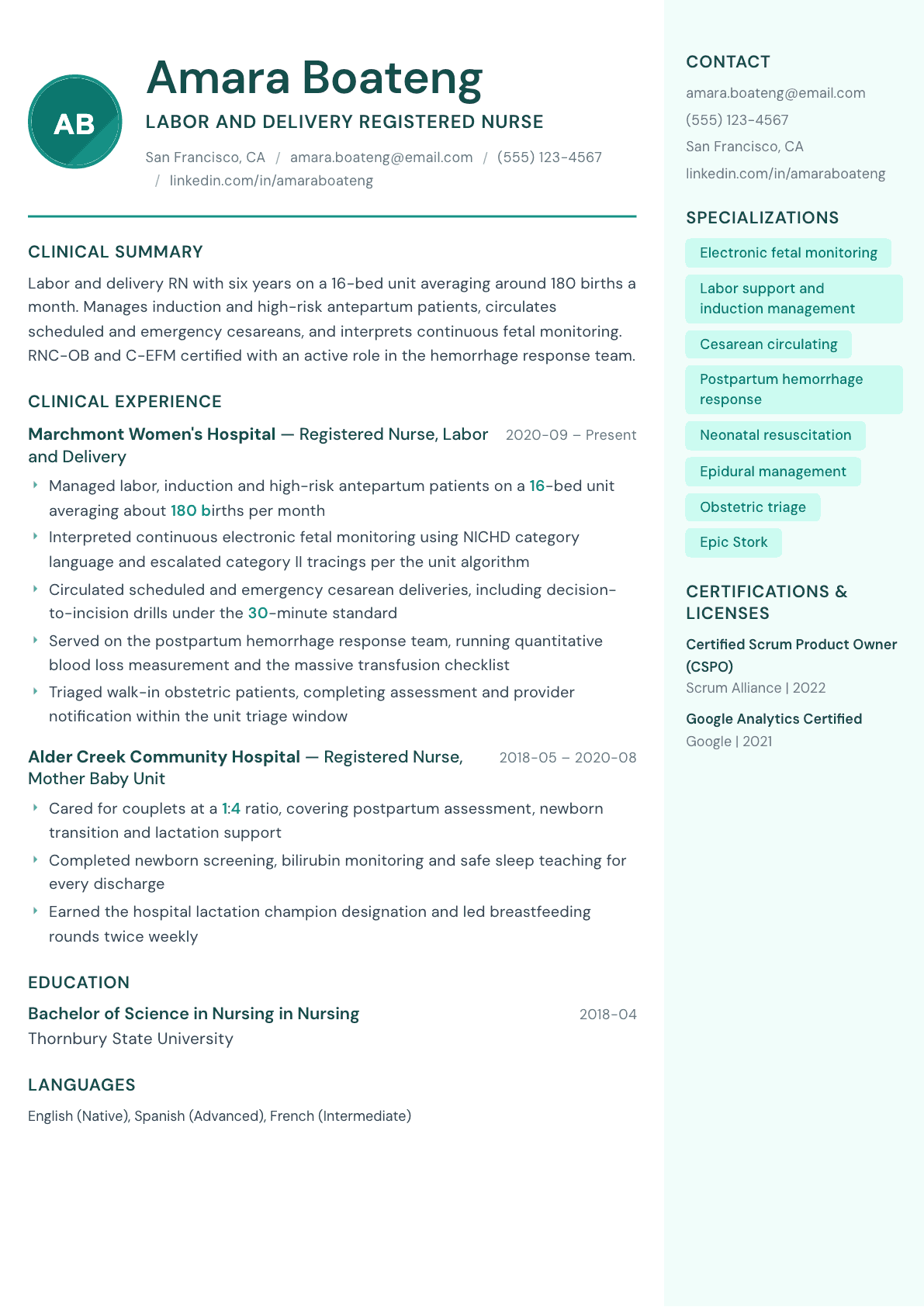
Example Labor and Delivery Nurse summary
Labor and delivery nurse with six years on a 16-bed unit averaging about 180 births a month. Manages inductions and high-risk antepartum patients, circulates emergency cesareans, and reads continuous fetal monitoring in NICHD category terms. RNC-OB and C-EFM certified and a standing member of the hemorrhage response team. Looking for a Level III center with an antepartum service.
Skills to list on a Labor and Delivery Nurse resume
- Electronic fetal monitoring
- NICHD tracing categories
- Labor support
- Oxytocin induction and augmentation
- Cesarean circulating and scrubbing
- Postpartum hemorrhage management
- Quantitative blood loss measurement
- Neonatal resuscitation
- Epidural and anesthesia support
- Obstetric triage
- Magnesium sulfate protocols
- Newborn transition care
- Lactation support
- Fetal scalp electrode and IUPC placement
What actually gets this resume read
- Give the unit size and the monthly or annual birth volume, since that number tells a manager how fast your floor moves.
- Use NICHD category language for fetal monitoring instead of vague phrases like monitored fetal well-being.
- Separate labor, cesarean circulating, triage, antepartum and recovery so a reader can see which roles you can fill.
- Name the emergency drills you have run: shoulder dystocia, hemorrhage, cord prolapse, eclampsia, crash cesarean.
- List RNC-OB, C-EFM and NRP in a credentials block, because obstetric managers screen for those three first.
- If you also cover mother baby or the nursery, say so, since small hospitals hire nurses who can cross both units.
How to write a labor and delivery nurse resume
Obstetric units hire on two things: how fast your floor moved and how you behaved when a tracing went bad. A labor and delivery nurse resume that gives the bed count, the birth volume and the fetal monitoring language a manager uses every day will be read to the end. One that says "assisted with deliveries and provided patient education" will not, because it could describe a student, a mother baby nurse or a traveler who covered two shifts.
The other thing an obstetric manager weighs is range. Labor rooms, obstetric triage, antepartum, cesarean circulating, recovery and mother baby are separate assignments, and small hospitals need nurses who cover several while large centers want depth in one. Spell out which of those you have staffed and how often.
This guide covers a sample labor and delivery nurse resume from header to first role, the header and credential block, the unit line that opens every job, how to write fetal monitoring and emergency bullets that hold up in an interview, the certifications obstetric managers screen for, and the questions nurses ask when moving into or out of labor and delivery.
Header and credentials: put RNC-OB and C-EFM where they are seen
Write your name with credentials in the order degree, license, certification, then a licenses and certifications block with your RN license and state, RNC-OB, C-EFM, neonatal resuscitation and basic and advanced life support. Obstetric managers screen for the first two acronyms specifically, and a certification buried on page two might as well not exist.
Keep a single column through the experience section. Two-column obstetric resumes with decorative icons routinely lose their dates in hospital parsers, and a labor and delivery resume without dates loses the years of volume that make it credible.
- Name with credentials, city and state, phone, email.
- Certifications: RN license and state, RNC-OB, C-EFM, NRP, ACLS, BLS.
- Order: summary, certifications, clinical experience, education, skills.
- Name your unit level, whether Level I community or a Level III regional center.
The unit line: beds, births, level of care
Open every job with the unit itself. "Registered Nurse, 16-bed labor and delivery unit, roughly 180 births per month, Level III perinatal center with an antepartum service" answers what a manager would otherwise spend the first interview question asking.
Volume matters because it sets pace. A nurse from a unit with a handful of births a week runs a different day than one from a high-volume center with a standing induction board, and both are legitimate. State yours honestly and let the reader place you.
Fetal monitoring: use the category language
Continuous electronic fetal monitoring is the core clinical skill of the role, so write it in the vocabulary the unit uses. Describe interpreting tracings in NICHD category terms, recognizing recurrent late or variable decelerations, applying intrauterine resuscitation measures, and escalating category II and category III tracings through the unit algorithm to the provider at the bedside.
Add the invasive monitoring you place or assist with: fetal scalp electrodes, intrauterine pressure catheters, and amnioinfusion. A nurse who names those has clearly worked labor rather than covered it occasionally.
Emergencies, cesareans and triage: separate them out
Give the emergency work its own bullets, because it is what the manager worries about. Postpartum hemorrhage response with quantitative blood loss measurement and the massive transfusion checklist, shoulder dystocia maneuvers, cord prolapse, eclampsia and magnesium sulfate protocols, and crash cesarean under the decision-to-incision standard are the drills every obstetric unit runs.
Say plainly whether you circulate cesareans, scrub them, or both, and roughly how many a month. Then describe obstetric triage as its own function: assessing walk-in patients, running nonstress tests, and getting a provider notification inside the unit window.
Cut the bullets that describe childbirth rather than your nursing. "Supported patients during labor" is on every obstetric resume ever written and takes the space a hemorrhage bullet needs.
Skills, systems and the mother baby crossover
List clinical skills that a posting will search for: electronic fetal monitoring, oxytocin induction and augmentation, epidural placement support and post-placement monitoring, cervical examination, amniotomy assistance, newborn transition care, and immediate skin-to-skin practice. Name the documentation system, since obstetric modules such as the Epic obstetric record or a dedicated perinatal charting system carry their own learning curve.
If you also cover mother baby, the nursery or antepartum, say so with the ratio you carried there. Cross-trained obstetric nurses are the ones community hospitals hire fastest, because one nurse can cover two holes in the schedule.
Labor and delivery nurse resume example: the top of the page
This sample labor and delivery nurse resume shows the top of the page for a labor and delivery RN with five years on one unit. Copy the order, not the facts: header, credentials, summary, the unit line, then bullets that keep labor, triage and the operating room apart.
A labor and delivery nursing resume for a new graduate keeps the same skeleton, with the obstetric clinical rotation in place of the unit line and the residency or preceptorship named in the summary.
- Header: Danielle Ortiz, BSN, RN, RNC-OB, C-EFM, then city, state, phone, email and the state license with its number.
- Summary: Labor and delivery RN with five years on a 12 bed unit in a community hospital. Cares for laboring, induction and antepartum patients, circulates cesareans and interprets continuous fetal monitoring in category language. Works as charge nurse two shifts a week.
- Unit line: hospital, unit type, beds, the birth volume your manager would quote, the level of maternal care and the nursery level behind you.
- First bullets: patient load in active labor, the induction protocols you run, triage assessments, cesarean circulating and recovery, and the emergency drills you lead or join.
- Certifications: BLS, ACLS and NRP with the issuer, then the obstetric certifications once you hold them.
Labor and Delivery Nurse resume summary examples
New graduate
BSN graduate with a 200-hour capstone on a labor and delivery unit and rotations through mother baby and a special care nursery. Trained in electronic fetal monitoring interpretation, oxytocin protocols and newborn transition care. Neonatal resuscitation and basic life support certified, seeking an obstetric nurse residency.
Six years in
Labor and delivery nurse with six years on a 16-bed unit averaging about 180 births a month. Manages inductions and high-risk antepartum patients, circulates emergency cesareans, and reads continuous fetal monitoring in NICHD category terms. RNC-OB and C-EFM certified and a standing member of the hemorrhage response team.
Charge nurse
Charge nurse on a Level III labor and delivery service with twelve years of obstetric practice, running the board, triage flow and staffing across a 22-bed unit. Leads quarterly hemorrhage and shoulder dystocia drills, precepts new obstetric nurses, and holds RNC-OB certification with advanced fetal monitoring credentials.
Work experience bullets: before and after
Before: Monitored fetal heart rate during labor.
After: Interpreted continuous electronic fetal monitoring in NICHD category terms, applied intrauterine resuscitation for recurrent late decelerations, and escalated category II tracings through the unit algorithm.
Category language and the escalation pathway show clinical reasoning, not that a monitor was running in the room.
Before: Assisted with cesarean sections.
After: Circulated scheduled and emergency cesarean deliveries, including crash cases run against the 30-minute decision-to-incision standard, with counts and specimen handling owned throughout.
Naming case types, the time standard and your specific responsibilities distinguishes circulating from simply being present.
Before: Responded to postpartum bleeding.
After: Served on the postpartum hemorrhage response team, performing quantitative blood loss measurement and running the massive transfusion checklist alongside anesthesia and the blood bank.
The measurement method and the named protocol prove structured emergency practice rather than reactive help.
Before: Triaged patients who came to the unit.
After: Assessed walk-in obstetric patients for labor status, bleeding and hypertensive symptoms, completing assessment, monitoring strip and provider notification inside the unit triage window.
The specific complaints screened and the notification standard turn triage into a defined skill with a clock on it.
Before: Helped with breastfeeding after delivery.
After: Supported first latch within the first hour for uncomplicated births, earned the hospital lactation champion designation, and led breastfeeding rounds on the mother baby unit twice weekly.
A timing standard and a named designation give the reader something verifiable instead of a general claim.
Hard skills
- Electronic fetal monitoring interpretation
- NICHD tracing categories
- Oxytocin induction and augmentation
- Cervical examination and labor progress assessment
- Cesarean circulating
- Postpartum hemorrhage management
- Quantitative blood loss measurement
- Magnesium sulfate and hypertensive protocols
- Neonatal resuscitation and newborn transition
- Obstetric triage and nonstress testing
- Epidural support and post-placement monitoring
- Fetal scalp electrode and intrauterine pressure catheter
Soft skills
- Labor coaching and comfort measures
- Calm under sudden deterioration
- Advocacy with providers on a tracing
- Support through pregnancy loss
- Handoff to anesthesia and the newborn team
- Teaching first-time parents
Certifications worth listing
- RNC-OB (Inpatient Obstetric Nursing) (National Certification Corporation)
- C-EFM (Electronic Fetal Monitoring) (National Certification Corporation)
- Neonatal Resuscitation Program (NRP) (American Academy of Pediatrics)
- Advanced Cardiovascular Life Support (ACLS) (American Heart Association)
- Basic Life Support (BLS) (American Heart Association)
- RNC-MNN (Maternal Newborn Nursing) (National Certification Corporation)
Mistakes that cost labor and delivery nurse candidates the interview
- Omitting the birth volume and bed count, which are the two numbers an obstetric manager uses to judge every other claim.
- Writing about supporting patients through childbirth rather than the monitoring, the drills and the emergencies you ran.
- Blending labor, triage, cesarean and mother baby work into one paragraph so the reader cannot staff you.
- Leaving RNC-OB or C-EFM off the top of the page when those acronyms are exactly what the screener searches.
- Letting neonatal resuscitation certification lapse, which blocks an obstetric application before a human sees it.
- Claiming high-risk experience without naming the conditions, such as preeclampsia, placenta accreta or preterm labor.
Labor and Delivery Nurse resume questions
How do I get into labor and delivery from another specialty?
Name every obstetric touchpoint you have: clinical rotations, float shifts to mother baby, postpartum recovery coverage, or emergency department obstetric patients. Then add neonatal resuscitation certification and an outside fetal monitoring course, which show intent that a manager can act on.
Should I list the number of births my unit handled?
Yes, monthly or annual volume gives the reader the pace of your floor. Pair it with the bed count and the perinatal level of the center, because volume alone does not distinguish a busy community unit from a regional referral service.
Do I need RNC-OB to apply for labor and delivery jobs?
Not to apply, but it separates you from equally experienced applicants and many hospitals pay a differential for it. If you have the required specialty practice hours, state that you are eligible and give the month you intend to test.
How do I describe emergency drills without exaggerating?
Distinguish between drills you ran in simulation and real events you responded to, and say which is which. Managers respect the honesty and will place you accordingly, whereas an inflated claim collapses during the first scenario question at interview.
Is mother baby experience useful on a labor and delivery resume?
Very, especially for community hospitals that cross-train across the perinatal service. Give the couplet ratio you carried, the newborn assessments and screenings you completed, and the lactation support you provided, then keep the labor bullets first.