Nurse Practitioner Resume Examples: the lines they read
Nurse Practitioner Resume: FNP and NP Resume Template, CV Samples
By Mustafa Tarabya, founder of CVBooster · Published · Updated
Nurse practitioner resume with a filled NP resume template, plus curriculum vitae entries for new graduates, working NPs and academic posts.
Sample resumes for a nurse practitioner
The same nurse practitioner content laid out in three CVBooster templates, so you can see what the finished document looks like before you write a word.
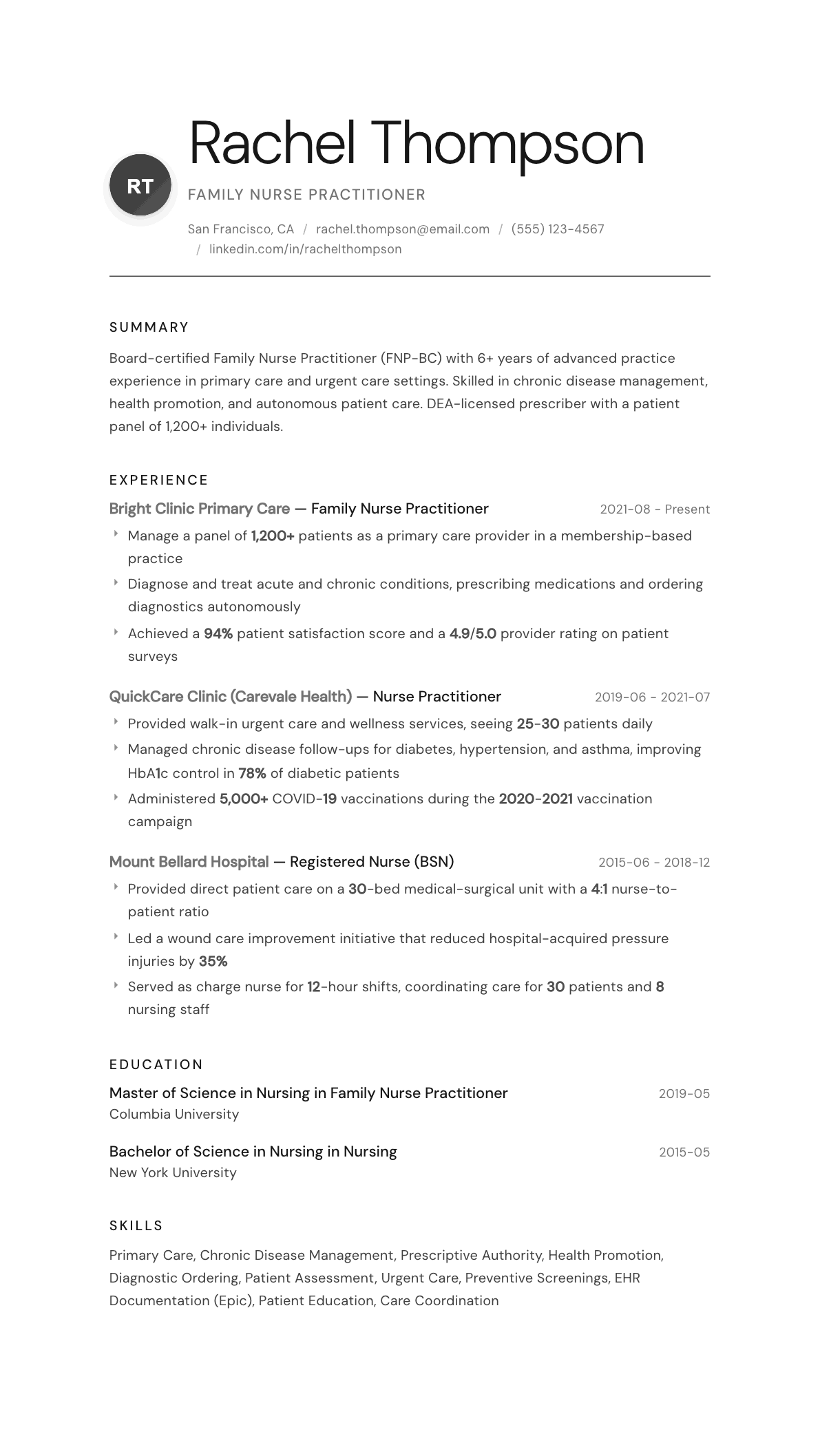
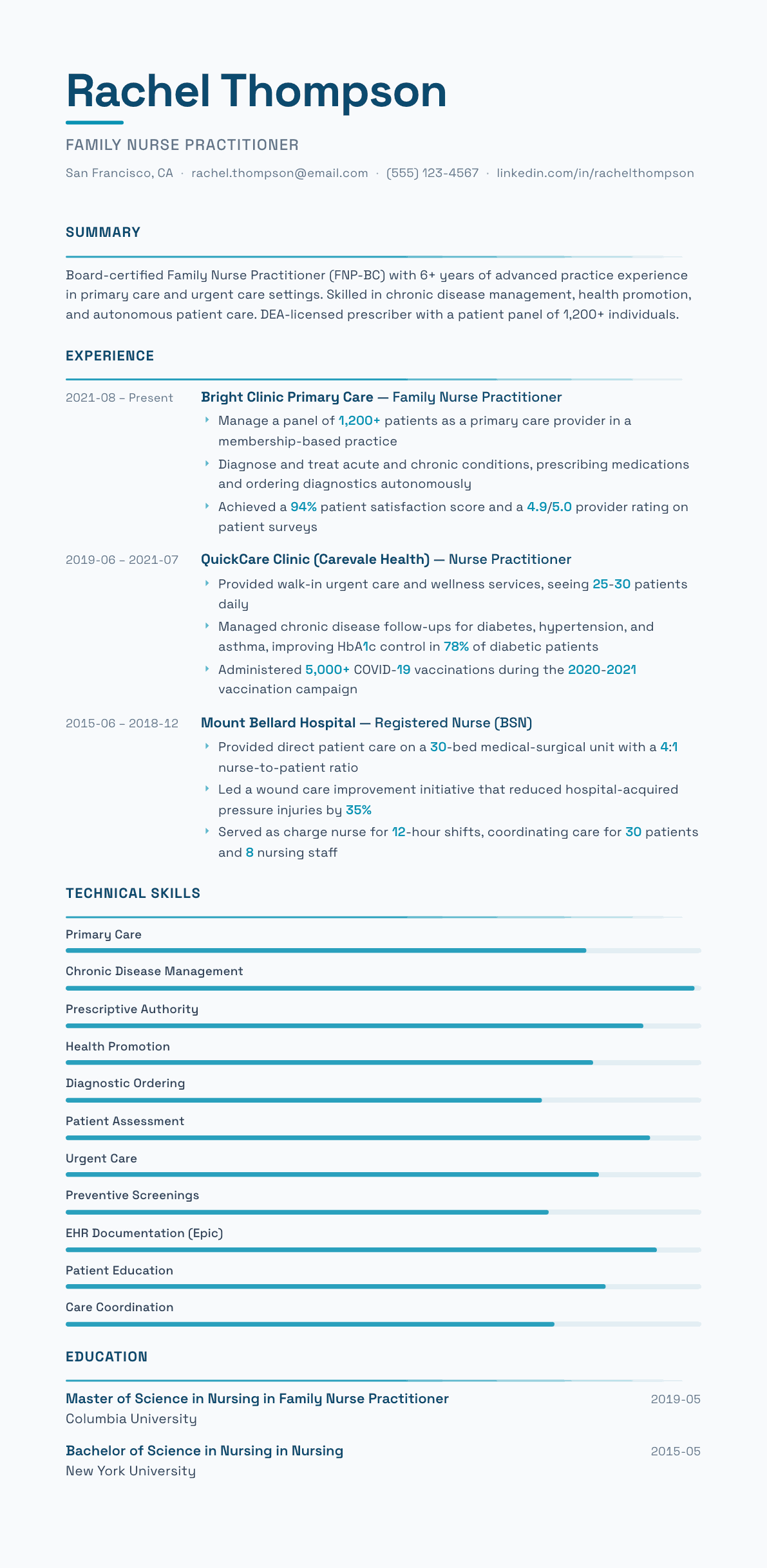
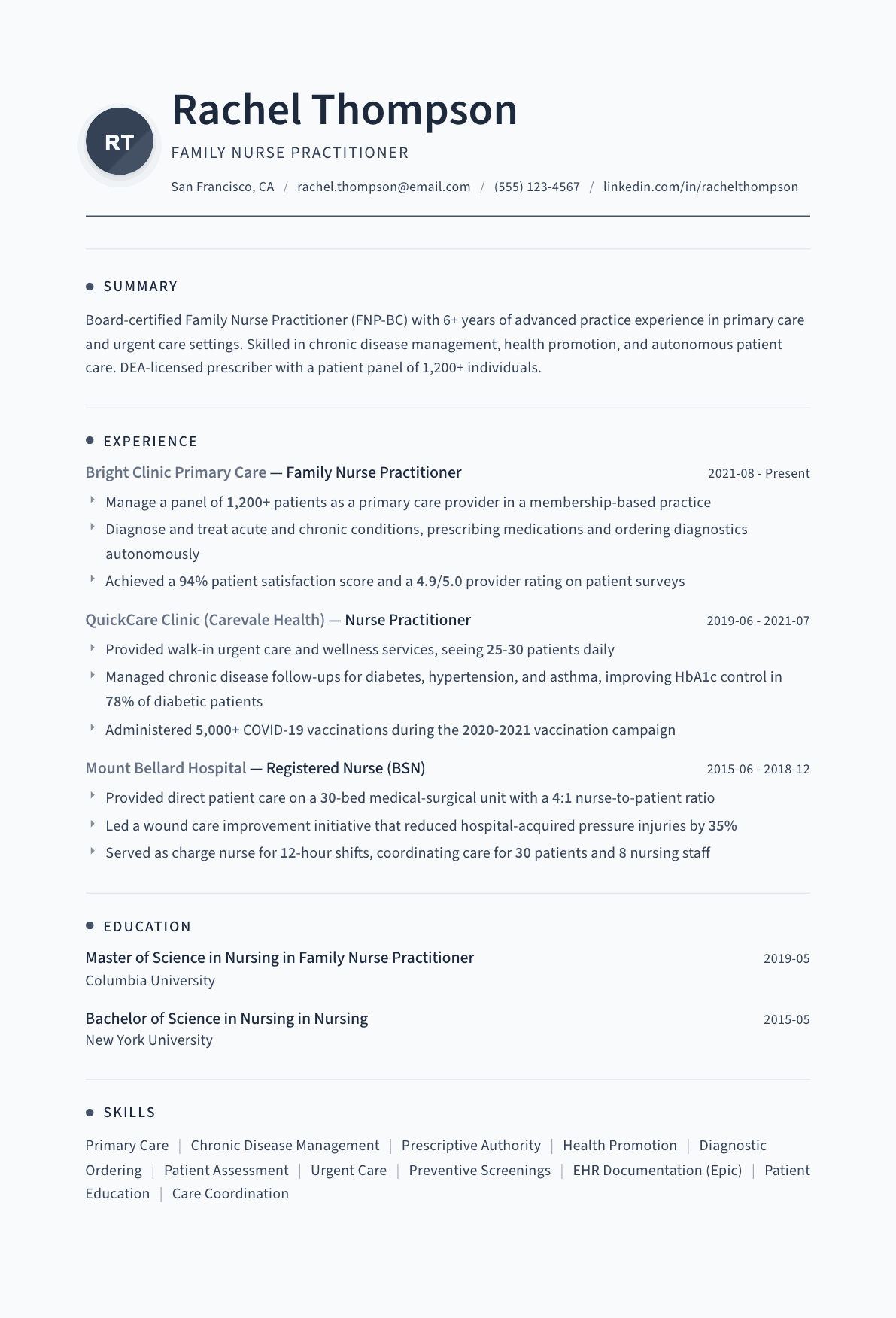
Example Nurse Practitioner summary
Board-certified FNP-BC with 6 years of advanced practice experience managing a panel of 1,200+ patients. Skilled in autonomous diagnosis, prescribing, and chronic disease management with a 94% patient satisfaction score. Seeking a primary care NP position in a patient-centered medical home.
Skills to list on a Nurse Practitioner resume
- Primary Care
- Chronic Disease Management
- Prescriptive Authority
- Health Promotion
- Diagnostic Ordering
- Patient Assessment
- Urgent Care
- Preventive Screenings
- Telehealth
- EHR Documentation
- Care Coordination
- Patient Education
- Wound Care
- Suturing
- Point-of-Care Testing
What actually gets this resume read
- Display your NP certification (FNP-BC, AGNP-C, etc.) after your name.
- Quantify patient panel size, daily volumes, and outcome metrics.
- Highlight autonomous practice authority and prescriptive privileges.
- Include both your RN and NP experience to show clinical depth.
- List state licenses and collaborative practice agreements if applicable.
- Show specialty skills like procedures, chronic disease protocols, or telehealth.
How to write a nurse practitioner resume
A nurse practitioner resume is read as a provider file, not a nursing file, and that single shift changes everything about how it should be written. The medical director or practice manager screening it wants the certification and its population focus, the state license and prescriptive authority, the collaborative or supervisory arrangement if the state requires one, the panel or visit volume, and the procedures you perform without help.
Many candidates carry over the habits of a bedside resume and lead with compassion and teamwork. A credentialing coordinator reads that page and cannot find the certification body, the DEA status or the clinical scope, and the file stalls before the physician ever sees it. Advanced practice hiring runs on credentials and scope.
This guide covers the section order employers expect from an advanced practice provider, how to present certification, licensure and prescriptive authority, how to write experience around panel size and visit volume, and the questions nurse practitioners ask when moving between primary care, urgent care, specialty and hospital based roles. For a family nurse practitioner CV, used for academic posts, hospital credentialing and some federal roles, see the curriculum vitae section near the end.
NP resume template: credentials in the header, licensure above experience
Reverse chronological, two pages is normal and expected. Advanced practice resumes carry a licensure block, a clinical experience section, procedures, and sometimes precepting and scholarly work, and squeezing that onto one page hides the parts credentialing needs.
Write the credential string exactly as the certifying board writes it. A family nurse practitioner certified through one board and one certified through another use different suffixes, and the correct string is the one a credentialing coordinator will match against a primary source verification.
- Header: name with degree and board certification, city and state, phone, email, and license states.
- Sections in this order: summary, licensure and certification, clinical experience, procedures and privileges, education, precepting and professional activity.
- Include the National Provider Identifier and DEA status by state without printing the numbers themselves.
- Template filled in for an invented family nurse practitioner. Header: Laura Bennett, MSN, APRN, FNP-C, Columbus, Ohio, licensed in Ohio and Kentucky.
- Summary line: Family nurse practitioner with four years in a federally qualified health center, panel of about 1,100 patients, 18 to 22 visits a day across chronic disease, pediatrics and women's health, bilingual English and Spanish.
- Licensure and certification line: APRN license with prescriptive authority, Ohio and Kentucky, with expiration months; FNP board certification with expiration month; DEA registration active in both states; NPI on file; BLS.
- Experience entry: Family Nurse Practitioner, Northside Community Health Center, four years to present, with four bullets for panel and visit volume, chronic disease outcomes the clinic tracks, procedures such as joint injections and skin biopsies with rough counts, and precepting of NP students.
- Below that: registered nurse experience in two or three lines, education with degree, school and year, then precepting, committees and memberships.
Summary: population focus, setting, panel, autonomy
Four lines. Name the population focus, the years in practice, the setting, the volume you carry and the level of autonomy you work at. "Board certified family nurse practitioner with seven years in primary care, managing a panel near 1,200 patients and seeing twenty patients a day with independent prescriptive authority" answers what a medical director wants to ask first.
If you are a new graduate nurse practitioner, do not hide it, and do not lead with your registered nurse years either. Lead with the certification and the clinical hours by rotation, then use the nursing background as supporting evidence of setting familiarity.
For a family nurse practitioner resume, the FNP credential and the across the lifespan population go in the first line, because family practice, urgent care and retail clinics hire on it. Written out: Family nurse practitioner, FNP-BC, licensed in Ohio with prescriptive authority, sees about 22 patients a day across pediatrics, adult chronic disease and women's health in a rural clinic, and performs skin biopsies, joint injections and IUD insertion.
Experience: panel size, visit volume, and what you manage
Open each role with the practice type, the population and the volume: patients per day, panel size, or admissions and consults per shift for a hospital role. Volume is the fastest way for a reader to compare candidates, and advanced practice resumes that omit it force a phone call.
Then write bullets around clinical scope. Diagnosis and management of the chronic conditions you actually own, acute presentations you work up, the diagnostics you order and interpret, the medications you initiate and titrate, referral thresholds, and the quality measures your practice is scored on such as chronic disease control, cancer screening completion and immunization rates.
Procedures deserve their own list. Joint injections, skin biopsies and excisions, laceration repair, incision and drainage, endometrial biopsy, intrauterine device insertion, casting and splinting, central and peripheral line placement, or point of care ultrasound, whichever apply, with a rough annual count. Credentialing committees grant privileges from lists like this.
Licensure, prescriptive authority and practice agreements
Give this its own section. Registered nurse license and advanced practice registered nurse license by state with expiration, board certification with the certifying body, DEA registration status, controlled substance registration where the state requires a separate one, and any prescriptive authority limits.
Say what practice authority you have worked under. Some states grant full practice authority, others require a collaborative or supervisory agreement with a physician, and a hiring practice needs to know which arrangement you are used to and whether you have an agreement in place. Add certification for controlled substance prescribing training where your state mandates it.
Basic and advanced resuscitation certifications belong here too, listed but not leading. A specialty certification relevant to the posting matters far more than the resuscitation cards every provider holds.
Keywords and the parts of the file credentialing reads
Advanced practice postings repeat a stable vocabulary: differential diagnosis, chronic disease management, health maintenance and preventive care, evidence based guidelines, quality measures, patient panel, collaborative practice, prescriptive authority, documentation and coding, and care coordination. Mirror the posting language once in the summary or skills and once in a bullet.
Coding is worth a line. Nurse practitioners who understand visit level documentation, chronic care management billing and annual wellness visits are directly valuable to a practice, and few candidates mention it. Name the electronic health record you chart in as well, because template familiarity shortens ramp up.
Nurse practitioner curriculum vitae: when to send a CV and what goes in it
A nurse practitioner curriculum vitae is the longer, complete record that academic posts, DNP programs, research roles and some hospital credentialing offices ask for instead of a two page resume. It keeps every clinical position, every license and certification with its number and expiration, and adds sections a resume leaves out: clinical rotations for new graduates, publications, presentations, teaching, committee work and professional memberships.
Use the same order a credentialing reviewer reads in: education, licensure and board certification, clinical experience, then the academic sections. The sample curriculum vitae entries below show how a nurse practitioner CV reads at three stages, and each line can be lifted into your own file with your own details.
Family nurse practitioner CV example, the credentials block written out: MSN, Family Nurse Practitioner, Hartwell University School of Nursing; FNP-BC from the American Nurses Credentialing Center or FNP-C from the American Academy of Nurse Practitioners Certification Board; state APRN license with prescriptive authority; DEA registration; clinical rotations listed by setting, such as family practice, pediatrics, women's health and urgent care. The family nurse practitioner CV then adds precepting, quality projects and any publications, which a one page resume leaves out.
- Sample entry, new graduate clinical rotations: Family Nurse Practitioner Clinical Rotation, community health center, final semester, 240 precepted hours. Managed a panel of adult and pediatric primary care visits under an FNP preceptor, including well child checks, chronic disease follow up and acute visits.
- Sample entry, licensure and certification: APRN license, Texas, with number and expiration month. Board certified Family Nurse Practitioner (FNP-C), American Academy of Nurse Practitioners Certification Board, with the certification date. DEA and NPI available on request.
- Sample entry, clinical experience: Family Nurse Practitioner, rural health clinic, four years to date. Independent panel of around 1,100 patients, 18 to 22 visits a day, prescriptive authority under a collaborative practice agreement, and on site procedures including joint injections and skin biopsies.
- Sample entry, presentations: Podium presentation, state nurse practitioner association annual conference, on a diabetes group visit model run in a rural clinic.
- Sample entry, teaching: Clinical preceptor for six FNP students from two universities over three years, and guest lecturer on primary care pharmacology for a graduate program.
- Sample entry, professional service: Member, clinic quality committee, leading the quarterly chart review for preventive screening rates.
Nurse Practitioner resume summary examples
New graduate nurse practitioner
Newly board certified family nurse practitioner with 720 clinical hours across family practice, urgent care, pediatrics and women's health, plus four years as a registered nurse on a medical-surgical unit. Comfortable with acute visits, chronic disease follow up and preventive care, and seeking a supported primary care position.
Seven years in primary care
Board certified family nurse practitioner managing a panel near 1,200 patients in a membership primary care practice, seeing twenty patients daily with independent prescriptive authority. Manages diabetes, hypertension, asthma and behavioral health follow up, and performs joint injections and skin biopsies in clinic.
Lead advanced practice provider
Family nurse practitioner with twelve years across urgent care and primary care, now lead provider for a four site group and preceptor to graduate students. Built the standing order set for urgent care, owns the quality measure dashboard, and holds licenses in three states for telehealth coverage.
Work experience bullets: before and after
Before: Provided care to patients in a primary care clinic.
After: Served as primary care provider for a panel of about 1,200 patients, seeing twenty visits daily across acute complaints, chronic disease follow up and annual wellness exams.
Panel size and daily volume are the two numbers a medical director uses to compare providers.
Before: Managed patients with chronic illnesses.
After: Managed diabetes, hypertension, hyperlipidemia and asthma to guideline targets, titrating insulin and antihypertensives independently and improving blood sugar control across the panel over two years.
Naming the conditions and the medication decisions shows the scope you actually own.
Before: Performed procedures as needed.
After: Performed roughly 150 in-office procedures a year including joint injections, skin biopsies, laceration repair and incision and drainage, with privileges granted at both clinic sites.
A procedure list with a volume and a privileging reference is what a credentialing committee needs.
Before: Prescribed medications to patients.
After: Prescribed under full independent authority with an active DEA registration, including controlled substance management for chronic pain patients under a written monitoring agreement.
Prescriptive authority is a scope question, and the specifics tell a practice what you can do on day one.
Before: Helped train new staff and students.
After: Precepted six graduate nurse practitioner students through full semester rotations and onboarded two new advanced practice hires onto clinic templates and documentation standards.
Counts and the type of learner turn a teaching mention into evidence of clinical seniority.
Hard skills
- Differential diagnosis
- Chronic disease management
- Independent prescribing
- Diagnostic interpretation
- In-office procedures
- Preventive care and screening
- Acute and urgent care evaluation
- Behavioral health screening and follow up
- Quality measure performance
- Visit documentation and coding
- Telehealth practice
- Electronic health record proficiency
Soft skills
- Independent clinical judgment
- Patient education
- Collaboration with physicians
- Time management across a full template
- Difficult conversation skills
- Mentoring students
Certifications worth listing
- Family Nurse Practitioner Certification (FNP-BC) (American Nurses Credentialing Center)
- Family Nurse Practitioner Certification (FNP-C) (American Academy of Nurse Practitioners Certification Board)
- Adult-Gerontology Acute Care Nurse Practitioner (ACNPC-AG) (American Association of Critical-Care Nurses Certification Corporation)
- Psychiatric-Mental Health Nurse Practitioner (PMHNP-BC) (ANCC certification program)
- Pediatric Primary Care Nurse Practitioner (CPNP-PC) (Pediatric Nursing Certification Board)
- Advanced Cardiovascular Life Support (ACLS) (American Heart Association)
Mistakes that cost nurse practitioner candidates the interview
- Writing the file as a bedside nursing resume, so a reader never finds the certification body or the clinical scope.
- Leaving out panel size and daily visit volume, which are the numbers a practice uses to model productivity.
- Omitting prescriptive authority and DEA status, which credentialing needs before an offer can be processed.
- Skipping the procedure list, so the privileging committee has nothing to grant against.
- Using the wrong certification suffix for the board that actually certified you, which fails primary source verification.
- Listing resuscitation cards at the top while the specialty certification the posting requires sits at the bottom.
- Never naming the practice authority arrangement you have worked under, which matters in every state that requires one.
Nurse Practitioner resume questions
Is there an NP resume template I can follow, and where does RN experience go?
Use this order: header with credentials and license states, summary, licensure and certification, clinical experience as an NP, procedures, registered nurse experience, education, then precepting and memberships. Keep RN roles short and below advanced practice work, with the unit, setting and years, because a medical director should read your provider scope first.
What should a nurse practitioner curriculum vitae include?
Education with degrees and dates, licensure and board certification with expiration dates, every clinical position with panel size and setting, clinical rotations if you are a new graduate, then publications, presentations, teaching, committees and memberships. A nurse practitioner resume is usually two pages; a curriculum vitae runs as long as the record requires.
What do I put on a resume as a new graduate nurse practitioner?
Lead with the board certification and license, then list clinical rotation hours by specialty with the site and the patient population. Follow with your registered nurse experience, and include any procedures you performed during rotations with a rough count.
Do I need to list my DEA and National Provider Identifier numbers?
State that they are active and in which states, but leave the actual numbers off a document you send widely. Credentialing will collect them through a secure application, and a resume circulating with those identifiers is an unnecessary exposure.
What makes an FNP resume different from other nurse practitioner resumes?
The population. A family nurse practitioner is certified across the lifespan, so an FNP resume should show visits with children, adults and older adults, plus the settings that hire FNPs most: family practice, urgent care, retail clinics and community health centers. Put FNP-BC or FNP-C after your name with the certifying body, and give a daily visit number with the age mix. If you want to move into a specialty, show the specialty cases you already manage inside family practice.