Owner Operator Truck Driver Resume Examples: free score
Write an Owner Operator Truck Driver Resume That Reads as a Business
By Mustafa Tarabya, founder of CVBooster · Published · Updated
An owner operator truck driver resume example covering authority, maintenance records, cost per mile and safety history, with keywords and a guide.
Sample resumes for a owner operator truck driver
The same owner operator truck driver content laid out in three CVBooster templates, so you can see what the finished document looks like before you write a word.
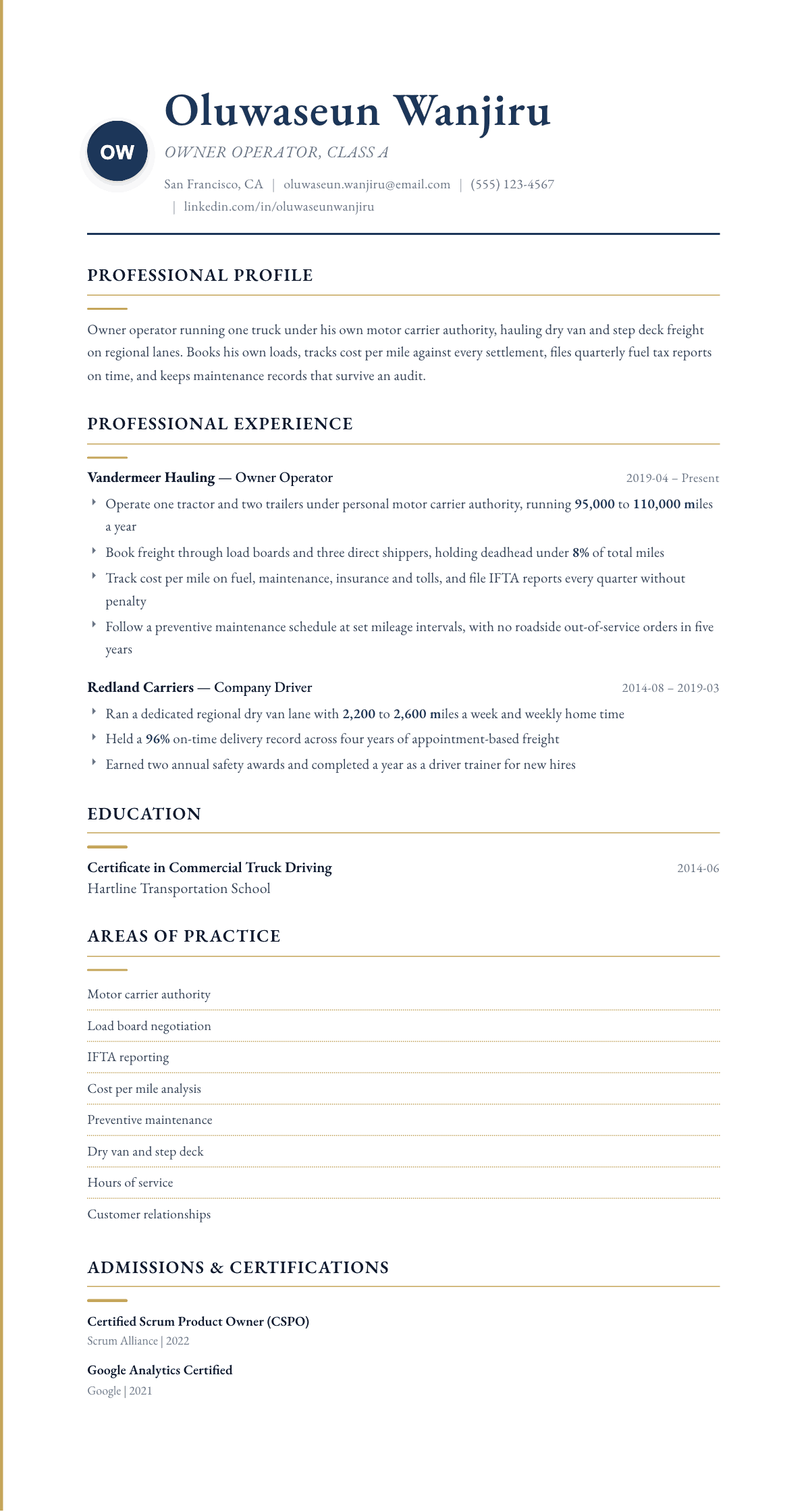
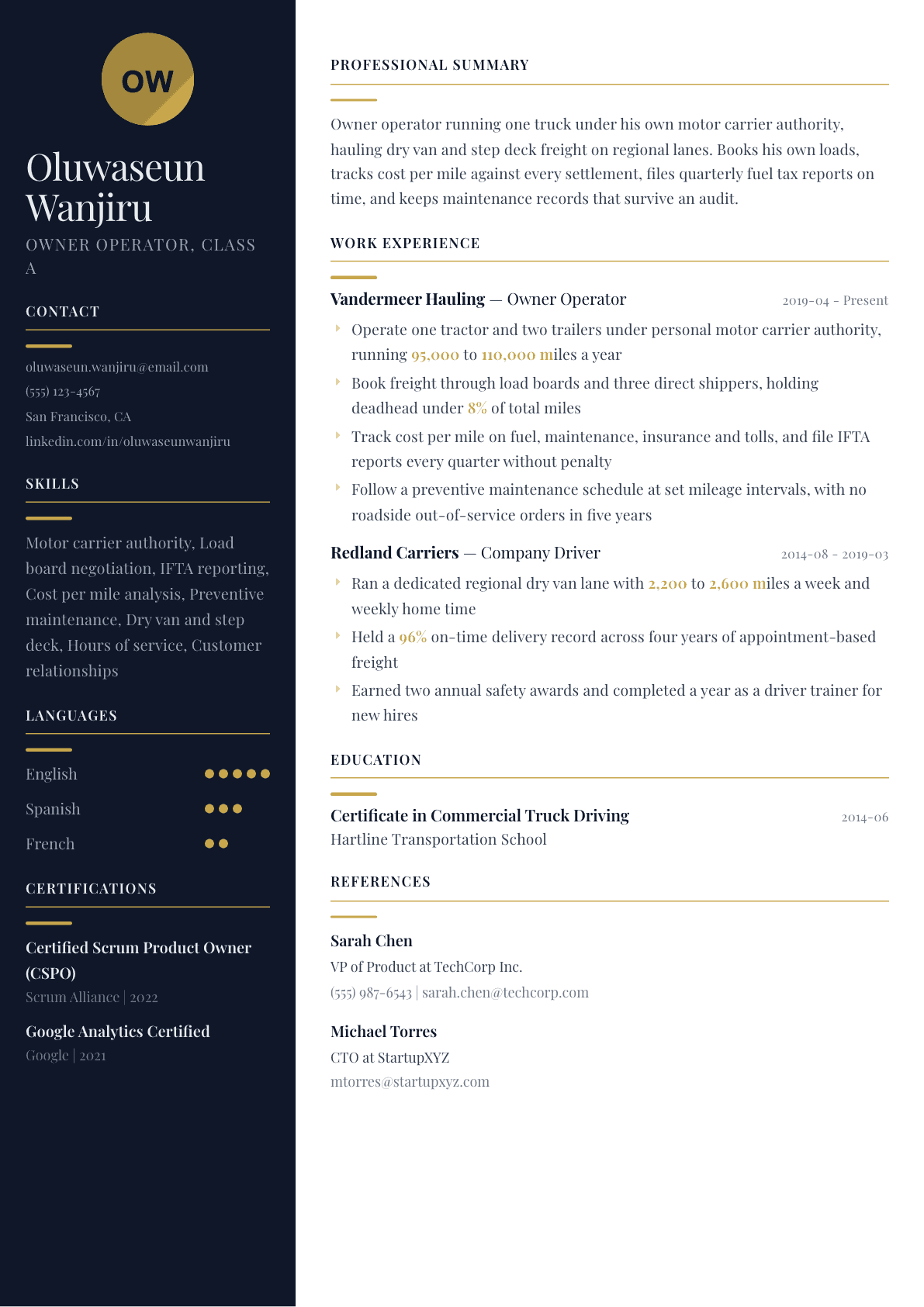
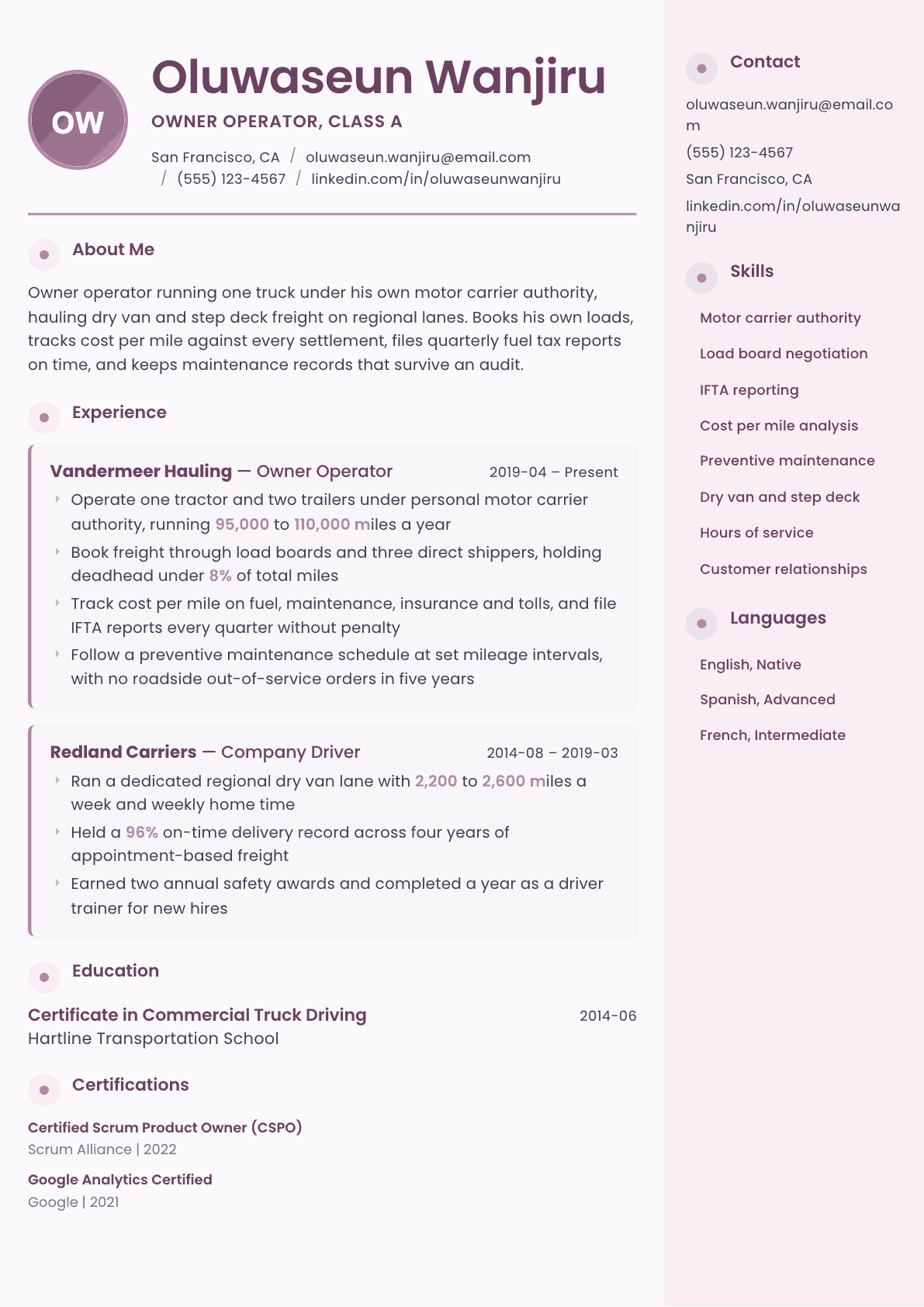
Example Owner Operator Truck Driver summary
Owner operator with eleven years behind the wheel, the last six under his own motor carrier authority running dry van and step deck freight on regional lanes. Books direct customers, holds deadhead under a tenth of total miles, files fuel tax quarterly, and has no out-of-service orders on record. Seeking a dedicated contract or a lease-on seat with a carrier that pays on the load and not the mile.
Skills to list on a Owner Operator Truck Driver resume
- Class A CDL
- Motor carrier authority
- Load board negotiation
- Rate per mile analysis
- IFTA fuel tax filing
- Preventive maintenance planning
- Dry van
- Step deck
- Hours of service
- Electronic logging device
- Customer account management
- Invoicing and settlements
- Load securement
- Trip planning
What actually gets this resume read
- Show the business side: authority, insurance, equipment owned, and the lanes or customers you built yourself.
- Give operating numbers a carrier respects: annual miles, deadhead ratio, on-time record and out-of-service history.
- Explain why you are applying, whether you are leasing on, selling the truck, or looking for a dedicated contract.
- List your maintenance discipline, since a carrier leasing you on inherits the risk of your equipment.
- Keep the tax and compliance work visible: quarterly fuel tax filings, annual inspections and audit history.
- Name the load boards, factoring service or dispatch software you used to keep the truck loaded.
How to write a owner operator truck driver resume
An owner operator resume has to work for two very different readers. One is a carrier recruiter looking for a driver to lease on, who reads your equipment, your authority status and your safety record as a risk assessment. The other is a customer or a broker deciding whether to hand you a dedicated lane, who reads the same page as a small business capability statement. Both need to see that you ran a truck as a business and not simply as a job.
That is the difference from a company driver page. Alongside miles and freight, an owner operator has numbers no employee has: deadhead ratio, cost per mile, maintenance intervals, quarterly fuel tax filings, insurance carried, and the customers won without a dispatcher. Those numbers are the argument, and leaving them off makes years of ownership look like an employment gap.
Below is the structure that works for both readers, how to write the business half without turning the page into an invoice, three example summaries, before and after bullets, and the questions owner operators ask when they lease on, sell the truck, or go back to a company seat.
Format: business identity, then equipment, then record
List your operation as an employer entry with your business name, your role as owner operator, and the dates, exactly as you would list a carrier. That single decision removes the appearance of a gap and frames the years correctly.
Under the contact block, give a short operating profile. It carries the facts a recruiter or broker needs before reading further, and it saves an entire round of email.
- Operating profile: authority status, years operating, equipment owned, insurance carried, and endorsements held.
- Equipment: tractor make and year range described in words, trailer types, and maintenance approach.
- Record: preventable accidents, out-of-service orders, inspection results and audit history.
Summary: what you run, how you keep it loaded, and why you are applying
Say in the first sentence what the operation is: one truck, two trailers, regional dry van and step deck, under your own motor carrier authority. Then say how the truck stays loaded, whether through load boards, direct customers or a dedicated contract, because that is the commercial skill an employee driver does not have.
Then state your intention plainly. Leasing on to a carrier, selling the equipment and returning to a company seat, and seeking a dedicated contract are three different applications, and a reader who has to guess assumes you will leave as soon as rates improve.
Experience: run the numbers a carrier respects
Cover four categories in your bullets: operating volume, freight sourcing, cost control and compliance. Operating volume is annual miles, loads per week and lanes. Freight sourcing is load boards, direct customers and how you priced the work. Cost control is cost per mile, deadhead ratio, fuel strategy and maintenance planning. Compliance is fuel tax filing, annual inspections, insurance and your safety record.
Write the maintenance discipline explicitly, because a carrier that leases you on inherits your downtime. Service intervals by mileage, in-frame work planned rather than reactive, tire management and a documented history all say the same thing: the truck will be under load next Tuesday.
If you had a period where the truck sat, address it once. Equipment down for a rebuild, a customer that folded, or a season spent on a lower-rate lane are ordinary events in the business, and naming one is far better than leaving three months unexplained.
Translating ownership for a company driver application
If you are returning to a company seat, keep the ownership evidence but shift the emphasis. Lead with driving: miles, freight types, service record, safety history. Then use two bullets, not eight, on the business side, framed as self-management rather than as running a competing operation.
Recruiters do worry that an owner operator will not take direction from dispatch. Answer that in the summary with a concrete reason for the change, such as wanting equipment cost and insurance off your own books, and the objection loses most of its force.
Skills and search terms brokers and recruiters use
The vocabulary that recurs across owner operator postings and broker conversations includes motor carrier authority, lease purchase, dedicated contract, cost per mile, rate per mile, deadhead, load board, factoring, settlement statement, fuel tax filing, preventive maintenance and out-of-service record.
Keep the freight vocabulary too. Dry van, step deck, flatbed, reefer, hotshot and power only each define which brokers will call, and the equipment you own decides which of those words belongs on your page.
Owner Operator Truck Driver resume summary examples
First year with own truck
Class A driver in the first year of operating a single tractor under a lease-purchase agreement, running regional dry van freight. Books through load boards, tracks fuel and maintenance costs against every settlement, and brings six prior years of company driving with a clean record.
Established one-truck operation
Owner operator running one tractor and two trailers under his own motor carrier authority, covering regional dry van and step deck lanes at roughly one hundred thousand miles a year. Holds deadhead under 8%, files fuel tax quarterly without penalty, and has no out-of-service orders in five years of operating.
Small fleet owner
Owner operator turned small fleet owner, running three trucks with two hired drivers on dedicated regional lanes. Handles authority, insurance, driver qualification files and customer contracts personally, and still drives one truck weekly. Eighteen years of commercial driving with no chargeable accidents.
Work experience bullets: before and after
Before: Owned and operated my own truck.
After: Operated one tractor and two trailers under personal motor carrier authority, covering a little over one hundred thousand miles a year on regional dry van and step deck lanes.
Equipment count, authority status, annual miles and freight types turn ownership into an operating profile a recruiter can size.
Before: Found my own loads.
After: Booked freight through load boards and three direct customers, negotiating rates per mile and holding deadhead under 8% of total miles run.
Direct customers and a deadhead ratio show commercial skill, which is the capability an employee driver cannot claim.
Before: Kept up with the paperwork.
After: Filed quarterly fuel tax reports and annual vehicle inspections on schedule with no penalties, and kept maintenance and settlement records ready for audit.
Naming the specific filings and the audit readiness shows administrative discipline rather than a general claim of being organized.
Before: Took care of the truck.
After: Followed a preventive maintenance schedule at set mileage intervals for oil, brakes and tires, with no roadside out-of-service orders across five years of operating.
A maintenance system paired with an out-of-service record speaks directly to the downtime risk a carrier is weighing.
Before: Made a profit every year.
After: Tracked cost per mile across fuel, maintenance, insurance and tolls on every settlement, and dropped two lanes that no longer covered operating cost.
The decision made from the numbers proves the tracking was real, which a bare profit claim never does.
Hard skills
- Motor carrier authority management
- Load board negotiation and rate setting
- Cost per mile tracking
- Quarterly fuel tax filing
- Preventive maintenance planning
- Dry van and step deck freight
- Load securement with straps and chains
- Hours-of-service compliance
- Electronic logging device use
- Settlement and invoice reconciliation
- Customer account development
- Insurance and permit administration
Soft skills
- Commercial judgment on rates
- Self-discipline without a dispatcher
- Direct customer relationship building
- Financial patience through slow seasons
- Willingness to take direction when leased on
Certifications worth listing
- Commercial Driver's License, Class A (State driver licensing agency)
- Motor Carrier Operating Authority (Federal Motor Carrier Safety Administration)
- Medical Examiner's Certificate (FMCSA National Registry of Certified Medical Examiners)
- Hazardous Materials Endorsement (H) (State driver licensing agency with TSA security threat assessment)
Mistakes that cost owner operator truck driver candidates the interview
- Leaving the ownership years off the page. Self-employment listed as an employer entry closes what would otherwise read as an unexplained gap.
- Writing only the driving. Authority, insurance, tax filing and customer development are the part of the record that no company driver can show.
- Giving revenue instead of operating ratios. Gross figures tell a reader nothing about the truck, while deadhead and cost per mile tell him everything.
- Failing to state why you are applying. A carrier assumes an owner operator is passing through unless the page gives a real reason for the change.
- Skipping the maintenance history. A leased-on truck that breaks becomes the carrier's service failure, so the schedule you keep is a selling point.
- Overloading the page with equipment specifications. Two lines on the tractor and trailers is enough, and the rest belongs in the conversation.
Owner Operator Truck Driver resume questions
How do I list self-employment as an owner operator on a resume?
Use your business name as the employer, owner operator as the title, and month and year dates like any other job. Then write bullets on miles, freight, customers and compliance so a reader sees an operating record rather than a period of unclear activity.
Will carriers hold my authority against me when I apply as a company driver?
Some recruiters worry that an owner operator will not accept dispatch direction. Address it in a line of the summary by explaining why you want equipment cost and insurance off your books, then let your safety and service record carry the rest.
What operating numbers should an owner operator show?
Annual miles, loads per week, deadhead ratio, on-time record, out-of-service history and the number of direct customers you built. Those six describe both driving capability and business capability, which is what separates your page from a company driver application.
Should I mention a lease purchase agreement?
Yes, and describe it plainly, including whether the truck is paid off or still under contract. Carriers want to know what equipment you bring and what obligations follow you, and the honest version prevents an awkward conversation during orientation.
How do I present a year when the truck was down?
Name the reason in one line, such as an engine rebuild or a customer that closed, then show what you did during the period. Equipment downtime is a normal part of running one truck, and an explained pause reads far better than a silent gap.
Related resume examples
- Truck Driver Resume example
- OTR Truck Driver Resume example
- CDL Driver Resume example
- Freight Broker Resume example
- Local Truck Driver Resume example
- Transportation Manager Resume example