OTR Truck Driver Resume Examples: the lines they read
Build an OTR Truck Driver Resume Recruiters Call Back
By Mustafa Tarabya, founder of CVBooster · Published · Updated
An OTR truck driver resume example with miles per year, safety record, endorsements and trailer types, plus ATS keywords and a writing guide.
Sample resumes for a otr truck driver
The same otr truck driver content laid out in three CVBooster templates, so you can see what the finished document looks like before you write a word.
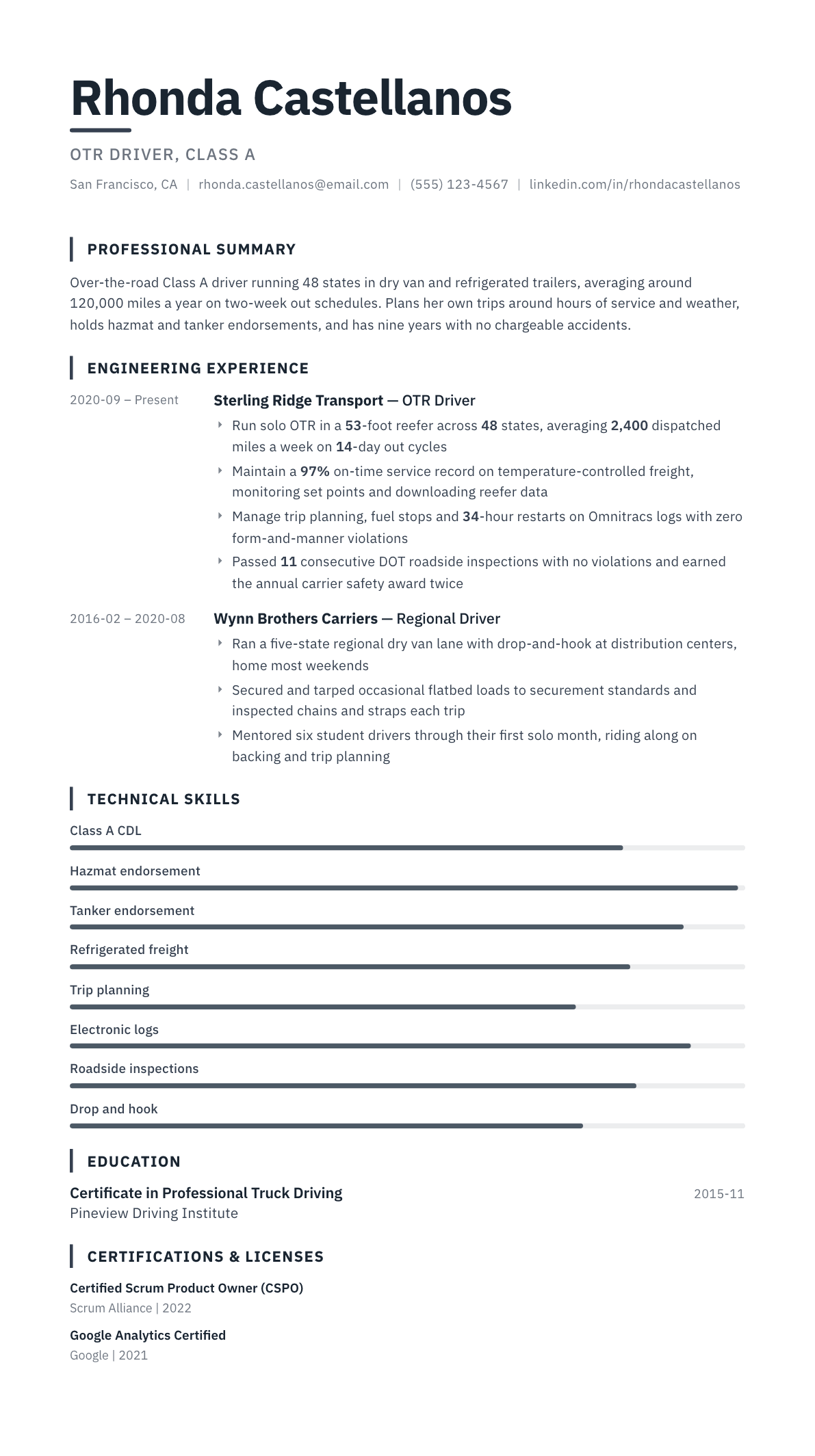
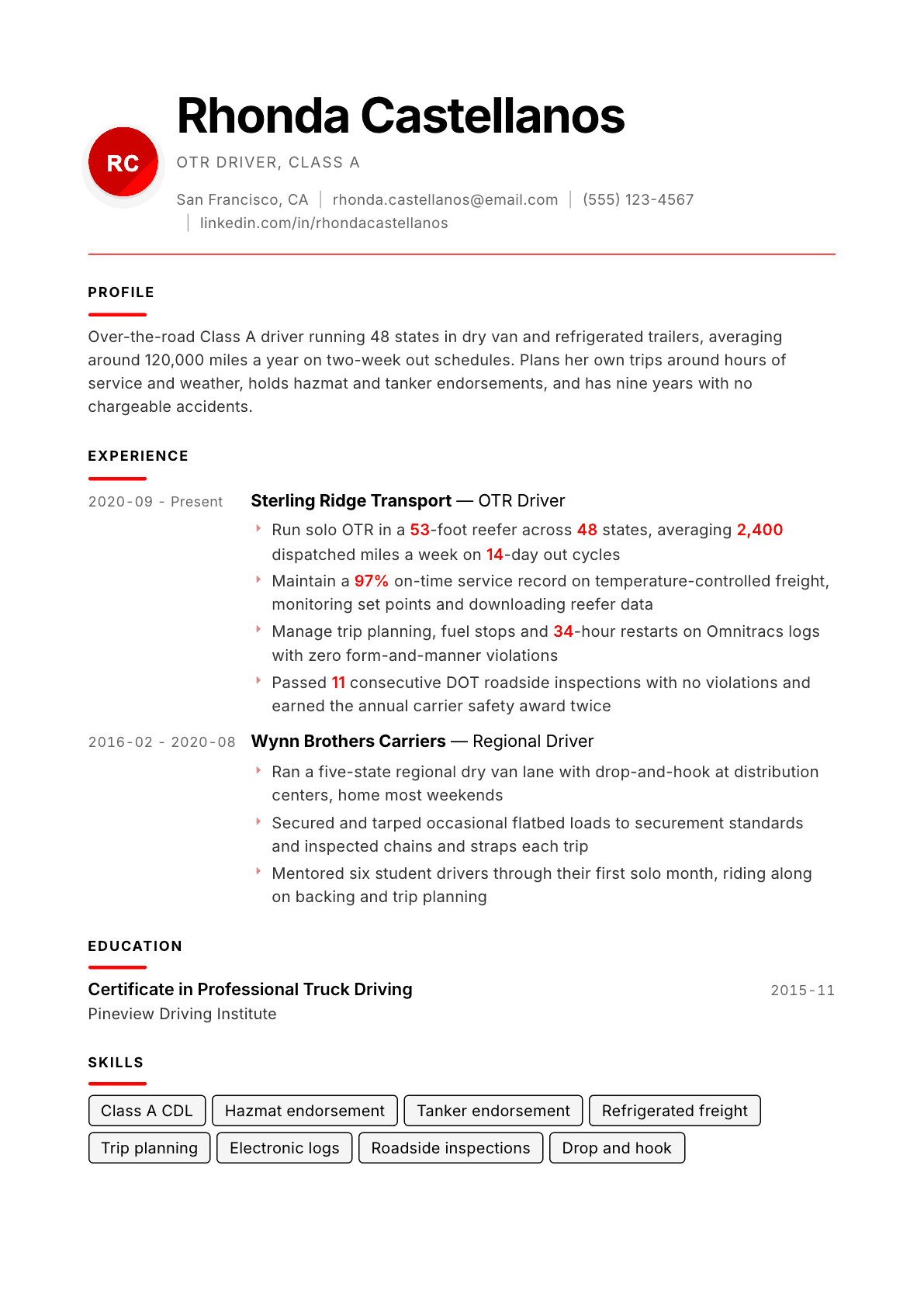
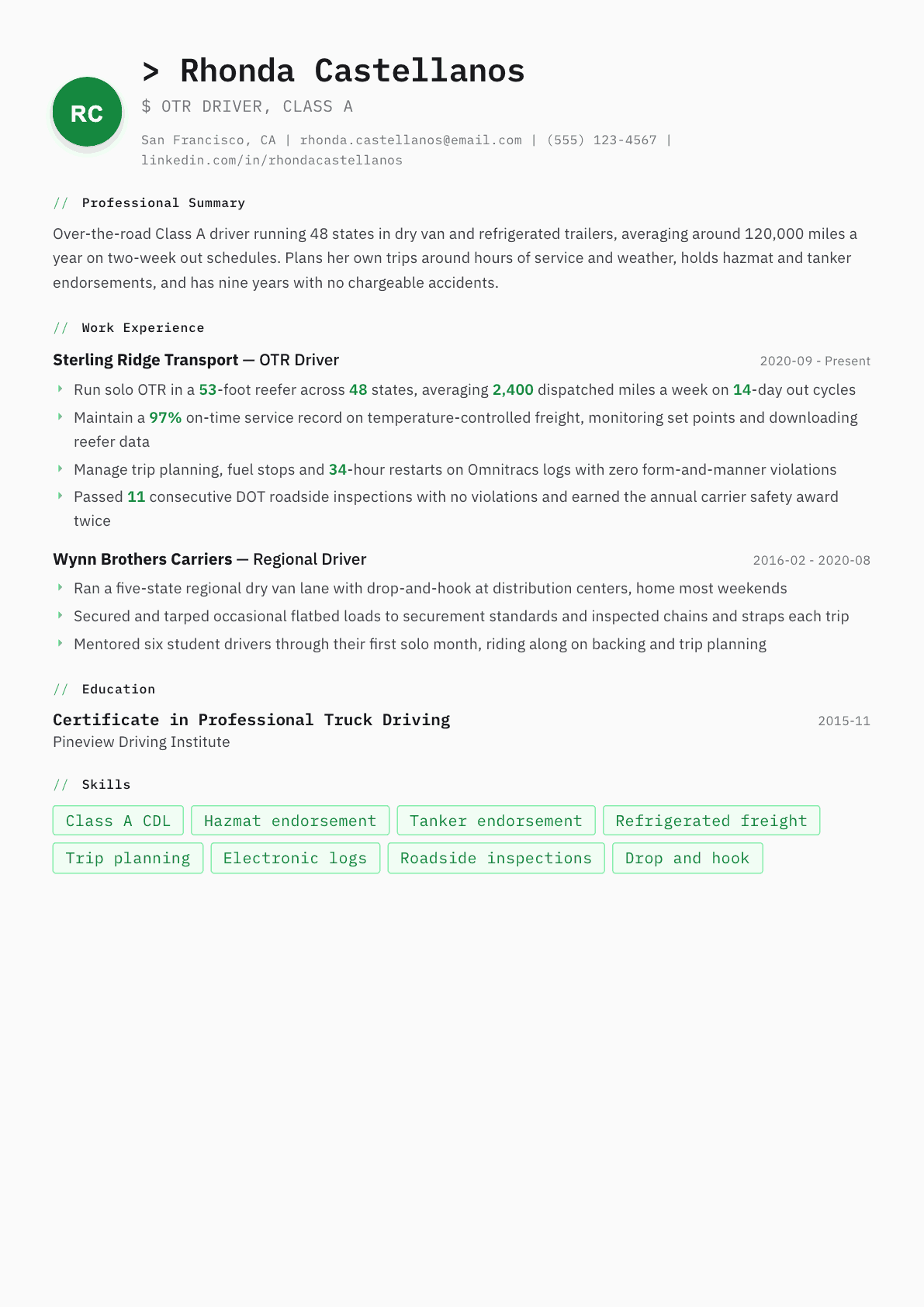
Example OTR Truck Driver summary
Over-the-road Class A driver with nine years running 48 states in dry van and refrigerated trailers, averaging around 2,400 dispatched miles a week on two-week cycles. Holds hazmat and tanker endorsements, plans her own trips around hours of service, and has no chargeable accidents and no logbook violations. Looking for a solo OTR seat with consistent freight and predictable home time.
Skills to list on a OTR Truck Driver resume
- Class A CDL
- Over-the-road driving
- Hazmat endorsement
- Tanker endorsement
- Refrigerated trailers
- Dry van
- Trip planning
- Hours of service
- Electronic logging device
- Drop and hook
- Roadside inspection
- Load securement
- Chain of custody paperwork
- Preventive maintenance checks
What actually gets this resume read
- Lead with miles per year and the lanes you ran, because that is the first number a recruiter asks for on the phone.
- List every endorsement by its letter code so both the software and the recruiter can see them at a glance.
- Give the trailer types: dry van, reefer, flatbed, tanker or doubles, since each one changes who will hire you.
- State your accident and violation history directly, and account for every gap between carriers by month.
- Show that you plan your own trips: fuel stops, restarts, appointment times, and how you handle a broken appointment.
- Note whether you run solo or team and how many days you are willing to stay out on a cycle.
How to write a otr truck driver resume
An OTR resume is read by a recruiter who is verifying three things before anything else: that your license and medical card are current, that your last three years of employment can be confirmed month by month, and that your accident and violation history will pass the carrier insurance underwriter. Nothing on the page matters until those clear, so the page should open with them rather than with a paragraph about dedication.
After the screening comes the fit question. Freight is not interchangeable. Reefer work means set points, pre-cooling and produce appointment times. Flatbed means tarping, chains and load angles. Tanker means surge and product handling. Dry van drop-and-hook is a different rhythm from live load. An OTR truck driver resume that names the trailer types and lanes gets routed to a recruiter with matching seats to fill.
This guide covers how to structure that page, what numbers to put in the summary, how to write experience that survives verification, three example summaries, before and after bullets, and the questions long-haul drivers ask most when they change carriers.
Format: a driver profile block, then carriers in order
Keep the layout plain and put a driver profile block under your contact details. Recruiters copy these fields straight into an application, so make them easy to lift.
Below that, list carriers in reverse-chronological order with month and year on both ends. Employment verification for interstate driving reaches back three years, so a resume with only years listed will generate a phone call asking for months anyway.
- Driver profile: CDL class and state, endorsements by letter, medical card expiry, total commercial miles, and years of over-the-road experience.
- Safety line: preventable accidents, moving violations, out-of-service orders and inspection history.
- Preferences: solo or team, days out per cycle, lanes you will run, and whether you will take hazmat freight.
Summary: miles, lanes, freight and home time
Recruiters ask about weekly miles on the first phone call, so answer it in writing first. Give dispatched miles a week or miles a year, the region or the number of states, the trailer type and the cycle you run. That is four facts in one sentence and it positions you against every other applicant in the stack.
Use the last line for the differentiator: endorsements, a safety award, a service record on appointment-critical freight, or experience training students. Avoid describing yourself as a safe and reliable driver, since every applicant claims that and none of them prove it in the summary.
Experience: freight, service record and self-management
Each carrier entry should name the equipment, the lane structure and the freight. Then use bullets to show the parts of OTR work that cannot be supervised: trip planning, fuel stops, appointment negotiation, weather routing and clock management across a cycle.
On-time service is the metric a customer service manager lives on, so put your service percentage or your record on appointment freight in a bullet. Follow it with equipment discipline: reefer downloads, pre-cool and set point checks, chain and strap inspection, tire and fluid checks at every stop.
Do not write bullets about obeying traffic laws or maintaining a positive attitude. They take the space where a real bullet about a lane, a customer or a difficult delivery should sit.
Safety and compliance history in your own words
Carriers pull your motor vehicle record and your inspection history, so write yours first and write it accurately. Give the count of preventable accidents, moving violations in the last three years, and how many roadside inspections you have passed with no violations. Clean inspection streaks carry real weight because they roll into the carrier safety measurement.
If you have an event on your record, do not hide it and do not narrate it on the resume. A single neutral line is enough, and you keep the explanation for the interview where you can describe what changed in your driving afterward.
Endorsements, equipment and keywords
Write endorsements by both letter and word, since a recruiter may search either. Hazmat, tanker, doubles and triples each open seats that pay differently, and a combination such as hazmat with tanker qualifies you for freight most applicants cannot take.
Common phrases across OTR postings include over-the-road, dispatched miles, drop and hook, live load, hours of service, electronic logging device, trip planning, reefer, dry van, flatbed, load securement, clean motor vehicle record and no preventable accidents. Mirror them once in the skills section and once where a bullet proves them.
OTR Truck Driver resume summary examples
Under a year OTR
Class A driver with nine months of solo over-the-road running dry van freight in a 48-state operation, averaging 2,100 dispatched miles a week. Completed entry-level driver training and a six-week mentor program, holds a clean record, and is comfortable staying out three weeks at a time.
Four years over the road
Over-the-road driver with four years in refrigerated freight, averaging 2,400 dispatched miles a week on 14-day cycles across 48 states. Holds hazmat and tanker endorsements, maintains a 97% on-time record on temperature-controlled loads, and has passed eleven consecutive roadside inspections with no violations.
Veteran driver and mentor
Long-haul driver with sixteen years and no chargeable accidents, running dry van, reefer and occasional flatbed lanes coast to coast. Spent the last three years as a finishing trainer, taking 22 new drivers through backing, trip planning and securement before their solo assignment.
Work experience bullets: before and after
Before: Drove long distances across the country.
After: Ran solo over-the-road in a 53-foot reefer across 48 states, averaging 2,400 dispatched miles a week on 14-day out cycles.
Trailer type, coverage, weekly miles and cycle length answer the four questions the recruiter would otherwise ask on the phone.
Before: Delivered loads on time.
After: Held a 97% on-time service record on appointment-based temperature-controlled freight, monitoring set points and downloading reefer data at each delivery.
The service figure and the reefer routine show a driver who protects the load rather than one who simply arrives.
Before: Kept my logbook up to date.
After: Planned fuel stops, breaks and 34-hour restarts around appointment times on Omnitracs logs, with no hours-of-service or form-and-manner violations in four years.
It reframes logging as trip planning, which is the skill that actually keeps a truck legal and loaded.
Before: Passed DOT inspections.
After: Passed eleven consecutive DOT roadside inspections with no violations recorded and earned the carrier annual safety award twice.
A count of clean inspections is verifiable through state records, so it carries far more weight than the general claim.
Before: Helped new drivers learn the job.
After: Mentored six student drivers through their first solo month, riding along on backing, trip planning and shipper check-in until each ran a full week unassisted.
Naming what was taught and the end point shows a training result rather than an informal favor to a colleague.
Hard skills
- Class A commercial driving
- Over-the-road trip planning
- Refrigerated trailer operation
- Dry van and flatbed freight
- Hazmat and tanker endorsement work
- Hours-of-service management
- Electronic logging device use
- Load securement with straps and chains
- Drop and hook and live load procedures
- Pre-trip and en route equipment checks
- Scale and weight distribution management
- Winter and mountain route driving
Soft skills
- Self-management across long cycles
- Discipline with the clock
- Calm handling of delays
- Respectful shipper communication
- Endurance and routine
Certifications worth listing
- Commercial Driver's License, Class A (State driver licensing agency)
- Hazardous Materials Endorsement (H) (State driver licensing agency with TSA security threat assessment)
- Transportation Worker Identification Credential (Transportation Security Administration)
- Medical Examiner's Certificate (FMCSA National Registry of Certified Medical Examiners)
Mistakes that cost otr truck driver candidates the interview
- Writing only years for each carrier. Verification runs on months, so a year-only history creates work for the recruiter and doubt about a gap.
- Leaving the trailer types out. A recruiter fills reefer seats and flatbed seats separately, and a resume without freight types cannot be matched to either.
- Rounding weekly miles upward. Dispatch records and settlements are checked at orientation, and an inflated figure ends the process late and badly.
- Hiding a preventable accident. Underwriters see the record regardless, and the discovery costs you more than the event itself would have.
- Skipping the endorsements you already hold. Hazmat and tanker qualify you for freight most drivers cannot take, which is leverage on pay.
- Padding the page with personal preferences about music, pets or riders. Those belong in the recruiter call, not the resume.
OTR Truck Driver resume questions
How many miles a week should I list on an OTR resume?
List the honest average from your settlements, given as a range if it moved with the season. Dispatch history is verified at orientation, and a recruiter reads a realistic figure with a stated cycle length as more credible than a peak week presented as normal.
Do I have to explain gaps between carriers?
Yes. Interstate carriers must account for three years of employment history, so any gap over a month will be questioned. Write one plain line such as home for a family matter or waiting on a medical card renewal and the issue closes there.
Is a hazmat endorsement worth listing if I never hauled hazardous freight?
Absolutely. Holding it means you passed the knowledge test and the security threat assessment, which is the slow part. Recruiters filter on the endorsement itself because it means you can be put on placarded freight without waiting weeks for clearance.
How do I show OTR experience if my last job was a mentor seat?
Treat the mentor period as its own entry with dates, the miles covered and the freight run. Training seats involve real dispatched miles under supervision, so describe the equipment and lanes rather than presenting the time as school.
Should an over-the-road driver mention preferred home time?
One short line is useful because it saves both sides a wasted call. Say the cycle you will run, such as two or three weeks out with four days home, and recruiters will route your application toward the fleets that actually offer it.
Related resume examples
- Truck Driver Resume example
- CDL Driver Resume example
- Local Truck Driver Resume example
- Owner Operator Truck Driver Resume example
- Courier Resume example
- Drone Pilot Resume example