Truck Driver Resume Examples: free ATS score and gap list
Drive Your Truck Driver Resume to the Finish Line
By Mustafa Tarabya, founder of CVBooster · Published · Updated
Truck driver resume examples with the skills recruiters filter on, a written out skills block, ATS keywords and an otr truck driver resume sample.
Sample resumes for a truck driver
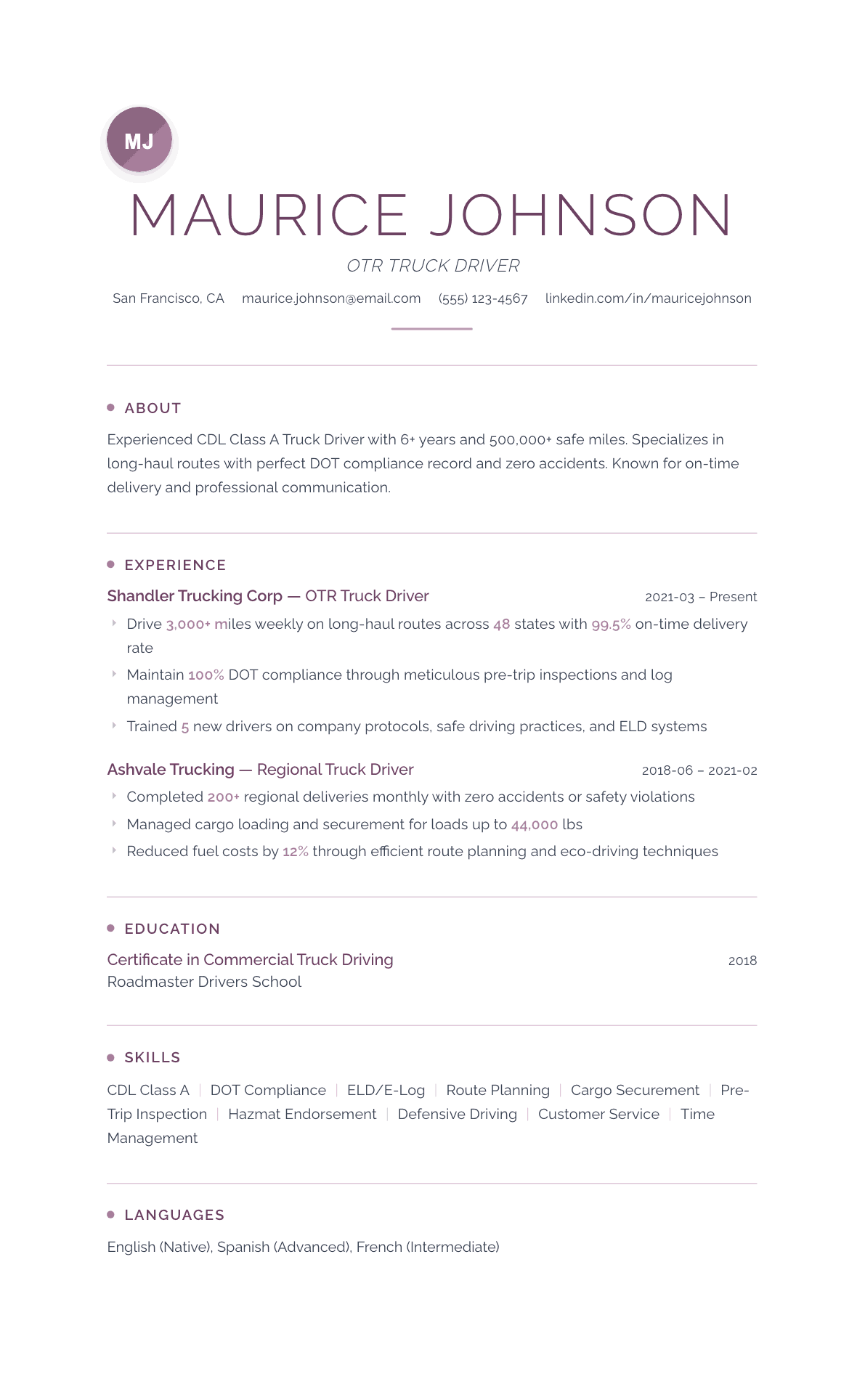
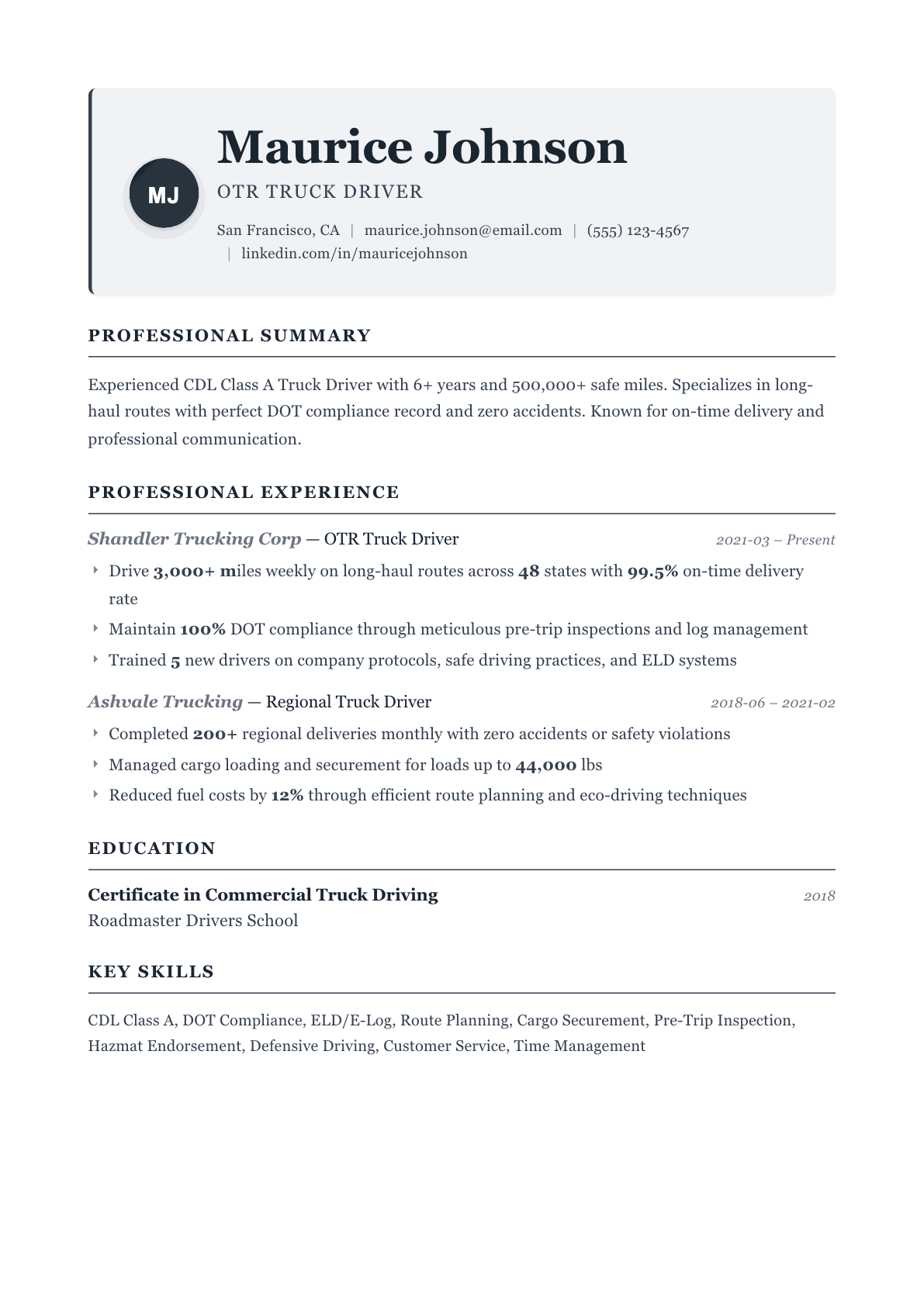
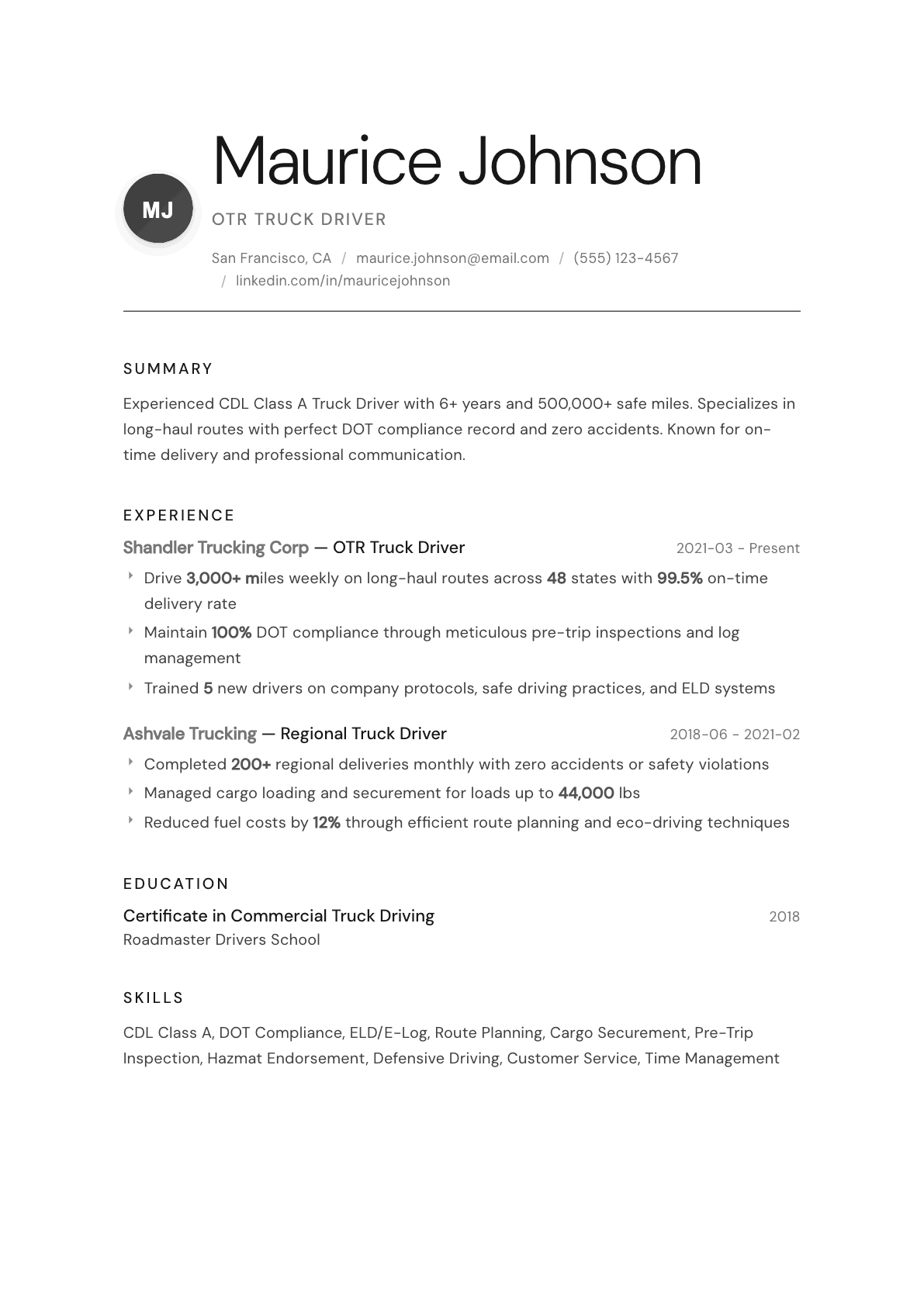
The same truck driver content laid out in three CVBooster templates, so you can see what the finished document looks like before you write a word.
Example Truck Driver summary
CDL Class A driver with hazmat endorsement, 6 years and 500,000 miles with no accidents or violations. Runs 3,000 miles a week over the road at 99.5% on-time delivery, keeps electronic logs clean through every DOT inspection, and has trained five new drivers.
Skills to list on a Truck Driver resume
- CDL Class A
- DOT Compliance
- ELD/E-Log
- Route Planning
- Cargo Securement
- Pre-Trip Inspection
- Hazmat Endorsement
- Defensive Driving
- Customer Service
- Time Management
What actually gets this resume read
- List CDL class, endorsements (hazmat, tanker, doubles), and clean driving record.
- Quantify: miles driven, on-time delivery rates, safety record.
- Include specific equipment experience (flatbed, reefer, tanker).
- Show DOT compliance and inspection pass rates.
- Mention technology proficiency (ELD, GPS, fleet management apps).
How to write a truck driver resume
A truck driver resume is screened by a recruiter who is checking hireability before talent. License class, endorsements, medical card, accident and violation history, employment gaps, and whether your experience matches the equipment on their yard. Everything else is secondary, because a carrier cannot seat a driver who will not pass the qualification file.
The second read is about fit. Over the road, regional and local delivery are different lives, and so are dry van, reefer, flatbed, tanker and car haul. A driver resume that never names the trailer type or the run pattern makes a recruiter guess, and a guessing recruiter calls the next file instead.
This guide covers what belongs in the qualification header, how to write experience for a driving job without turning it into a list of chores, how to handle gaps and accidents honestly, sample summaries for a new CDL holder through to an owner operator, and the questions drivers ask when changing carriers.
Format: one page, qualification facts at the top
One page is right for almost every driver. Put a qualification block directly under your name so a recruiter can clear you in ten seconds: CDL class and state, endorsements, restrictions, medical card status, years of verifiable experience and the equipment you run.
Use plain single-column text. Many carrier application systems parse the resume into their own driver qualification form, and anything decorative drops information that the Department of Transportation file requires anyway.
- Header: name, city and state, phone, email, CDL class and issuing state.
- Qualification block: endorsements such as hazmat, tanker, doubles and triples, plus medical card expiration and TWIC if you hold one.
- Order: summary, qualifications, driving experience, safety record, equipment, other work history, training.
Summary: run type, equipment, miles, record
Three lines. Say the run pattern you want and have done, the trailer types, the miles or stops behind you, and the state of your record. A recruiter hiring for a dedicated regional reefer account is looking for exactly those words, and a summary that says "hardworking professional driver" matches nothing.
If you are changing run type, say it directly. A driver leaving long haul for a local route should write that they are seeking a home daily position and name the local delivery skills already in hand, such as backing into tight urban docks or handling a liftgate.
Driving experience: carrier, equipment, freight, run pattern
Every driving job needs the carrier, whether it was company driver or owner operator, the tractor and trailer, the freight, the run pattern and the region. "Company driver, day cab and 53 foot dry van, dedicated grocery account, five stops a day across three states" tells a recruiter what you can do tomorrow.
Then bullets on what makes you a safer or more reliable driver than the next application. Pre-trip and post-trip inspection habits, load securement to the cargo securement rules, temperature monitoring and reefer download procedures, hours of service discipline in the electronic logging device, and how you handle a breakdown or a customer refusal.
Leave out the tasks every driver performs. "Delivered freight on time" and "drove a truck safely" occupy the space where your accident-free years, roadside inspection results and specialty freight experience should be.
Safety record and compliance: a section of its own
Give the safety record plainly: years and miles without a preventable accident, roadside inspections passed clean, and any awards or safety bonuses earned. Clean inspection history matters because it feeds the carrier safety scores that determine insurance costs and audit exposure.
Be honest about incidents. Carriers pull the motor vehicle record and the previous employer verification anyway, and a surprise late in the process ends the hire faster than the incident itself would have. Do not narrate incidents on the resume, but never claim a clean record the record will contradict.
The same applies to gaps. Write months and years for every position and explain a long gap in one short line, because unexplained time is a red flag in a driver qualification file.
Truck driver skills for a resume, and where each one goes
Truck driving skills for a resume belong in three places, not in one list. Licensing facts go in the qualification block, equipment, driving and compliance skills go in a short skills block under it, and people skills go inside the job bullets with proof attached. A skills list that mixes all three into one column of single words is the version recruiters skim past.
Here is the skills block written out for an invented regional driver, Marcus Hale, so you can see the level of detail that matches a carrier posting. Keep only what is true of you and spell each term the way the posting does.
- Licensing: CDL Class A, hazmat and tanker endorsements, no restrictions, medical card current, TWIC held.
- Equipment: day cab and sleeper tractors, 53 foot dry van and reefer, manual and automated transmissions, liftgate and electric pallet jack.
- Driving skills: blind side and alley docking, tight urban backing, mountain grades and chain law routes, winter driving.
- Compliance skills: pre-trip and post-trip inspection, hours of service planning in the electronic logging device, cargo securement, bill of lading and proof of delivery paperwork.
- People skills, proven in bullets rather than listed: calm dispatch updates when a load runs late, courtesy with receivers at the dock, and handling a refused load without a scene.
Terms recruiters filter on
Carrier job postings repeat a narrow set of terms: CDL Class A, hazmat, tanker, doubles and triples, over the road, regional, dedicated, home daily, dry van, reefer, flatbed, electronic logging device, hours of service, pre-trip inspection, cargo securement, backing, and clean motor vehicle record. Use the ones that are true of you, spelled the way the posting spells them, since driver recruiting systems search on exactly those strings.
Truck Driver resume summary examples
New CDL holder
CDL Class A holder with a recently completed 160 hour entry level driver training program and eight weeks over the road with a trainer. Comfortable with manual and automated transmissions, electronic logging and pre-trip inspection. Seeking an over the road position with a mentor program.
Six years driving
CDL Class A driver with six years and roughly 600 thousand accident-free miles across dry van and refrigerated freight in the lower 48. Hazmat and tanker endorsed, clean motor vehicle record, and three consecutive years of clean roadside inspections. Seeking a dedicated regional lane.
Owner operator
Owner operator with 14 years running flatbed and step deck under my own authority, hauling steel and machinery across the Midwest and Southeast. Maintains an equipment maintenance file, handles permitting for oversize loads, and holds a clean inspection history with no preventable accidents.
Work experience bullets: before and after
Before: Drove a truck and delivered freight on time.
After: Ran dedicated regional lanes in a 53 foot reefer, delivering 5 stops a day to grocery distribution centers across three states with 99% on-time arrival.
Equipment, run pattern, stop count and a service number let a recruiter match you to an open account immediately.
Before: Maintained a good safety record.
After: Logged six years and 600 thousand miles with no preventable accidents, and passed 22 roadside inspections with no violations recorded.
Miles, years and clean inspection counts are the exact figures that feed a carrier safety file.
Before: Performed inspections on the truck.
After: Completed pre-trip and post-trip inspections on tractor and trailer, catching a cracked brake drum and two air leaks before dispatch during the last year.
Naming the defects you found proves the inspection is real rather than a signature on a form.
Before: Secured loads before driving.
After: Secured steel coils and machinery on flatbed and step deck using chains, binders and edge protection to the cargo securement rules, with no load shift claims.
The freight type, the equipment used and the outcome show competence a flatbed recruiter can verify.
Before: Used electronic logs and followed the rules.
After: Planned routes and fuel stops around hours of service in the electronic logging device, finishing the year with no log violations and no service failures from running out of clock.
Trip planning around the clock is the skill behind the compliance, and the strong version shows both.
Hard skills
- CDL Class A operation
- Pre-trip and post-trip inspection
- Cargo securement and load balancing
- Hours of service and electronic logging
- Dry van, refrigerated and flatbed equipment
- Reefer temperature monitoring
- Backing and urban dock maneuvering
- Route and fuel planning
- Bill of lading and delivery paperwork
- Hazardous materials handling
- Basic roadside troubleshooting
- Department of Transportation compliance
Soft skills
- Alertness on long runs
- Customer courtesy at the dock
- Independent problem solving
- Punctuality
- Clear dispatch communication
- Patience in traffic and weather
Certifications worth listing
- Commercial Driver's License, Class A (State Department of Motor Vehicles)
- Hazardous Materials Endorsement (State licensing agency with TSA security threat assessment)
- Tanker and Doubles and Triples Endorsements (State licensing agency)
- Transportation Worker Identification Credential (TWIC) (Transportation Security Administration)
- Medical Examiner's Certificate (FMCSA National Registry certified medical examiner)
- Smith System Defensive Driving (Smith System Driver Improvement Institute)
Mistakes that cost truck driver candidates the interview
- Burying the CDL class and endorsements in a skills list instead of putting them under your name where a recruiter clears you.
- Leaving month and year off employment dates, which makes the driver qualification file impossible to build.
- Claiming an accident-free record that the motor vehicle record and previous employer checks will contradict.
- Never naming the trailer type or run pattern, so a recruiter cannot match you to an open lane.
- Skipping the medical card status and expiration, which a recruiter has to ask about before doing anything else.
- Writing a page of generic duties when clean inspections, specialty freight and endorsements are what actually get you hired.
Truck Driver resume questions
How do I explain a gap in my driving history?
Give the months and one short reason on the same line, such as caring for a family member, recovering from surgery or attending training. Carriers must account for every period in the qualification file, so an explained gap moves faster than a silent one.
Should I put an accident on my truck driver resume?
Do not describe incidents on the resume, but never state a clean record if your motor vehicle record shows otherwise. Prepare a short factual explanation for the interview, since the recruiter will see the record during the background check anyway.
How many miles should I list?
List total verifiable accident-free miles across your driving career and, where useful, the miles per week you typically ran. Recruiters use both to judge experience level and to check that your expectations match the pay package they offer.
Do I need a resume if the carrier has an online application?
Yes. The application builds the qualification file, but the resume is what a recruiter reads first and shares with the hiring manager. It is also where you show equipment experience and safety record in a form the application never asks for.
How do I go from over the road to a local driving job?
State the goal in the summary and lead with the skills local work requires: tight backing, multiple daily stops, customer contact, liftgate or pallet jack use and city routing. Long haul mileage alone does not persuade a local dispatcher you can handle 12 stops a day.
Related resume examples
- Warehouse Worker Resume example
- Logistics Coordinator Resume example
- Delivery Driver Resume example
- Local Truck Driver Resume example
- School Bus Driver Resume example
- Tow Truck Driver Resume example