CDL Driver Resume Examples: free ATS score and gap list
Write a CDL Driver Resume Built Around Your License
By Mustafa Tarabya, founder of CVBooster · Published · Updated
A CDL driver resume example that puts license class, endorsements and safety record up front, with ATS keywords and a section-by-section guide.
Sample resumes for a cdl driver
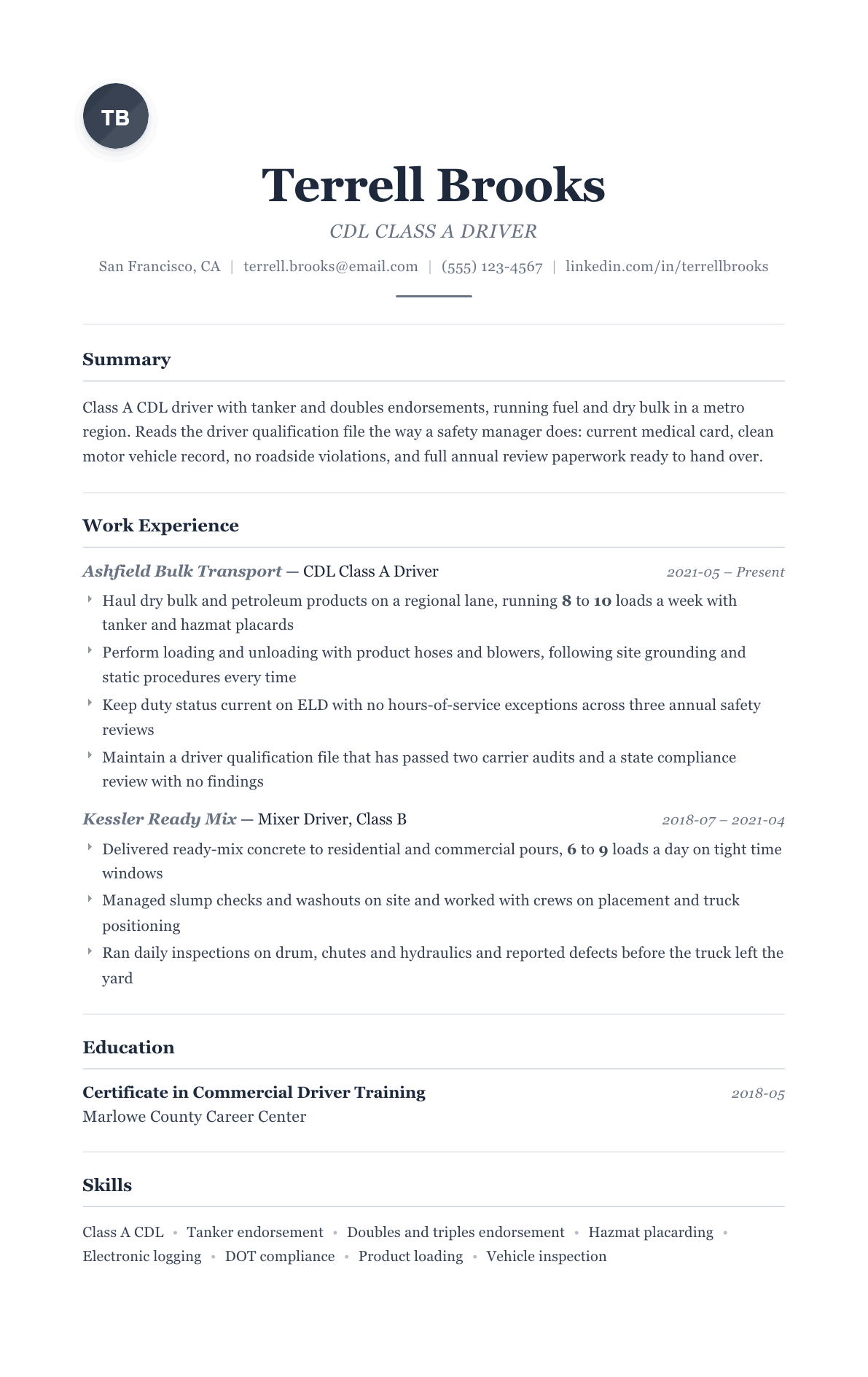
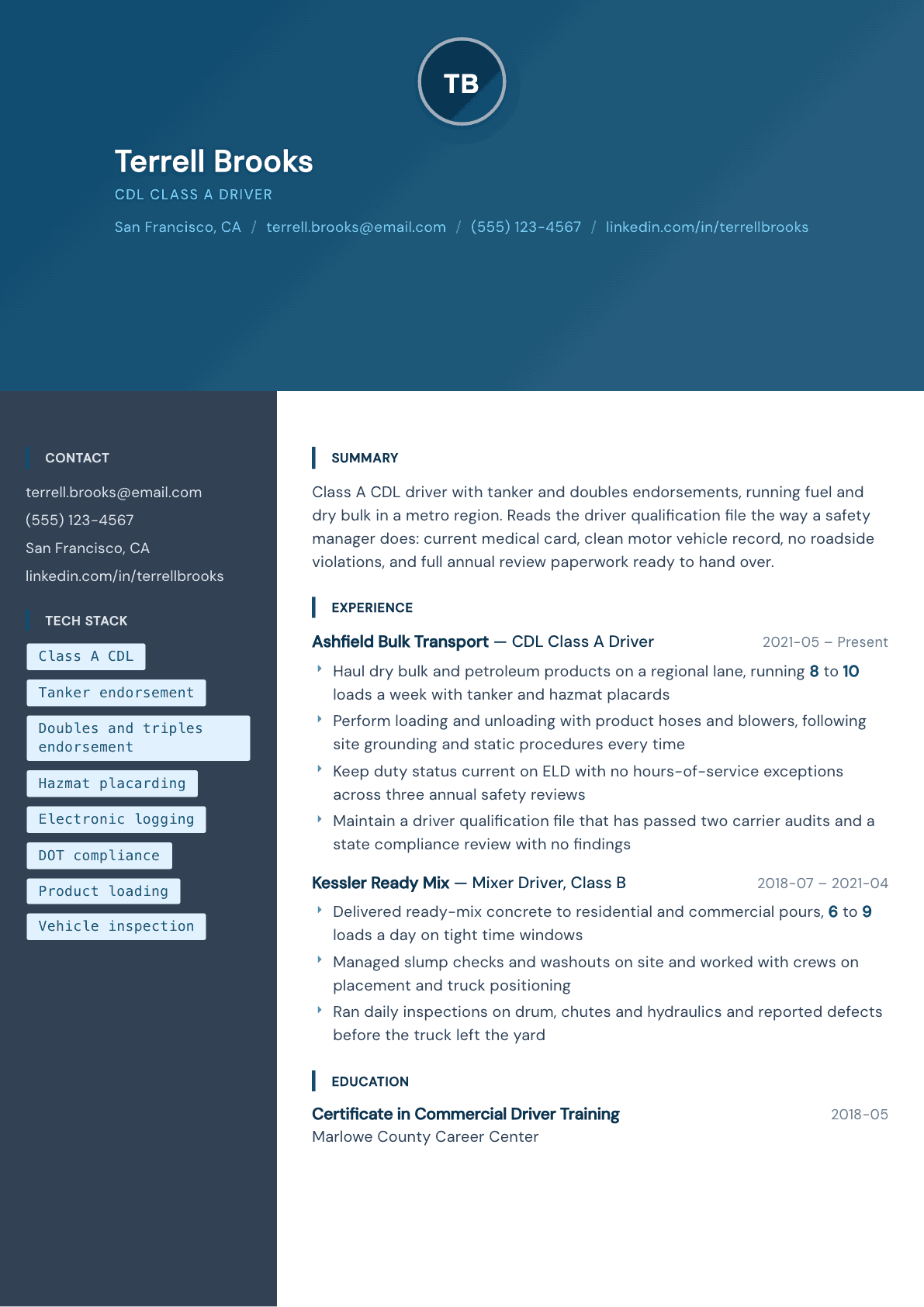
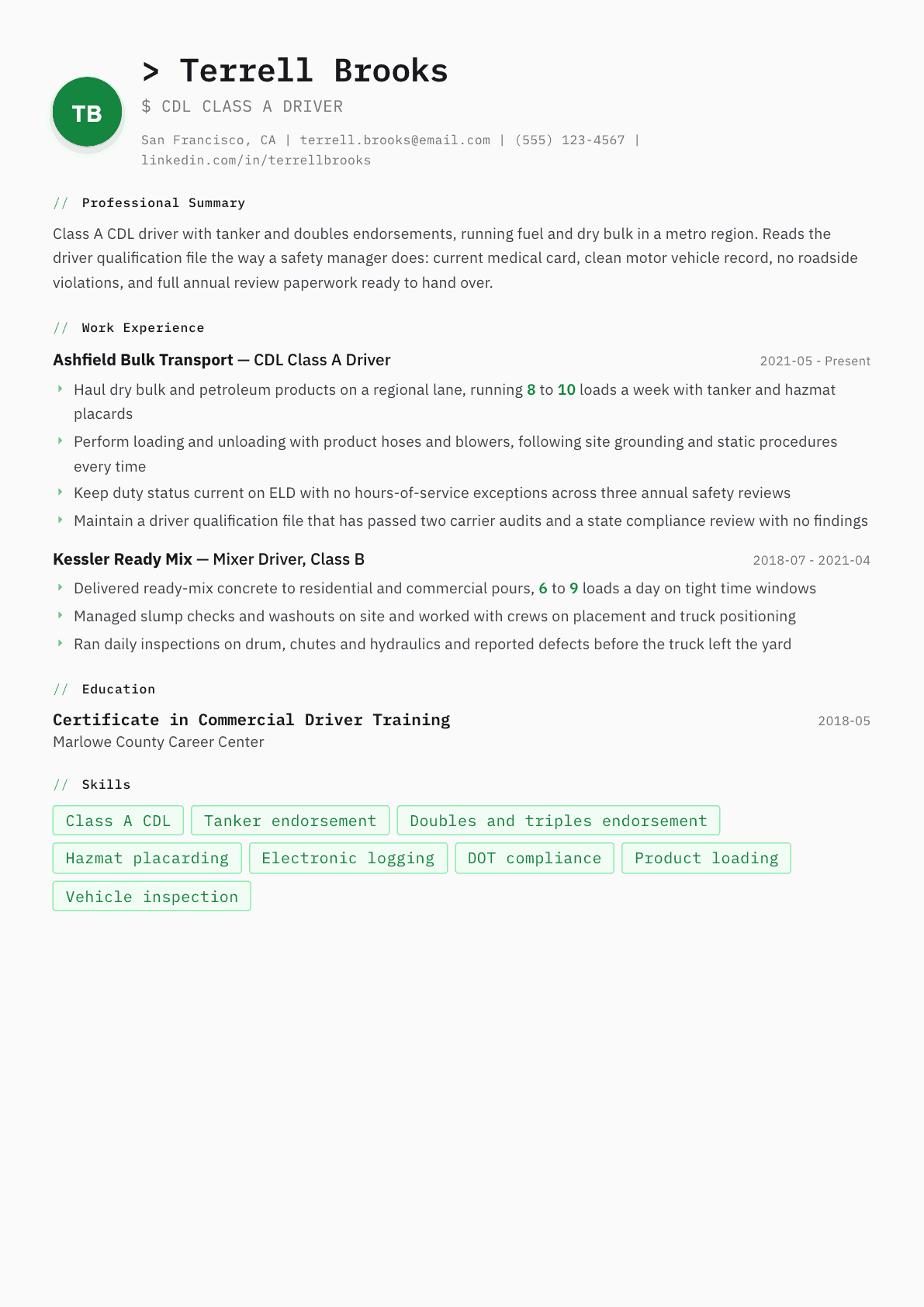
The same cdl driver content laid out in three CVBooster templates, so you can see what the finished document looks like before you write a word.
Example CDL Driver summary
Class A CDL driver with seven years across bulk tanker and ready-mix work, holding tanker, hazmat and doubles endorsements and a current medical examiner certificate. Runs 8 to 10 loads a week, handles his own product loading under site safety procedures, and has passed carrier and state compliance audits with no findings. Seeking a regional seat with steady freight and a well kept fleet.
Skills to list on a CDL Driver resume
- Class A CDL
- Class B CDL
- Tanker endorsement
- Hazmat endorsement
- Doubles and triples
- Air brake systems
- Hours of service
- Electronic logging device
- DOT compliance
- Pre-trip inspection
- Load securement
- Bulk product handling
- Defensive driving
- Driver qualification file
What actually gets this resume read
- Put license class, endorsements, restrictions and medical card expiry in a block near the top of the page.
- Spell out endorsements in full and by letter, since a screener may search either the code or the word.
- Give equipment by type and size: tractor, straight truck, tanker, dumper, mixer, doubles or car hauler.
- Show compliance work, not just driving: driver qualification file, annual reviews, roadside inspections and audits.
- Describe the loading and unloading you do yourself, because many CDL jobs are half driving and half product handling.
- Account for every month of employment, since carriers verify three years of history before they can hire you.
How to write a cdl driver resume
A CDL driver resume is a qualification document first and a career story second. The safety manager reading it is assembling a driver qualification file in his head: license class, endorsements and restrictions, medical examiner certificate, motor vehicle record, previous employer verification and drug and alcohol clearinghouse status. If your page makes those items obvious, you move to the phone call. If it makes him dig, your page waits behind the ones that did not.
CDL work also covers an enormous range of jobs that share nothing but the license: bulk tanker, ready-mix, refuse, dump, car hauling, beverage delivery, utility line trucks, motorcoach. The equipment and the physical work differ so much that a generic resume reads as a driver who has done none of it in depth. Name the trucks, the product and the site procedures.
The sections below cover the credential block that gets you screened in, how to describe equipment and product handling, the compliance evidence that safety managers value, three summaries for different stages, rewritten bullets, and answers to the questions CDL holders ask when they change sectors.
Format: put the license file at the top of the page
Give the credentials their own block under your name, laid out as short labeled lines rather than a paragraph. This is the part of your resume that gets typed into an application form, so make it lift cleanly.
Then keep the rest simple and one page where possible. Two pages is acceptable once you pass roughly a decade of driving with several sectors worth describing, but never break the credential block across a page.
- License: class, issuing state, endorsements by letter and word, restrictions such as an automatic transmission restriction.
- Medical: examiner certificate status and expiry month, and whether you hold any waiver.
- Record: preventable accidents, moving violations in the last three years, and clearinghouse status.
Summary: license, sector, and what you load
Lead with the license class and the endorsements that qualify you for freight other drivers cannot take. Then name the sector and the product, because a CDL driver who has pulled a fuel tanker has a set of habits that a dry van driver does not, and the reverse holds too.
Close the summary with the compliance angle: current medical card, clean record, and audit-ready paperwork. Safety managers are hiring risk as much as labor, and a driver who talks about his own qualification file in those terms is signaling that he understands what the job costs the company.
Experience: equipment, product handling and site procedure
Each job needs the equipment named precisely: tractor and trailer configuration, straight truck size, tanker capacity, mixer drum, roll-off hoist, boom, or trailer count for doubles. Weight class matters as well, since the commercial threshold begins around twenty-six thousand pounds and everything about the job changes above it.
Then describe what you do when the truck is stopped, which for most CDL work is the greater share of the day. Product hoses and blowers, grounding and bonding before a transfer, tarping and chaining a flatbed, slump checks on a pour, hydraulic hoist operation on a roll-off, hand delivery on a beverage route. Site procedure is what a safety manager reads to decide whether you will be safe on his customer property.
Include loads or trips per week and the shape of the schedule. Eight to ten bulk loads a week and six to nine ready-mix pours a day describe two very different working lives, and both are more useful than saying you delivered product efficiently.
Compliance evidence that safety managers actually value
Write your inspection record as a count. Clean roadside inspections, no out-of-service orders, and passing a state compliance review or a carrier audit are facts that exist in records outside your resume, which is exactly why they are persuasive.
Mention the routines behind them: written pre-trip and post-trip inspections, defect reporting to the shop, annual vehicle inspection scheduling, and keeping the qualification file current with license renewals and medical dates. Those are the habits that keep a fleet out of trouble, and they are quick to describe.
Skills and the vocabulary CDL postings reuse
The recurring terms are Class A, Class B, endorsements, air brakes, hours of service, electronic logging device, DOT compliance, pre-trip inspection, load securement, product transfer, hazmat placarding, clean motor vehicle record and driver qualification file. Use each once in a skills list and once inside a bullet that proves it.
If you are targeting a specific sector, borrow its vocabulary too. Refuse work talks about routes and lifts, ready-mix talks about pours and slump, bulk talks about grounding and blow-off, and car hauling talks about load angles and deck management.
CDL Driver resume summary examples
Newly licensed
Newly licensed Class A driver with air brake and tanker endorsements, fresh from an accredited driving school and a hundred hours of behind-the-wheel training. Holds a current medical certificate and a clean record, and is looking for a regional seat with a carrier that runs a structured finishing program.
Five years, two sectors
Class A driver with five years across bulk tanker and ready-mix work, holding tanker, hazmat and doubles endorsements. Runs 8 to 10 loads a week, performs his own product transfers under site grounding procedures, and has cleared three annual safety reviews with no hours-of-service exceptions.
Driver and safety lead
Commercial driver with fifteen years across tanker, flatbed and refuse, serving four years as the terminal safety lead running pre-trip audits and new driver evaluations. Holds every endorsement except school bus, and has kept a record with no out-of-service orders and no preventable accidents.
Work experience bullets: before and after
Before: Drove a truck for a bulk hauling company.
After: Hauled dry bulk and petroleum products on regional lanes, running 8 to 10 placarded loads a week in a tanker under hazmat rules.
Product, placards, load count and lane structure identify the exact sector experience a bulk carrier is screening for.
Before: Loaded and unloaded the truck.
After: Performed product transfers with hoses and blowers, following grounding, bonding and static dissipation procedures at every customer site.
The transfer procedure is the safety-critical part of tanker work, and naming it proves the training rather than claiming it.
Before: Never had a violation.
After: Kept a driver qualification file that passed two carrier audits and one state compliance review with no findings, including current medical and annual review paperwork.
Audit results are third-party evidence, which is far stronger than a driver's own assessment of his record.
Before: Drove a concrete mixer truck.
After: Delivered ready-mix concrete on 6 to 9 pours a day, managing slump checks, chute placement and washout on residential and commercial sites.
Pour count and the on-site tasks show the customer-facing half of mixer work that a plain driving line leaves out.
Before: Did daily checks on the vehicle.
After: Completed written pre-trip and post-trip inspections on drum, chutes, hydraulics and brakes, reporting defects to the shop before the truck left the yard.
Listing the components inspected and the escalation route turns a routine claim into a described work habit.
Hard skills
- Class A and Class B commercial driving
- Tanker and hazmat operations
- Doubles and triples handling
- Air brake systems
- Product loading and transfer
- Hours-of-service compliance
- Electronic logging device use
- DOT pre-trip and post-trip inspection
- Load securement and weight distribution
- Hydraulic hoist and lift gate operation
- Driver qualification file maintenance
- Placarding and freight paperwork accuracy
Soft skills
- Procedural discipline
- Site safety awareness
- Steady attendance
- Cooperation with dispatch and shop staff
- Careful record keeping
Certifications worth listing
- Commercial Driver's License, Class A (State driver licensing agency)
- Tanker Vehicles Endorsement (N) (State driver licensing agency)
- Doubles and Triples Endorsement (T) (State driver licensing agency)
- Entry-Level Driver Training (FMCSA Training Provider Registry)
Mistakes that cost cdl driver candidates the interview
- Writing CDL without the class. Class A and Class B qualify you for different equipment, and a recruiter cannot assume in your favor.
- Omitting restrictions. An automatic transmission restriction will surface at orientation, so it costs less to state it up front and apply where it fits.
- Describing driving only. Most commercial driving jobs are half product handling, and the loading procedures are where sector experience shows.
- Ignoring the medical certificate. An expiring card is a scheduling problem for the employer, so give the status and the expiry month.
- Letting the record read as vague. Phrases like mostly clean invite the worst interpretation, while an exact count of violations and accidents closes the question.
- Applying to every sector with one page. Tanker, refuse, car haul and beverage each want their own vocabulary in the summary and the first job entry.
CDL Driver resume questions
What is the difference between a Class A and a Class B resume?
The equipment list and the vocabulary. Class A pages talk about tractor-trailer combinations, fifth wheels and coupling procedures. Class B pages talk about straight trucks, mixers, refuse packers and boom equipment. Write for the class you hold and the sector you are entering.
Should I list endorsements I have not used at work?
Yes. An endorsement proves you passed the test and any required background screening, which is the part that takes time. Employers filter on the code itself, so list every one you hold and note in the interview where you have applied it.
How do I switch CDL sectors, for example from refuse to tanker?
Anchor the summary on the transferable habits: air brake systems, hours of service, inspection routine and a clean record. Then name the training you are willing to complete for the new product and any endorsement you already hold, so the safety manager sees a short ramp.
Does a driving school certificate belong on the resume?
It belongs in education while you are in your first years of commercial driving, with the training provider name and the behind-the-wheel hours. Once you have several years of verified driving history, the school matters much less than your record and equipment list.
What should a CDL driver put in the skills section?
Equipment, procedures and compliance items rather than personality traits. Air brakes, coupling, load securement, product transfer, logging, inspections and paperwork accuracy are all searchable terms that also give the interviewer something concrete to test you on.
Related resume examples
- Truck Driver Resume example
- Local Truck Driver Resume example
- OTR Truck Driver Resume example
- Fleet Manager Resume example
- Locomotive Engineer Resume example
- Ship Captain Resume example