Freight Broker Resume Examples: the lines they read
Move Your Career Forward with a Freight Broker Resume
By Mustafa Tarabya, founder of CVBooster · Published · Updated
Create a freight broker resume highlighting your load booking, carrier relationships, and revenue generation in the transportation industry.
Sample resumes for a freight broker
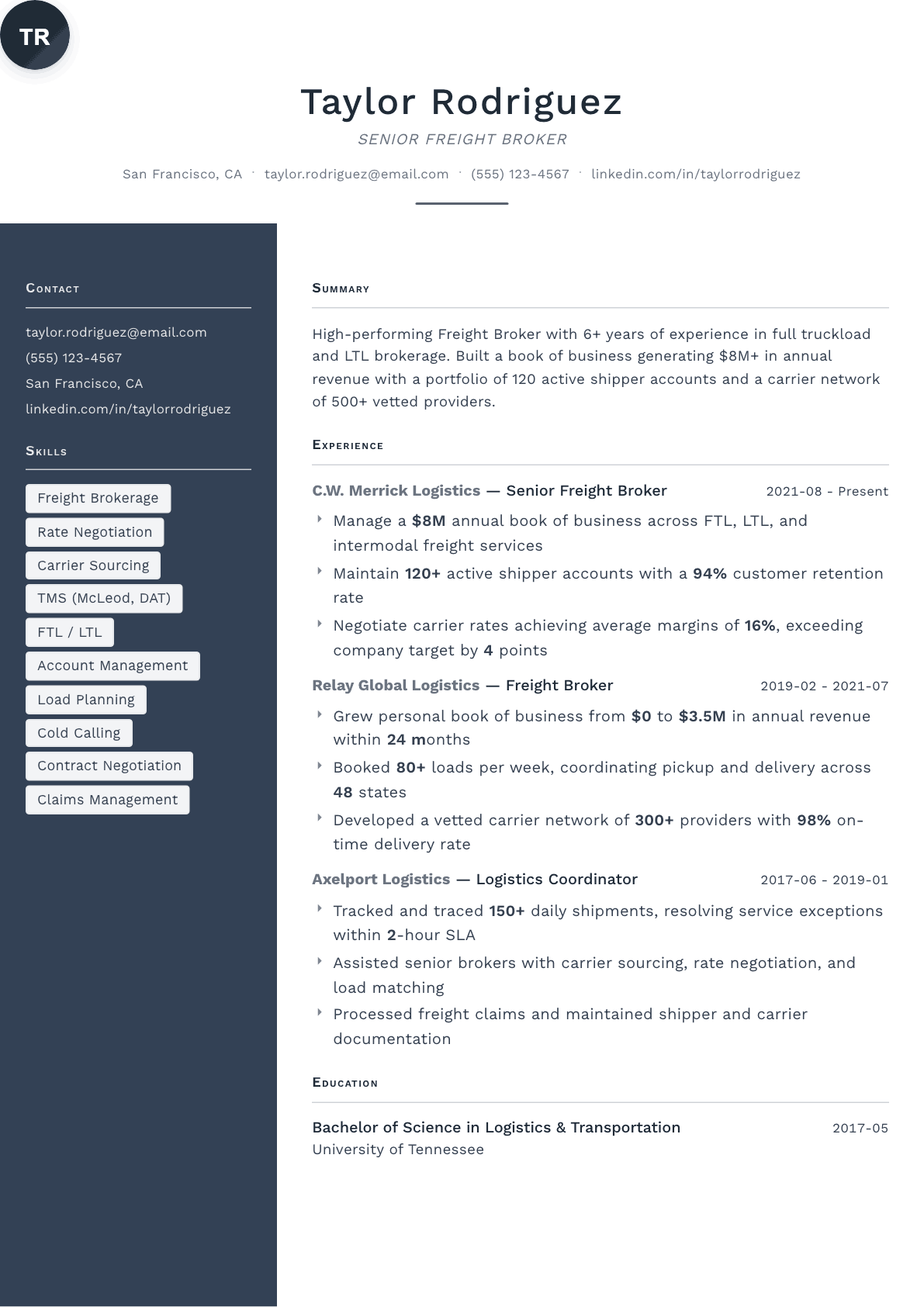
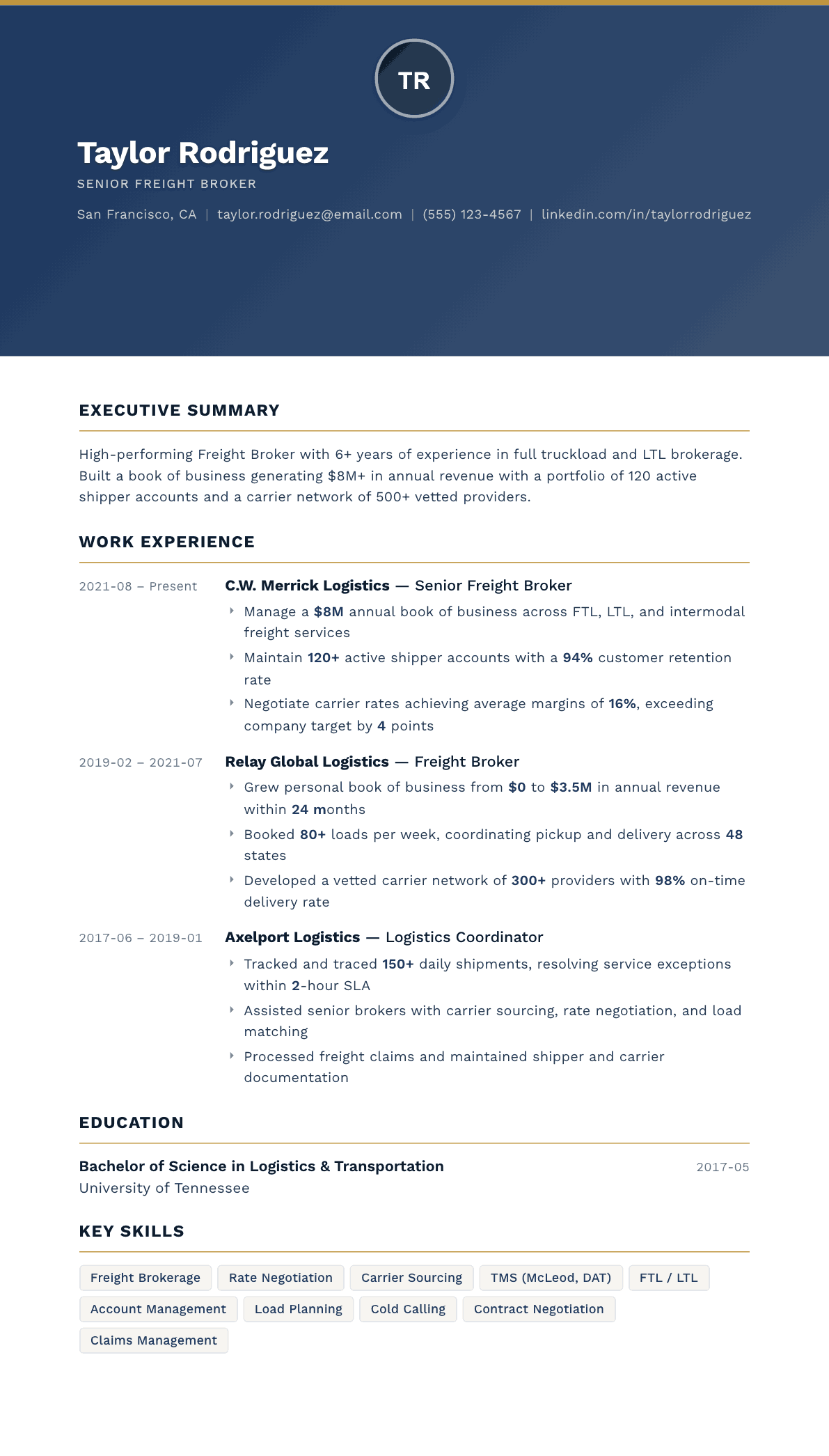
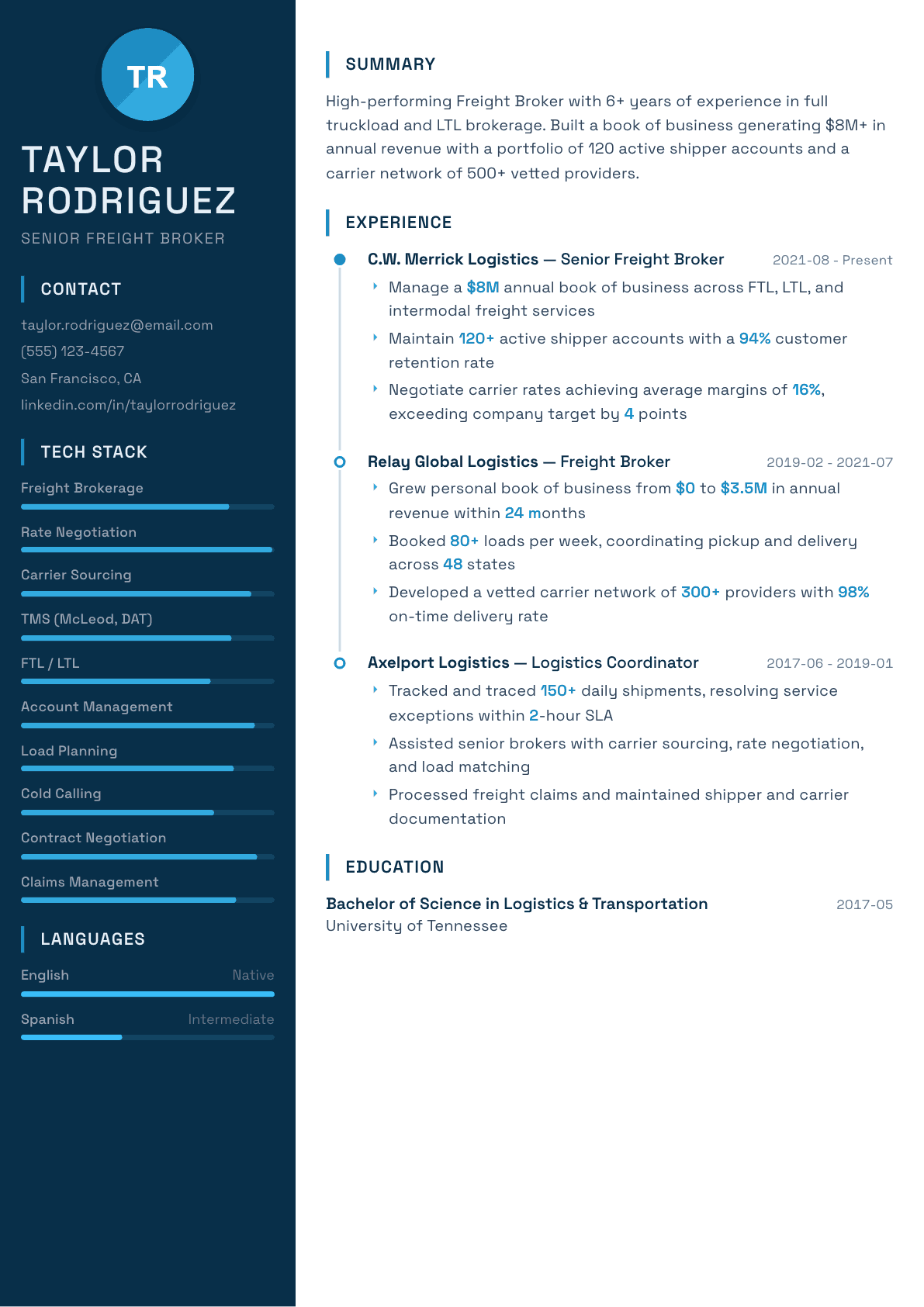
The same freight broker content laid out in three CVBooster templates, so you can see what the finished document looks like before you write a word.
Example Freight Broker summary
High-performing Freight Broker with 6 years of experience generating $8M+ in annual revenue. Built a portfolio of 120 active accounts with 94% retention and a carrier network of 500+ vetted providers. Seeking a senior brokerage or branch manager role.
Skills to list on a Freight Broker resume
- Freight Brokerage
- Rate Negotiation
- Carrier Management
- Shipper Relations
- TMS Systems
- Load Boards (DAT, Truckstop)
- FTL / LTL / Intermodal
- Account Development
- Cold Calling / Prospecting
- Contract Negotiation
- Claims Resolution
- Market Analysis
- Revenue Growth
- Compliance (FMCSA)
What actually gets this resume read
- Lead with your revenue numbers: annual book of business, revenue growth, and profit margins.
- Quantify your network: number of active shipper accounts, vetted carriers, and loads booked per week.
- Highlight your customer retention rate and on-time delivery performance.
- List TMS and load board platforms: DAT, Truckstop, McLeod, TMW, MercuryGate.
- Include TIA CTB certification as it is the recognized industry credential.
- Show career progression from coordinator to broker to demonstrate growth potential.
How to write a freight broker resume
Freight brokerage is a sales job wearing a logistics uniform, and the person hiring you knows it. A branch manager at a brokerage reads your resume looking for one thing before anything else: proof that you can build and hold a book of business. Everything else, the load boards, the carrier vetting, the claims paperwork, is the machinery around that.
That is why a freight broker resume lives or dies on numbers. Book size, gross margin, load count per week, active shipper accounts, carrier network depth, retention. A broker who writes "responsible for booking loads" has told the reader nothing that separates a top producer from someone who washed out of a training desk in month four.
This guide covers the sections a brokerage hiring manager reads, in the order they read them, with sample summaries for a broker trainee, a producing broker and a book owner, before-and-after bullets, and the questions brokers ask when their book is on the line and they need the resume to prove it.
Format: one page, numbers visible without scrolling
Reverse-chronological, one page until you have eight or more years of production history. Brokerage hiring moves fast because desks sit empty and empty desks lose money, so the file that gets a callback is the one where book size and margin are visible in the top third of the page.
Keep the layout single-column and plain. Brokerages run applicant tracking systems that parse text, and a two-column resume with a sidebar of icons regularly loses the dates on your last two jobs, which is exactly the data a manager uses to judge whether your book was built or inherited.
- Header: name, city and state, phone, email, and the modes you broker (FTL, LTL, intermodal, flatbed, reefer).
- Order: summary, experience, systems and load boards, education, certifications.
- Career changers from an operations or dispatch seat should add a short "Brokerage foundation" line under the summary.
Summary: book size, modes, margin, how you got the accounts
Four lines at most. Name the annual book you carry, the modes and lanes you know, your typical gross margin, and whether the accounts came from cold prospecting or from an assigned house list. That last distinction matters more than candidates realize, because a manager is trying to price your ramp time on a new desk.
If your book will not travel with you, say what does travel: the carrier relationships, the lane knowledge, the vertical experience. A broker who knows produce out of the Rio Grande Valley or automotive parts into Detroit is worth hiring even without a portable account list, and the summary is where you say which vertical you own.
Experience: production first, process second
Every brokerage job needs the employer, the desk type (carrier side, sales side, or full cycle), the modes you handled, and the size of the book. Lead each role with production: revenue, margin dollars, load volume, account count. Follow with the operational bullets that show you can hold the freight once you win it.
Name the accounts by industry rather than by company when the account is confidential: "a national beverage shipper" or "a tier-one automotive supplier" tells the reader the complexity without breaching a non-solicitation clause. Managers read that as professional rather than evasive.
Cut the bullets that describe brokerage itself. Every broker posts loads, calls carriers, checks in drivers and processes rate confirmations. Space on the page belongs to the deals you closed, the margins you defended and the service failures you prevented.
Systems and load boards: the section managers scan for fit
List the transportation management system by name, because onboarding time differs sharply between platforms. McLeod, MercuryGate, Aljex, Revenova and TMW all show up in postings, and a broker who already knows the house system is cheaper to train. Do the same for load boards: DAT, Truckstop, and any private capacity network you used.
Add the carrier vetting and compliance tools you worked in, such as Carrier411, RMIS, Highway or MyCarrierPackets, plus your comfort with FMCSA authority checks, insurance certificates and Carrier Safety Measurement System scores. Vetting failures cost brokerages real money in cargo claims, so proof you take it seriously is a hiring signal.
Keywords brokerage postings repeat
Brokerage job descriptions recycle a narrow vocabulary: book of business, carrier procurement, rate negotiation, spot market, contract freight, margin, load tender, on-time pickup and delivery, track and trace, cargo claims, customer retention. Mirror the wording once near the top and once inside a bullet where you can prove it. Do not build a keyword block at the bottom of the page; the manager reads the file straight after the software does, and a naked keyword list reads as padding.
Freight Broker resume summary examples
First brokerage desk
Freight broker trainee with 14 months on a carrier procurement desk covering dry van and reefer lanes in the Southeast. Sourced and vetted 90 new carriers, covered 45 loads per week on DAT, and completed the TIA new broker course. Ready to move to a sales desk.
Producing broker, four years
Full-cycle freight broker with four years and a self-sourced book of 38 active shippers across FTL and LTL. Holds 17% average gross margin on spot freight and 94% customer retention. Deep carrier bench in the I-35 and I-10 corridors, working daily in McLeod and DAT.
Senior broker and team lead
Senior freight broker with nine years, a contract-heavy book of 120 shipper accounts, and a vetted carrier network of 500 providers. Leads a pod of five brokers, sets margin floors by lane, and won three national bids covering intermodal and flatbed freight in the last two cycles.
Work experience bullets: before and after
Before: Booked loads and negotiated rates with carriers.
After: Covered 80 loads per week across dry van, reefer and flatbed, negotiating carrier rates against DAT market averages to hold a 16% gross margin.
Volume, modes, the benchmark used and the margin held turn a job description into a production record.
Before: Grew my book of business significantly.
After: Built a book from zero to 38 active shipper accounts in 24 months through cold prospecting, averaging 60 outbound calls a day in the first year.
The reader can now judge ramp speed and whether the accounts were self-sourced or handed over.
Before: Maintained good relationships with carriers.
After: Grew a vetted carrier bench to 300 providers, screening authority, insurance and safety scores before first tender, with zero double-brokered loads.
Vetting detail plus a risk outcome shows the manager you will not create a cargo claim on week two.
Before: Handled customer service issues and claims.
After: Resolved 40 cargo claims by working OS&D documentation with carriers and shippers, closing 9 of 10 without escalating to the customer's insurer.
Claim volume and a resolution rate prove you protect margin instead of passing problems upward.
Before: Helped train new brokers on the team.
After: Trained six new brokers on carrier vetting, rate building and load tender workflow in McLeod, with four still producing after their first year.
Naming the curriculum and the retention outcome makes a leadership claim verifiable.
Hard skills
- Carrier procurement
- Rate negotiation
- Spot and contract freight pricing
- DAT and Truckstop load boards
- McLeod and MercuryGate TMS
- Carrier vetting and FMCSA authority checks
- FTL, LTL and intermodal modes
- Track and trace
- Cargo claims and OS&D
- Bid and RFP response
- Margin management
- Account prospecting
Soft skills
- Cold call resilience
- Negotiation under time pressure
- Account retention
- Escalation judgment
- Pipeline discipline
- Carrier relationship building
Certifications worth listing
- Certified Transportation Broker (CTB) (Transportation Intermediaries Association)
- Certified Supply Chain Professional (CSCP) (Association for Supply Chain Management)
- Certified Logistics Associate (CLA) (Manufacturing Skill Standards Council)
Mistakes that cost freight broker candidates the interview
- Writing the resume without a single margin or revenue figure, which reads as a broker who never produced.
- Claiming a portable book without saying whether a non-compete or non-solicitation agreement applies to it.
- Listing every load board and TMS ever touched instead of the two or three you can work at speed on day one.
- Describing generic brokerage tasks that every desk performs, which crowds out the deals you actually closed.
- Hiding a period on a carrier procurement desk, when that experience is exactly what proves you can cover your own freight.
- Sending the same file to an asset-based brokerage and a pure 3PL without changing which modes and verticals lead.
Freight Broker resume questions
How do I show my book of business without breaking a non-compete?
Give the size and shape of the book rather than the names. Annual revenue, account count, industry verticals and lane geography tell a manager what you can rebuild, and none of it identifies a customer your former employer can claim you solicited.
What if I have never carried my own book?
Lead with carrier procurement volume instead. Loads covered per week, carriers onboarded, margin held on assigned freight and lane coverage in tough markets all prove you can execute, which is what a brokerage wants from a first sales desk.
Should a freight broker resume list every lane worked?
No. Name the corridors and regions where you have depth, usually three or four, plus any specialty freight such as reefer, flatbed or hazmat. A list of every state you have booked into reads as filler and buries the lanes that make you valuable.
Is the CTB credential worth putting on the resume?
Yes. The Certified Transportation Broker designation is the recognized industry credential and it signals you understand broker liability, contracts and carrier compliance rather than only sales. Put it in the header line and again in the certifications section.
How much detail should I give about my margins?
Give average gross margin as a percentage and, where you can, margin dollars for the year. Managers use both to judge whether your revenue came from thin, high-volume freight or from priced business you defended in negotiation.
Related resume examples
- Logistics Coordinator Resume example
- Dispatch Coordinator Resume example
- Customs Broker Resume example
- Freight Coordinator Resume example
- Truck Dispatcher Resume example
- Distribution Manager Resume example