Partnerships Manager Resume Examples: what gets the call
Write a Partnerships Manager Resume That Proves Revenue Impact
By Mustafa Tarabya, founder of CVBooster · Published · Updated
Partnerships manager resume examples with sourcing, deal and co-marketing bullets, ATS keywords, and a guide to writing every section well.
Sample resumes for a partnerships manager
The same partnerships manager content laid out in three CVBooster templates, so you can see what the finished document looks like before you write a word.
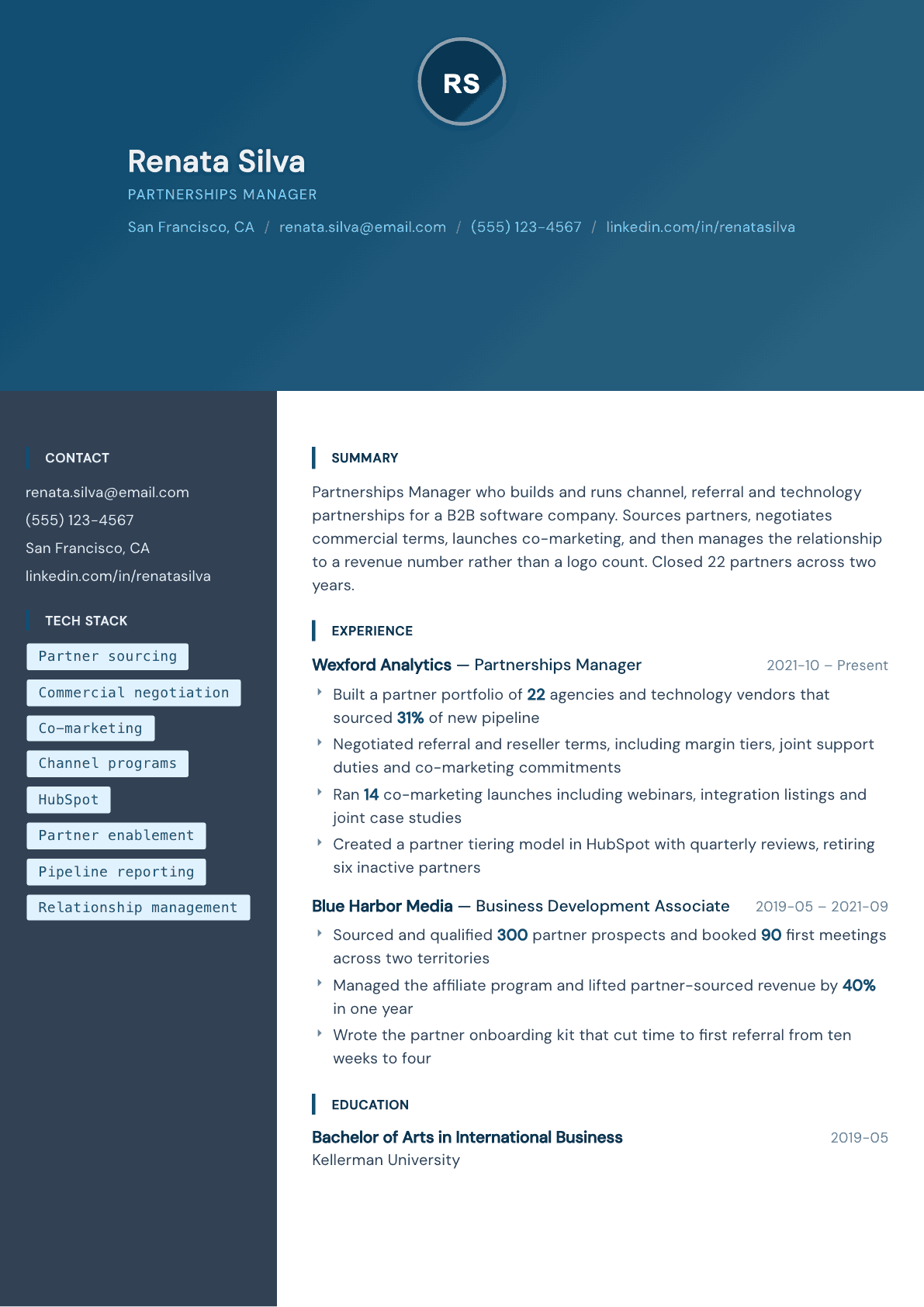
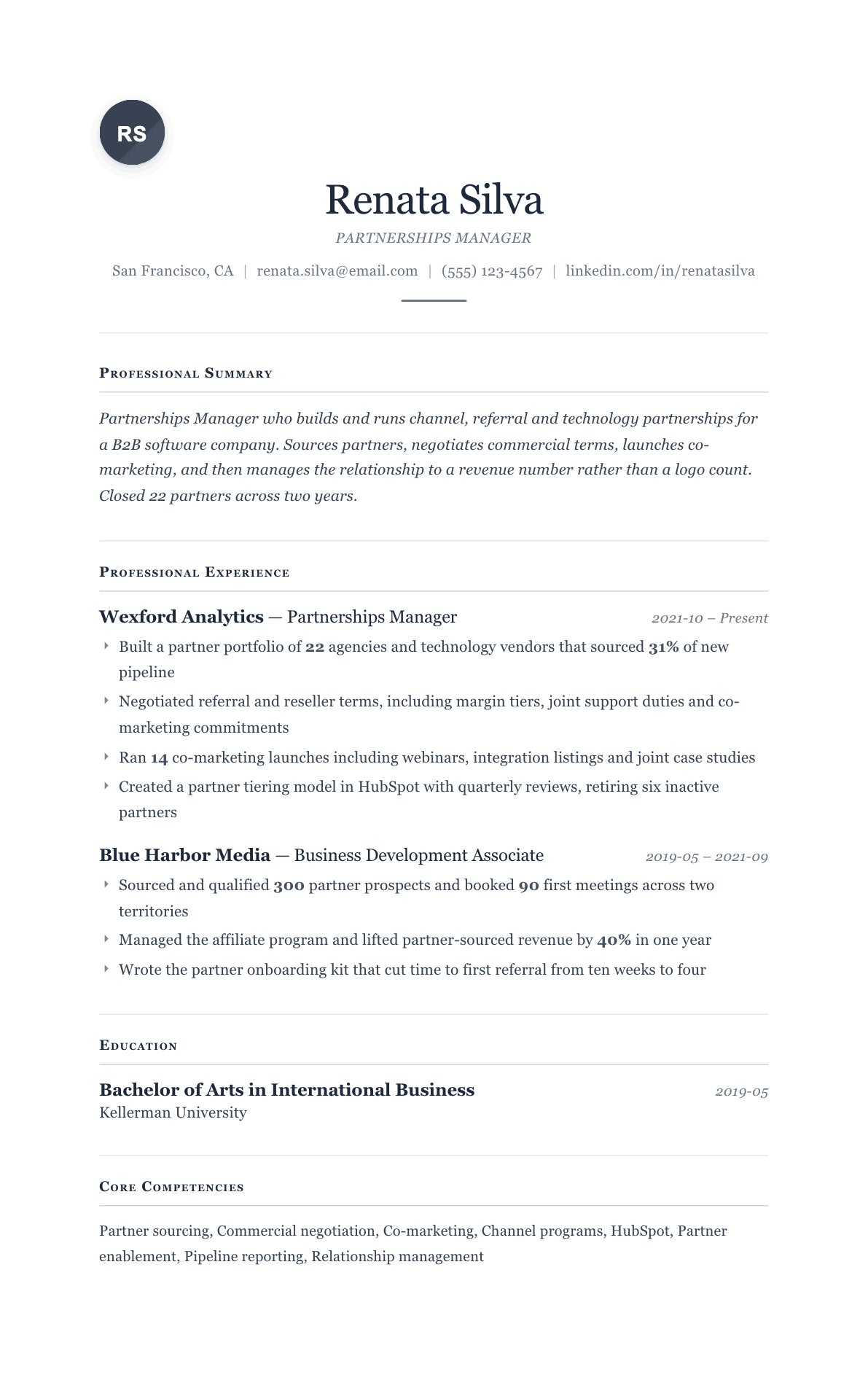
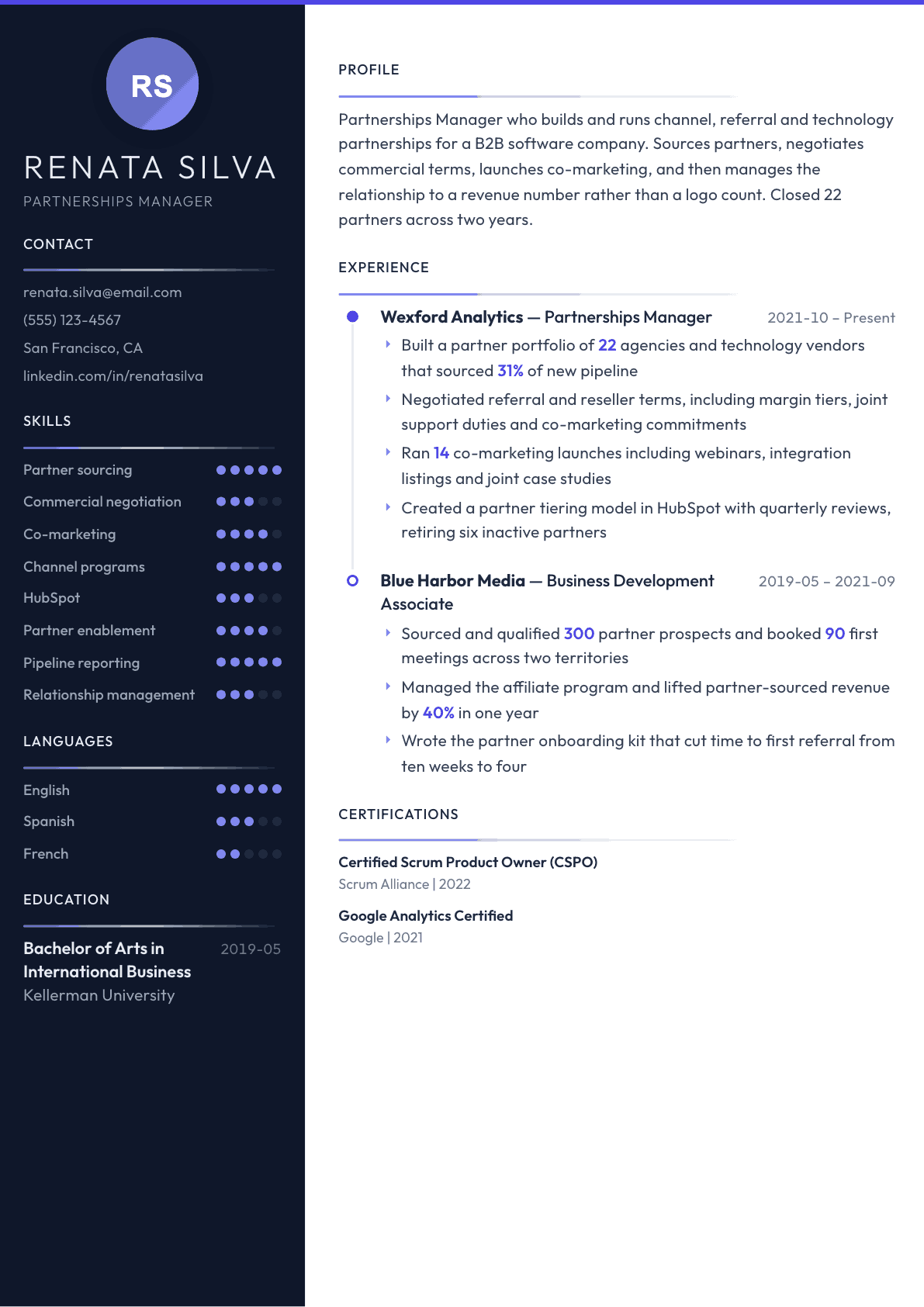
Example Partnerships Manager summary
Partnerships Manager with six years building channel, referral and technology programs for B2B software. Grew a portfolio to 22 active partners that sourced 31% of new pipeline, negotiated margin tiers and joint support terms, and ran 14 co-marketing launches. Built a partner tiering model with quarterly reviews and cut time to first referral from ten weeks to four.
Skills to list on a Partnerships Manager resume
- Partnership development
- Channel management
- Commercial negotiation
- Co-marketing
- Partner enablement
- Referral programs
- Revenue attribution
- HubSpot
- Salesforce
- Pipeline management
- Contract negotiation
- Account planning
- Cross-functional collaboration
- Quarterly business reviews
What actually gets this resume read
- Tie every partnership to a number the business cares about: sourced pipeline, closed revenue, or activated accounts.
- Say what kind of partnerships you ran, since channel, referral, technology and brand partnerships hire differently.
- Show the commercial terms you negotiated, such as margin tiers, referral fees, exclusivity or support obligations.
- Include partner enablement work: onboarding kits, certification, joint pitch decks and the time to first deal.
- Name the CRM and partner tools you managed the program in, and how you reported partner-sourced pipeline.
- Mention the partners you retired as well as the ones you signed, because portfolio discipline is a hiring signal.
How to write a partnerships manager resume
Partnerships hiring has changed. Companies used to reward a manager for the number of logos signed; now the first question in the screen is how much revenue or pipeline your partners actually produced. A partnerships manager resume that lists signed agreements without attribution reads as activity, and activity is exactly what a revenue leader is trying to stop paying for.
The second thing a hiring manager checks is what kind of partnerships you have run. Channel and reseller programs, referral networks, technology integrations and brand or co-marketing partnerships require different skills and different internal allies. Say which one you built, because a candidate who ran an integration ecosystem is not automatically ready to manage a reseller channel with margin tiers and deal registration.
This guide covers the structure that fits the role, how to write partnership bullets that survive scrutiny from a revenue leader, three summaries across career stages, and the questions candidates ask when moving between business development, sales and partnerships.
Format: revenue first, logos second
Reverse chronological, single column, one page unless you have led partner organizations. Under each title add a scope line: number of active partners, partnership type, and the pipeline or revenue those partners sourced or influenced.
Resist the temptation to build a logo wall. Two or three recognizable partners inside a bullet where you describe the deal you struck are worth more than a strip of names with no context.
- Scope line: partner count, partnership type, sourced pipeline or revenue.
- Section order: summary, experience, partner program highlights, systems, education.
- Name the market you sold into, since enterprise and small business partner programs differ sharply.
Summary: type of program, portfolio size, contribution
Three or four lines. The kind of partnerships, the size of the portfolio, the share of pipeline or revenue they contributed, and one structural thing you built such as a tiering model, an enablement program or a co-selling motion.
If you are moving from sales into partnerships, use the summary to show you understand the difference. Direct selling closes a deal; partnerships build a repeatable channel that other people close through. Name any indirect revenue you have already influenced.
Experience: source, sign, enable, run, and prune
Sourcing. How you found partners and how many you evaluated to sign the ones you did. A partnerships manager who says they assessed 300 prospects to sign 22 shows selection discipline rather than eagerness.
Signing. The commercial terms you negotiated: referral fees, margin tiers, revenue share, exclusivity, support obligations, marketing commitments and term length. This is where partnerships work resembles procurement, and detail here separates senior candidates.
Enablement. Onboarding kits, certification, joint pitch materials, technical integration support and the time from signature to first deal. Time to first referral is an underused and very persuasive metric.
Running the program. Tiering, quarterly reviews, joint business planning, co-marketing launches, deal registration and conflict resolution between partner and direct teams. Say what cadence you held and what came out of it.
Pruning. Partners retired for inactivity and what you did with the freed capacity. Portfolio discipline is a strong signal because most managers only add.
Systems and attribution: proving the number is real
Say how partner contribution was tracked. Deal registration, partner source fields in the customer relationship management system, unique referral links or a partner relationship management platform. A manager who can explain their attribution model is trusted with a target; one who cannot is not.
List the tools alongside the method. Reporting credibility is part of the job, and the interview will include a question about how you separated partner sourced revenue from partner influenced revenue.
- Customer relationship management: Salesforce, HubSpot, Pipedrive with partner source tracking.
- Partner platforms: PartnerStack, Impact, Crossbeam, Allbound, Reveal.
- Reporting: pipeline dashboards, deal registration reports, attribution definitions you documented.
Keywords partnership postings repeat
The recurring terms are strategic partnerships, channel sales, reseller, referral program, technology integration, co-marketing, co-selling, partner enablement, deal registration, joint business planning, partner sourced pipeline and go to market. Match the posting on whether the role is technology, channel or brand focused.
Include the internal functions you worked with by name, such as product, marketing, legal and revenue operations, because partnerships is an influence job and the reader wants proof you can move other teams.
Partnerships Manager resume summary examples
Business development associate
Business development associate who sourced and qualified 300 partner prospects and booked 90 first meetings across two territories. Managed an affiliate program that grew partner sourced revenue 40% in a year and wrote the onboarding kit that cut time to first referral from ten weeks to four.
Partnerships manager
Partnerships Manager running channel, referral and technology programs for a business software company. Built a portfolio of 22 partners that sourced 31% of new pipeline, negotiated margin tiers and joint support terms, and ran 14 co-marketing launches including webinars and joint case studies.
Head of partnerships
Partnerships leader with ten years building indirect revenue, currently managing four partner managers across two regions. Rebuilt the tiering and enablement model, took partner sourced revenue from a fifth to a third of new business, and established the deal registration process that ended channel conflict with direct sales.
Work experience bullets: before and after
Before: Built relationships with strategic partners.
After: Built a portfolio of 22 agency and technology partners that sourced 31% of new pipeline, with quarterly reviews and a tiering model that set support levels.
Portfolio size, contribution share and the governance structure make the relationship claim measurable.
Before: Signed several partnership agreements.
After: Negotiated referral and reseller agreements covering margin tiers, joint support duties and co-marketing commitments, closing nine agreements in two quarters.
Listing the commercial terms shows what you actually negotiated instead of that paperwork was signed.
Before: Ran marketing activities with partners.
After: Ran 14 co-marketing launches including joint webinars, integration listings and customer case studies, generating leads the partner and direct teams worked together.
The specific formats and the joint follow up show a program rather than a series of one-off events.
Before: Helped partners get started with our product.
After: Wrote the partner onboarding kit and certification path that cut time from signature to first referral from ten weeks to four across a cohort of eighteen partners.
Enablement becomes credible with a named artifact, a measured interval and the population it applied to.
Before: Reviewed partner performance regularly.
After: Introduced quarterly partner reviews against sourced pipeline and activation targets, retiring six inactive partners and reallocating enablement time to the top tier.
Ending partnerships on evidence demonstrates portfolio discipline, which few candidates ever show.
Hard skills
- Partnership sourcing and evaluation
- Commercial term negotiation
- Channel and reseller programs
- Referral and affiliate programs
- Technology integration partnerships
- Co-marketing campaign planning
- Partner enablement and certification
- Deal registration and channel conflict rules
- Partner sourced pipeline attribution
- Salesforce and HubSpot
- Joint business planning
- Quarterly business reviews
Soft skills
- Influence without authority
- Commercial storytelling
- Relationship building across companies
- Negotiation
- Cross-functional coordination
- Comfort saying no to a weak partner
Certifications worth listing
- Project Management Professional (PMP) (Project Management Institute)
- Salesforce Certified Administrator (Salesforce)
- HubSpot Sales Software Certification (HubSpot Academy)
Mistakes that cost partnerships manager candidates the interview
- Counting signed partners as the achievement while never stating what any of them produced.
- Leaving the partnership type unnamed, so the reader cannot tell channel work from integration work.
- Omitting the commercial terms, which hides the part of the job closest to negotiation.
- Failing to explain how partner contribution was attributed, which makes every number look soft.
- Presenting a logo wall of well known companies with no description of the actual arrangement.
- Ignoring enablement, so the resume reads as deal signing with no follow through into revenue.
Partnerships Manager resume questions
What metrics belong on a partnerships manager resume?
Partner sourced pipeline and revenue, share of total new business from partners, number of active and producing partners, time from signature to first deal, and partner retention. Those five let a revenue leader judge the program you ran.
How do I move from sales into partnerships?
Show indirect revenue you already influenced: referrals you cultivated, resellers you supported, or an integration partner whose customers you sold alongside. Then add program thinking, because partnerships is judged on repeatable channels rather than individual closes.
Should I name the partners I worked with?
Name a few where the arrangement is the point and the relationship is not confidential. Describe what the partnership actually did, such as a reseller agreement or a product integration, so the name carries information rather than decoration.
How do I explain a partnership that did not work out?
Frame it as portfolio management. Say what you tested, what the evidence showed, and what you did with the resources afterward. Hiring managers respect a candidate who ends unproductive partnerships more than one who claims every deal succeeded.
Is partnerships considered a sales role or a marketing role?
It sits between them and reports to either, depending on the company. Write the resume so both readers are served: revenue attribution for the sales leader, co-marketing and program building for the marketing leader.
Related resume examples
- Business Development Manager Resume example
- Account Manager Resume example
- Vendor Manager Resume example
- Growth Manager Resume example
- General Manager Resume example
- Startup Founder Resume example