Account Manager Resume Examples: the lines they read
Account Manager Resume and Account Management Resume Examples
By Mustafa Tarabya, founder of CVBooster · Published · Updated
Account management resume examples: an accounts manager sample resume with a complete entry, plus bullets for book size, retention, expansion and renewals.
Sample resumes for a account manager
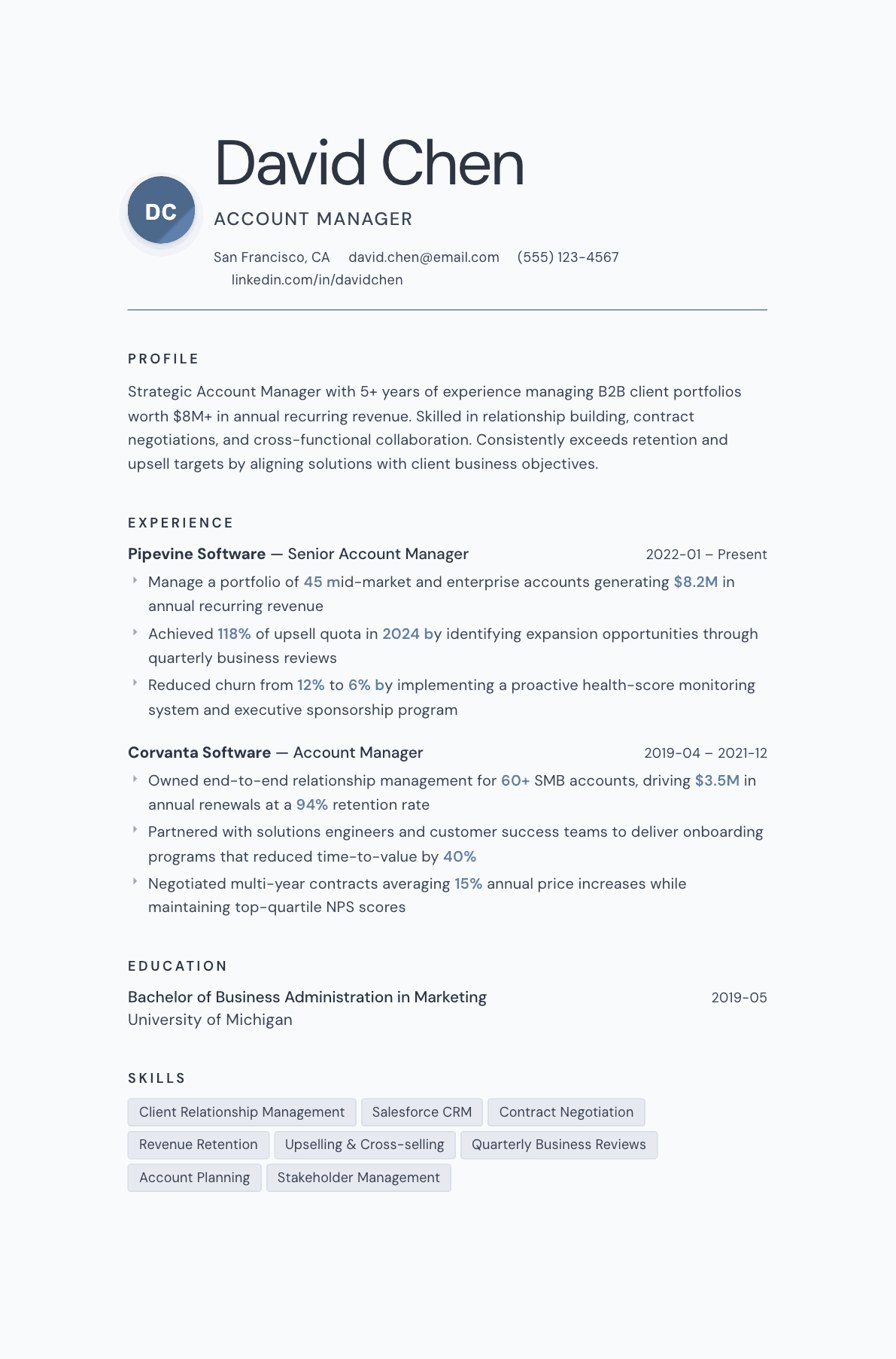
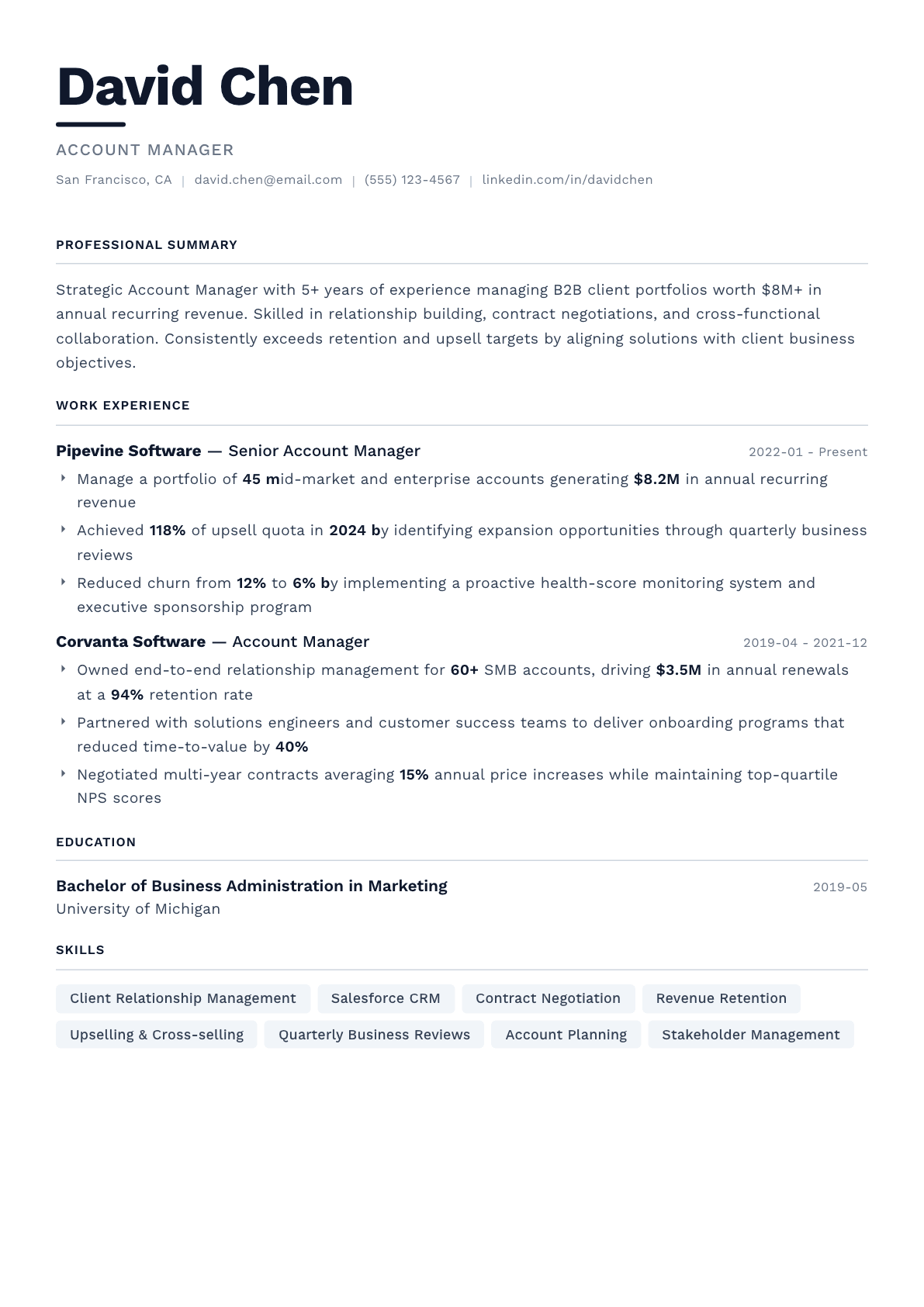
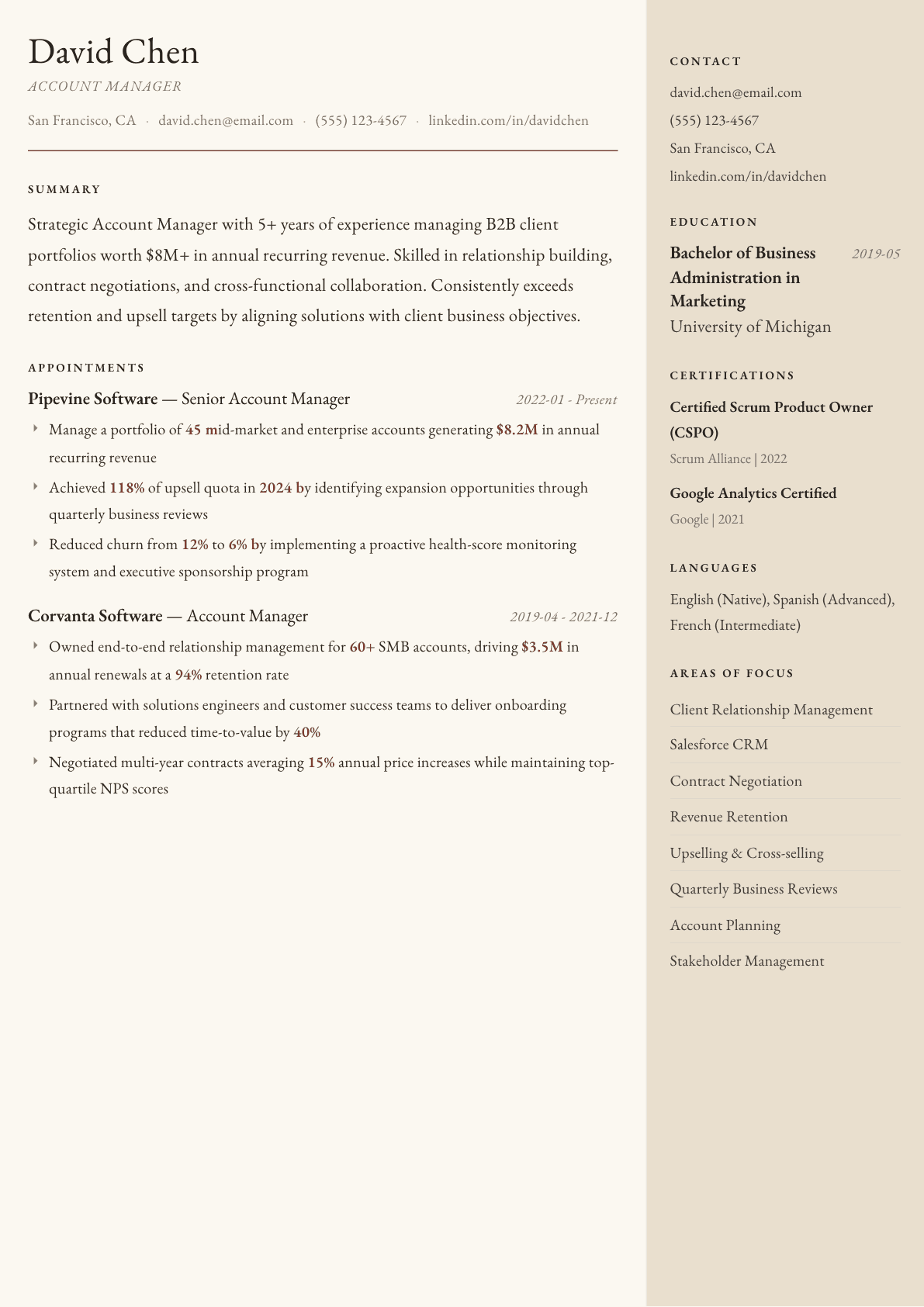
The same account manager content laid out in three CVBooster templates, so you can see what the finished document looks like before you write a word.
Example Account Manager summary
Account manager, 5 years, holding 45 mid-market and enterprise accounts worth $8.2M in annual recurring revenue. Hit 118% of upsell quota through quarterly business reviews, took churn from 12% to 6% with health-score monitoring and executive sponsorship, and renewed a 60-account SMB book at 94%.
Skills to list on a Account Manager resume
- Client Relationship Management
- Salesforce CRM
- HubSpot
- Contract Negotiation
- Revenue Retention
- Upselling & Cross-selling
- Quarterly Business Reviews
- Account Planning
- Stakeholder Management
- Pipeline Forecasting
- Customer Success
- SaaS / B2B Sales
What actually gets this resume read
- Lead with revenue metrics: ARR managed, upsell/cross-sell quota attainment, and retention or renewal rates.
- Quantify your portfolio: number of accounts, deal sizes, and total book of business value.
- Highlight CRM proficiency: Salesforce, HubSpot, Gainsight, or ChurnZero with specific features you used.
- Showcase strategic skills like account planning, quarterly business reviews, and executive relationship building.
- Demonstrate cross-functional collaboration with sales, product, and customer success teams.
- Include client satisfaction metrics: NPS scores, CSAT improvements, or client testimonials and case studies you influenced.
How to write a account manager resume
An account manager resume is judged on the book you carried and what happened to it. The hiring leader wants the size of the portfolio in revenue, the number of accounts, the segment, and then the three outcomes that define the job: how much of the book you kept, how much you grew it, and how healthy the relationships were when you left.
The trap is that the title covers several jobs. In one company an account manager is a renewals and expansion owner with a number. In another it is a client service role inside an agency, coordinating delivery and keeping the client happy. In a third it is a field sales role calling on distributors and retailers. A resume that does not make the version obvious gets read as the smallest one.
This guide covers account management resume examples and how to describe the book, how to write retention and growth results credibly, summaries for a junior account manager, an established portfolio owner and a strategic or enterprise account manager, before and after bullets, and the questions people ask when a churned account or a shrinking territory sits in the record.
Accounts manager sample resume: a complete entry
This accounts manager sample resume is for an account manager with four years in business software, carrying a book of mid-market customers. The hiring leader checks the size and type of the book first, then retention and growth, then how you work across the company, so the summary carries all three.
Summary: Account manager with four years in business software, owning a book of 60 mid-market accounts. Runs renewals and expansion against an annual target, leads quarterly business reviews with customer executives, and works with support and product to clear escalations before renewal.
Order for the page: header, summary, a short skills line naming the CRM and the methods, experience with four to six bullets per role, then education. Accounts manager and account manager are the same job title in most adverts, so use whichever spelling the posting uses. The experience entry for this sample reads as the bullets below.
- Own renewals and expansion for 60 mid-market accounts, managed in Salesforce with a forecast updated weekly.
- Run quarterly business reviews with each top account, agreeing usage goals and the next expansion step.
- Coordinate onboarding with implementation and support for every new account in the book.
- Flag at-risk accounts from usage data and lead the save plan with the customer success team.
- Negotiate multi-year renewals and price increases with procurement teams.
Describe the book before you describe the work
Under each title, write a book line: total revenue under management, number of accounts, segment by customer size, industry concentration, average account value, and whether you carried a growth number, a retention number or both. That single line lets a leader compare you against the territory they are filling.
Say what kind of account management it was. Renewal and expansion ownership with a quota is a sales job. Agency client service is a delivery and relationship job measured on retention and scope. Distributor or channel account management is a field job measured on sell through and program compliance. Each attracts a different reader, so name yours plainly.
- Header: name, city and state or remote, phone, email, professional profile link.
- Section order: summary, book of business snapshot, experience, retention and growth results, systems, education.
- Per role: revenue under management, account count, quota type, renewal cycle length and who you partnered with internally.
Retention: the number the job actually exists for
Give gross retention and, where your company measures it, net revenue retention. Gross retention shows what you kept. Net retention shows whether expansion outran the losses. Reporting both is the fastest way to look like someone who understands the economics of a portfolio rather than someone who attends meetings with customers.
Then show how you produced it. Health scoring and how you acted on a declining score, executive sponsorship pairing, adoption and usage reviews, renewal planning started months before the date, and the save motion you ran when a customer signaled they were leaving. A save story with the specific intervention is one of the most persuasive bullets on this kind of resume.
Be honest about losses and turn them into evidence. An account manager who can name why a customer churned, what was in their control and what was not, and what changed in the process afterward reads as a professional. One whose resume implies nothing ever churned reads as either junior or evasive.
Growth: expansion, cross-sell and pricing
Expansion revenue is where account managers earn a seat at the sales table. Give the expansion quota and attainment, the growth of the book year over year, and the mechanisms: additional seats or volume, new products cross-sold, upgrades to a higher tier, multi-year commitments, and contractual price increases negotiated at renewal.
Quarterly business reviews deserve a bullet, but only if you describe what one contained. A review that presented usage against the customer's stated goals, surfaced a gap and produced an agreed action plan is a business conversation. A review that walked through a slide deck of support tickets is a status meeting. Say which one you ran.
Add the negotiation side. Renewal negotiations with procurement, defending price against a competitive bid, restructuring a contract to keep a customer without a discount, and multi-year agreements with an annual uplift are all commercially serious work that reads well.
Working across the company on the customer's behalf
The unglamorous half of account management is internal. Escalating a support issue and driving it to resolution, getting a customer request onto a product roadmap conversation, coordinating implementation and onboarding, and pulling in a solutions engineer at the right moment. Show the coordination, because that is what makes a customer stay when the product has a bad month.
Name the systems: the customer relationship management platform, the customer success or health scoring tool, the support desk, the billing and contract system, and the analytics you used to see usage. Add the reporting cadence you owned, since a leader taking on a new account manager wants to know whether the book will be visible or opaque.
Keywords the screener is scanning for
Postings repeat a defined vocabulary: book of business, gross and net revenue retention, churn, expansion, upsell and cross-sell, renewal, quarterly business review, account planning, stakeholder mapping, escalation management, adoption and executive sponsorship. Use the ones your results support.
Vocabulary shifts by industry. Software wants retention rates, adoption and seat expansion. Agencies want scope, utilization, campaign performance and client satisfaction. Consumer goods and distribution want sell through, planogram compliance, promotional programs and joint business planning. Rewrite the summary and the first bullets for the world you are applying into.
Account Manager resume summary examples
Junior account manager
Account Manager owning 70 small business accounts worth roughly a million in recurring revenue, handling onboarding, renewals and first-line escalations. Held gross retention at 91% in the first full year and grew the book by 8% through seat expansion and plan upgrades.
Portfolio owner, five years in
Account Manager responsible for 45 mid-market accounts producing eight figures in recurring revenue, carrying both a retention and an expansion number. Delivered 118% of expansion quota and lifted net revenue retention from 104% to 116% by rebuilding the review cadence around usage data.
Strategic account manager
Strategic Account Manager for eight named enterprise customers in healthcare, each with multiple business units and annual agreements. Owns executive sponsorship, joint account plans and multi-year renewals, and has grown the largest relationship across three consecutive contract cycles.
Work experience bullets: before and after
Before: Managed a portfolio of client accounts.
After: Owned 45 mid-market accounts producing eight figures in recurring revenue across three industries, carrying both a gross retention target and an expansion quota.
Account count, revenue scale and the type of number you carried define a job the title leaves ambiguous.
Before: Maintained strong client relationships and reduced churn.
After: Held gross retention at 94% and lifted net revenue retention from 104% to 116% by acting on health score declines at 90 days out and pairing at-risk accounts with an executive sponsor.
Two retention measures plus the intervention behind them show a repeatable method instead of good chemistry.
Before: Upsold customers on additional products.
After: Delivered 118% of an expansion quota through seat growth, two product cross-sells and tier upgrades, and converted six accounts to multi-year agreements with an annual uplift built in.
Naming each expansion mechanism proves you engineered the growth rather than received it from renewals.
Before: Held quarterly business reviews with clients.
After: Ran quarterly reviews that measured product adoption against the goals the customer stated at signature, surfaced the gaps and closed each session with a written action plan owned on both sides.
Describing what the meeting produced separates a business conversation from a recurring status call.
Before: Worked with internal teams to solve customer issues.
After: Drove 30 escalations to closure with support and engineering, cutting average time to resolution on critical issues, and carried three customer requests into roadmap review with the product team.
Internal coordination becomes credible once it has volume, an outcome and named counterparts.
Hard skills
- Book of business management
- Renewal forecasting and negotiation
- Gross and net revenue retention analysis
- Expansion and cross-sell planning
- Customer health scoring
- Quarterly business reviews
- Account and stakeholder mapping
- Escalation management
- Contract and pricing structures
- Salesforce and HubSpot CRM
- Customer success platforms
- Usage and adoption analytics
Soft skills
- Trust building with executives
- Listening for unstated risk
- Advocacy inside your own company
- Difficult pricing conversations
- Follow-through on commitments
- Prioritizing across a large book
Certifications worth listing
- Certified Customer Success Manager (CCSM) (SuccessCOACHING)
- Salesforce Certified Administrator (Salesforce)
- HubSpot Sales Software Certification (HubSpot Academy)
- Strategic Account Management Certification (Strategic Account Management Association)
- Project Management Professional (PMP) (Project Management Institute)
Mistakes that cost account manager candidates the interview
- Leaving out the size of the book, which is the first thing a hiring leader uses to compare candidates.
- Writing relationship language with no retention or expansion number attached to it.
- Failing to say whether you carried a quota, which decides whether you are read as a sales hire or a service hire.
- Presenting a resume as though no account ever churned, which reads as evasive to anyone who has run a portfolio.
- Describing quarterly reviews without saying what they produced, so they sound like recurring status meetings.
- Ignoring the internal half of the job: escalation, onboarding coordination and roadmap advocacy.
- Using the same document for a software renewals role and an agency client service role, which want different evidence.
Account Manager resume questions
What is the difference between an account manager and an account executive resume?
An account executive resume is built around new business quota, pipeline and win rate. An account manager resume is built around a book of business: retention, expansion, renewal negotiation and the health of existing relationships. Lead with whichever set matches the posting.
How do I write about an account that churned?
Name it, give the reason, separate what you controlled from what you did not, and say what changed afterward in your process or in the company. A candidate who can analyze a loss honestly reads as far more experienced than one who claims never to have had one.
What should an accounts manager sample resume include?
The size and segment of the book, whether you carried a target, retention and expansion results, the CRM you used, and how you worked with support, product and finance on the customer's behalf. The sample entry at the top of this guide shows that order in a complete form.
What do strong account management resume examples have in common?
They size the book before anything else: revenue, number of accounts and segment. Then they show what happened to it, with gross retention and, if your company measured it, net revenue retention side by side, so the reader sees whether you kept customers and whether expansion outran the losses. Duties come last, if at all.
How do I move from customer support into account management?
Lead with the commercial edges of your support work: renewals you influenced, upgrades you identified, escalations you owned end to end, and executive relationships you built during incidents. Then show you understand a book carries a number, not just a queue.