Vendor Manager Resume Examples: the lines they read
Build a Vendor Manager Resume That Shows Supplier Control
By Mustafa Tarabya, founder of CVBooster · Published · Updated
Vendor manager resume examples, sample bullets, ATS keywords and a writing guide covering supplier scorecards, SLAs and renewal savings.
Sample resumes for a vendor manager
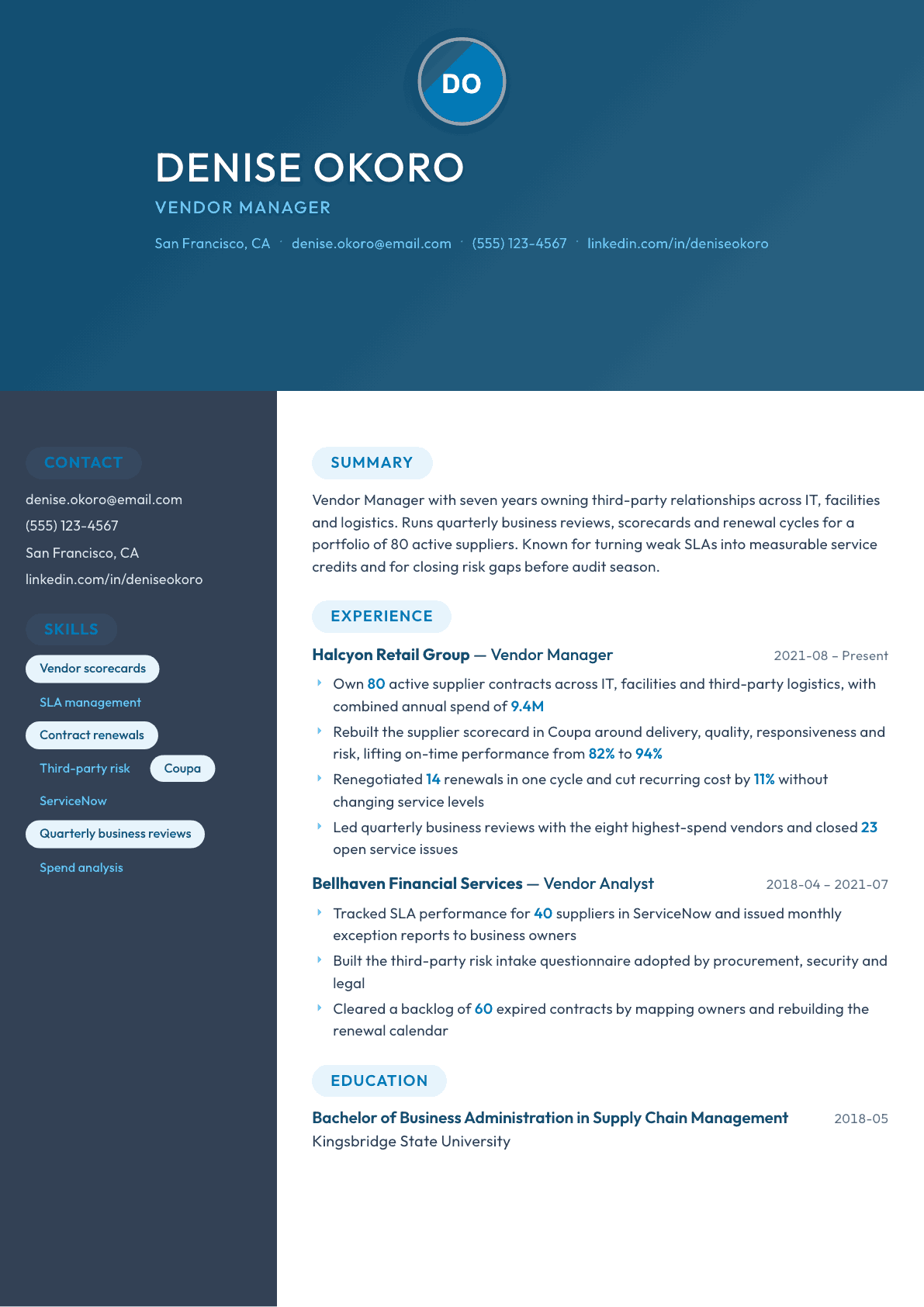
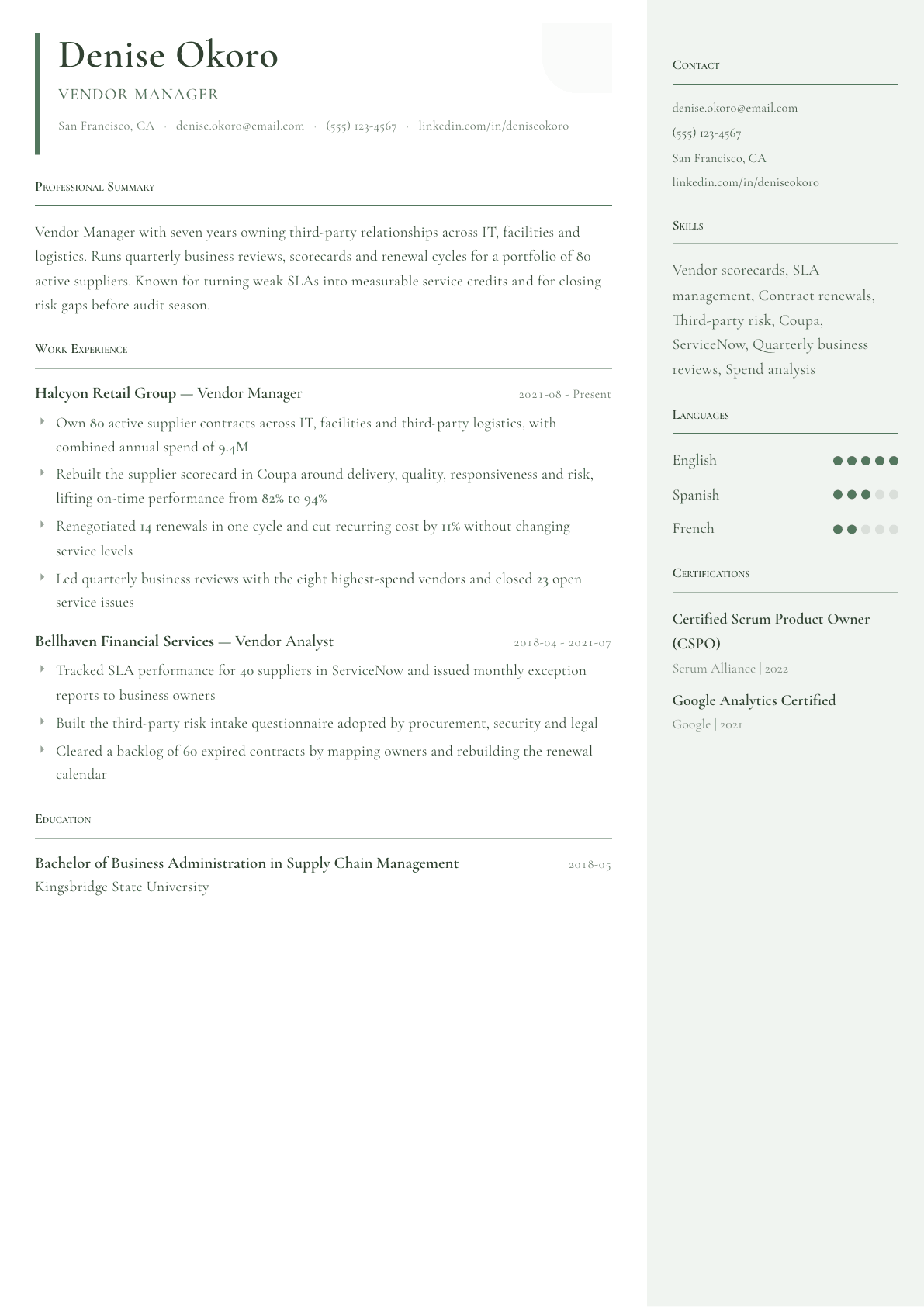
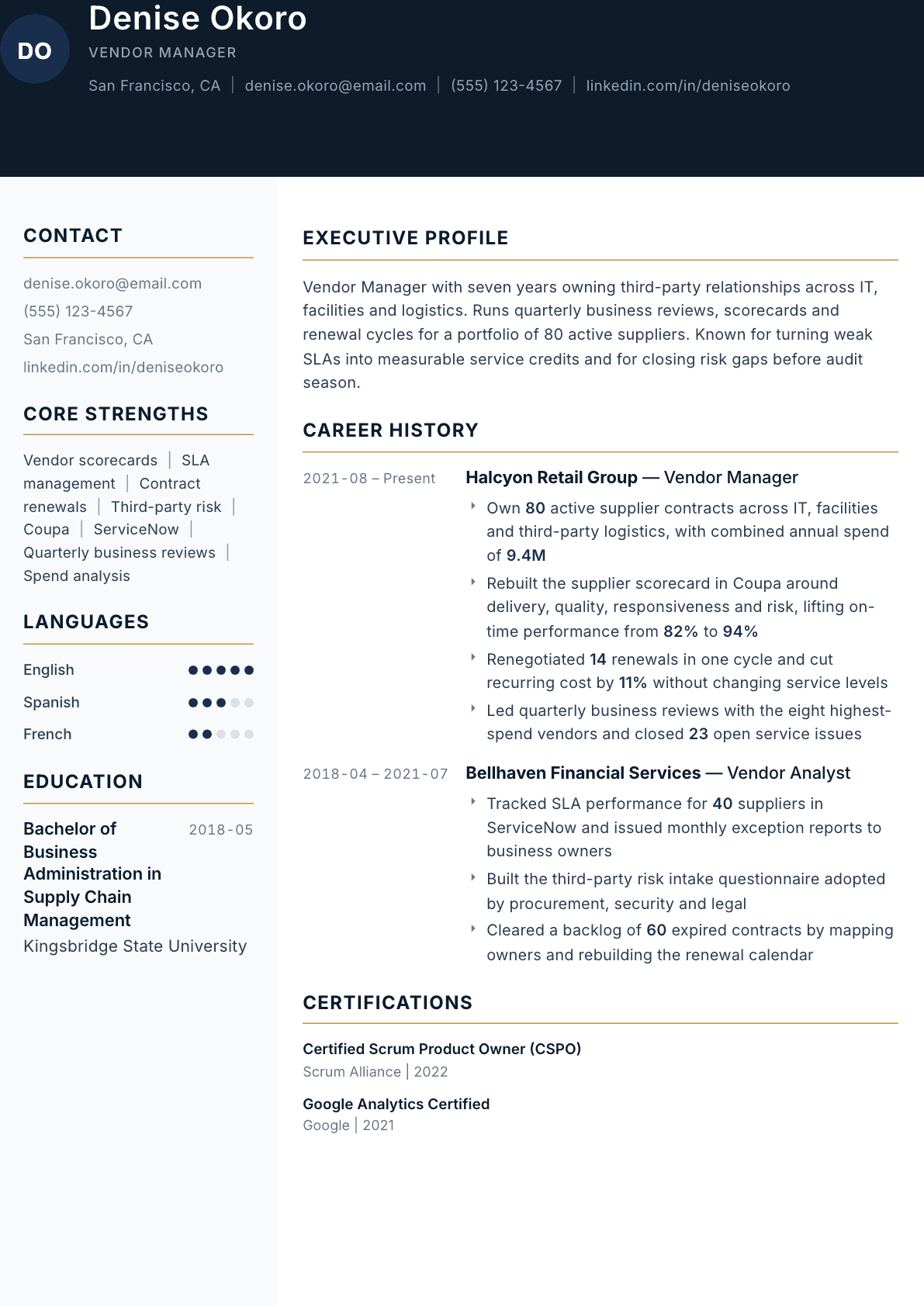
The same vendor manager content laid out in three CVBooster templates, so you can see what the finished document looks like before you write a word.
Example Vendor Manager summary
Vendor Manager with seven years governing IT, facilities and logistics suppliers for a multi-site retailer. Owns 80 active contracts and 9M in annual spend, runs quarterly business reviews and a four-factor scorecard, and lifted on-time delivery from 82% to 94% in two cycles. Renegotiated 14 renewals for an 11% recurring cost reduction. Seeking a portfolio lead role with wider category ownership.
Skills to list on a Vendor Manager resume
- Vendor management
- Supplier performance scorecards
- SLA negotiation
- Contract renewals
- Third-party risk management
- Spend analysis
- Quarterly business reviews
- Coupa
- SAP Ariba
- ServiceNow
- Stakeholder management
- Cost reduction
- Supplier onboarding
- Issue escalation
- Category strategy
What actually gets this resume read
- Open every job with the size of your vendor portfolio, the spend you controlled and the categories you covered.
- Name the systems you managed vendors in, such as Coupa, Ariba, ServiceNow or Zip, because screeners filter on them.
- Show one renewal you renegotiated and what changed: rate, term, service credits, or the exit clause you added.
- Prove governance, not just relationships: scorecards, quarterly business reviews, escalation paths and issue closure rates.
- Include third-party risk work such as security reviews, insurance certificates and business continuity attestations.
- Separate vendor management from purchasing on your resume so the reader sees ongoing ownership, not one-time buying.
How to write a vendor manager resume
A vendor manager resume is screened for one thing before anything else: how much third-party spend you have actually been accountable for, and whether you governed it or simply processed it. The recruiter looks for portfolio size, categories and the systems you worked in. The hiring director, usually a head of procurement, IT operations or shared services, reads the bullets to decide whether you can walk into a quarterly business review with a supplier who is missing targets and leave with a corrective action plan.
Most applicants lose the screen by describing relationships instead of control. Phrases like built strong supplier partnerships appear on nearly every resume in the pile and prove nothing. What proves control is a scorecard with named measures, an SLA with a remedy attached, a renewal where you changed the commercial terms, and a risk file that was complete when the auditor asked for it.
This guide covers the section order a vendor management hiring panel reads, three summaries written for different career stages, before and after bullets taken from the situations this job really involves, and the questions candidates ask when they sit down to rewrite the page.
Format: portfolio facts first, one page until you manage managers
Use reverse chronological order and keep the layout single column. Vendor management sits inside procurement or IT operations, and both function areas run applicant tracking systems that read a single column cleanly and scramble side by side layouts.
Under each job title, add a one line scope statement before the bullets. Something like portfolio of 80 suppliers, 9M annual spend, categories IT, facilities and third-party logistics gives the reader the three facts they were about to hunt for. Everything after that line is evidence.
- Header: name, city and state, phone, email, and a short line naming your categories.
- Section order: summary, core competencies, professional experience, systems, education, certifications.
- One page under eight years. Two pages once you lead a team or a global portfolio.
Summary: spend, portfolio, categories, and the outcome you repeat
Four lines maximum. Name the spend under governance, the number of active suppliers, the categories, and the one result you can repeat anywhere: cost held flat through a renewal cycle, service performance lifted, a risk backlog cleared.
If you are moving from purchasing into vendor management, use the summary to draw that line yourself. Buying is transactional and ends at the order; vendor management starts at signature and runs through performance, risk and renewal. Say which of those you have already done.
Experience: governance evidence, not relationship adjectives
Each role wants four to six bullets, and they should cover four distinct areas so the reader sees a complete operator. First, performance management: the scorecard, its measures, the cadence, and what moved. Second, commercial work: renewals, rate cards, service credits, term changes, exit rights. Third, risk and compliance: security reviews, insurance certificates, business continuity attestations, regulatory obligations. Fourth, stakeholder work: how business owners were brought into decisions they used to make alone.
Anchor each bullet in a number that a manager can verify in a system: number of suppliers, dollar value of the renewal, service level achieved against target, days to onboard, open issues closed. Vague improvement claims fail the interview because the follow up question is always how did you measure that.
One escalation story earns its place on the page. A supplier that missed targets for two quarters, what you invoked, and how the relationship ended, either recovered or exited, tells a hiring manager more than five bullets about collaboration.
Systems and tools: the section that survives the keyword filter
Vendor management postings name platforms directly, so a short systems block near the bottom pays for itself. List the source to pay or contract system, the ticketing tool where SLA breaches are logged, the risk platform, and the reporting tool you built dashboards in.
Do not claim depth you cannot defend. If you ran scorecards out of a spreadsheet fed by exports, say that, and say what the spreadsheet contained. Interviewers respect a well built manual process more than a vague claim about a platform you only viewed.
- Source to pay and contracts: SAP Ariba, Coupa, Zip, Icertis, Ironclad.
- Service and issue tracking: ServiceNow, Jira Service Management.
- Risk and reporting: security questionnaire platforms, Power BI, Tableau, Excel models.
Keywords the screen is scanning for
Vendor management job descriptions recycle a narrow vocabulary: supplier relationship management, service level agreement, key performance indicator, quarterly business review, third-party risk, contract renewal, spend under management, supplier scorecard, escalation and remediation. Use the exact phrasing from the posting once in the summary and once inside a bullet where it is doing real work.
Avoid stacking these terms into a keyword block with no context. A human reads the file within a minute of the software, and a naked keyword list signals that the substance is missing.
Vendor Manager resume summary examples
Moving in from purchasing
Procurement professional with three years of purchasing across IT and facilities, now managing supplier performance for 25 accounts. Built the first scorecard for the category, tracks SLA exceptions in ServiceNow, and supported four contract renewals. Seeking a dedicated vendor management role with full portfolio ownership.
Five to seven years in
Vendor Manager governing 80 suppliers and 9M in annual spend across IT, facilities and logistics. Rebuilt the scorecard around delivery, quality, responsiveness and risk, lifting on-time performance from 82% to 94%. Renegotiated 14 renewals in one cycle for an 11% recurring cost reduction with no service reduction.
Head of vendor management
Vendor management leader with twelve years running third-party portfolios, currently overseeing four analysts and 300M in governed spend across three regions. Built the tiering model, risk cadence and executive review pack now used company wide, and led two supplier exits with no service interruption to the business.
Work experience bullets: before and after
Before: Managed relationships with key vendors and ensured good service.
After: Governed 80 active suppliers across IT, facilities and logistics, running monthly scorecards and quarterly reviews that lifted on-time performance from 82% to 94%.
Portfolio size, categories, cadence and a measured move replace an adjective that every candidate uses.
Before: Negotiated contracts with suppliers.
After: Renegotiated 14 renewals in a single cycle, adding service credit clauses and tiered rate cards that cut recurring cost 11% while holding the same service levels.
The reader learns the volume, the specific commercial levers used, and that quality was protected.
Before: Worked on vendor risk and compliance requirements.
After: Closed a backlog of 60 expired third-party risk files by rebuilding the intake questionnaire with security and legal, then clearing insurance and continuity evidence for every tier one supplier.
It names the gap, the partners, the fix and the scope, which is what an audit conversation actually needs.
Before: Held meetings with vendors regularly.
After: Chaired quarterly business reviews with the eight highest spend vendors, publishing an issue log that closed 23 open service problems within two quarters.
A meeting becomes governance once the reader can see the agenda output and the closure count.
Before: Helped reduce costs for the department.
After: Consolidated nine overlapping software agreements into three enterprise contracts, removing duplicate licenses and freeing budget the department redirected into a security tool.
The mechanism of the saving is visible, which lets a hiring manager judge whether it repeats in their environment.
Hard skills
- Supplier relationship management
- Supplier performance scorecards
- Service level agreement management
- Contract renewal negotiation
- Third-party risk management
- Spend analysis
- Quarterly business reviews
- SAP Ariba
- Coupa
- ServiceNow
- Supplier onboarding and offboarding
- Vendor tiering and segmentation
Soft skills
- Escalation judgment
- Cross-functional influence
- Negotiation under pressure
- Written executive reporting
- Stakeholder management
- Conflict resolution
Certifications worth listing
- Certified Professional in Supply Management (CPSM) (Institute for Supply Management)
- Certified Supply Chain Professional (CSCP) (ASCM)
- Certified Third Party Risk Professional (CTPRP) (Shared Assessments)
- Project Management Professional (PMP) (Project Management Institute)
Mistakes that cost vendor manager candidates the interview
- Describing partnerships in adjectives while never naming a single measure the supplier was held to.
- Leaving out spend under governance, so the reader cannot tell a 2M portfolio from a 200M one.
- Presenting purchase order volume as vendor management, which reads as transactional buying to a governance panel.
- Omitting third-party risk work entirely, which is now the fastest growing part of the job description.
- Listing platforms with no indication of what you built inside them or which processes you ran there.
- Hiding the one supplier exit or recovery you led, which is the story interviewers most want to hear.
Vendor Manager resume questions
What is the difference between a vendor manager resume and a procurement resume?
A procurement resume is judged on sourcing events, competitive bids and savings at award. A vendor manager resume is judged on what happened after signature: performance measurement, risk monitoring, issue escalation and renewal outcomes. Lead with whichever half the posting emphasizes.
How do I show vendor management experience if it was never my job title?
Pull the governance work out of whatever title you held and give it its own bullets. Scorecards you built, service reviews you chaired, renewals you shaped and risk files you cleared are the substance. The title matters far less than the evidence of ownership.
Should I list every vendor by name on my resume?
No. Name a handful of recognizable categories or platform types instead, and only name individual suppliers where the relationship is the point, for example a major cloud or logistics provider whose contract you renegotiated. A long logo list crowds out results.
How much detail should I give about savings figures?
Give the value and say how it was measured, either as a hard reduction against prior pricing or as avoidance against a proposed increase. State who validated it, usually finance. Unqualified savings claims invite an interview question you may not be able to answer.
Do I need a certification to be competitive for vendor manager roles?
It is rarely required, but a supply management or third-party risk credential helps when you are moving from an adjacent function and lack a formal procurement background. Real portfolio evidence outranks any certificate when both appear on the same page.
Related resume examples
- Procurement Manager Resume example
- Contract Manager Resume example
- Category Manager Resume example
- Procurement Specialist Resume example
- Purchasing Manager Resume example
- Business Manager Resume example